Advent 3: Birthday Wishes

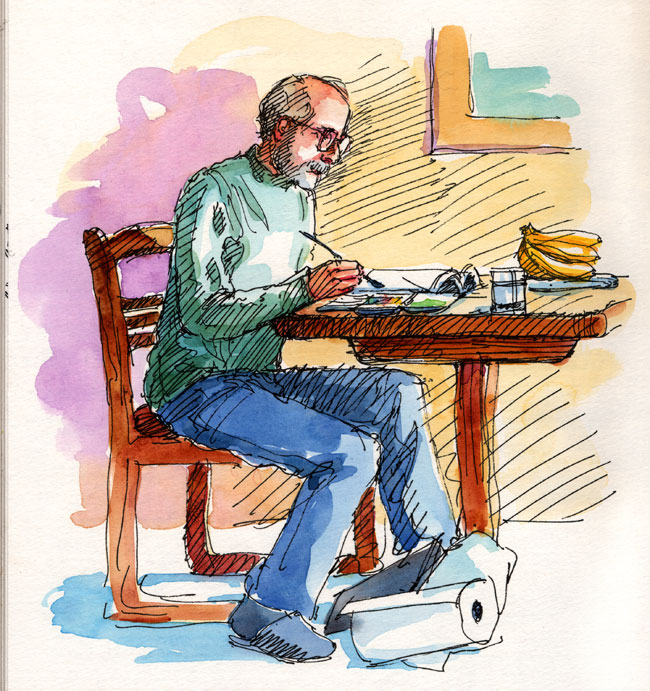
In honor of my husband’s birthday, I post a sketch of him on holiday, painting, which is something I hope he will find more time to do as he fulfills his ongoing quest for retirement.

He shares this birthday with writer Alfred de Musset (1810-1857), and so I post a poem that speaks eloquently, and appropriately, of the overlooked and sleeping poet universally within.
JPainting

Ami, tu l’as bien dit: en nous, tant que nous sommes,
Il existe souvent une certaine fleur
Qui s’en va dans la vie et s’effeuille du coeur.
“Il existe, en un mot, chez les trois quarts des hommes,
Un poète mort jeune à qui l’homme survit.”
Tu l’as bien dit, ami, mais tu l’as trop bien dit.

Tu ne prenais pas garde, en traçant ta pensée,
Que ta plume en faisait un vers harmonieux,
Et que tu blasphémais dans la langue des dieux.
Relis-toi, je te rends à ta Muse offensée ;
Et souviens-toi qu’en nous il existe souvent
Un poète endormi toujours jeune et vivant.

Friend, you have spoken well: in us, such as we are,
There frequently exists a certain flower
That blossoms, fades and from the heart its leaves are shed.
“In three quarters of mankind, you understand,
A poet has died young yet outlived by the man.”
Well said, my friend—but a little too well said.

You didn’t pay attention, laying out your thought,
That your pen made poetry then and there, unsought.
In his own tongue you took Apollo’s name in vain.
I betray you to your injured Muse: Read again,
And remember that in all of us there often keeps
A poet young and vibrant, who is not dead, but sleeps.

—Alfred de Musset

PieForJJimmy

Advent 2: Day in Autumn

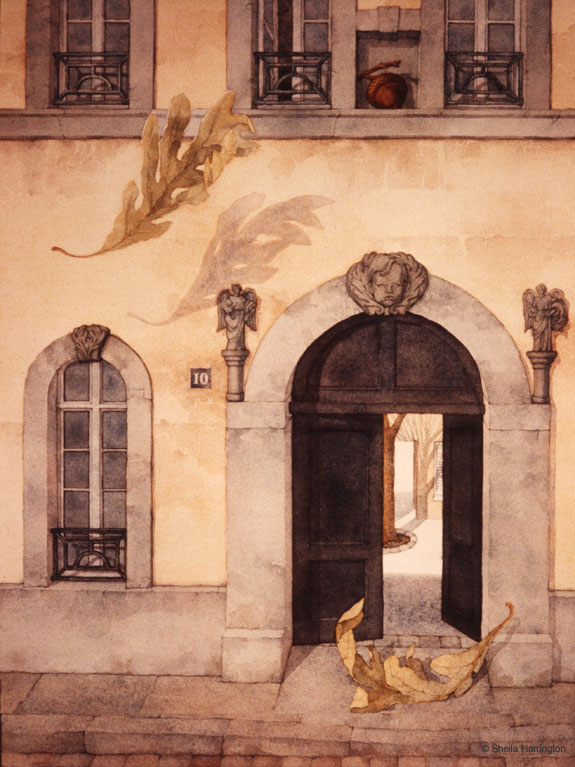
The second Sunday of Advent falls on the birthday of Rainer Maria Rilke (1875-1926), and in celebration I post this seasonal poem in the original German, along with one of its numerous translations, and a painting. If you have a translation you prefer then please tell me about it.

For another Rilke poem, and a sketch, please see Holding up all this falling.

Acorn

Herbsttag

Herr: es ist Zeit. Der Sommer war sehr groß.
Leg deinen Schatten auf die Sonnenuhren,
und auf den Fluren laß die Winde los.
Befiel den letzten Früchten voll zu sein;
gib ihnen noch zwei südlichere Tage,
dränge sie zur Vollendung hin und jage
die letzte Süße in den schweren Wein.
Wer jetzt kein Haus hat, baut sich keines mehr.
Wer jetzt allein ist, wird Es lange bleiben,
wird wachen, lesen, lange Briefe schreiben
und wird in den Alleen hin und her
unruhig wandern, wenn die Blätter treiben.

—Rainer Maria Rilke (1902)

Day in Autumn

Lord: it is time. Great was the Summer’s feast.
Now lay upon the sun-dials your shadow
And on the meadows have the wind released.
Command the last of fruits to round their shapes;
Grant two more days of south for vines to carry,
To their perfection thrust them on, and harry
The final sweetness into the heavy grapes.
Who has not built his house will not start now
Who now is by himself will long be so,
Be wakeful, read, write lengthy letters, go
In vague disquiet pacing up and down
Denuded lanes, with leaves adrift below.

—Trans. Walter Arndt (1989)

December

Dec1-11

First snow! The flakes,
So few, so light,
Remake the world
In solid white.

All bundled up,
We feel as if
We were fat penguins,
Warm and stiff.

The toy-packed shops
Half split their sides,
And Mother brings home
Things she hides.

Old carols peal.
The dusk is dense.
There is a mood
Of sweet suspense.

The shepherds wait,
The kings, the tree—
All wait for something
Yet to be,

Some miracle.
And then it’s here,
Wrapped up in hope—
Another year.

—John Updike


Sisterhood of Squash

SquashCuke

It’s finally getting too cold to draw from nature outdoors, so we’re sketching from the pantry, and thus cut open a recent discovery: a Sunshine Squash. (If you like winter squash, you will love this super-sweet and tender variety.)

It was my daughter who noticed the squash’s interior division into thirds, and, more subtly, sixths, and who suggested we add our squash drawings to our cucumber drawing pages. So we did. It’s exciting to find, despite their apparent exterior differences, their interior commonalities. And together they make a lovely pair. There’s a life lesson for you.

CakeTomatoesGina


Andalusian Treasures

At all the major festivals and turning points of the year, it’s a natural impulse to find commonalities within the celebration with the larger human community, past and present, and gain a sense of connection.

Revels07

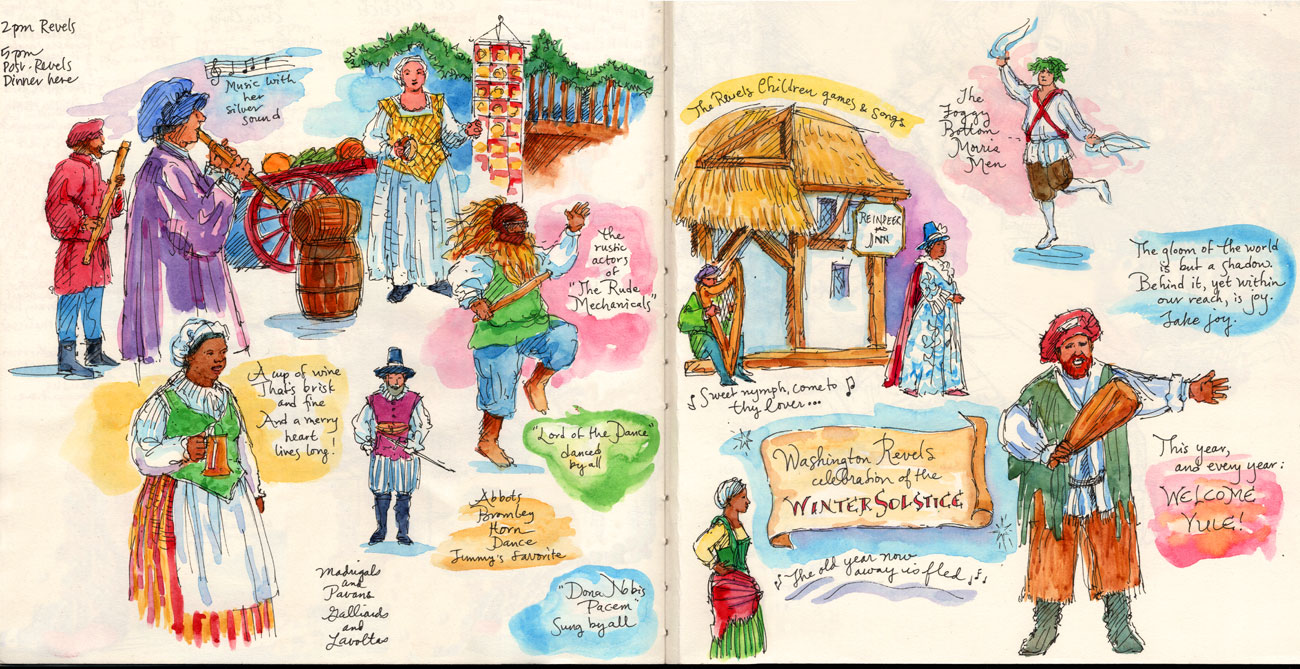
In this winter season, one especially delightful and moving experience of shared celebration is found in the music, dance, and storytelling of the Washington Revels, which each year changes its theme (always carefully researched and skillfully interpreted) but whose underlying message acknowledges and salutes the struggle to find beauty, joy, humor, peace, and love amid the darkness, uncertainty, and losses of our life journeys.

This year’s theme is Andalusian Treasures, and I quote:

Our 29th annual celebration of the winter solstice harkens back over 1,000 years to the confluence of Moorish, Sephardic and Iberian cultures in medieval Andalusia. Led by the antics of two fools, and joined by guest musicians, Trio Sefardi and Layali El Andalus (“Andalusian Nights” in Arabic), we celebrate the legacy of the extraordinary flowering of arts and culture that began there and extended to much of the world for centuries thereafter. Presenting the three cultures together on stage, we honor the symbol that Andalusia has become (however imperfect the reality) of the ideal of greater tolerance and acceptance among different cultures and religions.

Shows run December 3-4 & 9-11, matinees and evenings, at GW Lisner Auditorium in Washington, DC, and there are still tickets available through the Revels website. Believe me, once you have sung and danced for the solstice with a thousand gladsome companions, you will want to make it a family tradition.

The sketches above are from a 2007 Renaissance Revels. For more Revels sketches, and a mini-history, please see Revelry.


Prince and the Pauper

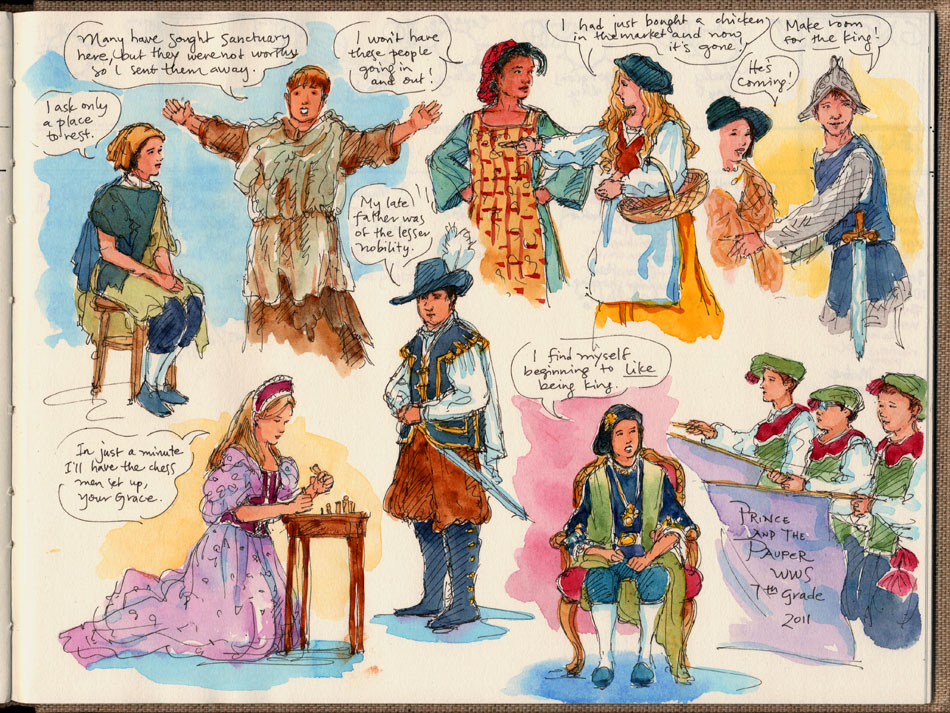
I sat in one day on a rehearsal of my daughter’s class play and surreptitiously made some sketches. Having seen a number of middle school plays over the years in which the objective seems to be to finish and get off stage as fast as possible, I was struck by the students’ expressiveness, pacing, and evident understanding of their roles.

Prince&Pauper