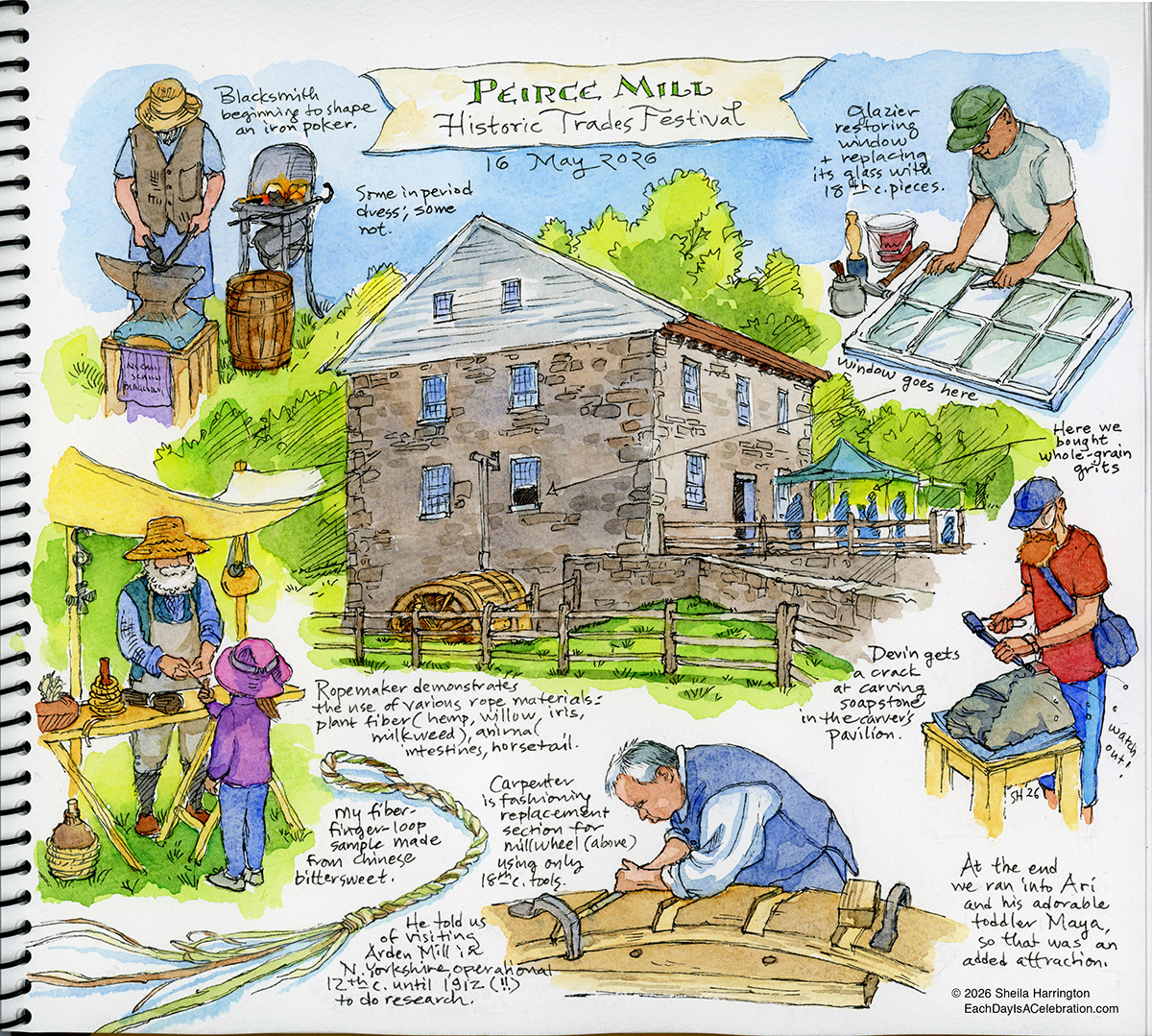
Peirce Mill, built in 1829 on Rock Creek, has served variously as a grain mill, sawmill, orchard, tree nursery, and tea room. Regardless of whether it has been open and in use, or closed for various renovation projects, it has consistently remained a picturesque site for hikers, bikers, and picnickers, where you often see families of ducklings on the creek in the spring. This year the Friends of Peirce Mill organized the first-ever Historic Trades Festival, with friendly, informative craftspeople and hands-on activities. Freshly-ground Peirce Mill flour used to be sold as recently as the 1970s to use for baking and pancakes. This is no longer permitted (the ground grains are now for animal use only), but on this festival day there were stands with local producers selling their wares. I learned about the Common Grain Alliance, which connects and supports small grain farmers, millers, bakers, and brewers, and I bought a pound of whole-grain grits from the FreshFarm Grain Stand (delicious!). I hope this will become an annual event.
Attempting to sketch was unusually tough during this concert (part of the 2025-2026 Dumbarton Concerts series), not only because of the remarkably captivating performance, but also because the two musicians were, through subtle changes in expression and gesture, so devotedly and vividly engaged in their music and in the shared communication regarding its interpretation. Between pieces, Randall Goosby spoke briefly but eloquently (and humorously) about his and Zhu Wang‘s musical decisions, with some background on the works’ composition, history, and influences, in which Goosby clearly has an intense interest. While you wait to see them in person, you can enjoy a Tiny Desk performance here.
In honor of International Women’s Day, the Villa Albertine at La Maison Française at the French Embassy, which throughout the year presents a vast range of programs aimed at making French language and culture accessible (check it out!), this spring hosted a panel discussion on the role of women of both countries in the American Revolution. Participants were historian/author Samantha Snyder and history professor/author Lauren Duval, moderated by scholar and lecturer Faya Causey. The conversation was fresh, lively, and informative, and I came away with the intention to seek out their respective books.
An especially stunning concert at Dumbarton Concerts, this one in honor of Bernardo Frydman, and featuring pianist Janeba Kanneh-Mason. She is one of the phenomenal musical Kanneh-Mason siblings, and as she is now only 23 years old (what!) we can only barely imagine how she will unfold over time. May I be around at least while longer, to be a joyful listener (and sketcher).
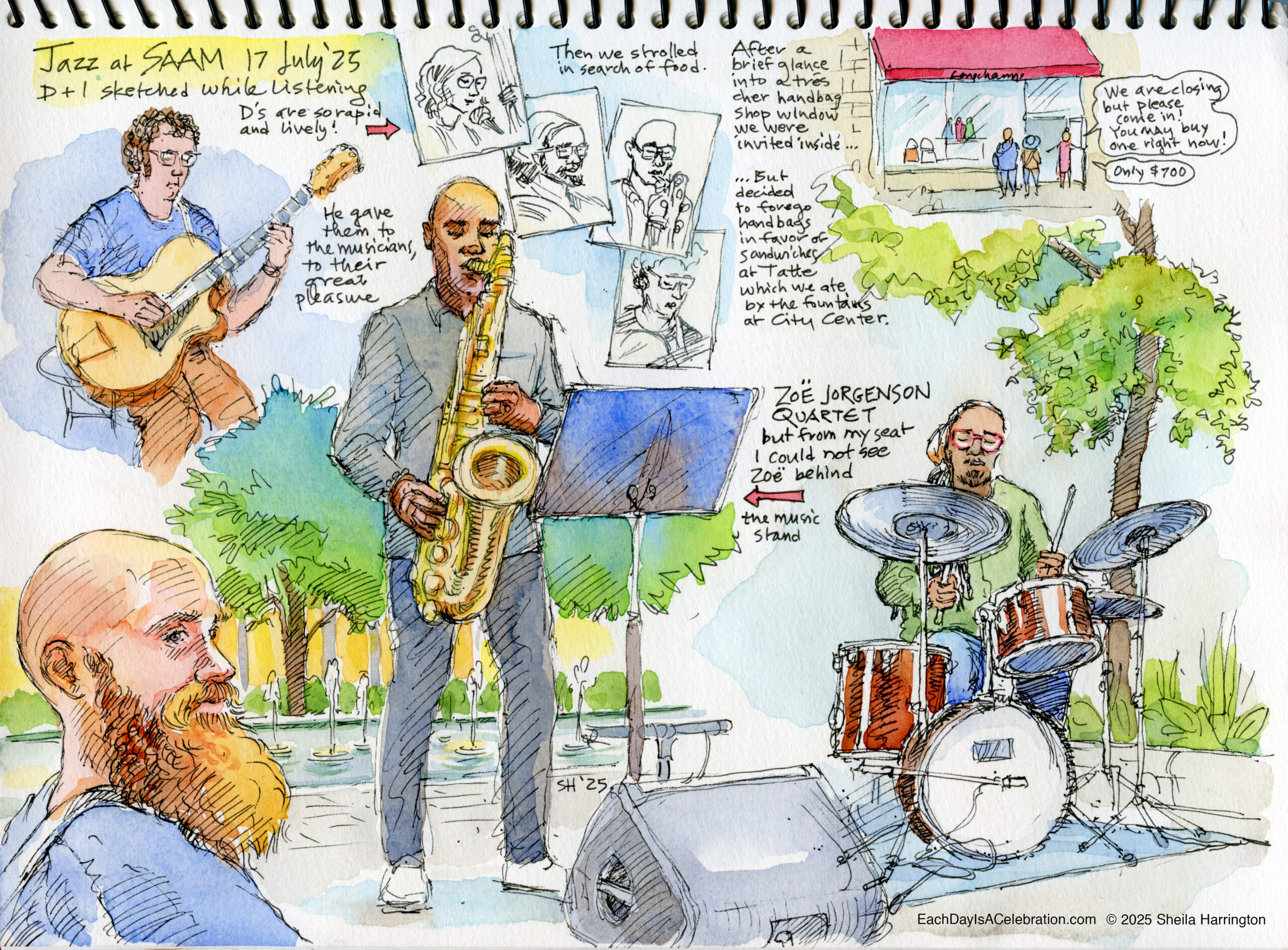
SAAM (the Smithsonian American Art Museum) hosts Luce Unplugged, a free local concert series in the skylit courtyard, which in 2026 is celebrating its tenth anniversary. After exploring the exhibits at either SAAM or the National Portrait Gallery, you can pick up a drink at the cafe and sit in the courtyard between the two, enjoying music. On the day of our visit the Zoë Jorgensen Quartet played to an enthusiastic crowd. The Luce Local Artist Series is scheduled for Saturday, July 11th, 2026.
In summer, Washington DC’s Omni Shoreham Hotel hosts a variety of concerts, not only to those staying at the hotel but also to neighbors. The Adam Fluger Jazz Trio was scheduled to play in the garden. But the day was so hot that the event was moved indoors to the Diplomat Ballroom, which suited the romantic repertoire.
To gaze at water in any form—seaside… lakeside… steady trickles from a watering can—is a blessing on these appallingly hot days. Here’s an option: the Japanese garden at the Hillwood Museum. (The stepping-stones across the stream below make it an enticing destination for children.)
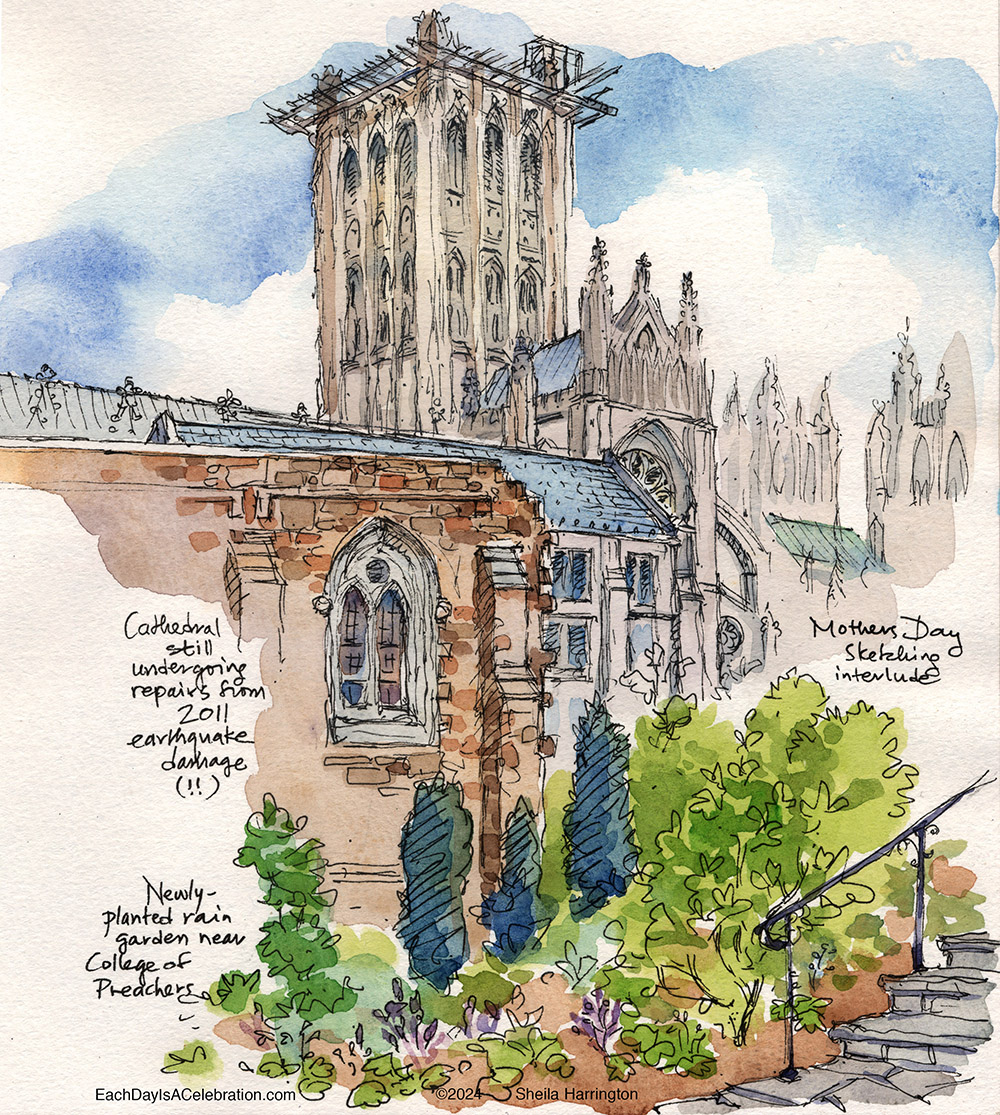
Washington National Cathedral is about halfway through repairs to the damage from the 2011 earthquake. You can see before and after photos on their website (and, if you wish, make a donation toward the project).
Today is the birthday (at least on the Gregorian calendar) of Ukrainian artist Taras Shevchenko, 1814-1861. If you walk southward on 22nd Street toward P Street in Washington, DC, you will pass a monument to Shevchenko, across from the Church of the Pilgrims. Since the statue is erected on a concrete island in the middle of two-way traffic, to examine it further you can’t just stroll by idly but will need to make it your pedestrian destination.
Taras Shevchenko was born in 1814 in the village of Moryntsi in what is now Ukraine (then part of the Russian Empire), into a family of serfs, his father a merchant whom Taras assisted. When he was 11 he was orphaned and spent the next several years working at a variety of jobs for the local cleric, herding sheep, driving a delivery wagon, supplying fire and water for the cleric’s school and simultaneously taking grammar classes and discovering Ukrainian literature. At a young age, Schevchenko displayed gifts not only for language and writing poetry but also for painting and drawing, sketching self-portraits and local figures and landscapes. At 14 he obtained work as a serving boy at the Engelgardt court in Vilshana. At first Shevchenko’s master had him punished for his artistic pursuits; later, he apparently relented, and when the court moved to St. Petersburg and, perhaps for the status implied in having a court artist, sent Shevchenko to study painting. His work increasingly received recognition and won awards. At 24 his freedom from serfdom was obtained by auctioning a portrait.
It was Shevchenko’s poetry, however, that led eventually to his persecution. Having been divided and ruled by multiple empires (Polish-Lithuanian, Ottoman, Russian) for centuries, Ukraine was experiencing by the 19th century a burgeoning nationalist movement. Shevchenko’s own growing nationalism increasingly inspired his work. His art depicted Ukrainian cultural figures and monuments and historical and archeological sites. His writings expressed not only traditions and folklore of the Ukrainian people but also described the conditions under which Ukraine was suffering under foreign rule. Combining intimate lyricism with biting political sarcasm, he aimed to spark the desire for liberty in his fellow Ukrainians. He wrote in Ukrainian (as well as Russian), which since the 17th century had been periodically banned. Shevchenko also joined the clandestine Ukrainian-Slavic Society which promoted national autonomy and a Ukrainian language revival.
Shevchenko was arrested, convicted for “writing in the Ukrainian language, promoting the independence of Ukraine and ridiculing the members of the Russian Imperial House,” exiled to a Russian military garrison, and forbidden to write or paint. Curiously, he was first sent to accompany a naval expedition to document the coastline, after which he was confined for seven difficult years in a remote penal colony. When he was finally released, he was forbidden to return to Ukraine. He spent the next four years of his life writing and painting, but his harsh imprisonment had affected his health and he died in 1861, shortly before the emancipation of the serfs.
In his importance to Ukrainian culture, Shevchenko has been compared by historians at the Library of Congress to Walt Whitman in the USA and Rainer Maria Rilke in Germany; yet neither was also a painter, illustrator, and political revolutionary. As Ukraine struggles courageously to maintain its freedom as a sovereign nation in the face of an invasion led by a ruthless and possibly psychopathic neighbor, Shevchenko’s own history is inspirational. You can learn more about him, his poetry, and his paintings on the Shevchenko Museum website.
Hymn Of Exile
The sun goes down beyond the hill, The shadows darken, birds are still; From fields no more come toilers’ voices In blissful rest the world rejoices. With lifted heart I, gazing stand, Seek shady grove in Ukraine’s land. Uplifted thus, ‘mid memories fond My heart finds rest, o’er the hills beyond. On fields and woods the darkness falls From heaven blue a bright star calls, The tears fall down. Oh, evening star! Hast thou appeared in Ukraine far? In that fair land do sweet eyes seek thee Dear eyes that once were wont to greet me? Have eyes forgotten their tryst to keep? Oh then, in slumber let them sleep No longer o’er my fate to weep.