Spring Moon

FullMoon

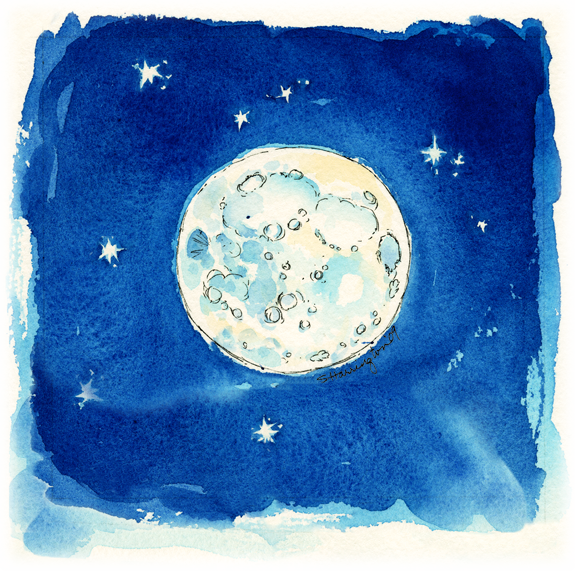
Wherever you are on this last day of winter, cross your fingers for a clear evening sky, and at sunset climb onto your roof or a tree or a nearby hill to await the moonrise. Because this is the night of the Perigee Moon (from the Greek peri, “around” + ge, “earth”), an unusually large and bright full moon that occurs only about every twenty years.

The moon’s elliptical orbit around the earth means that sometimes it’s closer, sometimes further away from us; and tonight the full moon coincides almost perfectly with the moment of its shortest distance to earth. The apparent increase in size is about 14%, which is enough to make a visible difference. After all, if your weight suddenly increased by 14%, wouldn’t your family notice your unusually large full moon?

Accompanying the large lovely moon will be a noticeable but not alarming rise in the tides, and perhaps an increase in howling. Also, this morning at breakfast we discovered that last night everyone in the family had slept very badly. Was it the dinner? Or, because we earthlings are composed mostly of salt water, could the nearness of the moon affect our inner tides, and therefore our sleep?

See you out there! In the meantime, here are two moon poems suitable for the Eve of Spring.

For another eve-of-spring picture, please see Dream of Spring.

Face of the spring moon–
about twelve years old,
I’d say.

—Kobayashi Issa

who knows if the moon’s
a balloon,coming out of a keen city
in the sky–filled with pretty people?
(and if you and i should
get into it,if they
should take me and take you into their balloon,
why then
we’d go up higher with all the pretty people
than houses and steeples and clouds:
go sailing
away and away sailing into a keen
city which nobody’s ever visited,where
always
it’s
Spring)and everyone’s
in love and flowers pick themselves

—E. E. Cummings


CakeBalloons2Janet


The Faces of Misfortune

NebaGarden

The mind flinches as it tries to absorb the devastating succession of natural disasters that have taken place merely within the last few years. Hurricanes in the Gulf of Mexico; multiple tsunamis in Indonesia; earthquakes in Haiti, Chile, New Zealand; innumerable floods, landslides, volcanic eruptions and wildfires. And now Japan, with scenes surreal of wreckage and relentless rushing waters and lives swept away—a triple whammy of earthquake, tsunami, and nuclear catastrophe.

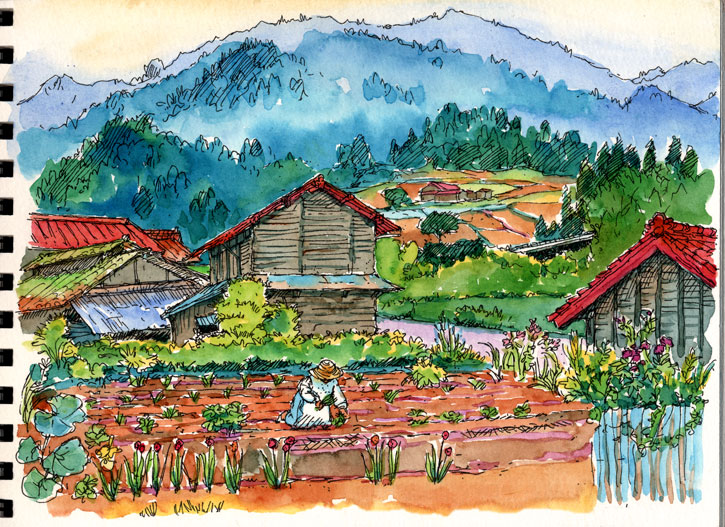
Here is a sketch from a visit we made to Japan when our son was teaching there. No matter where we went, total strangers were invariably kind, helpful, and generous, never hinting at the fact of our having dropped atomic bombs on them (the only country in the world to have suffered thus). On a walk one afternoon, we stopped to watch a woman working in her garden. Eventually noticing us, she invited us to see the rest of her garden—and her house—and meet her mother—and finally sent us off with just-harvested potatoes, radishes, and strawberries. This was absolutely typical of the entire trip.

I realize that politeness is a Japanese cultural value. There is a stiff-upper-lip quality that makes me think of stories about post-Blitzed World War II British (is there something about tea?), a characteristic that may lengthen the road to an American-style intimacy. But such sturdiness, resilience, and grace in the face of misfortune can be a blessing and a gift. Shikata ga nai.

The earth has grown so populous that natural disasters have enormous human impact, and simultaneously grown so connected that our common awareness of them is nearly instantaneous. The entire globe is now, truly, at our fingertips. It is theoretically possible to call up a picture of Anywhere, Earth, on the smartphone in one’s hand, if it has been visited by someone with a camera. And, thanks to international airlines (which actually used to be quite a speedy form of travel), many—through school or vacation or international aid organizations or family connections or business—have firsthand knowledge of worlds far from home. From knowledge, connection. We already carry the peoples and landscapes of the earth in our minds. The natural next step is the heart.

If you want to help, one way is to make a donation through the American Red Cross.


Glimpse of Spring

DogwoodTwig

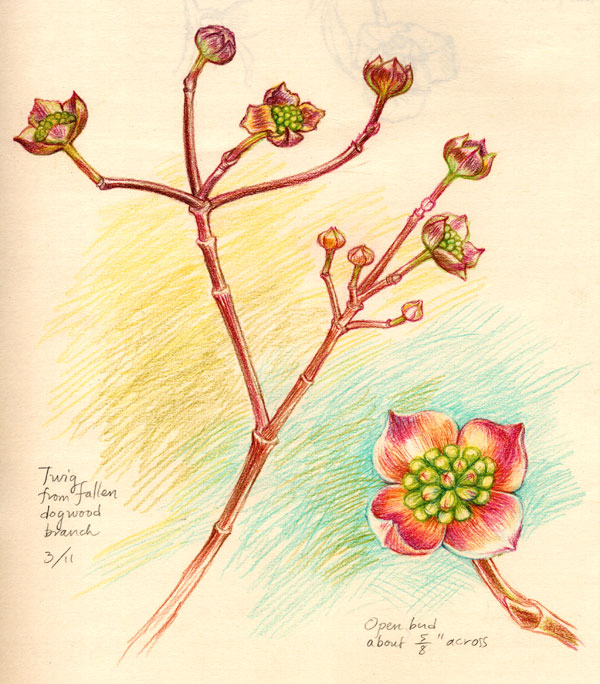
A few weeks ago a fierce thunderstorm blasted our area. The following morning the neighborhood was strewn with dozens of enormous broken branches—all in bud. A little sadly, we brought home a few sprays and put them in water, the vases of bare twigs giving our table a poignant wintery appearance.

The buds, unaware of their fallen state, are now confidently unfolding and bringing forth their hidden treasures, but in miniature. This one is from a pink dogwood tree. The four bracts that usually unfold to a 2″ or 3″ diameter are here only about 5/8” across. But still beautiful.

Today is the birthday of Shakespeare and Company founder Sylvia Beach. For a sketch and a mini-bio, please see Paris Memory.

CakeBerries2Kara


To Err is Divine

ComedyErrors

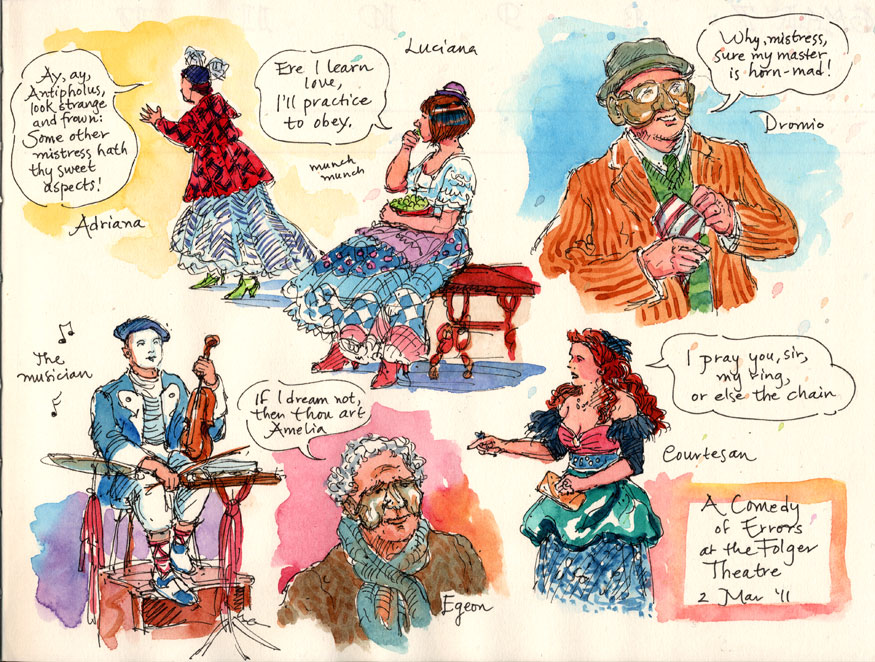
If you live in the Washington, DC area and you would like to spend two hours in culturally elevated laughter, run run run to the Folger Shakespeare Library and purchase a ticket to A Comedy of Errors.

You may already be acquainted with the plot—lost and separated twins, eccentric servants, misguided lovers, amusing mix-ups, and a happy ending all around (which familiar elements—except for the last—Shakespeare adopted from ancient Roman comedy). But it’s well worth another viewing in this current manifestation, framed somewhat unusually in a manner I will not divulge, and influenced by Italian Commedia dell’Arte with its masks, wild costumes, and physical gags, here not excessively annoying. The Folger Theatre itself is worth the visit, a warm, wood-paneled and intimate space that feels more residential than institutional.

My daughter and I saw a mid-week matinee for school groups, most of them high school students greatly appreciative of the bawdy jokes that went over the heads of our younger homeschoolers.

For another illustration in celebration of this day, please see Saved by the Bell.

Come Live With Me and Be My Love

SylvanCourt

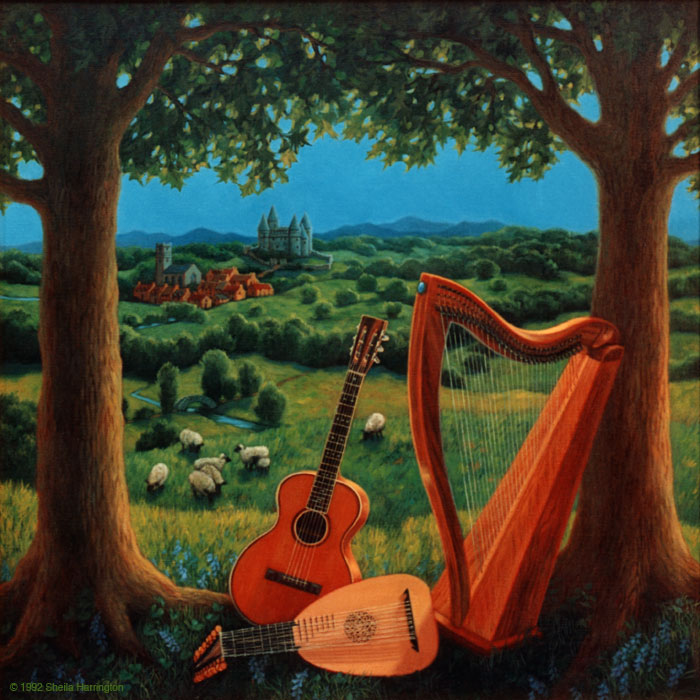
Although the imagery isn’t exactly appropriate for the weather, I post this verse and accompanying painting in honor of the baptismal date (his actual birthdate is unknown) of Christopher Marlowe (1564-1593), poet, playwright, freethinker, and influential contemporary of Shakespeare. Anyway, March is just around the corner, so pretty lambs and melodious birds cannot be far off.

The combination of Marlowe’s successful career, yawning gaps in the biographical record, and early mysterious death in a tavern brawl have led to much speculation about his love life, religious views, and supposed alternate career as a government spy. I can’t think why his story hasn’t yet been made into a swashbuckling PBS mini-series.

Come live with me and be my love,
And we will all the pleasures prove
That valleys, groves, hills, and fields,
Woods or steepy mountain yields.

And we will sit upon the rocks,
Seeing the shepherds feed their flocks,
By shallow rivers to whose falls
Melodious birds sing madrigals.

And I will make thee beds of roses
And a thousand fragrant posies,
A cap of flowers, and a kirtle
Embroidered all with leaves of myrtle;

A gown made of the finest wool
Which from our pretty lambs we pull;
Fair lined slippers for the cold,
With buckles of th purest gold;

A belt of straw and ivy buds,
With coral clasps and amber studs:
And if these pleasures may thee move,
Come live with me and be my love.

The shepherds’ swains shall dance and sing
For thy delight each May morning:
If these delights thy mind may move,
Then live with me and be my love.

—Christopher Marlowe

The painting above was created for the cover of a CD, The Sylvan Court.