Joy of Pancakes

CelestiaCooks

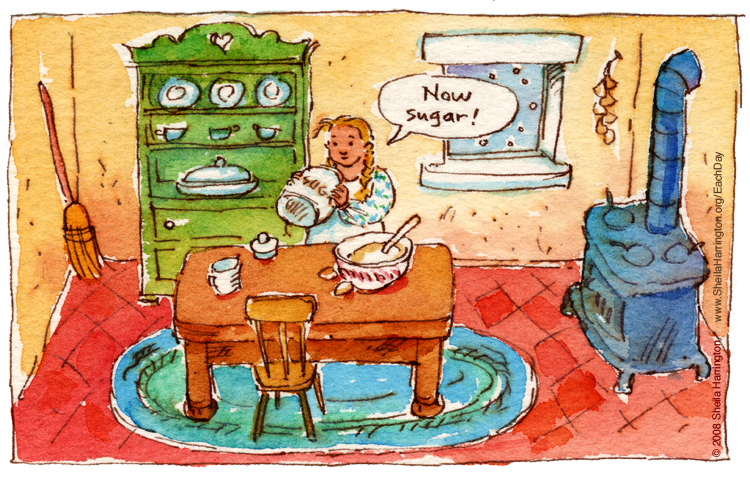
Today is the birthday of Irma Rombauer, author (with her daughter Marion Rombauer Becker) of that kitchen classic, The Joy of Cooking. In her honor, I post, along with this sketch, my family’s favorite whole-grain pancake recipe, a standard here for everyone’s birthday breakfast, as well as for many Saturday mornings. I have tried out quite a few pancake recipes on the gang over the years, but they always insist on this one from good old Joy. Happy Birthday, Irma Rombauer! I hope that wherever you are the food is good.

Joy of Cooking Whole Grain Griddle Cakes

Sift and measure:
3/4 cups whole grain flour
3/4 cups cake flour (but I use unbleached white)
Resift with:
1 tsp salt (but I use just a pinch)
3 T sugar plus 2 T molasses (but I use 3 T brown sugar instead)
1-3/4 tsp baking powder
Beat lightly:
1-2 eggs (depends on egg size)
If you double the recipe (which I ALWAYS do), you can separate the eggs and beat the whites separately.
Mix beaten egg (or yolks) with:
3 T melted butter
1-1/4 cups milk (but I use buttermilk)
Then blend wet and dry ingredients. Fold in stiffly beaten whites gently, if you have reserved them.
If it’s a birthday, I make shaped pancakes (animals, hearts, initials). I use a pointy spoon.
CakeAutLeavesAlanna

Fern Hill

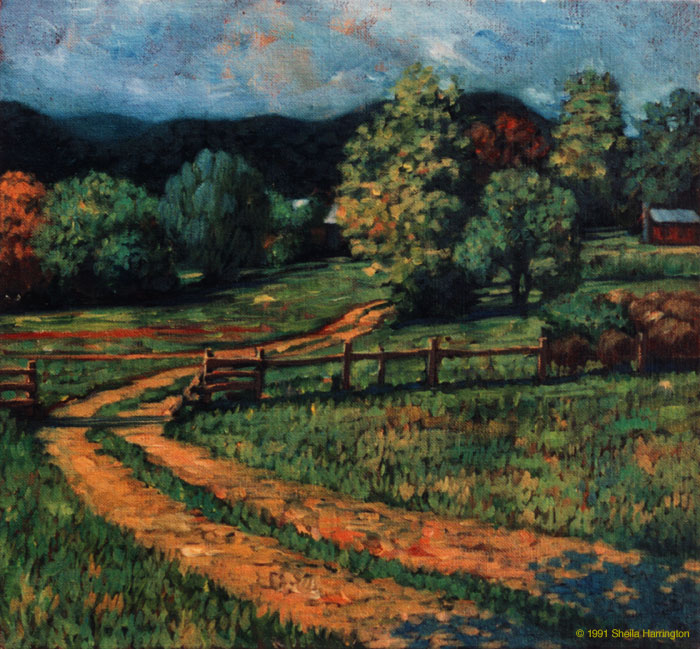
Today I celebrate the birthday of Dylan Thomas, who lived way too short a life (1914-1953), with the first verse of one of my favorites, “Fern Hill,” and a painting of the wonderful farm in Virginia that used to host our organic CSA. Not exactly Wales, but in the right spirit.

JordanRiver

Now as I was young and easy under the apple boughs
About the lilting house and happy as the grass was green,
The night above the dingle starry,
Time let me hail and climb
Golden in the heydays of his eyes,
And honoured among wagons I was prince of the apple towns
And once below a time I lordly had the trees and leaves
Trail with daisies and barley
Down the rivers of the windfall light…

—Dylan Thomas

CakePigJana

United Nations Day

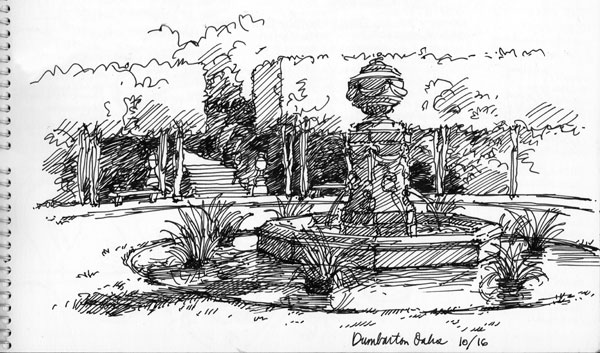
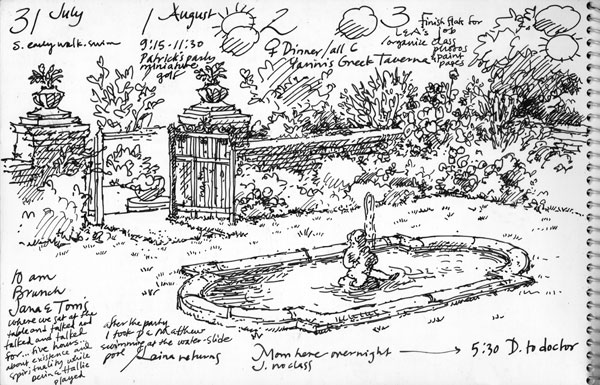
These drawings are from a couple of sketchbook-journals carried on visits to the beautiful gardens of Dumbarton Oaks in Georgetown, Washington, DC. However, I post them not for the sake of those lovely gardens themselves (to which the sketches don’t do justice) but in honor of today’s anniversary of the ratification of the charter for the brand-new United Nations. Perhaps some of you folks out there already knew that the foundation of its charter had been hammered out at Dumbarton Oaks. I only learned it recently.
DumbartonFountGrey

DumbartonPoolGrey

Dumbarton Oaks, built in 1801 as a private home, was purchased in 1920 by diplomat Robert Bliss and his wife Mildred. With Beatrix Ferrand they created the fabulous gardens and renovated the house, adding a music room for concerts and lectures, and a museum for their art collection. In 1940 they gave the property to Harvard University.

Although in 1940 the United States had not yet even officially entered the Second World War, entities private and governmental were already discussing the possible creation of a post-war international peacekeeping organization—but secretly, because of the strong isolationist, anti-League of Nations element existing in the country. Isn’t it amazing what significant matters we managed to keep secret in a pre-Internet era?

FDR first offered the optimistic term “United Nations” to refer to such an organization in a 1942 Declaration composed at the Arcadia Conference by the USA, the UK, the USSR, China, and twenty-two other countries to lay out their common goals during and after the war. Other nations signed on later. Bliss, speaking for Harvard, offered the use of Dumbarton Oaks as a possible location for future talks. This setting was deemed suitable, and the offer was accepted.

So, between August and October, 1944, representatives of the USSR, the UK, the USA, and China (although never with the USSR and China at the same table at the same time!) gathered at Dumbarton Oaks to wander the lawns, dine in the Orangery, and sit in the music room for a series of discussions. At their conclusion, the four nations had agreed upon a series of proposals which, along with provisions born of the Yalta conference, formed the basis for the new United Nations Charter, which was signed in San Francisco on October 24th, 1945.

Among the goals were these: The development of friendly international relations. The strengthening and maintenance of international peace and security. The removal of threats to peace through collective cooperation. And collective measures to solve economic and humanitarian problems.

What an impressive and inspiring global perspective, especially for a species that only a few thousand years earlier routinely regarded an unfamiliar tribe as the enemy. (This antiquated response is occasionally observed even now.) May we see these goals one day fully realized.

CakeDaisiesEugenie

Yahrzeit2Aunt Mary

Woman in the Air

Probably ever since we began paying attention to the birds, we human beings have longed to fly ourselves. And once the Wright Brothers proved this possible in 1903, it was not only men who were keen to give it a try.

Blanche Stuart Scott (1885-1970), born in Rochester, New York, was known as a “tomboy.” Her father let her drive the family automobile around town, and although some of the neighbors objected to a fifteen-year-old behind the wheel, there was as yet no minimum driving age.

In 1910 Scott became the first woman to drive across the country, from New York City to San Francisco, which brought her to the attention of Jerome Fanciulli, a promoter for Glenn Curtiss. Curtiss was a pioneer in the U.S. aviation industry, who designed aircraft and hired pilots to demonstrate his products. He wasn’t crazy about the idea of training a female pilot, though he agreed to accept her as a pupil—but he kept a block of wood behind her throttle pedal, so that although Scott learned to operate the plane and run it back and forth on the ground, it never took off.

Airplane-ECS

This was probably fun for a while, but one day while Scott was practicing, the block of wood mysteriously became dislodged. Oops! Wonder how THAT happened! Scott zoomed off on an unscheduled flight, alarming her instructor but landing safely, and demonstrating that a woman could actually operate a plane not only on the ground, but also in the air. Eventually she joined Curtiss’ Exhibition Team, and made her first Official Flight on October 23rd, 1910, of which today is the anniversary. (That first “accidental” flight didn’t count.)

Scott became known as “Tomboy of the Air,” flying upside-down and executing heart-stopping dives, for a heart-stopping salary, too. In 1911 she made the first woman’s long-distance flight—sixty miles—another “unplanned” event, when she decided one day just to keep flying. Scott went on to become the first female pilot to test prototypes, but after a number of male colleagues lost their lives in terrible accidents, and sensing that her spectators anticipated her own eventual crash, she retired from flying and spent several decades in broadcasting instead. Her flying days weren’t over, however—in 1948 she became the first American woman to fly in a jet, piloted by none other than Chuck Yeager.

From a travel sketchbook I post a page that seemed appropriate for today’s anniversary: airplane/daring daughter.

CakeChrysanthJan


Thou shalt wander like a breeze

UmbriaL

Today is the birthday of Samuel Taylor Coleridge (1772-1834), and so I post this excerpt from one of his poems, Frost at Midnight. Coleridge’s better-known works include the innovative yet strange (one might even say alarming) poems The Rime of the Ancient Mariner and Kubla Khan, but I chose one that reveals another side of this unhappy, troubled, brilliant man: a tender-hearted and optimistic poem written while caring for his new infant son Hartley. Clearly he anticipates a loftier path for Hartley than the one he has followed himself.

Accompanying it is a detail from a larger painting.

Dear Babe, that sleepest cradled by my side,
Whose gentle breathings, heard in this deep calm,
Fill up the interspersed vacancies
And momentary pauses of the thought!
My babe so beautiful! it thrills my heart
With tender gladness, thus to look at thee,
And think that thou shall learn far other lore,
And in far other scenes! For I was reared
In the great city, pent ‘mid cloisters dim,
And saw nought lovely but the sky and stars.
But thou, my babe! shalt wander like a breeze
By lakes and sandy shores, beneath the crags
Of ancient mountain, and beneath the clouds,
Which image in their bulk both lakes and shores
And mountain crags: so shalt thou see and hear
The lovely shapes and sounds intelligible
Of that eternal language, which thy God
Utters, who from eternity doth teach
Himself in all, and all things in himself.

—Samuel Taylor Coleridge