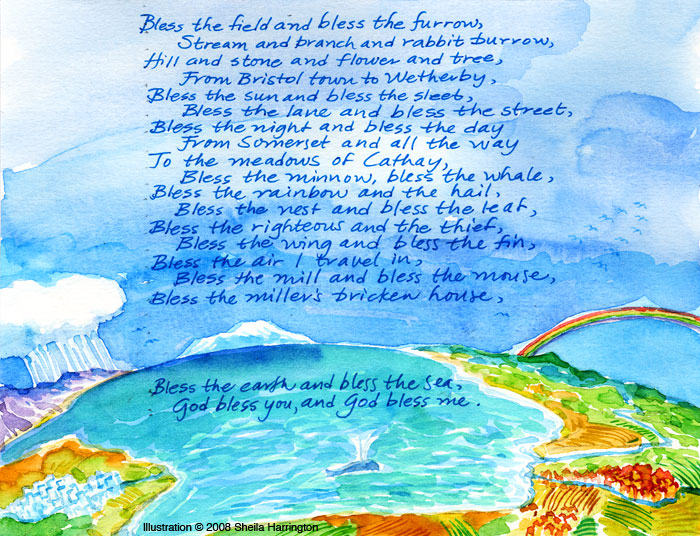
Bless the Field and Bless the Furrow

BlessTheField

To begin the work week, a traditional blessing from our homemade family mealtime verse book.

I especially like “Bless the righteous and the thief.” To hold this vision of the world deeply in one’s heart is worth striving for. Ongoing struggle though it may be from day to day. Well, it is for me, anyway.

Wild About Harry

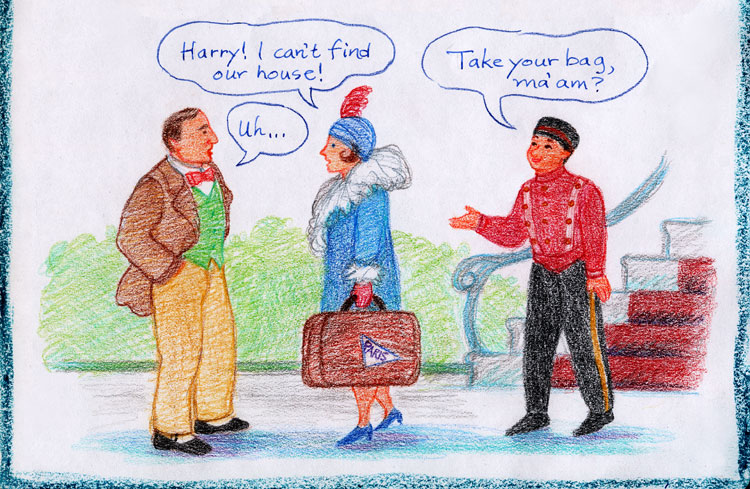
This picture is from our Local History and Geography lesson block.

Wardman

If you lived in Washington, DC in 1938, ONE out of every TEN of your neighbors was living in a house or apartment built by Harry Wardman (1872-1938), whose birthday it is today. Not bad for a guy born in Bradford, England who came to the United States at age 17 and started out as a department store floorwalker in New York. He moved on to a store in Philadelphia, then to Washington, DC in 1893, where he found carpentry work and learned to build staircases.

Wardman wasn’t satisfied with staircases, however. Washington suffered from housing shortages both after the Civil War and after World War I, and Wardman was poised and eager to fill the need. He moved on from staircases to building entire houses, and then larger structures: buying land, building on it and selling, then buying new land for another project. He built apartment buildings, office buildings, hotels, clubs, and whole neighborhoods of row houses renowned for the quality of their construction and materials.

Wardman built many of Washington’s grandest apartment buildings, the Hay-Adams Hotel, and the British Embassy, but his best-known project is probably the Wardman Park Hotel in Woodley Park. Wardman and his wife already had an impressive mansion in the neighborhood, at the intersection of the newly-extended Connecticut Avenue and Woodley Road. An iron bridge had only just been built in 1891 allowing easier travel across the ravine of Rock Creek Valley, and Wardman decided that Woodley Park would be a fine location for a hotel.

So in 1916, while his wife was overseeing their daughter’s schooling in Paris, Wardman ordered a crew to empty their house of its furnishings, and then he had the place torn down, to be replaced by the Wardman Park Hotel (now the Marriott Wardman Park). People called it “Wardman’s Folly.” Why, you ask? Supposedly because no one in his right mind would ever want to stay in a hotel soooo far away from downtown. But I’m trying to imagine returning from a trip to Paris and discovering that my husband has knocked down our house and replaced it with a hotel. “Folly” is certainly one word that would come to mind. Many other words, too, probably.

Wardman made a fortune. By 1929 he had amassed $30 million (which I understand was a lot of money in those days). Most of it was lost in the stock market crash, but he retained enough to continue some of his building projects and was on his way to a second fortune when he died, having spent years putting roofs of one sort or another over the heads of Washingtonians. Our family lives today in a Wardman neighborhood (our house turns 100 years old this year), and I definitely plan to put some candles in the dessert tonight and sing Happy Birthday to Harry.

CakeBalloons2Greg

Sugaring off

MapleSyrup

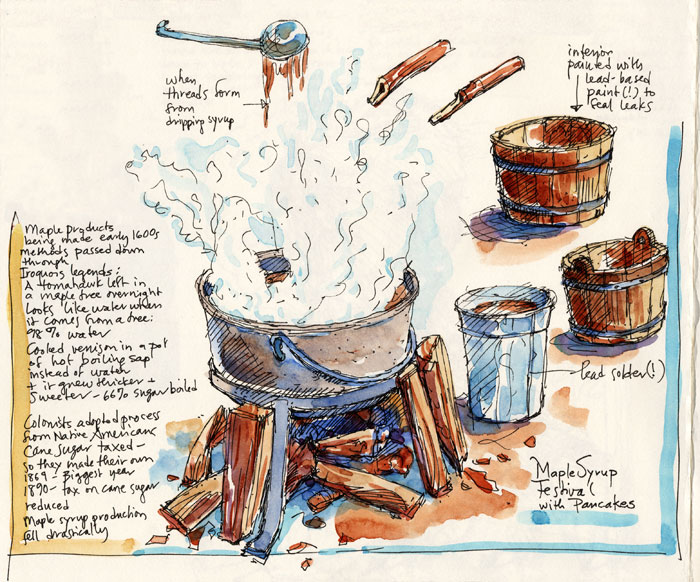
Spring is a time for field trips—outdoors, if possible. This is from my sketchbook, when, as part of a homeschooling Farming block one year, we visited Cunningham Falls in the Catoctin Mountains for their annual maple syrup festival. We were able to see the entire process from tree-tapping to boiling down sap to sampling the final product at a pancake breakfast. Wonderful park guides provided explanations of each step and answered our many questions. The syrup was a whole lot better than their Lake Wobegon pancakes, though. They definitely need a new recipe.


My Heart Leaps Up

My heart leaps up when I behold
A rainbow in the sky.
So was it when my life began;
So is it now I am a man;
So be it when I grow old,
Or let me die!
The Child is father of the Man;
And I could wish my days to be
Bound each to each by natural piety.
—William Wordsworth
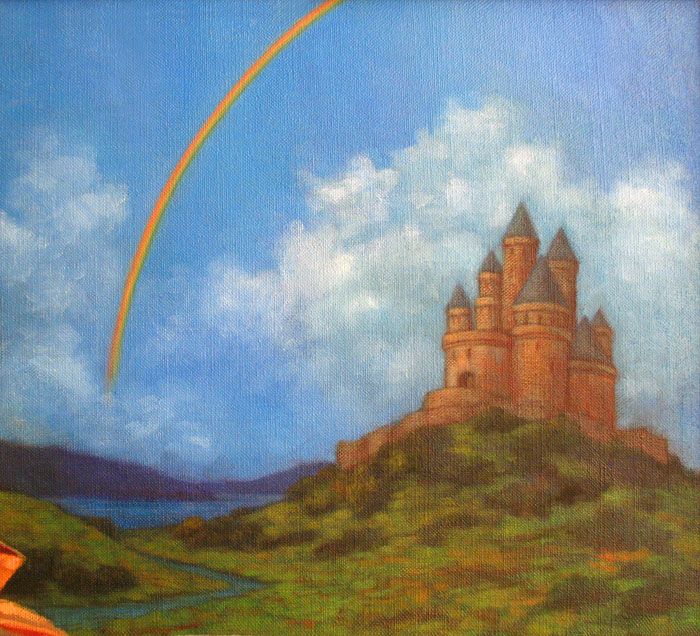
Rainbow

(painting is a detail from a larger work, The Age of Reason)

Whenever someone in the family mentions a rainbow, my husband launches into this poem. (It’s now inevitably become a sort of family tradition—wait for it….) And today we celebrate the fortuitous birthday of its author, William Wordsworth (1770-1850), born in Cumberland, England.

Is it obligatory for English poets to have had unhappy childhoods? Wordsworth’s was no exception—his father, mysteriously, lived apart from the family, and when the children’s mother died, instead of taking them in, he parcelled them out between boarding schools and a series of unpleasant misery-inducing relatives. Wordsworth wasn’t reunited with his beloved favorite sister Dorothy for years. The highlight of his dismal schooling (besides introducing him to his future wife) was the holidays, which he consistently spent going long walks in nature and writing poetry.

At twenty Wordsworth set off on a walking tour of Italy, Switzerland, and post-Revolutionary France, where he became a passionate advocate of the republican cause. In France he formed a liaison with a local girl, but the relationship was discouraged by her parents (despite his having fathered a daughter whom he visited and supported rather erratically over the years). He returned home alone, disillusioned by the increasing violence of the revolution and England’s violent response to it, aimless, without profession, depressed.

This dark period was finally relieved by a legacy from Raisley Calvert, a sculptor and loyal former classmate, that allowed Wordsworth to support himself while writing poetry. May we all be so fortunate in our old school friends! With a steady income, he was able to form a household with Dorothy and their mutual friend Samuel Coleridge that Dorothy termed “three persons with one soul.”

It was a creative partnership that marked the birth of English Romanticism. Inspired by one another, Wordsworth and Coleridge produced innovative, experimental, controversial poetry, and Dorothy’s letters (luckily for literary historians) documented the process. Wordsworth defined poetry as “the spontaneous overflow of powerful feelings” but his rapture was borne within measured frameworks, among them the sonnet form, which Wordsworth reawakened after its long disuse. In 1798 they published Lyrical Ballads (“Tintern Abbey,” “The Idiot Boy,” “Rime of the Ancient Mariner”) and Romanticism was up and running.

The Romantic movement emphasized the value of individual experience, the contributions of ethnic traditions and folklore, the primal power of wild landscape and the wonders of nature, a consciousness of the infinite, and the use of imagination and the senses as a path to spiritual truth. It was a break from the formal elegance, polish, dignity and conservative restraint that characterized the formerly hot movement, Neoclassicism. Instead of, say, a series of elevated dramatic couplets on the epic semi-divine hero of ancient tragedy, we have a lyrical meditation on the soul-response to a sea of daffodils, or to the loss of a much-loved child. A personal perspective on life, the natural world, and mortality.

Yes…quite a break! taken up by Blake, Scott, and Göethe, followed by a whole string of younger Romantic poets and writers (Byron, Shelley, Keats, Hugo, Dumas, Pushkin) and the Transcendentalists (Emerson, Thoreau) and later the Victorians (Browning, Tennyson). Where would it end?? Culture as well as politics seems to be an ongoing struggle between the poles of head and heart, with adherents of each movement certain of having achieved a universally valid means of expression. But that is a subject for another post.

The partnership foundered on a falling-out with Coleridge, a pretty gloomy fellow, as one would expect of someone who writes a lengthy baffling poem about a curse-bearing dead albatross. Wordsworth and Dorothy moved on, settling eventually in the beautiful Lake District, that region abundant in literary inspiration and indomitable tourists. Joined by Robert Southey, the two became known as the “Lake Poets,” and Wordsworth married and proceeded to have five children. A sizable household. But a household that, as any other, had its share of suffering, with the drowning of William and Dorothy’s brother, and the deaths of three of the children. Wordsworth’s poetry grew more sober, restrained, and elegiac. In fact in his later years, while serving as England’s poet laureate, he was criticized by younger writers for his increasing conservatism. Suffering and loss does shade and temper youthful abandon.

Even if you can’t recite a Romantic poem in entirety, you know that your head is filled with lovely memorable fragments (“Dear God! the very houses seem asleep; And all that mighty heart is lying still…” “I wandered lonely as a cloud That floats on high o’er vales and hills…” “The Soul that rises with us, our life’s Star, Hath had elsewhere its setting, And cometh from afar…”) that are part of our literary legacy and that emerge in moments of wonder and joy. For the fragments, for the poetry, for the consciousness that shaped them, and for my husband’s regular recital of the rainbow poem, thank you, William Wordsworth, and Happy Birthday.

Cherry Blossom Breakfast

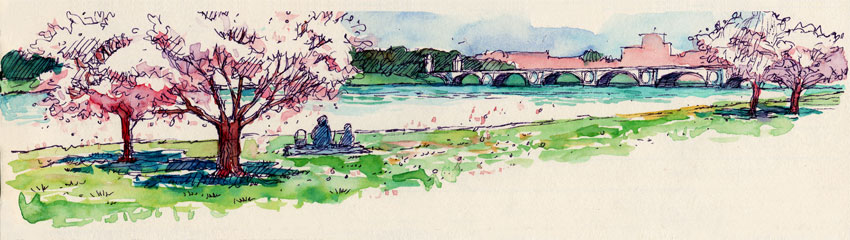
This morning we officially began our homeschooling Botany block, with springtime poetry, an early morning picnic and stroll under the cherry blossoms, and a long conversation about the astonishing, exuberant and generous world of plants, which brings forth hourly surprises in this season. (Was it only last month that a mountain of snow still blocked the alley exit?)

CherryBlossomPicnic

Lo, the winter is past, the rain is over and gone;
the flowers appear on the earth;
the time of the singing of birds is come,
and the voice of the turtle is heard in our land.

The fig tree putteth forth her green figs,
and the vines with the tender grape give a good smell.

Arise, my love, my fair one, and come away.

—Song of Solomon 2:11-13

CakeBerries2Louise


Down on the Farm

Farmhouse

Each spring at this time, the children of our homeschooling coop spend a week on a working farm. They feed the animals, gather eggs, milk cows, spread manure, plant seeds, work on meal preparation and cleanup, and generally help out with whatever needs to be done. This year they also participated in gathering and boiling sap for maple syrup, which they then ate with their pancakes the next morning. When we parents go to fetch them at the end of the week, they are muddy, tired, and already looking forward to returning next year. We always hope the children will come home begging for a few more chores to be added to their lists. Maybe if we kept a cow…


Easter Garden

EasterGarden

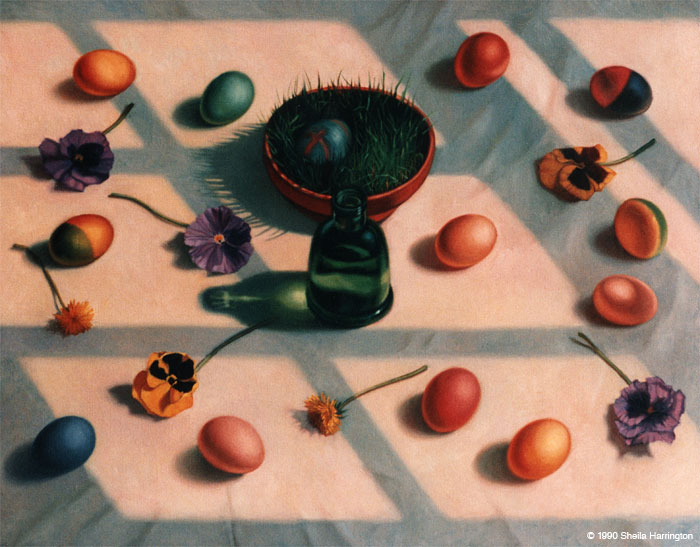
Some years ago I was moved to paint a still life based on our Easter customs.

Every year during Lent we plant a tiny garden of rye or clover seed and set it in the middle of the dining room table. And every year it’s startling (even though I’ve seen it so often before!) to find one morning that new, fragile green sprouts have pushed their way upward through the weight of earth. What fortitude. What will to live. So may we all find our way toward the light this springtime season.

CakeDaisiesSaul