Mother of Level Measurements

Fannie&Fiona

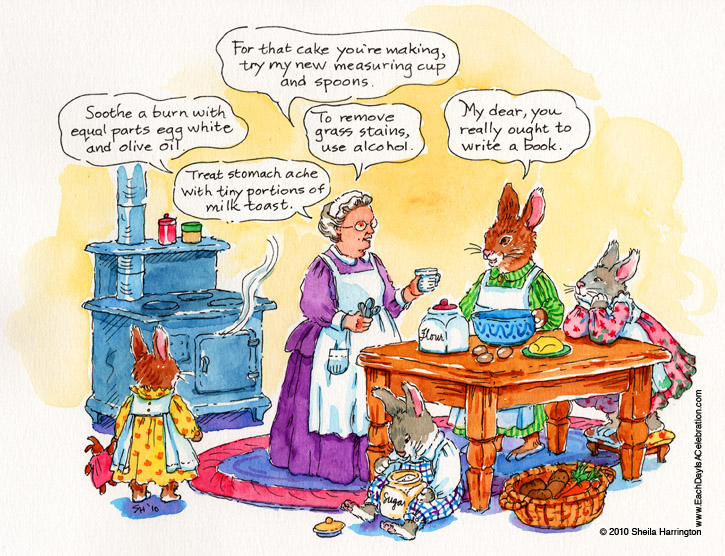
If you were an American housewife setting out to bake a cake or a loaf of bread in the 19th century—or the 18th—or the 17th—you generally relied upon what you had learned at your mother’s side. You assembled flour and milk and sugar and milk and shortening and eggs, estimating amounts as best you could and combining them from memory in the proper order. In 1303 Edward I of England had standardized the pound, and the American colonists brought with them, and still use today, the old English standards of measurement (the British have revised their system several times since then, so we no longer match), and most farm wives could measure in pounds, pecks, and bushels. But as for smaller units you were on your own with vague descriptions (“a dab of cream” “a piece of butter as large as an egg”) or whatever teacups you were fortunate enough to possess.

That is, until Fannie Farmer (1857-1915), who was born on this day in Medford, Massachusetts. Her father was an editor and printer, and her parents believed in higher education for girls, but Fannie suffered a stroke at age 16 (!), which prevented her attending college. What she could do, however, was take up responsibility for the household’s cooking. Evidently she had a natural talent. When the family home became a boarding house, it gained a reputation for its fine meals.

So Farmer was encouraged by a friend to obtain teacher training at the Boston Cooking School, which took a scientific approach to food preparation, and she did so well that she stayed on to become Assistant Principal and then Principal in 1891. And in 1896, Farmer published The Boston Cooking-School Cookbook.

Now, cookbooks were not unknown to American housewives. Amelia Simmons’ American Cookery had been self-published in 1796, with colonial favorites like pumpkin pudding, watermelon pickles, and spruce beer (Mmmm!), and by the late 19th century there was an explosion of cookbooks by women, offering medical mixtures (“A wash to prevent the hair from falling off”) and household advice (“Words of Comfort for a Discouraged Housekeeper”—now there’s one we could use) as well as recipes.

Farmer’s cookbook was even more comprehensive, including sections on the chemistry of cooking and cooking techniques, the specific components of food and why each was necessary for health, how a stove works, how flour is milled, what happens during fermentation, and extensive detailed advice on caring for the sick. In addition to these she offered recipes with straightforward, precise directions and—Ta-Daaa!—Actual Measurements, the tools for which (the standard measuring cup, divided into ounces, and graduated measuring spoons) she had created earlier. The publisher, Little, Brown, had “little” faith in the book’s success, and insisted Farmer foot the printing bill herself. When the book became hugely popular (it has sold millions of copies and has never been out of print), this turned out very well for her because she had retained copyright. Ha! Unlike poor Irma Rombauer who unfortunately sold her rights for $3,000 to Joy of Cooking’s publisher.

Farmer’s success enabled her to open her own cooking school. She wrote other books, one of them focusing on cooking for the invalid; was invited to lecture at Harvard Medical School (which lectures were widely printed and read); wrote a regular cooking column in the Woman’s Home Companion; and continued to test and invent recipes and to lecture until the last few days of her life.

You can find Fannie Farmer’s cookbook today—in its 13th edition—at your local library and bookstore. And to celebrate the birthday of the “Mother of Level Measurements,” as she was called, you can make Fannie Farmer’s “Birthday Cake.” If you own a measuring cup and spoons, that is. I have the recipe right here, and if you email me, I will send it to you. (It may be straightforward by 19th century standards but it’s waaay too long to include here.)

Bugs for Breakfast

WoodpeckerJMaple

I was sitting in the garden sketching plants when I became aware of a persistent rat-tat…rat-tat-tat…rat-tat… I finally looked up, and there on the tree trunk a few feet away was a female (no red patch on the head) downy woodpecker pecking for her breakfast. I had been sitting so still that she hadn’t paid attention to me. So I ve-e-e-ry slowly turned the page in my sketchbook and drew her instead.


Not THAT Grover

Cleveland

Now be honest. How often have you celebrated the birthday of Grover Cleveland? I thought so. Well, this is a first for me too. But it’s about time, because THIS Grover used to live in our neighborhood, as we learned during a Local History and Geography homeschooling lesson.

Cleveland (1837-1908), our 22nd AND 24th President, was born on this day in Caldwell, New Jersey, one of the nine children of a Presbyterian minister. When he was 16, his father died, and Cleveland left school to help support the family. From that point his career followed such an uneventful path that one would not imagine it arriving at the White House: assistant teacher… scribe… secretary.

Then a position as law clerk in Buffalo led to his admission to the bar without his ever actually having attended law school. Or any university. Or finishing high school. Yet he launched what turned out to be a prosperous law career. (Aren’t you just kicking yourself, you lawyers, for frittering away all that money on your education?) Well, what else was there to do after that but… run successfully for sheriff, and then Mayor? And Mayor Cleveland’s refusal to award city contracts based on political connections was remarkable and unusual enough to establish his reputation for honesty, and propelled him next into the Governor’s seat.

As the Presidential primaries loomed in 1884, the Democrats, who had not won a Presidential election since before the Civil War, eyed the blunt outspoken Cleveland as a possible challenge to the series of weak and corrupt Republican administrations with which the public was disgusted. Reformist Republican voters (“Mugwumps”) deserted their party to help put Cleveland in the White House. That’s what this country needs. More Mugwumps.

Cleveland sent shock waves through his supporters when he announced that his appointments would be based on ability rather than loyalty or party affiliation. What a concept. He also used the Presidential veto freely, especially when a bill called for profligate or potentially fraudulent spending. The most contentious issues of his Presidency were protective tariffs (he was skeptical) and the gold standard (he supported it). Ongoing disputes and enemies made over these issues led to his supposed defeat by Benjamin Harrison in the 1888 election. (Acknowledged fraud achieved Cleveland’s loss of electoral votes in key states, although he won the popular vote.) The ruinous policies of the Harrison administration, however, led to Cleveland’s re-election in 1892, leaving him to deal with the resulting crises of bank failures, economic depression and unemployment. (Hmm, where have I heard that before?)

When he entered the White House, Cleveland was a bachelor, but he had the responsibility to supervise the upbringing and education of Frances Folsom, the daughter of an old friend who had passed away and named Cleveland as executor of his estate. Cleveland must have thought she turned out pretty well because in 1885 he asked her to become the First Lady. She was 21, beautiful, and charming—he was 49—the media and the country went wild. The wedding took place in the White House with John Philip Sousa conducting the Marine Band. Frances, the youngest-ever First Lady, was extremely popular, and the activities of their growing family were followed eagerly. Baby Ruth had a candy bar named after her.

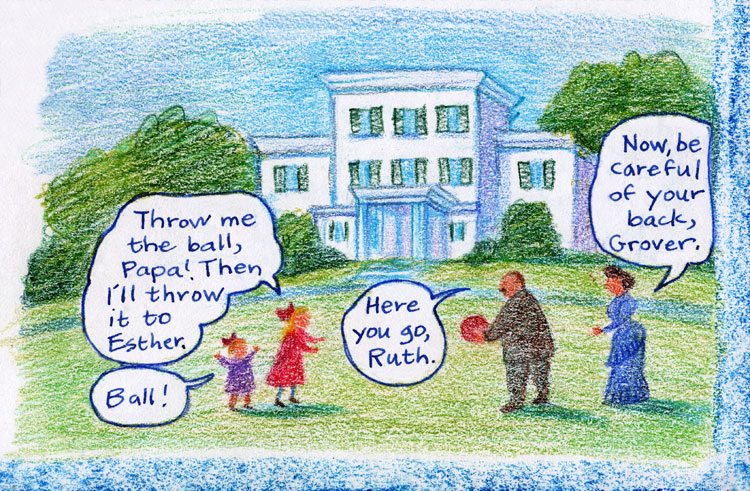
Which brings me back at last to the neighborhood. In his first term, the Clevelands modernized Oak View, a country farmhouse in northwest Washington, to use as a retreat, and Cleveland commuted downtown by buggy. Unfortunately the house has since been razed, but his presence gave the name Cleveland Park to the neighborhood. In his second term, the Clevelands, now a family, rented Woodley, the mansion built in 1801 for Philip Barton Key (Francis Scott Key’s uncle), as a summer home, where the children could enjoy peace and quiet and country air far from the bustle of the White House. This house still stands and is currently Maret School. Now, whenever I stroll by, I imagine the little Clevelands cavorting on the lawn.

Knitting/Dreaming

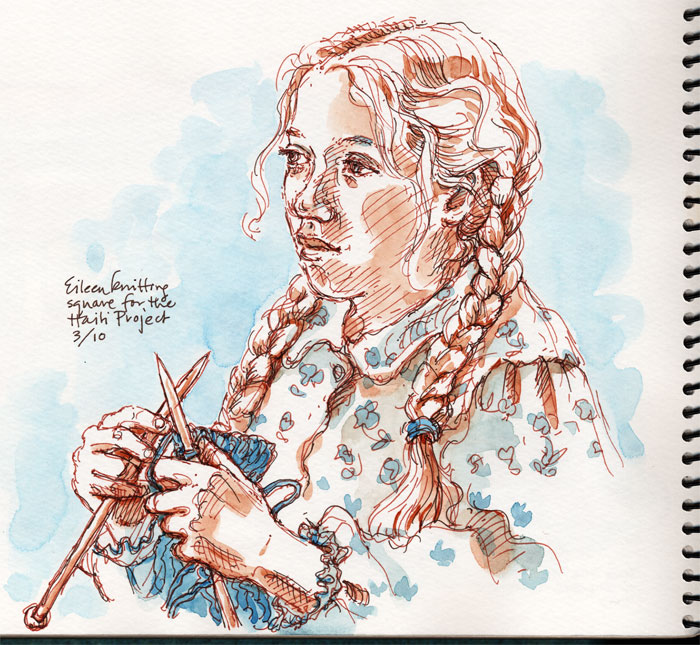
Here is my daughter knitting a square for the Haiti project, for which you can see yesterday’s post or download the flyer here.

EKnittingSquare

If she looks a little dreamy-eyed, it’s because we are also watching Walt Disney’s Cinderella, made in 1950. My, the animation is impressive, considering it was hand-drawn and painted frame by frame with no computer assistance! Go watch again the scene where Cinderella scrubs the floor, her image reflected in dozens of lovely floating multicolored soap bubbles.

Quilt Raffle for Haiti

Some of you already know about the Quilt Raffle for Haiti Projects that our homeschool cooperative has undertaken. But for those of you who don’t, today I post a flyer describing the project. If you like, you can view a clearer version of the flyer and download a printable raffle ticket form. Please feel free to email me if you have any questions.

QuiltFlyer

Paris Memory

JS33rueJuge

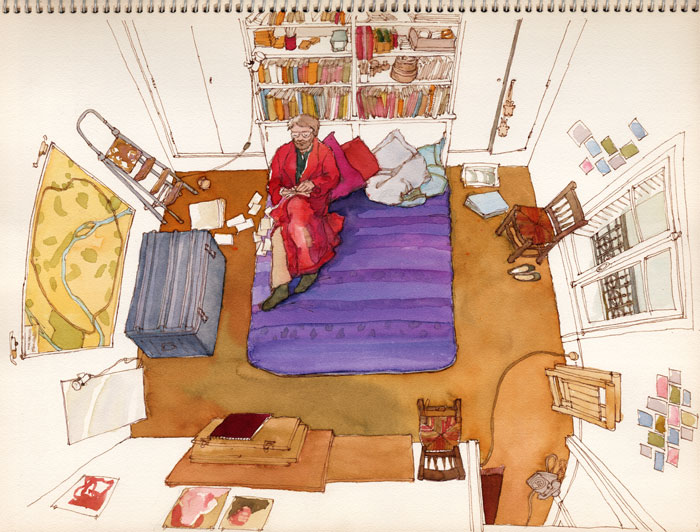
This rather yellowed sketch is from a previous lifetime when my husband and I were first married and living in Paris, drawing, painting, sculpting. Before children. Before we became rather yellowed ourselves. I chose this particular walk down la rue des souvenirs, when we were temporary expatriates, in honor of Sylvia Beach (1887-1962), whose birthday it is today.

Beach was born in Baltimore, Maryland, and was actually christened Nancy, but she later changed it to a name she chose herself. There were generations of clergy and missionaries on both sides of her family, but Beach chose literary passion and Francophilia over religious fervor. Definitely similarities there though.

Perhaps she became a Francophile during her father’s assignment to the American Church in Paris when she was fourteen, because she returned to Paris later to pursue studies in French literature, and stayed for the rest of her life. Her research led her to a meeting, collaboration, and romance with Adrienne Monnier, who had in 1915 opened a bookshop-cum-lending library specializing in French translations of modern works. By 1921 Beach’s own shop, Shakespeare and Company, was installed across the street at 12, rue de l’Odéon, in the Latin Quarter, offering classical and modern literature and periodicals in English and English translations.

Shakespeare and Company quickly became one of the centers of the Paris literary world, with authors, poets, and readers wandering back and forth across the street between the two complementary shops (imagine!) to engage in discussion, exchange news, and borrow money (struggling writers being ever short-handed). But she was far more than a seller of books. Kind, cheerful, enthusiastic, and generous as well as learned, she took it upon herself to help aspiring writers succeed, introducing them to one another and to helpful contacts, taking them round to visit Gertrude Stein’s salon of poets and artists, organizing readings to bring their works before the public. She helped James Joyce and Henry Miller find publishers for their work, which was banned and unprintable in their native countries.

When the Germans invaded Paris in 1939, Beach was forced to close her shop and spent six months in an internment camp, afterwards hiding out with a friend (she was after all an enemy American) until the war’s end. The shop never reopened after the war, but a new version was launched in 1951 under the same name, with Beach’s permission, on rue de la Bûcherie (about which more in a later post).

Pretend you are a young, aspiring American writer on your first visit to Paris. Back on the farm they think you’re crazy. You wander into Shakespeare and Company and encounter Ernest Hemingway… F. Scott Fitzgerald… Ezra Pound. Miss Beach ropes you in to help edit press proofs. In the afternoon she takes you to the Steins’ to see the new work of Pablo Picasso and Henri Matisse and in the evening to admire Josephine Baker dancing at the Théatre des Champs-Elysées. Paris in the 1920s was a refuge from Puritanism, Prohibition, and Prejudice, and Sylvia Beach did her part to make it so. Happy Birthday, Patron Saint of the Independent Booksellers.

CakeYellowRoses2 Kara