
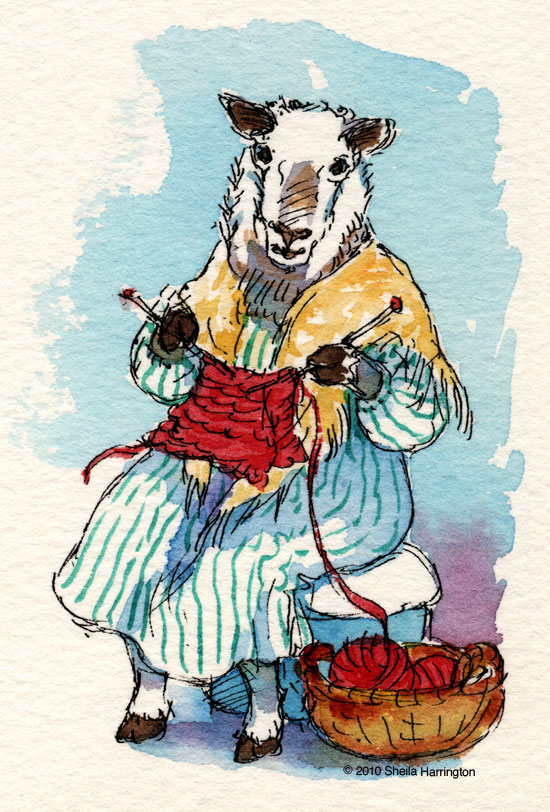
As Christmas approaches, secret projects are taking shape.
 Nick
Nick
 Noah
Noah
As Christmas approaches, secret projects are taking shape.
Nick
Noah
(continued from December 6th)
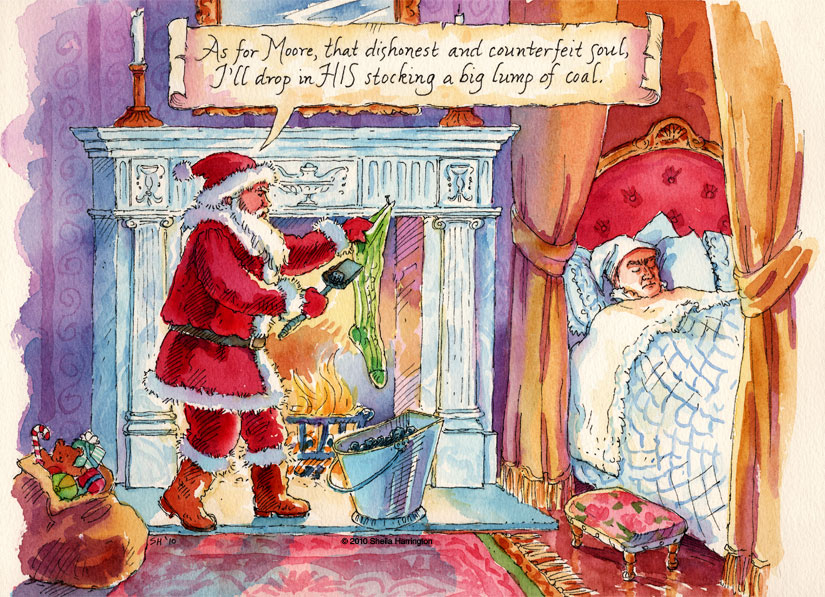
However, after Livingston’s death in 1829, Moore quietly wrote to the newspaper asking if they knew the author of the popular verse, “The Night Before Christmas.” When the editors replied that they did not, as it had been published anonymously, Moore claimed authorship, saying that he had been “too embarrassed” to claim it previously. His surprised and delighted family, and many others, came to believe him.
When Moore later included it in a book of “his” poetry (which actually included several other poems later revealed not to be Moore’s own—tsk, tsk), the astonished Livingston children protested. But would a rich and respected theologian actually LIE about his work? Not to be believed. So nobody did. Livingston’s papers, including his handwritten copy of the poem with its changes and crossed-out passages, had perished in a fire, and the children had no evidence beyond their personal knowledge. Moore later churned out several handwritten copies of his own (not exactly matching Livingston’s original, but what the heck) which eventually sold to collectors for big bucks.
End of story… until the arrival on the scene of Donald Foster, an English professor at Vassar and a well-known textual scholar, who included in his 2000 book Author Unknown a fascinating analysis of the use of language in the work of Moore and of Livingston. His conclusion, built step by step on literary evidence, is that Livingston, and not Moore, authored the poem in question.
But even we lay people, dear reader, can probably deduce this for ourselves by reading further examples of poetry.
For example, contrast with Moore’s grim and foreboding efforts the poem Livingston wrote for his own daughter’s marriage:
‘Twas summer when softly the breezes were blowing And Hudson majestic so sweetly was flowing The groves rang with music & accents of pleasure And nature in rapture beat time to the measure When Helen and Jonas so true and so loving Along the green lawn were seen arm in arm moving Sweet daffodils, violets and roses spontaneous Wherever they wandered sprang up instantaneous.And another, in a letter to his brother, praising the sewing of a cousin:
To my dear brother Beekman I sit down to write Ten minutes past eight & a very cold night. Not far from me sits with a baullancy cap on Our very good couzin, Elizabeth Tappen, A tighter young seamstress you’d ne’er wish to see And she (blessings on her) is sewing for me. New shirts & new cravats this morning cut out Are tumbled in heaps and lye huddled about. My wardrobe (a wonder) will soon be enriched With ruffles new hemmed & wristbands new stitched.The only real benefit from Moore’s perpetrated fraud is that Livingston’s poem has survived for generations to enjoy it. Perhaps now, thanks to Donald Foster, its true author will be recognized.
Today is the Feast of St. Nicholas. On the eve of this day, our children put out their shoes, and in the morning each finds therein a golden walnut (we have quite a collection by now) and one or two small gold-wrapped treats. In honor of this day, I post a tribute to the author of “A Visit from St. Nicholas,” Henry Livingston, Jr.
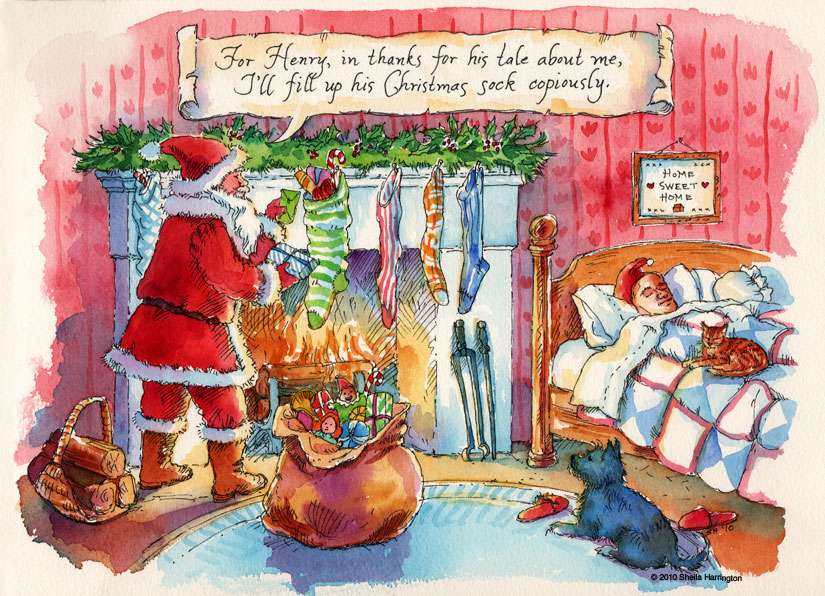
“Uh, Henry Who?” you are muttering. “I thought it was written by Clement Clarke Moore.” Well, that’s what Clement Clarke Moore would like you to think, too, unless he has repented his wicked ways in whatever hell is the repository of naughty plagiarists.
Henry Livingston (1748-1829) was born in Poughkeepsie, New York. As a young man he served briefly in the army; later he worked as a farmer and surveyor, and in his spare time wrote poetry and made sketches for the amusement of his large family (eventually nine children). His daughter Eliza wrote, “When we were children he used to entertain us on winter evenings by getting down the paint box… first he would portray something very pathetic, which would melt us to tears; the next thing would be so comic, that we would be almost wild with laughter.”
Some of his work was published anonymously in local papers and journals. One of these poems was “A Visit from St. Nicholas,” which the children recalled their father reciting to them in the early 1800s. It made its way through the family’s various households and it was submitted, as usual anonymously, and printed in the newspaper. In this pre-electronic era, writing and reading poetry were popular pastimes, and there was plenty of dreck going around. But this particular poem was well-received, and it grew in popularity. Livingston died a few years later, unacknowledged as its author, except by his family.
Enter Clement Clarke Moore (1779-1863), a prosperous Biblical scholar in New York and a relative of Livingston by marriage. Moore also dabbled in poetry in his spare time, churning out tracts and verses admonishing children and reminding them to be humble and serious. Here is an excerpt from Moore’s jolly poem “Old Santeclaus,” written from Santa’s perspective:
But where I found the children naughty, In manners rude, in temper haughty, Thankless to parents, liars, swearers, Boxers, or cheats, or base tale-bearers, I left a long, black, birchen rod, Such as the dread command of God Directs a Parent’s hand to use When virtue’s path his sons refuse.Or, how about this cheery, romantic poem Moore penned for his daughter on her wedding day:
But oh! how soon we pass this endless track,
That, like perspective art, deludes our view:
And, when we turn and on our path look back,
How short the distance! and our steps how few!
Till death do part, how gaily we repeat
When joy and health are in their prime and strength:
Life is a vista then whose borders meet;
So endless, to our fancy, seems its length.
Trust not the gilded mists and clouds that rise
Where flattering Hope and fickle Fancy reign;
But turn from these, and seek with anxious eyes
The clear bright atmosphere of Truth’s domain.
(continued on December 7th!)
It was worth it, every dish.
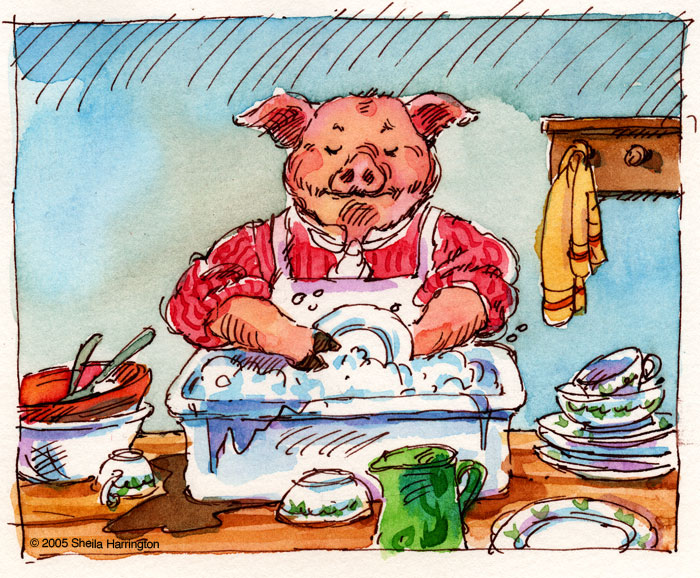

Happy Thanksgiving, everyone! May we be grateful for blessings large and small on this warm and hopeful holiday.

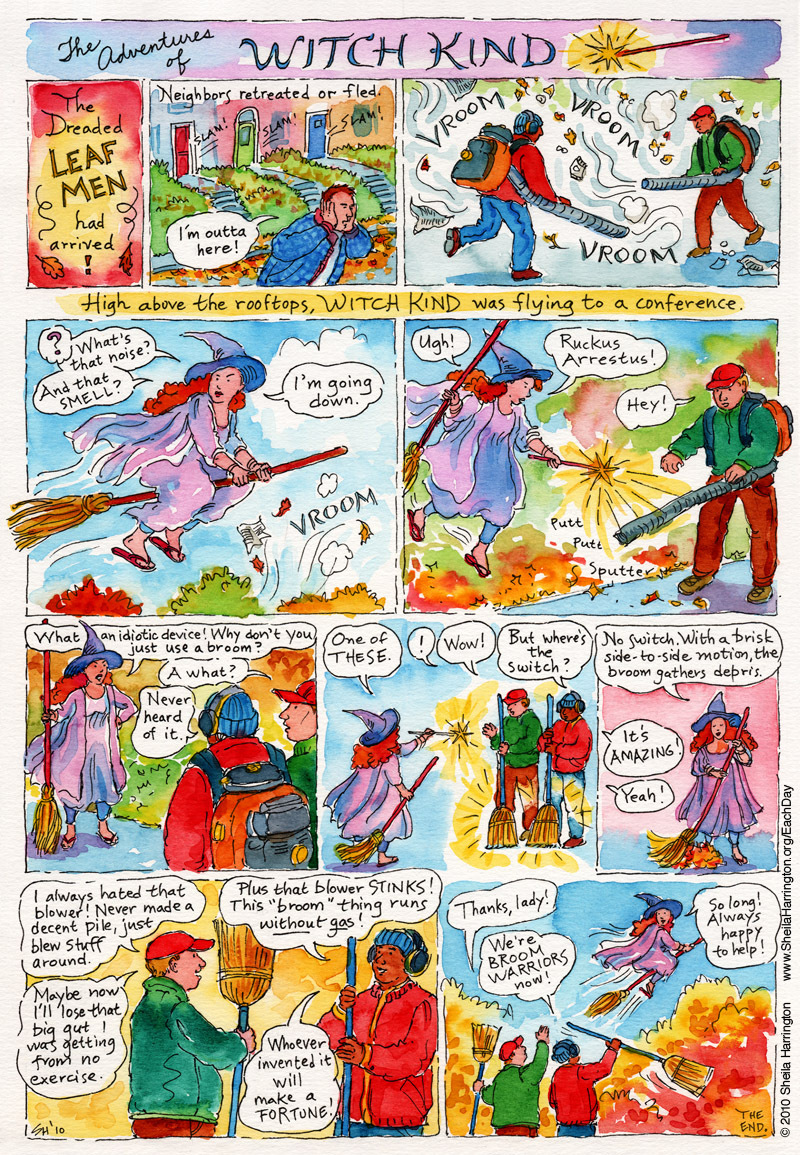
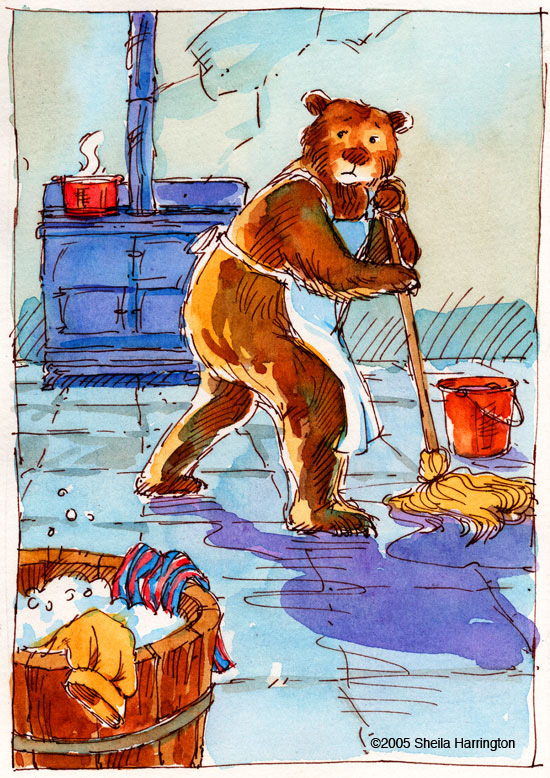
And not everyone is happy about that.
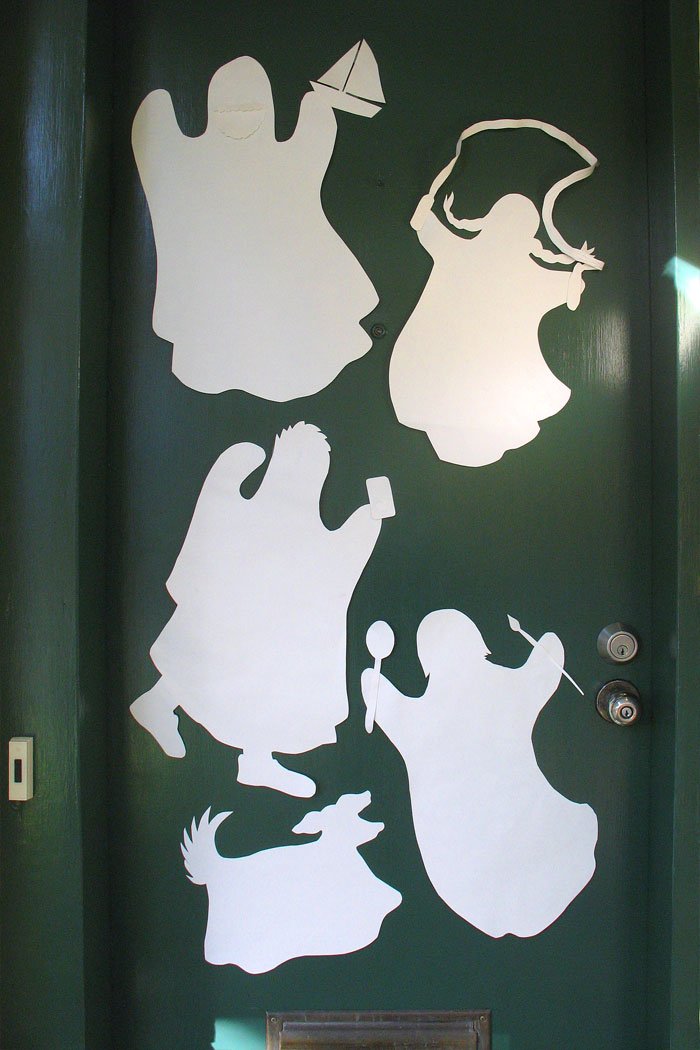
Here’s an art form I don’t use too often but which comes in handy for large-scale decorating in a hurry—big white paper cutouts. This is our frightening Halloween front door, featuring the ghost family: Dad with mini-version of boat he is building; Sis with energetic jump-rope; Bro with faithful iPhone; Mom with paintbrush and spoon; and the world’s least scary Dog, unless you fear relentless licking.
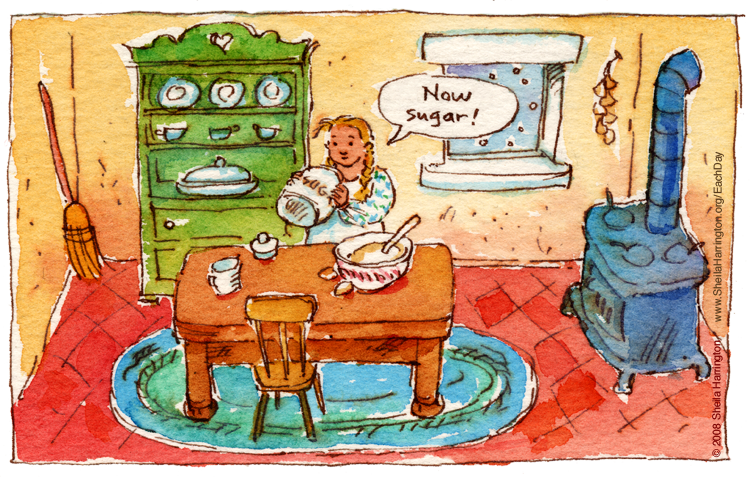
Today is the birthday of Irma Rombauer, author (with her daughter Marion Rombauer Becker) of that kitchen classic, The Joy of Cooking. In her honor, I post, along with this sketch, my family’s favorite whole-grain pancake recipe, a standard here for everyone’s birthday breakfast, as well as for many Saturday mornings. I have tried out quite a few pancake recipes on the gang over the years, but they always insist on this one from good old Joy. Happy Birthday, Irma Rombauer! I hope that wherever you are the food is good.
Joy of Cooking Whole Grain Griddle Cakes
Sift and measure: 3/4 cups whole grain flour 3/4 cups cake flour (but I use unbleached white) Resift with: 1 tsp salt (but I use just a pinch) 3 T sugar plus 2 T molasses (but I use 3 T brown sugar instead) 1-3/4 tsp baking powder Beat lightly: 1-2 eggs (depends on egg size) If you double the recipe (which I ALWAYS do), you can separate the eggs and beat the whites separately. Mix beaten egg (or yolks) with: 3 T melted butter 1-1/4 cups milk (but I use buttermilk) Then blend wet and dry ingredients. Fold in stiffly beaten whites gently, if you have reserved them. If it’s a birthday, I make shaped pancakes (animals, hearts, initials). I use a pointy spoon. Alanna