Advent 3: Birthday Wishes

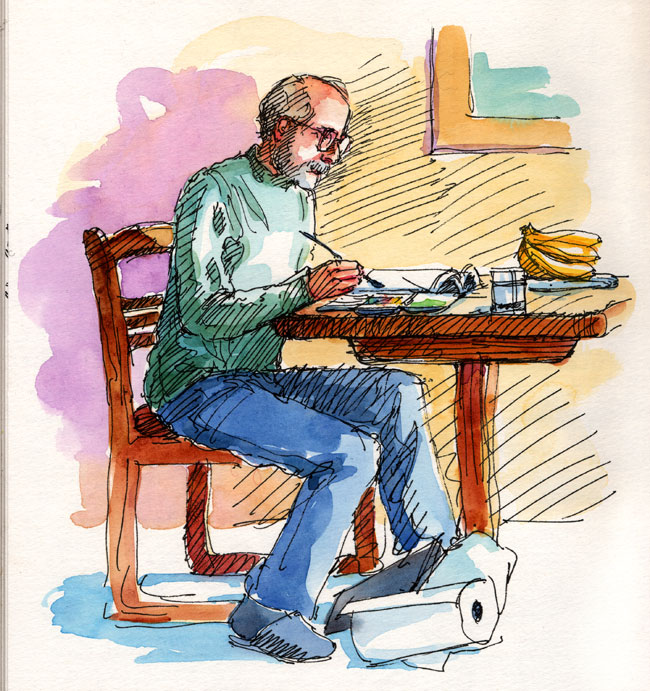
In honor of my husband’s birthday, I post a sketch of him on holiday, painting, which is something I hope he will find more time to do as he fulfills his ongoing quest for retirement.

He shares this birthday with writer Alfred de Musset (1810-1857), and so I post a poem that speaks eloquently, and appropriately, of the overlooked and sleeping poet universally within.
JPainting

Ami, tu l’as bien dit: en nous, tant que nous sommes,
Il existe souvent une certaine fleur
Qui s’en va dans la vie et s’effeuille du coeur.
“Il existe, en un mot, chez les trois quarts des hommes,
Un poète mort jeune à qui l’homme survit.”
Tu l’as bien dit, ami, mais tu l’as trop bien dit.

Tu ne prenais pas garde, en traçant ta pensée,
Que ta plume en faisait un vers harmonieux,
Et que tu blasphémais dans la langue des dieux.
Relis-toi, je te rends à ta Muse offensée ;
Et souviens-toi qu’en nous il existe souvent
Un poète endormi toujours jeune et vivant.

Friend, you have spoken well: in us, such as we are,
There frequently exists a certain flower
That blossoms, fades and from the heart its leaves are shed.
“In three quarters of mankind, you understand,
A poet has died young yet outlived by the man.”
Well said, my friend—but a little too well said.

You didn’t pay attention, laying out your thought,
That your pen made poetry then and there, unsought.
In his own tongue you took Apollo’s name in vain.
I betray you to your injured Muse: Read again,
And remember that in all of us there often keeps
A poet young and vibrant, who is not dead, but sleeps.

—Alfred de Musset
PieForJJimmy

December

Dec1-11

First snow! The flakes,
So few, so light,
Remake the world
In solid white.

All bundled up,
We feel as if
We were fat penguins,
Warm and stiff.

The toy-packed shops
Half split their sides,
And Mother brings home
Things she hides.

Old carols peal.
The dusk is dense.
There is a mood
Of sweet suspense.

The shepherds wait,
The kings, the tree—
All wait for something
Yet to be,

Some miracle.
And then it’s here,
Wrapped up in hope—
Another year.

John Updike


Sisterhood of Squash

SquashCuke

It’s finally getting too cold to draw from nature outdoors, so we’re sketching from the pantry, and thus cut open a recent discovery: a Sunshine Squash. (If you like winter squash, you will love this super-sweet and tender variety.)

It was my daughter who noticed the squash’s interior division into thirds, and, more subtly, sixths, and who suggested we add our squash drawings to our cucumber drawing pages. So we did. It’s exciting to find, despite their apparent exterior differences, their interior commonalities. And together they make a lovely pair. There’s a life lesson for you.

CakeTomatoesGina


Andalusian Treasures

At all the major festivals and turning points of the year, it’s a natural impulse to find commonalities within the celebration with the larger human community, past and present, and gain a sense of connection.

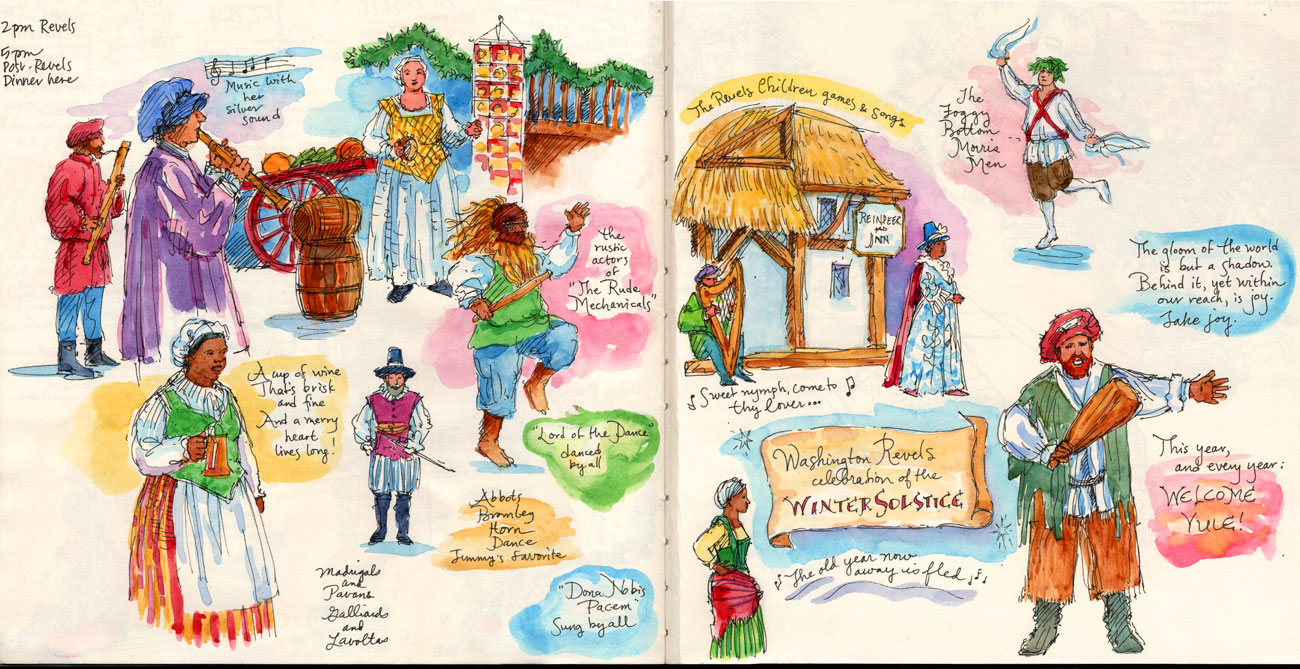
Revels07

In this winter season, one especially delightful and moving experience of shared celebration is found in the music, dance, and storytelling of the Washington Revels, which each year changes its theme (always carefully researched and skillfully interpreted) but whose underlying message acknowledges and salutes the struggle to find beauty, joy, humor, peace, and love amid the darkness, uncertainty, and losses of our life journeys.

This year’s theme is Andalusian Treasures, and I quote:

Our 29th annual celebration of the winter solstice harkens back over 1,000 years to the confluence of Moorish, Sephardic and Iberian cultures in medieval Andalusia. Led by the antics of two fools, and joined by guest musicians, Trio Sefardi and Layali El Andalus (“Andalusian Nights” in Arabic), we celebrate the legacy of the extraordinary flowering of arts and culture that began there and extended to much of the world for centuries thereafter. Presenting the three cultures together on stage, we honor the symbol that Andalusia has become (however imperfect the reality) of the ideal of greater tolerance and acceptance among different cultures and religions.

Shows run December 3-4 & 9-11, matinees and evenings, at GW Lisner Auditorium in Washington, DC, and there are still tickets available through the Revels website. Believe me, once you have sung and danced for the solstice with a thousand gladsome companions, you will want to make it a family tradition.

The sketches above are from a 2007 Renaissance Revels. For more Revels sketches, and a mini-history, please see Revelry.


Prince and the Pauper

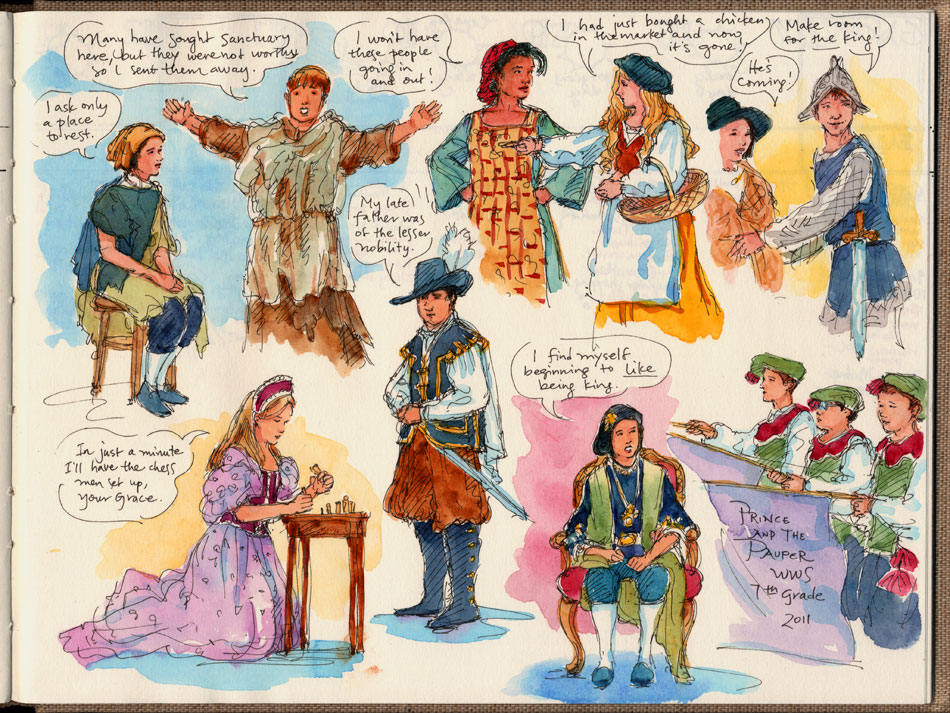
I sat in one day on a rehearsal of my daughter’s class play and surreptitiously made some sketches. Having seen a number of middle school plays over the years in which the objective seems to be to finish and get off stage as fast as possible, I was struck by the students’ expressiveness, pacing, and evident understanding of their roles.

Prince&Pauper

Holiday Bazaar

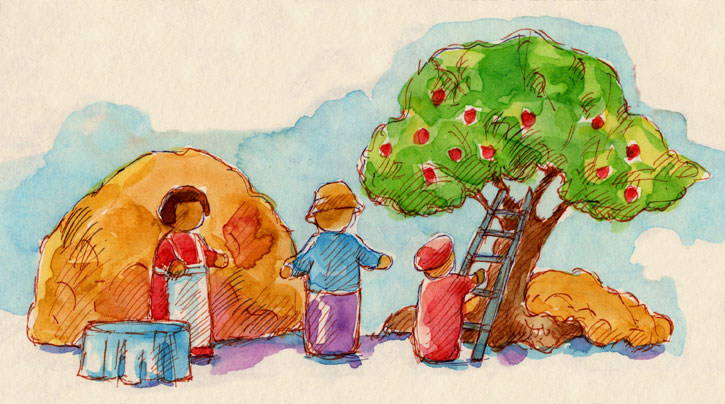
On Saturday, November 19th, the Washington Waldorf School in Bethesda, Maryland will hold what is probably the most unusual holiday bazaar in the Washington area, reflective as it is of the artistry of Waldorf education.

PuppetStoryAppleTree

Adults with an eye to gift-giving appreciate the wide range of beautiful handcrafts, from pottery to woven scarves to toys to jewelry.

Younger children enjoy the storytelling and puppet shows, candle-decorating, visiting the Magical Maze of evergreens and twinkling lights, making an excursion to the Children’s Shop for their own secret purchases, and taking a peek into the pockets of the wandering Pocket Wizard or Pocket Lady. Older children like making wooden toolboxes, or copper lanterns, or ornamenting themselves with a henna-tattoo.

All will happily sink into a seat at the Bazaar Bistro for a truly delicious homemade lunch, a special dessert, or a cappuccino, where they can listen throughout the day to live musical offerings.

Admission is free, but, although it runs from 10 to 3, arrive promptly, because handmade goods and puppet show tickets sell out EARLY.

When Autumn Came

Nov1&2

This is the way that autumn came to the trees:
it stripped them down to the skin,
left their ebony bodies naked.
It shook out their hearts, the yellow leaves,
scattered them over the ground.
Anyone could trample them out of shape
undisturbed by a single moan of protest.
The birds that herald dreams
were exiled from their song,
each voice torn out of its throat.
They dropped into the dust
even before the hunter strung his bow.
Oh, God of May have mercy.
Bless these withered bodies
with the passion of your resurrection;
make their dead veins flow with blood again.
Give some tree the gift of green again.
Let one bird sing.


—Faiz Ahmed Faiz, translated by Naomi Lazard

Yahrzeit3Filomena


Over the Moon/s

Last night at about 9pm my son and I went outside with a pair of ordinary bird-watching binoculars and trained them on a bright starry object we’d been noticing in the western sky during the last dog walks of the evening. And this is what we saw (as best I can recall):

JupiterMoons

According to the NASA website (whose picture is much better than mine), this is no star, but our giant neighbor Jupiter, with four of its 62 moons: Io, Europa, Ganymede, and Callisto, called the Galilean moons, after Galileo Galilei, who first spotted them in 1610.

Jupiter appears especially bright to us right now because it is both in opposition (directly opposite the sun from Earth, peaking on Oct. 29th Universal Time) and closer to Earth than it will be again until 2022. I don’t know about you, but I find it wondrous that without the aid of observatory or telescope we can see these heavenly bodies from our city street corner. In fact, if Jupiter weren’t itself so bright, we could probably see the Galilean moons without binoculars.

Their appearance left us starry-eyed, and dwarfed the importance of political squabbling, and getting that last load of laundry done, and pretty much anything else.