I post this ever-so-timely poem, along with a sketch of a neighbor’s garden, in honor of William Wordsworth (1770-1850), whose birthday it is today.

—William Wordsworth
For another Wordworth poem, a bio, and a painting, please see My Heart Leaps Up.
I post this ever-so-timely poem, along with a sketch of a neighbor’s garden, in honor of William Wordsworth (1770-1850), whose birthday it is today.
—William Wordsworth
For another Wordworth poem, a bio, and a painting, please see My Heart Leaps Up.
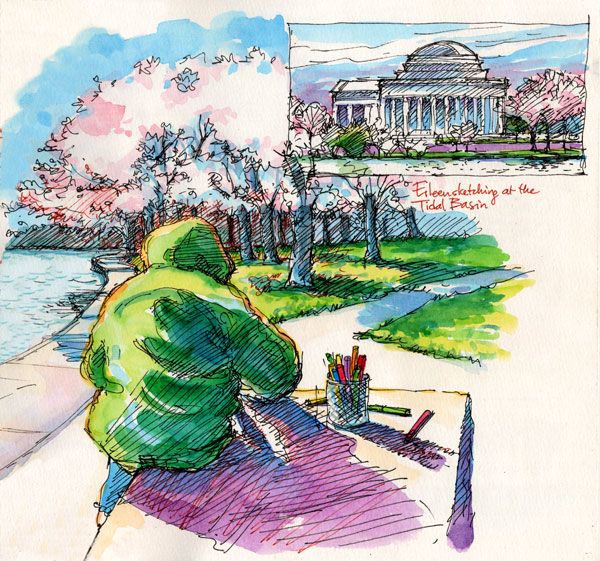
Despite the cold, my daughter and I bundled up and betook ourselves and the dog to the Tidal Basin just after sunrise for our annual cherry blossom breakfast. The blossoms seem unusually beautiful this year—extraordinarily cloudlike, illusory, celestial—worth every shiver. Gazing upward as we nibble our scones, it’s easy to forget the day of work and school that lies ahead of us. A serious photographer and three mallard ducks are our only companions, until the tour buses arrive.
For another cherry blossom picture, and a beautiful springtime verse from Song of Solomon, please see Cherry Blossom Breakfast.
 Saul

 Giampaolo
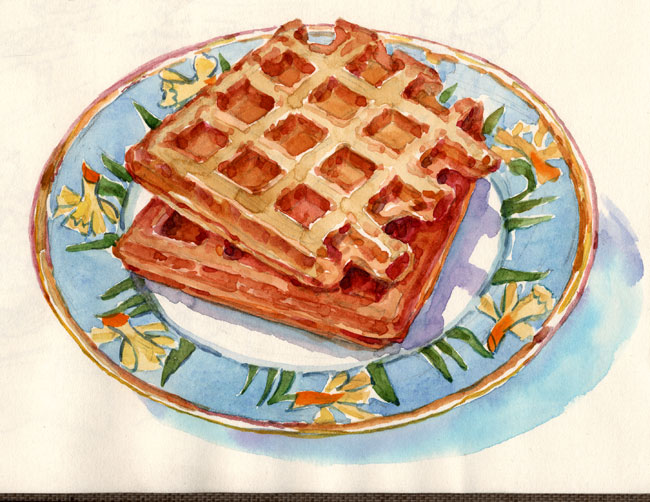
According to tradition, today is the feast of the Annunciation, the day on which the angel Gabriel appeared to Mary to announce an unexpected little surprise that was to arrive on Christmas Day…EXACTLY nine months later. Unlike most of the rest of us moms, Mary was apparently not fated to go into premature labor or run weeks past her due date, thus alarming midwives, spouse, and relatives.
In Sweden, this day is celebrated with waffles. You may ask why we celebrate the pregnancy 2000 years ago of a nice small-town Jewish girl with a medieval Dutch cake? Well, as the story goes, in Sweden, the Feast of the Annunciation is called Vårfrudagen, or “Lady Day.” Which is similar enough to Våffeldagen, “Waffle Day,” to cause a little confusion on March 25th and launch an annual tradition. It’s a confusion we are happy to perpetuate in our household, despite its being the middle of Lent. It IS the Annunciation, after all.
 Lauren
This image is available as a high-resolution print on 8.5″ x 11″ archival paper.
Today winter officially packed its bags and departed, and spring took the throne. It ought to come as no surprise, because we have seen it coming for weeks in the swelling tips of branches, the green points pushing up through the earth, the increase in morning birdsong that disregards Daylight Savings Time. Nevertheless every year it astonishes.
Much poetry and prose has been written in praise of spring, but if you have not yet stumbled across Louis J. Halle’s Spring in Washington, let this be the year. Beginning in the mid-1940s, Halle (1911-1988) worked in Washington, DC for about ten years at the U.S. State Department. Although Halle was a citydweller with a theoretically brief commute and could have dozed until practically the last minute, instead he had the habit of rising before dawn, hopping on his bicycle, and heading out for a ten or twelve mile exploration of DC’s wild green pockets and fringes before heading to the office.
No doctor ever prescribed a view of the open world for me, though it was the tonic I needed, rather than something to take in a glass before meals.
In 1947 he published Spring in Washington, an account of his wanderings. With wisdom, humor, an artist’s eye and a poet’s quill (well, in his case, a typewriter) he shared his observations and discoveries throughout the approach, unfolding, and departure of one expanded spring: January to June, 1947.
To snatch the passing moment and examine it for signs of eternity is the noblest of occupations. It is Olympian. Therefore I undertook to be monitor of the Washington seasons, when the government was not looking. Though it was only for my own good, that is how the poorest of us may benefit the world. A more ambitious man might seek to improve the President of the United States.
Each year I drag this book out and read aloud passages to my family. As I leaf through it now, searching for representative quotes, it’s difficult not to reproduce the book in entirety.
The muskrat swims and raises its young in the woodland stream beneath Connecticut Avenue, never knowing of the crowded buses and taxis that swarm overhead… Roaches Run is a marshy lagoon trapped between the National Airport, on one side, and the railway tracks on the other. Ducks and gulls and herons have remained faithful to it, despite low-roaring airplanes and smoke-breathing locomotives. They are accustomed to these dragons and these pterodactyls, regarding them not.
Halle moved on (his field was actually foreign policy), along the way publishing 22 books, eventually retiring to Switzerland. Plenty of hiking opportunites THERE. He made a visit to DC in 1988, to help launch a new edition of this book, the rights to which he had long ago turned over to the Audubon Naturalist Society (where his book can be obtained). While here he went birding and biking in some of the same old wild green places, which, remarkably (thanks in part to folks like himself), still survive for a venturesome bureaucrat’s early morning ramble.
In early March I look at the apparently lifeless skeletons of the elm trees on the Ellipse and say to myself that in two weeks they will be flowering, as the trees have flowered here for a hundred thousand years. In the middle of April I say that in another ten days the city will be full of singing wood thrushes, though there is none here yet. I know all this will be, but it seems to me so miraculous that I cannot take it for granted.
A few months later he made his own final migration to the great Beyond. Even if he had done nothing else on earth, this jewel of a book that resurfaces each spring, endlessly amusing, sensitive, and wise—an everlasting source of inspiration—would suffice. Happy Spring, Louis Halle.
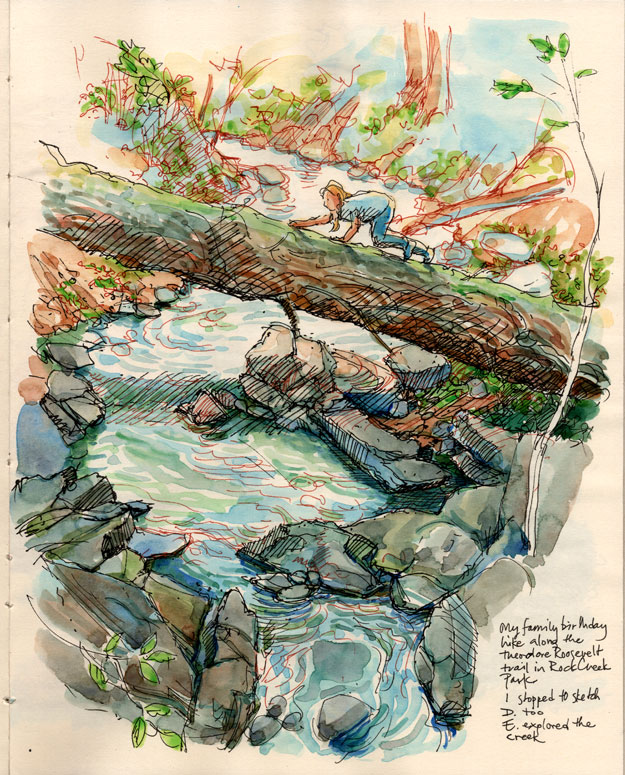
(This sketch is from a family ramble through Rock Creek Park, mere minutes from our utterly urban home.)
The mind flinches as it tries to absorb the devastating succession of natural disasters that have taken place merely within the last few years. Hurricanes in the Gulf of Mexico; multiple tsunamis in Indonesia; earthquakes in Haiti, Chile, New Zealand; innumerable floods, landslides, volcanic eruptions and wildfires. And now Japan, with scenes surreal of wreckage and relentless rushing waters and lives swept away—a triple whammy of earthquake, tsunami, and nuclear catastrophe.
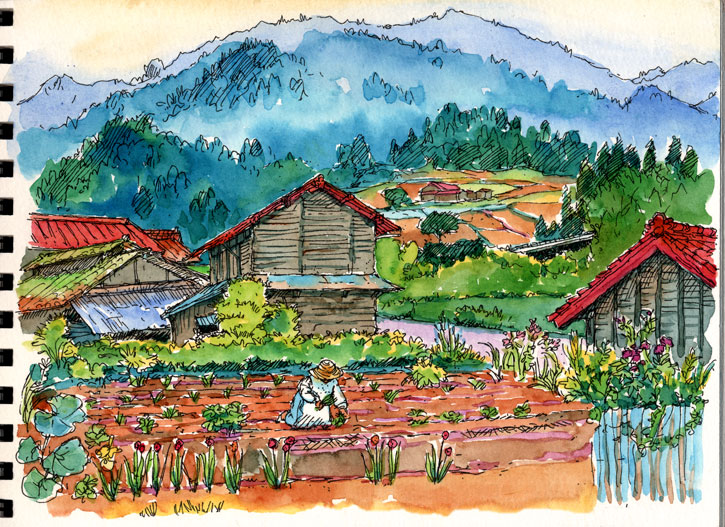
Here is a sketch from a visit we made to Japan when our son was teaching there. No matter where we went, total strangers were invariably kind, helpful, and generous, never hinting at the fact of our having dropped atomic bombs on them (the only country in the world to have suffered thus). On a walk one afternoon, we stopped to watch a woman working in her garden. Eventually noticing us, she invited us to see the rest of her garden—and her house—and meet her mother—and finally sent us off with just-harvested potatoes, radishes, and strawberries. This was absolutely typical of the entire trip.
I realize that politeness is a Japanese cultural value. There is a stiff-upper-lip quality that makes me think of stories about post-Blitzed World War II British (is there something about tea?), a characteristic that may lengthen the road to an American-style intimacy. But such sturdiness, resilience, and grace in the face of misfortune can be a blessing and a gift. Shikata ga nai.
The earth has grown so populous that natural disasters have enormous human impact, and simultaneously grown so connected that our common awareness of them is nearly instantaneous. The entire globe is now, truly, at our fingertips. It is theoretically possible to call up a picture of Anywhere, Earth, on the smartphone in one’s hand, if it has been visited by someone with a camera. And, thanks to international airlines (which actually used to be quite a speedy form of travel), many—through school or vacation or international aid organizations or family connections or business—have firsthand knowledge of worlds far from home. From knowledge, connection. We already carry the peoples and landscapes of the earth in our minds. The natural next step is the heart.
If you want to help, one way is to make a donation through the American Red Cross.
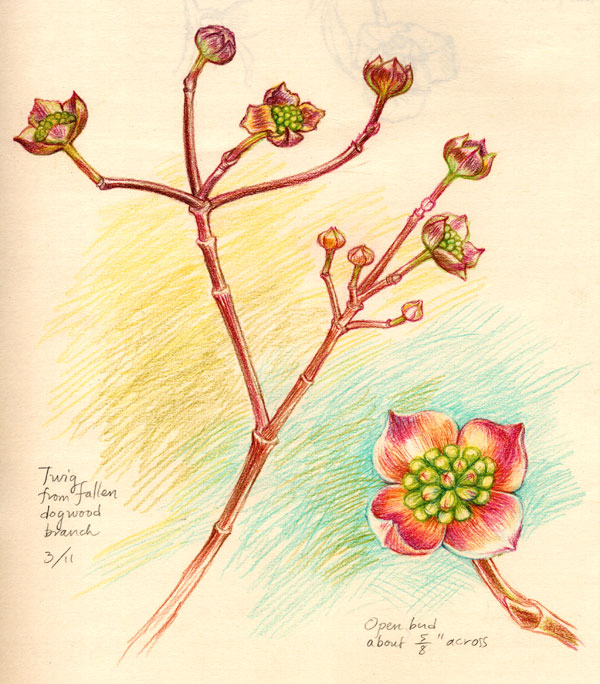
A few weeks ago a fierce thunderstorm blasted our area. The following morning the neighborhood was strewn with dozens of enormous broken branches—all in bud. A little sadly, we brought home a few sprays and put them in water, the vases of bare twigs giving our table a poignant wintery appearance.
The buds, unaware of their fallen state, are now confidently unfolding and bringing forth their hidden treasures, but in miniature. This one is from a pink dogwood tree. The four bracts that usually unfold to a 2″ or 3″ diameter are here only about 5/8” across. But still beautiful.
Today is the birthday of Shakespeare and Company founder Sylvia Beach. For a sketch and a mini-bio, please see Paris Memory.
 Kara
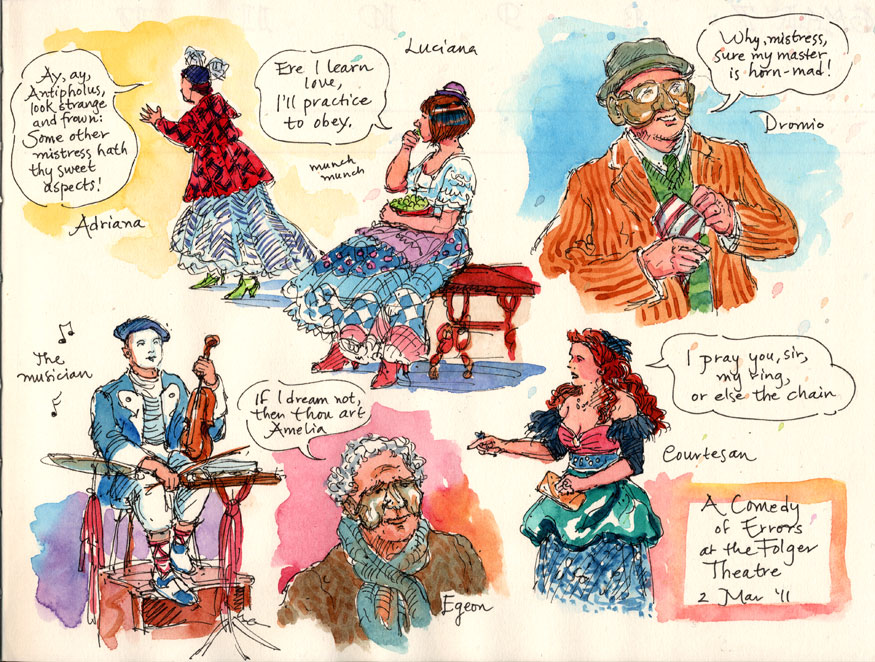
If you live in the Washington, DC area and you would like to spend two hours in culturally elevated laughter, run run run to the Folger Shakespeare Library and purchase a ticket to A Comedy of Errors.
You may already be acquainted with the plot—lost and separated twins, eccentric servants, misguided lovers, amusing mix-ups, and a happy ending all around (which familiar elements—except for the last—Shakespeare adopted from ancient Roman comedy). But it’s well worth another viewing in this current manifestation, framed somewhat unusually in a manner I will not divulge, and influenced by Italian Commedia dell’Arte with its masks, wild costumes, and physical gags, here not excessively annoying. The Folger Theatre itself is worth the visit, a warm, wood-paneled and intimate space that feels more residential than institutional.
My daughter and I saw a mid-week matinee for school groups, most of them high school students greatly appreciative of the bawdy jokes that went over the heads of our younger homeschoolers.
For another illustration in celebration of this day, please see Saved by the Bell.

For Valentines Day my wonderful husband gave me flowers, and the lilies—which were buds in the February 14th bouquet—are now opening in time to greet the month of March.
For another March 1st welcome, please see In Like a Lion.
 Polly
Unbelievably, it has been FIFTY YEARS since the inauguration of John F. Kennedy, and in honor of this anniversary the Kennedy Center here in Washington, DC has created a blockbuster lineup of events. Both President and Jacqueline Kennedy were enthusiastic supporters of the arts, so the celebration includes a bounteous variety of musical, theatrical, and dance performances, some ticketed and some free of charge. It is, after all, the Kennedys who helped bring to fruition a long-languishing plan for a National Cultural Center, which was renamed the Kennedy Center after Kennedy’s assassination in 1963.
Whatever you may think of its architectual style, you must acknowledge that it’s been a fantastic addition to the Washington cultural scene all these years, providing a setting for a huge range of artistic performances (including Millennium Stage, with 365 free performances a year!) and inspiring the launch of many additional venues. And it has a lovely view from the terrace. Anyway, we’re all used to it now, as a familiar icon for which we feel affection, like some eccentric great-aunt who is known for her peculiar hats.
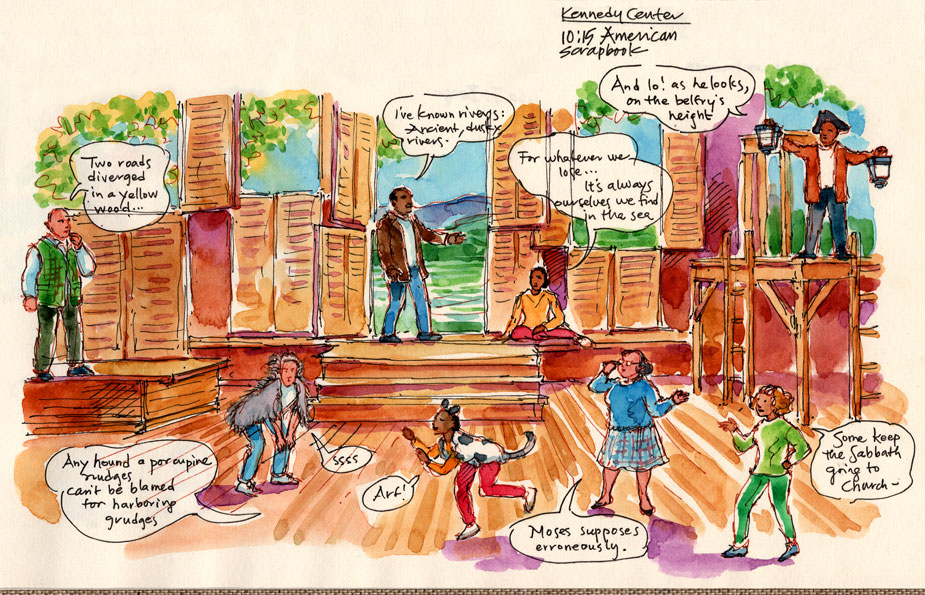
As part of a homeschoolers’ outing, my daughter and I attended American Scrapbook, A Celebration of Verse, a theatrical interpretation of some of the Kennedys’ favorite poetry. The family had a lovely tradition which (WARNING) will assuredly make you long to go back and raise your semi-literate, poetry-impaired children all over again: for the parents’ birthdays, the children Caroline and John Jr. each chose poems and then created drawings to accompany them, which were then pasted into a scrapbook.
This scrapbook collection inspired the play, which was essentially a seamlessly interwoven, thematically arranged series of “recitations”—although I hesitate to use that dry schoolhouse term, because the interpretations were so engaging and heartfelt. (I tried to sketch, but it was pretty dark and the actors were awfully “active,” thus the rough, scribbled result.)
The set was simple, modest, effective: tall wooden shutters that opened and closed in a variety of configurations to reveal changing images that supported, rather than distracted from, the spoken word.
Lively, imaginative, yet true to the spirit of the poems, the program transfixed the audience of elementary and middle-school children for an hour, which, when you’re talking about poetry, is truly a laudable achievement.
 Walter