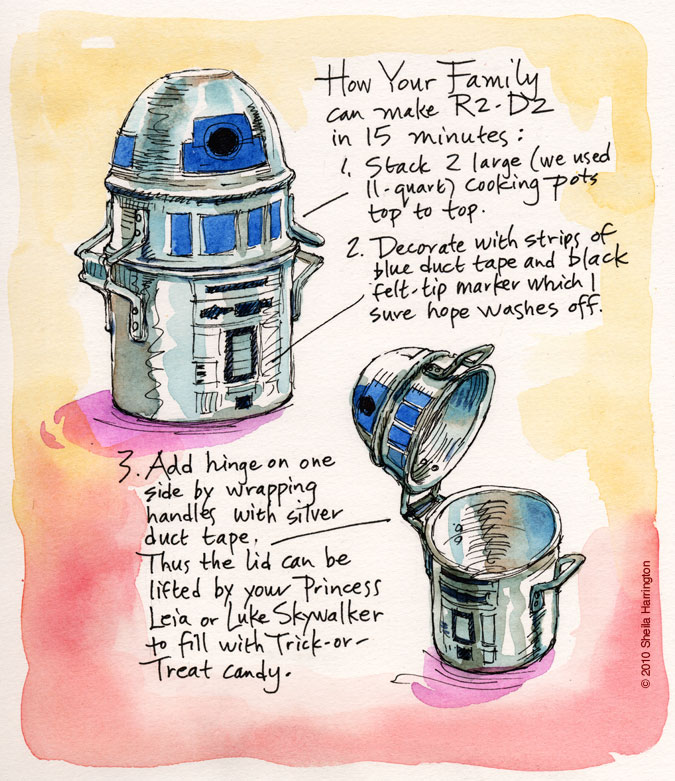
So you can begin planning for next year. I swear, our big old cooking pots were the hit of the neighborhood. I just hope that black magic marker wears off.
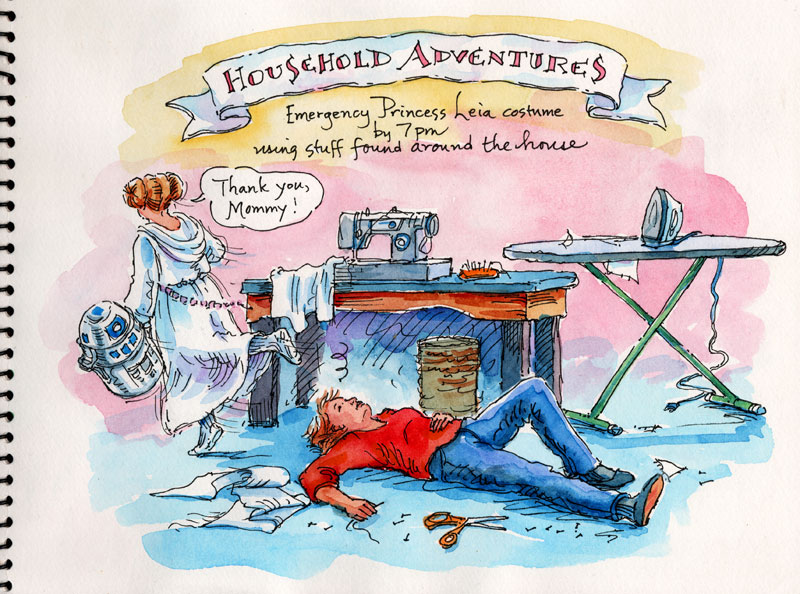
…when your daughter tells you at breakfast that she’s finally chosen her identity for her brother’s Halloween in Space party that evening.
These drawings are from a couple of sketchbook-journals carried on visits to the beautiful gardens of Dumbarton Oaks in Georgetown, Washington, DC. However, I post them not for the sake of those lovely gardens themselves (to which the sketches don’t do justice) but in honor of today’s anniversary of the ratification of the charter for the brand-new United Nations. Perhaps some of you folks out there already knew that the foundation of its charter had been hammered out at Dumbarton Oaks. I only learned it recently.
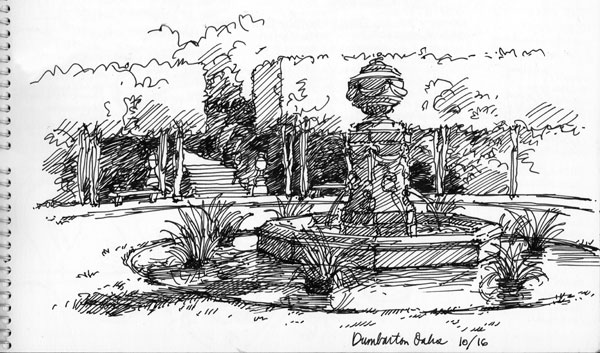
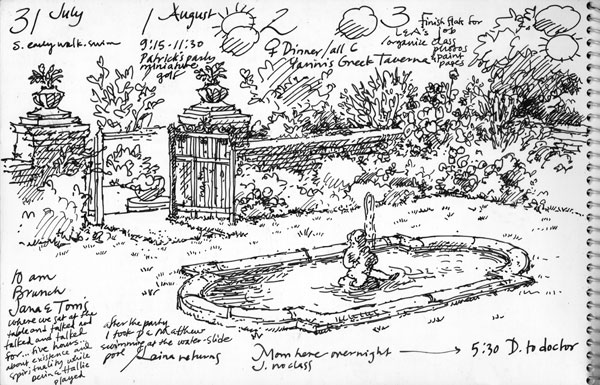
Dumbarton Oaks, built in 1801 as a private home, was purchased in 1920 by diplomat Robert Bliss and his wife Mildred. With Beatrix Ferrand they created the fabulous gardens and renovated the house, adding a music room for concerts and lectures, and a museum for their art collection. In 1940 they gave the property to Harvard University.
Although in 1940 the United States had not yet even officially entered the Second World War, entities private and governmental were already discussing the possible creation of a post-war international peacekeeping organization—but secretly, because of the strong isolationist, anti-League of Nations element existing in the country. Isn’t it amazing what significant matters we managed to keep secret in a pre-Internet era?
FDR first offered the optimistic term “United Nations” to refer to such an organization in a 1942 Declaration composed at the Arcadia Conference by the USA, the UK, the USSR, China, and twenty-two other countries to lay out their common goals during and after the war. Other nations signed on later. Bliss, speaking for Harvard, offered the use of Dumbarton Oaks as a possible location for future talks. This setting was deemed suitable, and the offer was accepted.
So, between August and October, 1944, representatives of the USSR, the UK, the USA, and China (although never with the USSR and China at the same table at the same time!) gathered at Dumbarton Oaks to wander the lawns, dine in the Orangery, and sit in the music room for a series of discussions. At their conclusion, the four nations had agreed upon a series of proposals which, along with provisions born of the Yalta conference, formed the basis for the new United Nations Charter, which was signed in San Francisco on October 24th, 1945.
Among the goals were these: The development of friendly international relations. The strengthening and maintenance of international peace and security. The removal of threats to peace through collective cooperation. And collective measures to solve economic and humanitarian problems.
What an impressive and inspiring global perspective, especially for a species that only a few thousand years earlier routinely regarded an unfamiliar tribe as the enemy. (This antiquated response is occasionally observed even now.) May we see these goals one day fully realized.
 Eugenie
 Aunt Mary
Probably ever since we began paying attention to the birds, we human beings have longed to fly ourselves. And once the Wright Brothers proved this possible in 1903, it was not only men who were keen to give it a try.
Blanche Stuart Scott (1885-1970), born in Rochester, New York, was known as a “tomboy.” Her father let her drive the family automobile around town, and although some of the neighbors objected to a fifteen-year-old behind the wheel, there was as yet no minimum driving age.
In 1910 Scott became the first woman to drive across the country, from New York City to San Francisco, which brought her to the attention of Jerome Fanciulli, a promoter for Glenn Curtiss. Curtiss was a pioneer in the U.S. aviation industry, who designed aircraft and hired pilots to demonstrate his products. He wasn’t crazy about the idea of training a female pilot, though he agreed to accept her as a pupil—but he kept a block of wood behind her throttle pedal, so that although Scott learned to operate the plane and run it back and forth on the ground, it never took off.

This was probably fun for a while, but one day while Scott was practicing, the block of wood mysteriously became dislodged. Oops! Wonder how THAT happened! Scott zoomed off on an unscheduled flight, alarming her instructor but landing safely, and demonstrating that a woman could actually operate a plane not only on the ground, but also in the air. Eventually she joined Curtiss’ Exhibition Team, and made her first Official Flight on October 23rd, 1910, of which today is the anniversary. (That first “accidental” flight didn’t count.)
Scott became known as “Tomboy of the Air,” flying upside-down and executing heart-stopping dives, for a heart-stopping salary, too. In 1911 she made the first woman’s long-distance flight—sixty miles—another “unplanned” event, when she decided one day just to keep flying. Scott went on to become the first female pilot to test prototypes, but after a number of male colleagues lost their lives in terrible accidents, and sensing that her spectators anticipated her own eventual crash, she retired from flying and spent several decades in broadcasting instead. Her flying days weren’t over, however—in 1948 she became the first American woman to fly in a jet, piloted by none other than Chuck Yeager.
From a travel sketchbook I post a page that seemed appropriate for today’s anniversary: airplane/daring daughter.
 Jan
Balzac glows meditatively in the golden light of an October afternoon.

 Trish

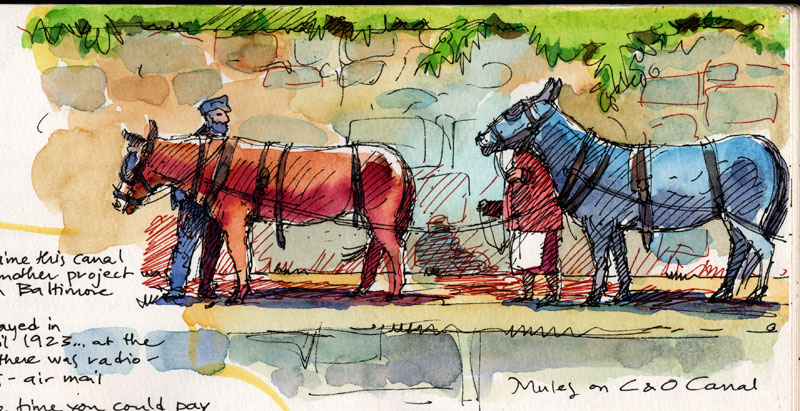
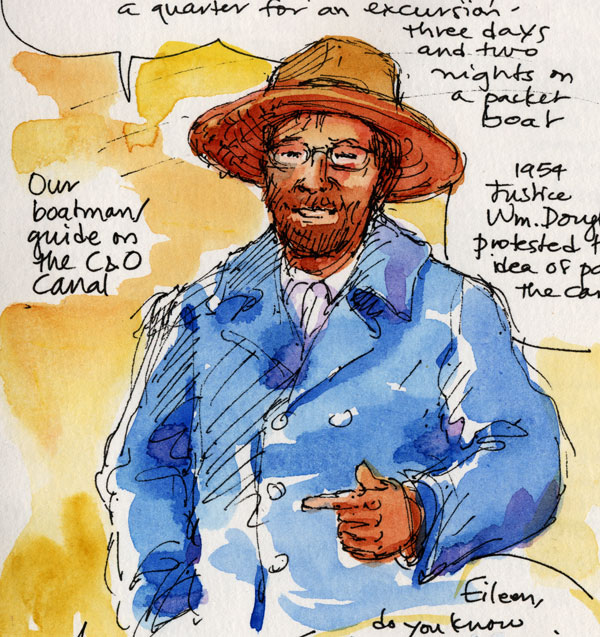
This sketch is from a canal barge tour we took on the C&O Canal as part of our homeschooling Local History & Geography block. It was mid-week, and my daughter and I were the only non-senior citizens on the trip, so she was definitely the focus of kindly attention (being small and cute with long blond braids), which was fine with her. The restored barge was beautiful, the costumed guide was excellent, the mules were friendly, and it was a lovely day.
ANYWAY, I post the sketch in honor of Supreme Court Justice William O. Douglas (1898-1980), whose birthday it is today. What, you may ask, is the connection?
Well, some of you may know that Douglas, in addition to serving for 36 years on the Supreme Court, was an avid outdoorsman and supported various environmental causes, even serving briefly on the board of the Sierra Club.
In the 1950s, an era newly keen on the divine glory of automobiles and expanses of concrete pavement, there was a movement in Congress, supported by The Washington Post, to replace the canal with a highway. Douglas, familiar with the canal’s scenery and wildlife, thought this an idiotic and short-sighted idea and challenged the Post’s editorial staff to accompany him on a hike of the canal’s entire length.
Douglas expected that perhaps a handful of folks might accompany him; however, news of the challenge spread, and by the departure date there were 58 in the group, including conservationists, historians, geologists, ornithologists, and zoologists. Each night when they crashed, the group had a free, informative lecture, offered by one of their traveling companions, on some aspect of the canal.
Word got around, and thousands of newspapers carried updates on the hikers. Organizations along the way hosted them and prepared meals. Children and townspeople watched for them and shouted their support. Some joined in for parts of the route.
Even given the ongoing attention, it was a tough hike. The C&O Canal is 185 miles long, and Douglas, age 55, maintained an average pace of 23 miles a day. This was a man who had, after all, hiked the 2,000-mile Appalachian Trail. Only eight of his companions made it to the end. By then, public support to save the canal was enormous. Douglas organized and worked with a committee to plan its restoration and preservation, and The Chesapeake and Ohio Canal National Historical Park Act finally passed in 1971.
Canal-lovers, imagine this place as a highway! Today it’s one of the most popular national parks in the U.S., enjoyed by millions of hikers, boaters, bicyclists, and birdwatchers. Not to mention the birds themselves, as well as countless fish, frogs, beaver, fox, and deer. Happy Birthday, Justice Douglas! We have you to thank for this gift, all year round.
 Aunt Bett

Each year the Washington Opera presents “Opera Look-In,” at the Kennedy Center Opera House to educate children about opera. The program presents opera in a highly accessible manner, combining storytelling, brief scenes in costume, and selected arias (accompanied by the full Opera House Orchestra!) with behind-the-scenes explanations of the use of lighting, music, costumes, and props. School groups attend from all over the Washington, DC area, including homeschool groups—lucky us.
Last year the program revolved around the opera Carmen, and included an exhibition of costumes created by fashion design students at Duke Ellington School for the Arts. This year’s program featured Ellington School students supposedly lost in an opera house, encountering as if by accident scenes from The Barber of Seville, Madame Butterfly, Lucia di Lammermoor, The Magic Flute, and (big crowd-pleaser) Cosi Fan Tutte. It’s not easy to sketch in the dark, and by the end I gave up and settled back to enjoy the humorous last quintet.
To engage an auditorium packed with elementary school students is no easy task, and the kids were riveted. I wonder how many go home and ask their parents to rent Cosi Fan Tutte so they can see the rest of the story.
Where is Nancy Drew when we need her?


Today, October 12th, is the REAL Columbus Day, despite its being established in 1971 to fall always on a Monday and to be celebrated festively by taking the day off from work to shop for reduced-price merchandise.
The arrival of Columbus being a difficult event to “celebrate,” given the centuries of death, destruction, and mad land-grabbing that followed the encounter with two great big plentiful American continents, we recognize the day here at home with a short Columbus bio read aloud, and a Native American blessing, followed by a consciously created Old World-New World meal. Encounters between civilizations, often marked by pain and loss, can also bear promising fruit. Not only botanically speaking, but in terms of eventual (even if it takes centuries) mutual enlightenment.
Tonight we will have sweet potatoes, black beans, and corn on the cob, followed by apple pie and ice cream.
Damp weather is good not only for flourishing flu germs (see yesterday’s post) but also for rich green mosses. On a botany excursion we found three distinctly different kinds all growing near each other.

 Brad