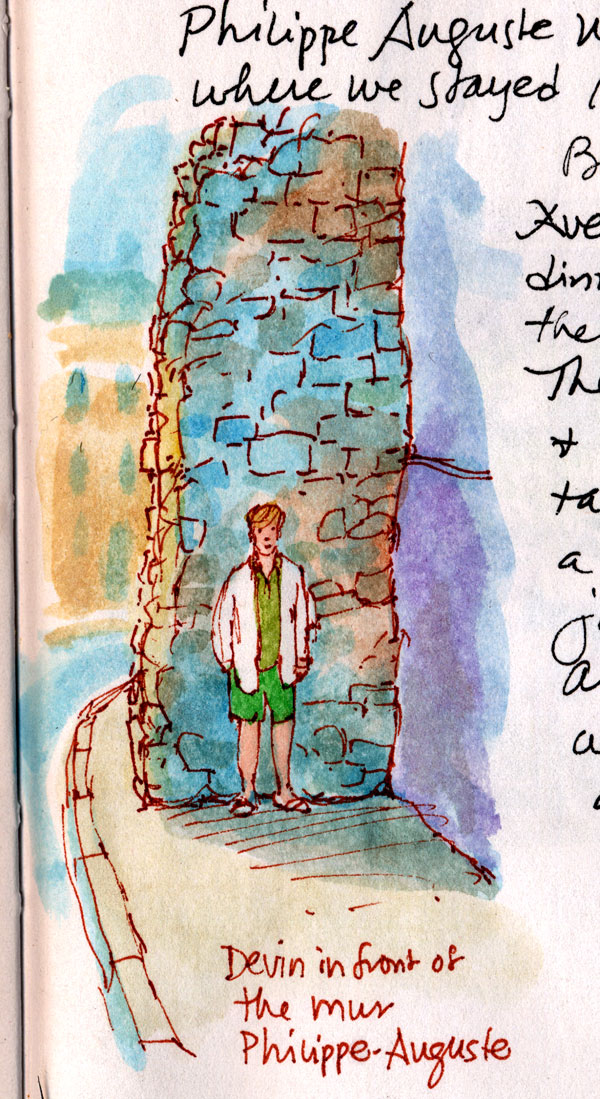
I post this hastily drawn very poor sketch of my son in Paris in honor of King Philippe-Auguste of France (sorry, Your Majesty), whose birthday it is today.
Years ago, when we lived in Paris, I encountered Philippe-Auguste (1165-1223) in a roundabout way, by means of the wall that he had constructed around the city for its protection between 1190 and 1215. The Gaulois had probably had a palisade around their village on the island of Lutetia (as Paris was formerly known), and a rampart certainly existed under Roman occupation of the Parisii as protection from barbarian invasion, but Philippe-Auguste’s wall was a great leap beyond these.
His wall, built of two outer walls of dressed stone and filled with rubble, grew to be twenty to twenty-five feet high and about ten feet thick at the base, with a walkway on the top, and along it were interspersed 77 towers and eleven gates (four more were added later). At the same time he built a fortress on the left bank of the Seine to defend from invasion by water. Little did Philippe know that one day eight million foreign invaders annually would traipse through his fortress (now greatly expanded in size and function) to stare at the Venus de Milo and the Mona Lisa.
People tended to build residences up against such city walls, making use of them for the back of the house. Voilà! one less wall to build! and a sturdy one besides!—trés commode. As the population grew, houses were also built up against the outside of the city wall (although citizens abandoned these homes and retreated within the walls during sieges). Eventually there were so many new people and structures that a new wall had to be built outside the old one. And so on.
Paris had a succession of these walls, a few reminders of which survive today. The Porte-Saint-Denis in the 10th arrondissement, for example, was built in 1672 to celebrate one of Louis XIV’s military victories. It actually replaced a medieval gate in the wall built by Charles V between 1364 and 1380 (one of the towers of which was the Bastille). But the medieval wall itself is long gone. Only Louis’ fancy newfangled gate remains to laud him and to recall the ghost wall. Some of the grand boulevards follow circuits of disappeared walls. But generally earlier walls were removed to make way for new construction.
But, because they tended to be incoporated into structures rather than replaced by roads, some fragments of Philippe’s 12th century wall survive. For some reason this wall has always fascinated me. Or, rather, what remains of it. Some is invisible, woven into the foundations of modern Paris (which exists above the level of the medieval city). But numerous fragments are visible, like this one on the rue Clovis, behind my son. Others can be found within buildings, down hallways, through shop windows. One lives in an underground parking garage, surrounded by Renaults and Peugeots. And a long stretch (now part of a lycée) stands on the rue des Jardins St.-Paul, and includes one of the 77 towers. There is a wonderful website with photos of these fragments.
Paris, like other continuously inhabited ancient cities of the world, is an architectural palimpsest, and perhaps that’s the source of fascination to one who grew up in an American suburb. Happy Birthday, Philippe-Auguste! You builded better than you knew.


 Doug & Krissy
 Rob
 Anne’s Aunt KT