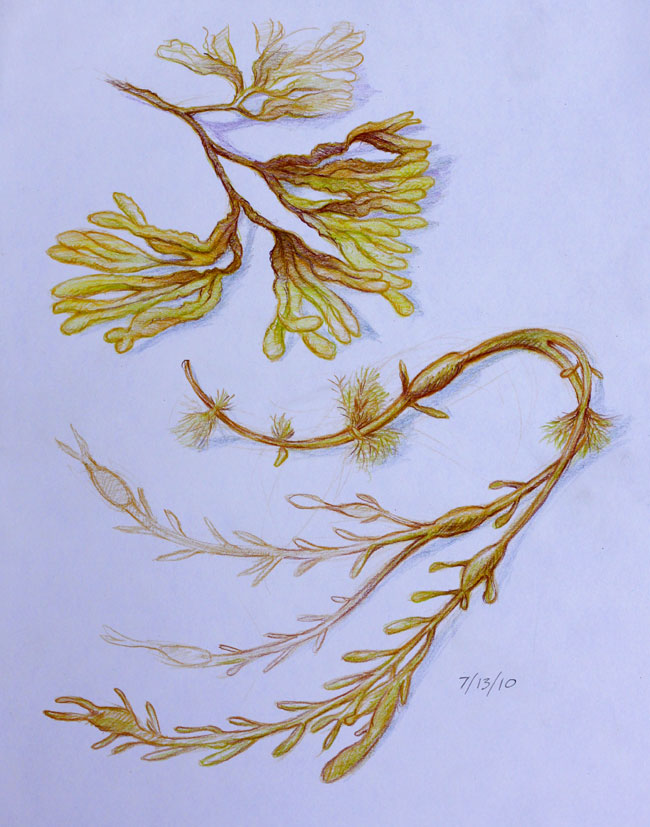
Our botany drawing for today: two kinds of seaweed we found on the beach. Both have little puffy air-filled floats.
(I wonder if we, wrapped in enough strands of this seaweed, could float ourselves?)
Our botany drawing for today: two kinds of seaweed we found on the beach. Both have little puffy air-filled floats.
(I wonder if we, wrapped in enough strands of this seaweed, could float ourselves?)
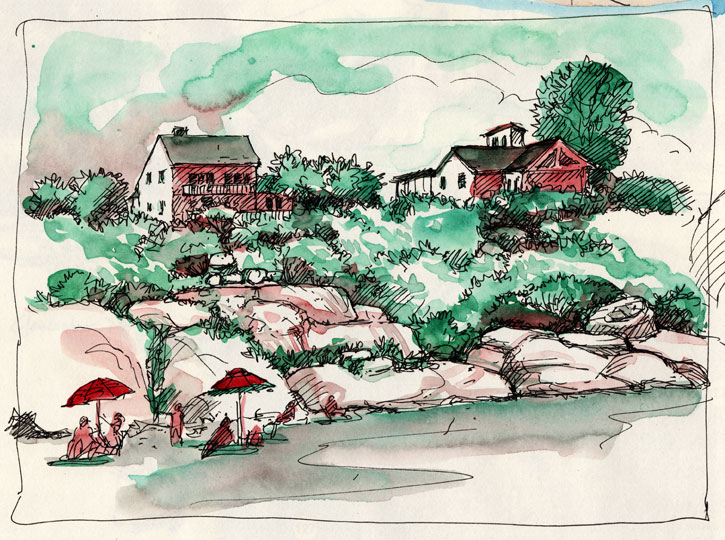
From my sketchbook. A beach scene using two colors.
Ahhh…My husband sleeping late on a summer morning.

—D.H. Lawrence
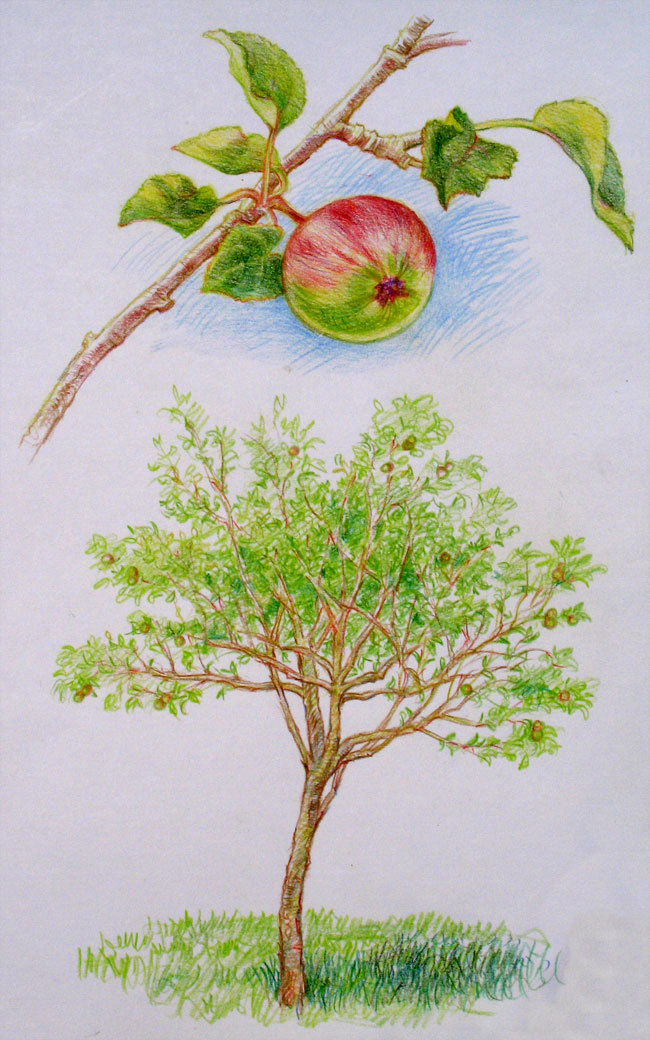
For Botany today we wander the apple orchard, examining the branches with their swelling fruit; then we sit beneath one of the trees and draw. Flies buzz overhead, birds sing in the woods nearby, and the dog stretches out on the grass for a rest. That’s what I call Natural Science.
The russet, crab and cottage red burn to the sun’s hot brass, then drop like sweat from every branch and bubble in the grass.
They lie as wanton as they fall, and where they fall and break, the stallion clamps his crunching jaws, the starling stabs his beak.
In each plump gourd the cidery bite of boys’ teeth tears the skin; the waltzing wasp consumes his share, the bent worm enters in.
I, with as easy hunger, take entire my season’s dole; welcome the ripe, the sweet, the sour, the hollow and the whole.
—Laurie Lee
 Grandma Clarke
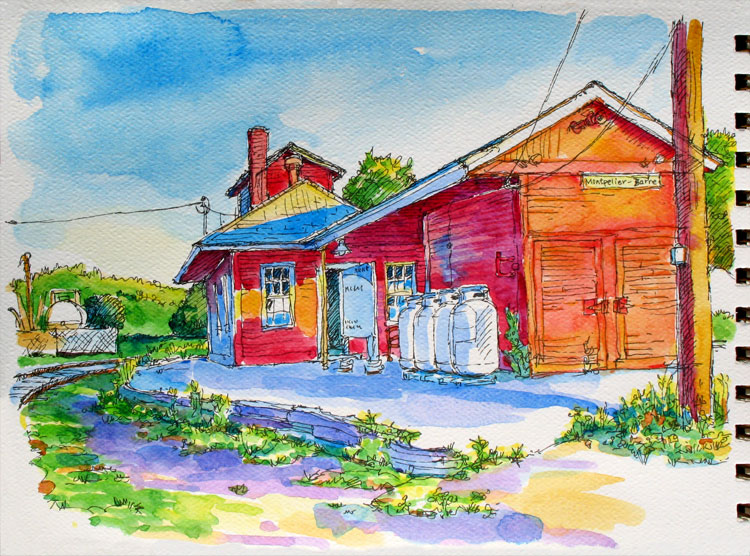
Here is the train station where we picked up our son, who was joining us for a summer holiday. It’s possible to board the train in Washington, DC after breakfast, and arrive in Montpelier, Vermont before sunset. What a concept! Verging on European in its convenience and good sense! What a pity all cities of this country are not similarly connected. Inside the station are eight wooden seats for passengers awaiting the train, and a rock collection featuring local specimens to admire in the meantime.
 Helga
Helga
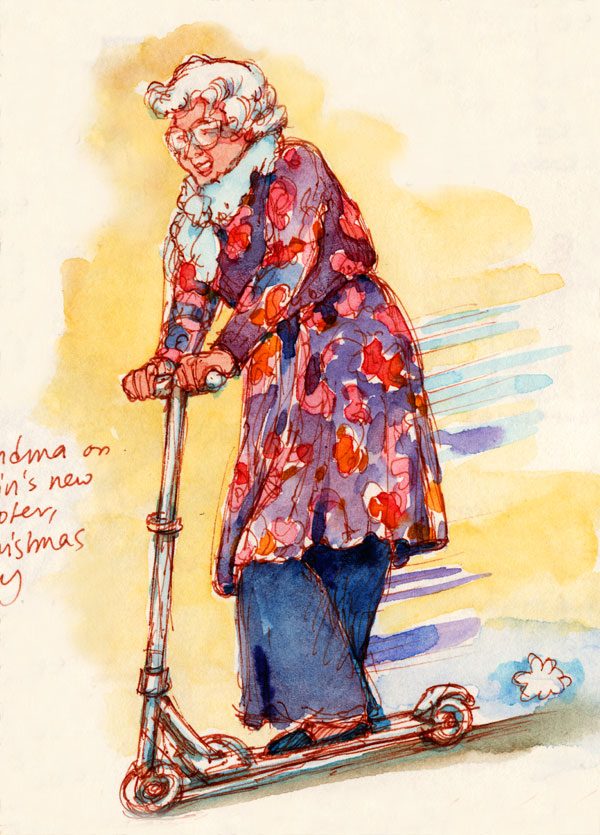
One of my mother’s appealing qualities was her willingness to risk making a fool of herself. Of course this annoyed me no end when I was thirteen, but I grew to appreciate it. Here she is ten years ago, on the Christmas morning my son found a scooter under the tree. After his first ride, he offered it to Grandma, and off she went, wobbling and laughing. She would have been 90 today. Happy birthday, Mom.
 Mom
Mom
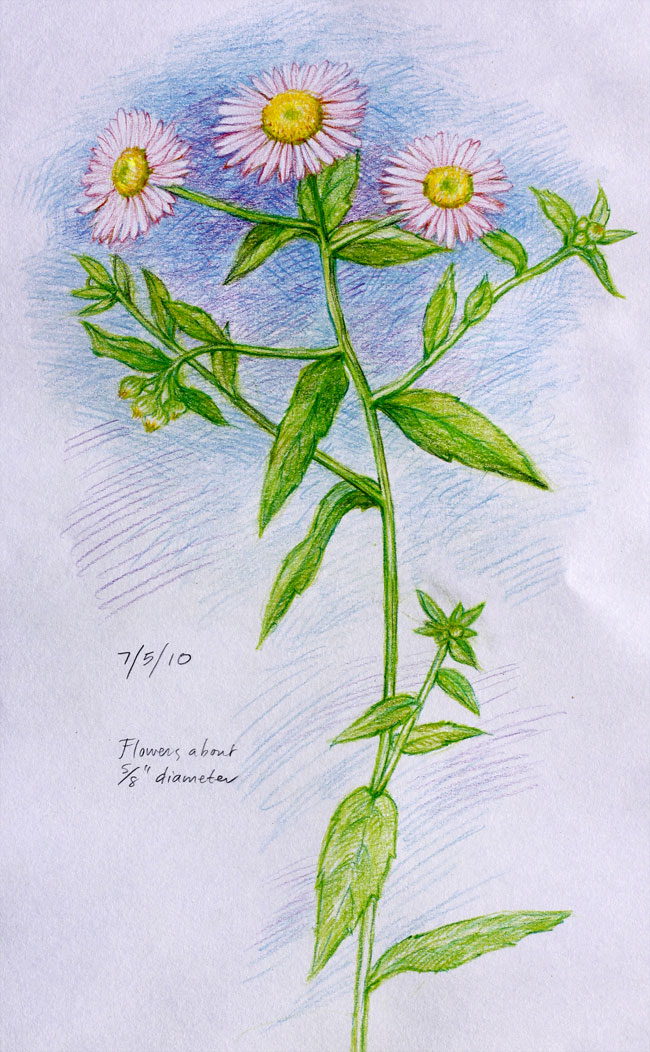
July is the season of botanical abundance, in the garden, in the fields, and along the roadside. My daughter chose these wildflowers for our botany drawing today.
 Kathy
Kathy
 Colen
Colen
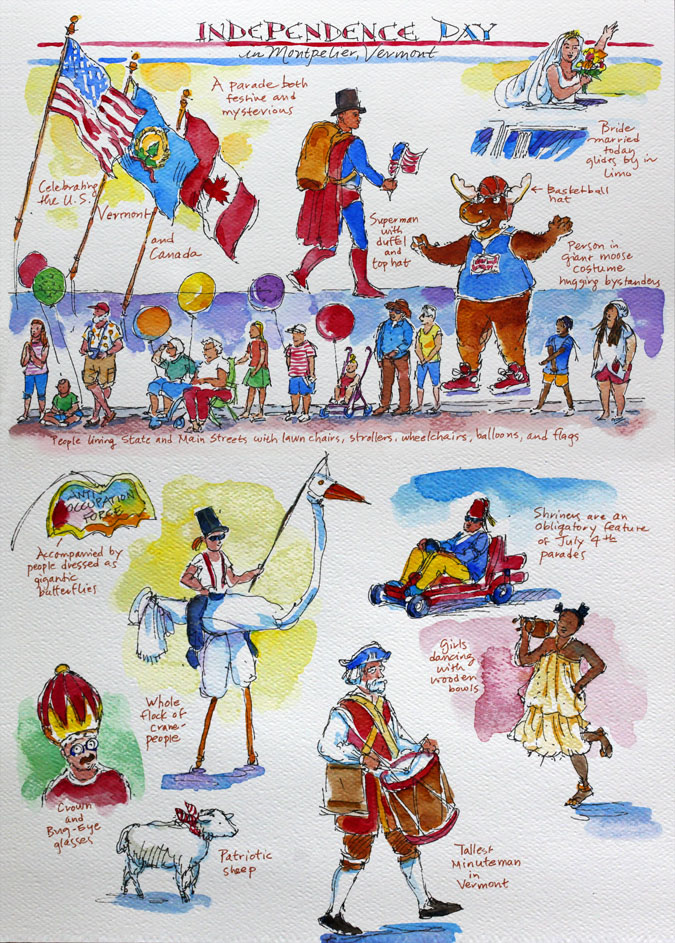
My favorite parades are not those of the professional gigantic floats and inflatable cartoon characters, but the small-town variety featuring decorated bicycles and the local fire truck. Especially if there are participants expressing themes so personal and local that they are perfectly incomprehensible to an out-of-towner.
 Melinda
 Carrie
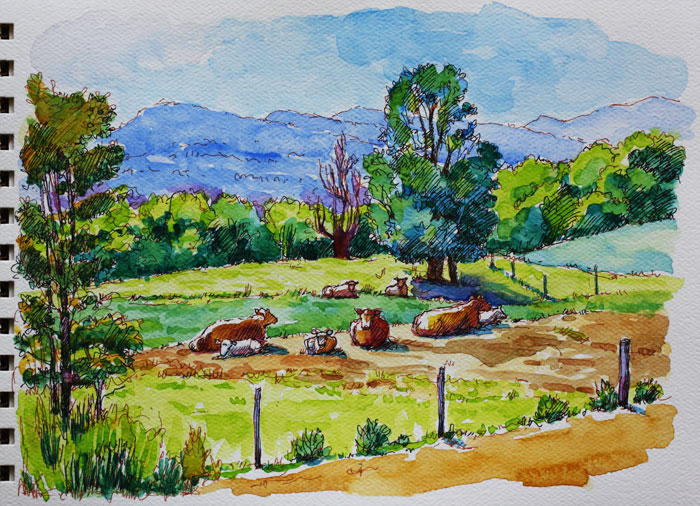
Here are cows I sketched on an early morning walk. The lovely and generous cow works hard all the time, transforming grass into milk, butter, and ice cream. Yet she always looks like she’s on vacation.
Whenever I encounter this poem, I receive it as a gentle reminder of the value of cow-ness. I post it here in honor of its author, William Henry Davies (1871-1940), whose birthday it is today.
What is this life if, full of care, We have no time to stand and stare. No time to stand beneath the boughs And stare as long as sheep or cows. No time to see, when woods we pass, Where squirrels hide their nuts in grass. No time to see, in broad daylight, Streams full of stars, like skies at night. No time to turn at Beauty’s glance, And watch her feet, how they can dance. No time to wait till her mouth can Enrich that smile her eyes began. A poor life this is if, full of care, We have no time to stand and stare.—William Henry Davies
Well, not THAT Louis XIV. This one lives in a henhouse on the grounds of Thyme in the Country, a lovely B&B in Hudson, New York, where we enjoy visiting the cows and poultry, strolling around the pond, and admiring the organic vegetable garden. He’s probably happier than the original Louis.

 Hannah
 Camille