Call the Ewes to the Hills

Eire24DingleBayBurns

Today is the birthday of poet Robert Burns (1759-1796), and if you are a lover of his poetry perhaps you may be inspired to host a Burns Supper tonight. You will have to make your own haggis from scratch, however (good luck with that), because apparently the importation of haggis to the United States remains forbidden, as are all food products made with lungs. (Mystifyingly, Spam, although of questionable provenance, can be purchased without a special license and is consumed in this country at the rate of 3.8 cans per second.) Along with sampling haggis, you may toast the poet and each other with whiskey, and when sufficiently inspired recite some of your favorite Burns poems.

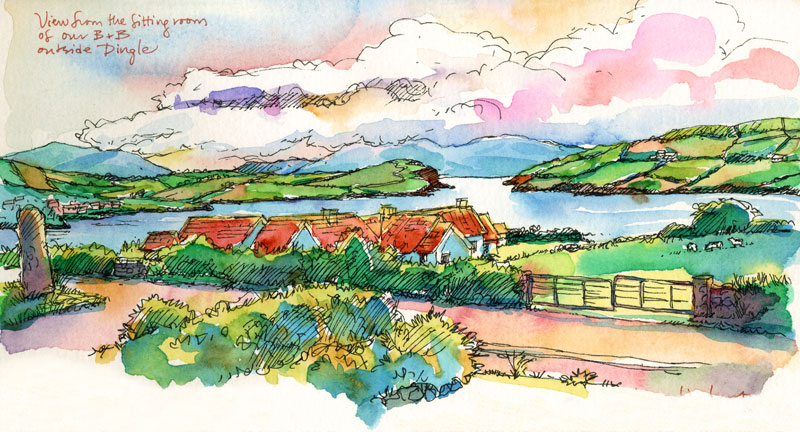
In honor of Burns’ birthday I post a song (with a helpful glossary at the end) which I have sung many a time to my children as they drifted off to sleep. (You can listen to a far lovelier rendition by singer Anne Lewis here.) The sketch is from my Ireland sketchbook. For another Burns sketch, please see Move Yer Hurdies.

Ca’ the yowes to the knowes,
Ca’ them where the heather grows,
Ca’ them where the burnie rows,
My bonnie dearie.
Hark! the mavis’ evening sang
Sounding Clouden’s woods amang,
Then a-faulding let us gang,
My bonnie dearie.
We’ll gae down by Clouden side,
Through the hazels spreading wide,
O’er the waves that sweetly glide
To the moon sae clearly.
Yonder Clouden’s silent towers,
Where at moonshine midnight hours
O’er the dewy bending flowers
Fairies dance sae cheery.
Ghaist nor bogle shalt thou fear;
Thou’rt to Love and Heaven sae dear,
Nocht of ill may come thee near,
My bonnie dearie.
Fair and lovely as thou art,
Thou hast stown my very heart;
I can die–but canna part,
My bonnie dearie.
While waters wimple to the sea;
While day blinks in the lift sae hie;
Till clay-cauld death shall blin’ my e’e,
Ye shall be my dearie.

—Robert Burns

A-faulding: Sheep-gathering
Burnie: Small brook
Gang: Go
Knowes: Hills
Mavis: Thrush
Rows: Rolls
Yowes: Ewes

 

Winter-Worship

BMAgarden

Mother of Darkness, Our Lady,
Suffer our supplications,
our hurts come unto you.
Hear us from absence your dwelling place,
Whose ear we plead for.
End us our outstay
Where darkness is light, what can the dark be,
whose eye is single,
Whose body is filled with splendor
In winter,
inside the snowflake, inside the crystal of ice
Hung like Jerusalem from the tree.
January, rain-wind and sleet-wind,
Snow pimpled and pock-marked,
half slush-hearted, half brocade
Under your noon-dimmed day watch,
Whose alcove we harbor in,
whose waters are beaded and cold.
A journey’s a fragment of Hell,
one inch or a thousand miles.
Darken our disbelief, dog our steps.
Inset our eyesight,
Radiance, loom and sting,
whose ashes rise from the flames.

—Charles Wright

Yahrzeit2Alanna


The work of Christmas begins

FirstDay

When the song of the angel is still,
When the star in the sky is gone,
When the kings and princes are home,
When the shepherds are back with their flock,
The work of Christmas begins:
To find the lost,
To heal the broken,
To feed the hungry,
To release the prisoner,
To rebuild the nations,
To bring peace among peoples,
To make music in the heart.

—Howard Thurman


Rainbow Bridge

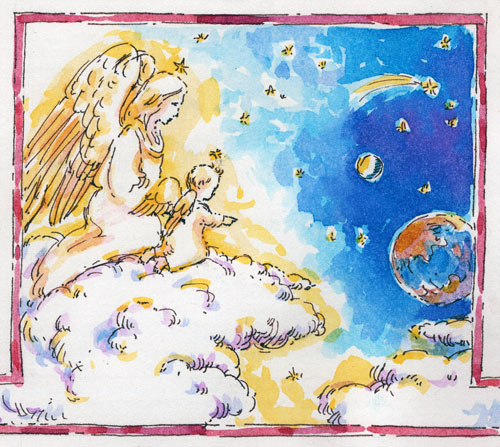
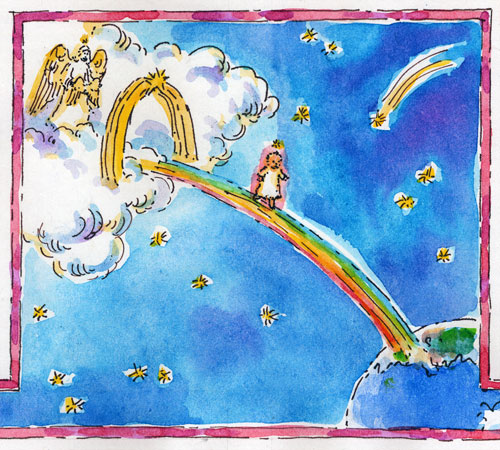
Twelve years ago today I was in labor. I had been in labor since dawn of the winter solstice the day before. We said: A solstice baby! Uh, no, guess not. Labor would continue for another two days… My daughter was contemplating the looooong journey ahead of her.

E&Angel

Then she was ready. You go girl!

ERainbowBridge

These sketches are from a baby journal I began after our daughter was born. Not the same day though.

This is a verse we say on the eve of a birthday (filling in the appropriate ages):

When I have said my evening prayer,
And clothes are folded on the chair,
And mother switches off the light,
I’ll still be [     ] years old tonight.

But from the very break of day,
Before the children rise and play,
Before the purple turns to gold,
Tomorrow I’ll be [     ] years old.

[     ] kisses when I wake,
[     ] candles on my cake.

—Anonymous

Advent IV: Wrapped in sleep

Here is a verse we sometimes say during Advent before dinner, or as part of our homeschool lesson opening exercises. 

SnowyNight
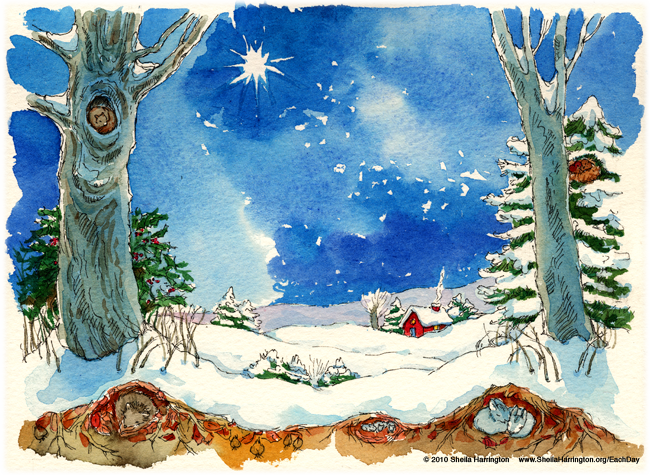
Now the twilight of the year
Comes, and Christmas draweth near.
See, across the Advent sky
How the clouds move quietly.
Earth is waiting, wrapped in sleep,
Waiting in a silence deep.
Birds are hid in bush and reed
Flowers are sleeping in their seed.

Through the woodland to and fro
Silent-footed creatures go.
Hedgehog curled in prickly ball
Burrows beneath the leaves that fall.
Man and beast and bird and flower
Waiting for the midnight hour
Waiting for the infant’s birth
Down from Heaven, onto Earth.

—Ann Ellerton

This image is available as a high-resolution print on 8.5″ x 11″ archival paper.


This World is not Conclusion

Today is the birthday of Emily Dickinson (1830-1886), and it is difficult to choose from among her rich and relentless outpouring. But here is one to ponder as we move inexorably, yet hopefully, toward the darkest time of year.

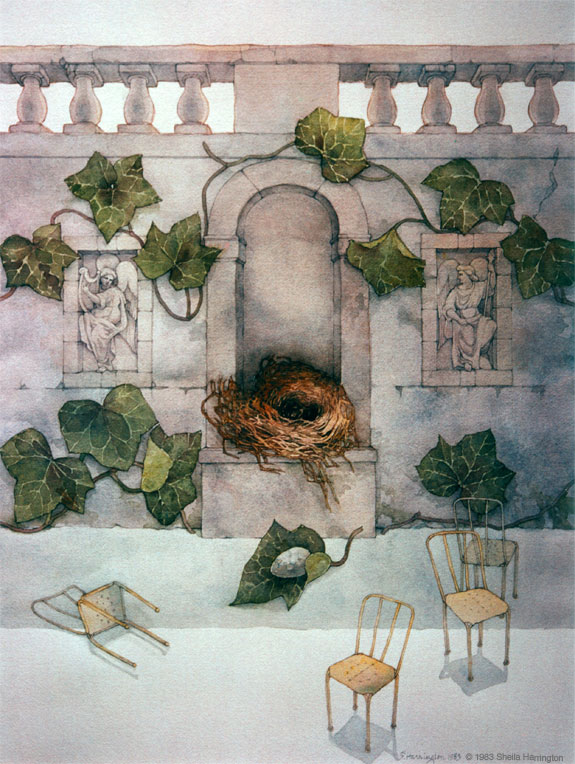
Nest

This World is not Conclusion.
A Species stands beyond —
Invisible, as Music —
But positive, as Sound —
It beckons, and it baffles —
Philosophy — don’t know —
And through a Riddle, at the last —
Sagacity, must go —
To guess it, puzzles scholars —
To gain it, Men have borne
Contempt of Generations
And Crucifixion, shown —
Faith slips — and laughs, and rallies —
Blushes, if any see —
Plucks at a twig of Evidence —
And asks a Vane, the way —
Much Gesture, from the Pulpit —
Strong Hallelujahs roll —
Narcotics cannot still the Tooth
That nibbles at the soul —

—Emily Dickinson

CakeGreenCharles


Paradise Lost

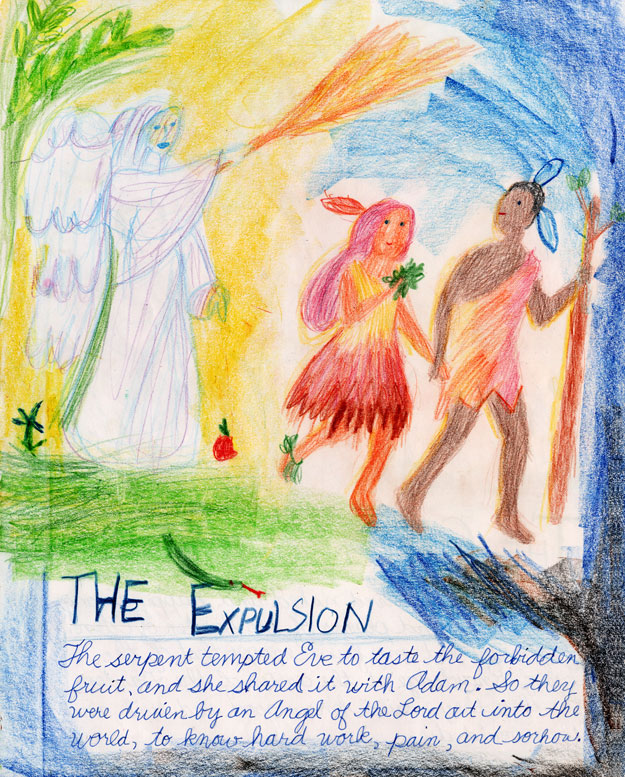
Today is the birthday of John Milton (1608-1674), and in his honor I post the closing lines of his masterpiece Paradise Lost, along with a drawing by my daughter from our homeschooling Old Testament block several years ago. It’s not exactly a match, but I couldn’t resist.

Her drawing belies the solemnity of the poem. Adam and Eve actually look rather pleased at their departure from the Garden of Eden.

ExpulsionES

In either hand the hastening angel caught
Our lingering parents, and to the eastern gate
Led them direct, and down the cliff as fast
To the subjected plain; then disappeared.
They, looking back, all the eastern side beheld
Of Paradise, so late their happy seat,
Waved over by that flaming brand; the gate
With dreadful faces thronged, and fiery arms:
Some natural tears they dropt, but wiped them soon;
The world was all before them, where to choose
Their place of rest, and Providence their guide:
They, hand in hand, with wandering steps and slow,
Through Eden took their solitary way.

—John Milton


Imagine

RoseSunrise

Imagine there’s no Heaven
It’s easy if you try
No hell below us
Above us only sky
Imagine all the people
Living for today
Imagine there’s no countries
It isn’t hard to do
Nothing to kill or die for
And no religion too
Imagine all the people
Living life in peace
Imagine no possessions
I wonder if you can
No need for greed or hunger
A brotherhood of man
Imagine all the people
Sharing all the world
You may say that I’m a dreamer
But I’m not the only one
I hope someday you’ll join us
And the world will live as one

—John Lennon

CakeBerries2Sophie

Yahrzeit2John Lennon


St. Nicholas Day: Part 2

(continued from December 6th)

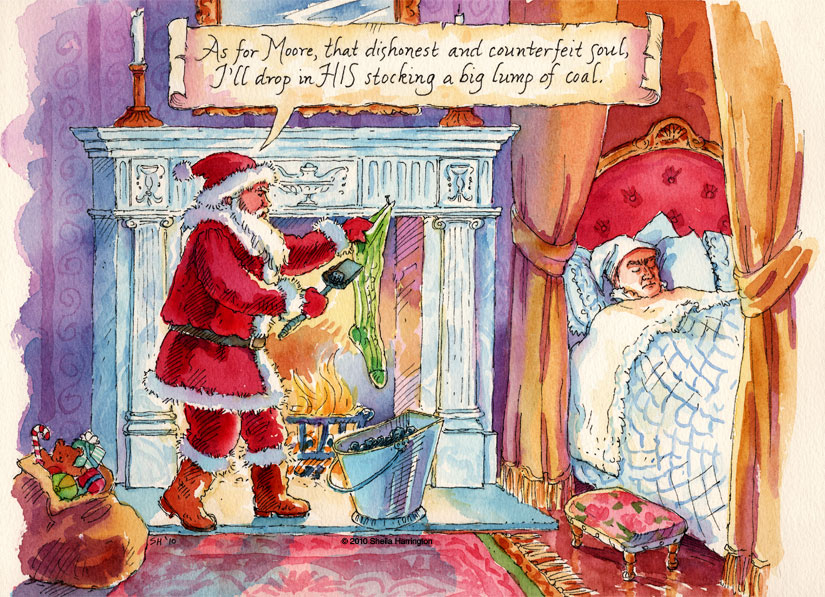
Santa&Moore

However, after Livingston’s death in 1829, Moore quietly wrote to the newspaper asking if they knew the author of the popular verse, “The Night Before Christmas.” When the editors replied that they did not, as it had been published anonymously, Moore claimed authorship, saying that he had been “too embarrassed” to claim it previously. His surprised and delighted family, and many others, came to believe him.

When Moore later included it in a book of “his” poetry (which actually included several other poems later revealed not to be Moore’s own—tsk, tsk), the astonished Livingston children protested. But would a rich and respected theologian actually LIE about his work? Not to be believed. So nobody did. Livingston’s papers, including his handwritten copy of the poem with its changes and crossed-out passages, had perished in a fire, and the children had no evidence beyond their personal knowledge. Moore later churned out several handwritten copies of his own (not exactly matching Livingston’s original, but what the heck) which eventually sold to collectors for big bucks.

End of story… until the arrival on the scene of Donald Foster, an English professor at Vassar and a well-known textual scholar, who included in his 2000 book Author Unknown a fascinating analysis of the use of language in the work of Moore and of Livingston. His conclusion, built step by step on literary evidence, is that Livingston, and not Moore, authored the poem in question.

But even we lay people, dear reader, can probably deduce this for ourselves by reading further examples of poetry.

For example, contrast with Moore’s grim and foreboding efforts the poem Livingston wrote for his own daughter’s marriage:

‘Twas summer when softly the breezes were blowing
And Hudson majestic so sweetly was flowing
The groves rang with music & accents of pleasure
And nature in rapture beat time to the measure
When Helen and Jonas so true and so loving
Along the green lawn were seen arm in arm moving
Sweet daffodils, violets and roses spontaneous
Wherever they wandered sprang up instantaneous.

And another, in a letter to his brother, praising the sewing of a cousin:

To my dear brother Beekman I sit down to write
Ten minutes past eight & a very cold night.
Not far from me sits with a baullancy cap on
Our very good couzin, Elizabeth Tappen,
A tighter young seamstress you’d ne’er wish to see
And she (blessings on her) is sewing for me.
New shirts & new cravats this morning cut out
Are tumbled in heaps and lye huddled about.
My wardrobe (a wonder) will soon be enriched
With ruffles new hemmed & wristbands new stitched.

The only real benefit from Moore’s perpetrated fraud is that Livingston’s poem has survived for generations to enjoy it. Perhaps now, thanks to Donald Foster, its true author will be recognized.