The Man with the Plan

L'Enfant

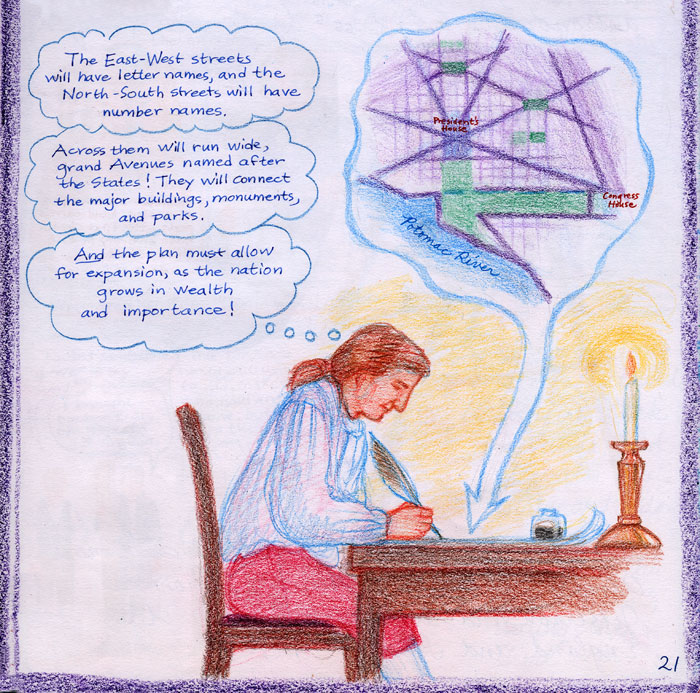
Here is a drawing from our homeschooling Local History and Geography book, in honor of Pierre Charles L’Enfant (1754-1825), whose birthday it is today. Because of other obligations I cannot give him the lengthy post he deserves, but I hope to do him justice in 2011.

L’Enfant, an artist and son of an artist, came from France with the Marquis de Lafayette, as most Washingtonians probably know, to fight alongside the American colonists for independence, and later, having impressed the General with his battlefield sketches, was appointed by George Washington to design the United States’ new capital, Washington, DC. He created a a plan which was unfulfilled during his lifetime and has been only incompletely followed since, but which nevertheless gives us today this lovely and unusual city.

L’Enfant examined a quiet, hilly site of woodland, meadow, and marsh, uninhabited but for a handful of farms and the tiny port of Georgetown, and visualized an orderly grid overlaid by wide diagonal avenues allowing for long vistas, designed to incorporate stately public buildings, canals, bridges, squares, parks, and monuments: not simply a new bureaucratic center, but a Grand Capital for a young, energetic New Nation.

He had also a number of sensible, intelligent ideas as to how construction of the new city might have been financed, which were unfortunately never followed. Reading about the snail-like early development of the city, its wrangling political factions, its stodgy unimaginative Commissioners, and its greedy unscrupulous speculators, would make your hair stand on end. It also sounds uncomfortably familiar.

In the midst of it L’Enfant and Washington kept before them the vision of a finished work. Along the way L’Enfant, a hot-headed and demonstrative fellow, offended any number of people by vehemently defending his plans against unattractive provincial alterations (like any artist worth his salt) to the point of knocking down a new house that intruded on one of the proposed avenues. Not the way to keep your job. Which he finally lost after an exasperated Washington could no longer defend him against his many critics. L’Enfant remained bitter about his treatment—he was never paid for his work, although others made considerable sums through its implementation—and spent his remaining years as the poverty-stricken guest of a kind friend in rural Maryland, to be buried finally in their garden.

He has since been removed to a more honorable site in Arlington Cemetery, overlooking the city that finally rose to meet his expectations. Happy Birthday, Pierre, and I hope you are enjoying the view.

Water

From my sketchbook, the fountain in the courtyard of the Freer Gallery of Art, a quiet place to sit and meditate (and wish you were in that pool). And a verse for Sunday.

FreerFountain

If I were called in
To construct a religion
I should make use of water.
Going to church
Would entail a fording
To dry, different clothes;
My liturgy would employ
Images of sousing,
A furious devout drench,
And I should raise in the east
A glass of water
Where any-angled light
Would congregate endlessly.

— Philip Larkin


Mountain Woman Part 1

JuliaHolmes

Imagine that you are a little girl born in a village in North America in the early 19th century. You, like the other village girls and their mothers, help maintain a family farm: growing vegetables, cooking, scrubbing, making clothes. You might see your destiny as a farmer’s wife, raising children to follow in your footsteps.

But perhaps your mother is also an advocate for women’s suffrage, and your father is a fierce abolitionist, which might give you a somewhat different perspective on your life. This was the parentage of Julia Archibald (1838-1887), later Julia Archibald Holmes, born in the village of Noël, Nova Scotia, in 1838. And today, August 5th, is the anniversary of the day she became the first woman to reach the top of Pikes Peak, Colorado, when she was twenty years old.

When Julia was about ten, the family moved to Worcester, Massachusetts (where her mother became friends with Susan B. Anthony). But they didn’t stay there long. Slavery had been abolished in Canada in 1834, but there was a growing anti-slavery movement in the United States, and Kansas was the place in which the Archibalds decided to support it. They had a mission.

A series of treaties had declared Kansas to be Indian Territory, and a number of Native American tribes had been removed from their eastern lands and resettled there. Nevertheless, increasing numbers of westward-bound pioneers followed trails that passed through the territory, and by 1850 settlers were squatting along the trails and elsewhere in Kansas. Pressure from these land-hungry folks led eventually to (familiar story) the creation of new treaties, the removal of tribes to areas yet further west, and the passage of the Kansas-Nebraska Act in 1854, opening the area officially to settlement.

It was not only Native American tribes who were unhappy about this. Slave-state Southerners were displeased that the decision about the existence of slavery in the new territory was to be left to its residents. So, as you might guess, both advocates and opponents of slavery rushed into Kansas, each staking out territory and hastily setting up local provisional governments and institutions that were attacked by both sides, setting off several years of violence that foreshadowed the Civil War.

The Archibalds settled in Lawrence, Kansas, a center of controversy, and their house became a way station on the Underground Railroad. In Lawrence Julia met James Holmes, a veteran of John Brown’s campaigns. Apparently he was fiery and dedicated; she was handsome and spirited; there were certainly similarities of background. They were married in 1857.

But they didn’t stick around in Kansas for the resolution of the national conflict. The following year they joined a wagon train headed for Colorado, where gold had been discovered. And a lot of other excited Kansans were doing the same thing. Not many gold-seekers actually found what they sought, but their immigration resulted in the founding in Colorado of towns, businesses, churches, and probably plenty of saloons, as well as a rapid dramatic increase in its population.

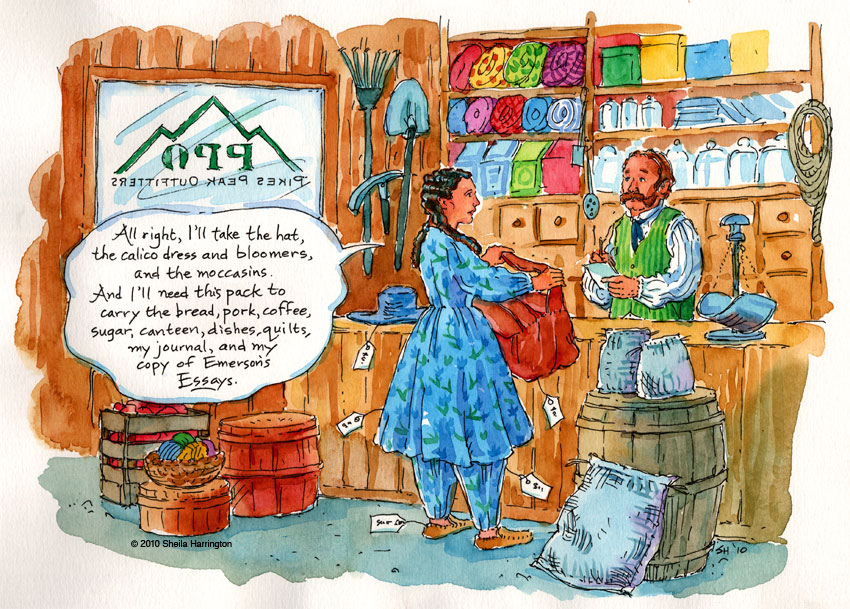
According to Julia’s journal, their own party was driven more by “a desire to cross the plains and behold the great mountain chain of Noth America” than to search for gold. She acquired what she deemed a sensible traveling outfit: hat, moccasins, short calico dress, and bloomers. Bloomers had been recently introduced to the public by women’s suffragists as more sensible than skirts.

Her choice of clothing gave Julia the freedom to walk beside the covered wagons instead of riding. She improved her stamina by deliberately increasing her daily distance, and she recorded her observations of wildflowers, landscape, and skies in her journal. The only other woman on the trip disapproved of Julia’s unconventional garb and stayed in her wagon, thus missing most of the scenery. (Like my children, with noses in their books when we travel. “Look! Look out the window!”)

To Be Continued—Please see August 6/Mountain Woman Part 2

Sunset Serenade at the Zoo

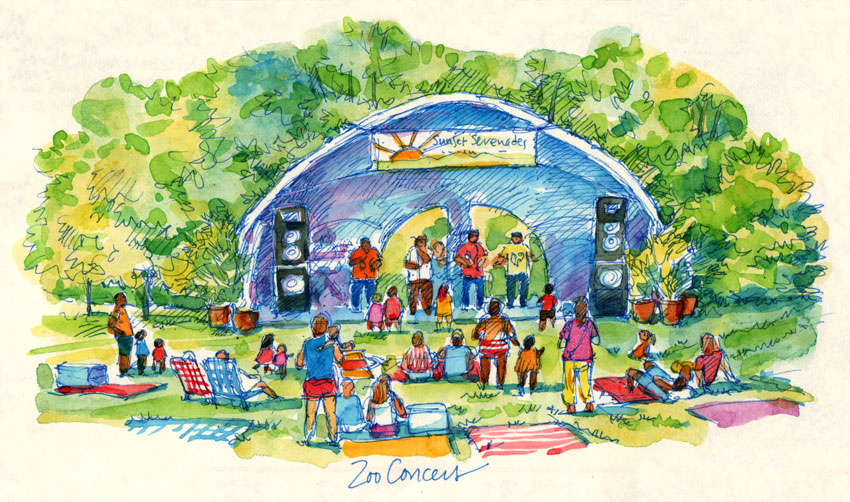
This is a heads-up that the LAST National Zoo Sunset Serenade of the summer takes place tomorrow night—Thursday, August 5th (weather permitting), from 6:30 to 8pm. If you have never attended any of these free outdoor concerts, then this is your last chance (this summer, anyway) to pack a picnic dinner and join the fun on Lion-Tiger Hill. The evening usually ends with spontaneous barefoot dancing. According to the Zoo website, tomorrow’s group is The Grandsons, performing from their WAMMIE Roots Rock-winning albums.

ZooConcert

Tree of Life

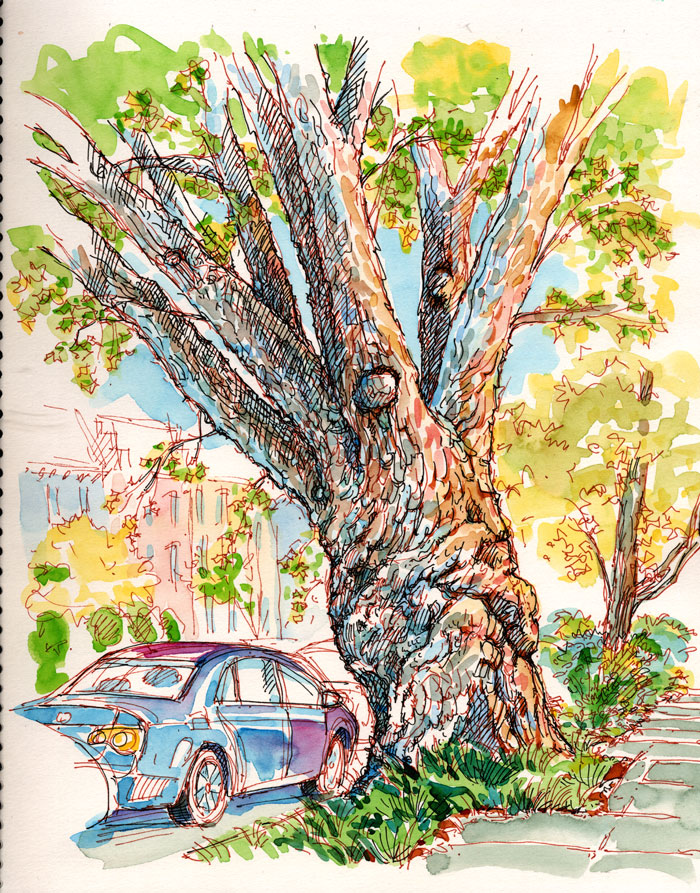
I have ambivalent feelings about this tree. On the one hand, I never park under it, for fear that I would return to find my car crushed. On the other hand, it is the most powerful and heart-lifting tree in our neighborhood, with its fantastically sculpted trunk and enormous, light-filled crown, simultaneously shimmering and shady, undoubtedly home to innumerable beetles, birds, and squirrels.

After a recent summer thunderstorm, I went to check it out. There it stood, serene as ever, despite its permanent streetward slant. It’s a variety of maple (to find out what kind we’ll have to check Melanie Choukas-Bradley’s wonderful City of Trees), although it has the ancient, stalwart feel of an oak, as if it arose here here long before any of our houses.

Below, a tree poem for Sunday.

GiantMaple

A Final Affection

I love the accomplishments of trees,
How they try to restrain great storms
And pacify the very worms that eat them.
Even their deaths seem to be considered.
I fear for trees, loving them so much.
I am nervous about each scar on bark,
Each leaf that browns. I want to
Lie in their crotches and sigh,
Whisper of sun and rains to come.
Sometimes on summer evenings I step
Out of my house to look at trees
Propping darkness up to the silence.
When I die I want to slant up
Through those trunks so slowly
I will see each rib of bark, each whorl;
Up through the canopy, the subtle veins
And lobes touching me with final affection;
Then to hover above and look down
One last time on the rich upliftings,
The circle that loves the sun and moon,
To see at last what held the darkness up.

—Paul Zimmer

CakeChocCurls2Francine


Half-Birthday

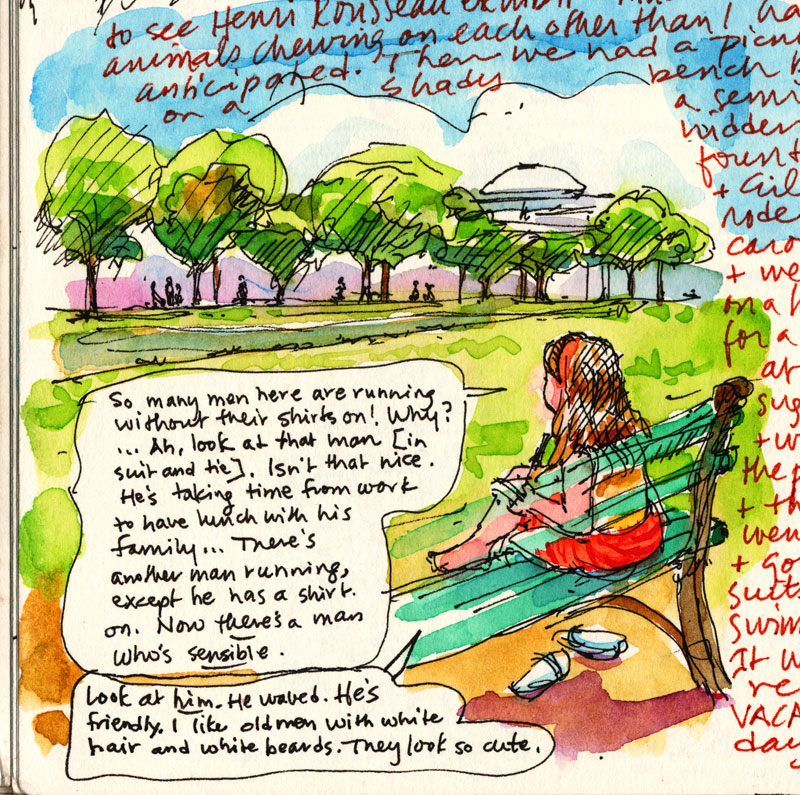
A trip to the Mall with my daughter, who invariably offers thoughtful commentary on her surroundings, whatever they may be.

EonMall

I post this sketch in honor of her half-birthday today. Long ago, when the children were tiny and each week seemed to mark another milestone, we developed the habit of celebrating their half-birthdays every year, as if they weren’t already sufficiently doted upon… But it’s a modest celebration, with a candle in a pancake, a little package beside the plate, and a rousing round of “Happy Half-Birthday.”

Yahrzeit2Ruthie

Flag Day

PeruvianDance

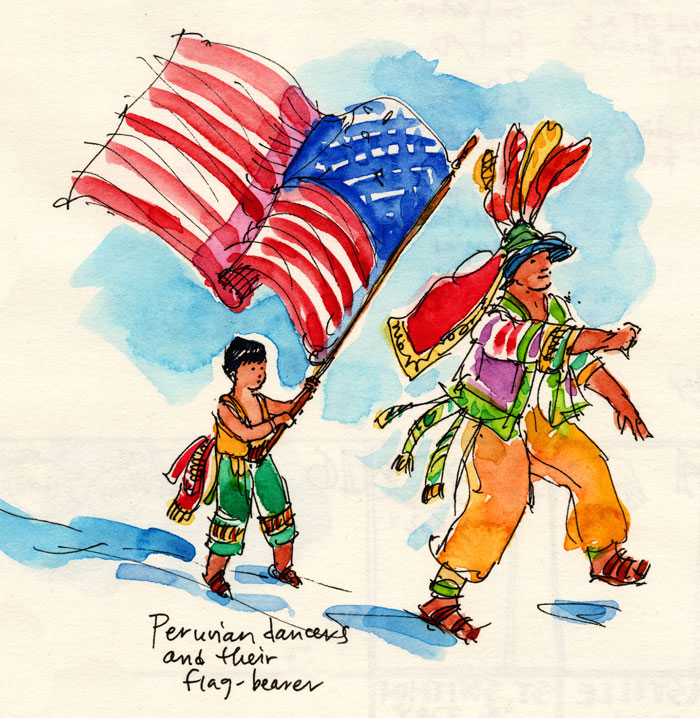
The story of the Stars and Stripes, as passed down through the family of upholsterer Betsy Ross, is that George Washington visited her and asked if she could create a flag from a sketch he presented. Upholsterers commonly took up other work to keep bread on the table (for a while Betsy Ross also made musket balls for the army). The finished product was adopted by the Continental Congress on this day in 1777 as the official flag of the new United States. I post here a sketch, from the Palisades neighborhood Fourth of July parade, of the Peruvian dance troupe’s young standard-bearer. The scene struck me as so, well, American.