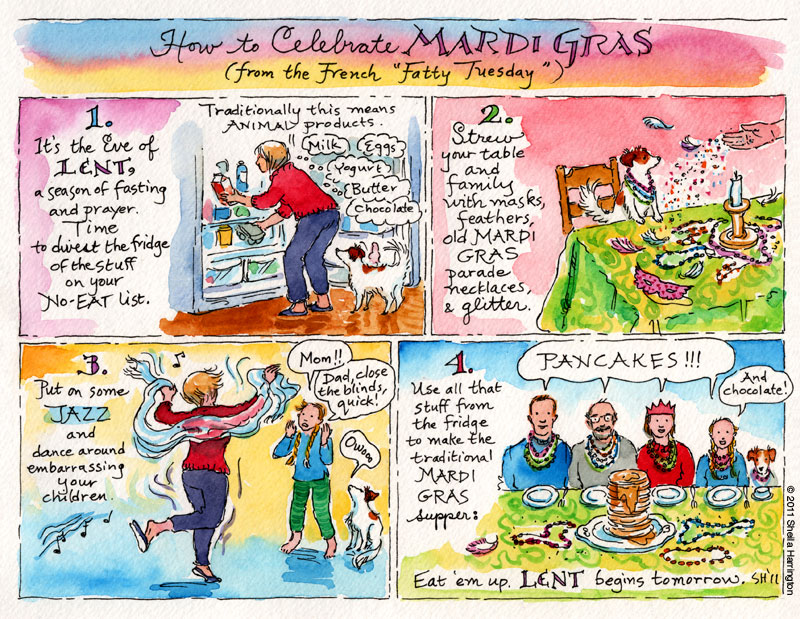
For another Mardi Gras illustration, please see Two-Part Tuesday.
 Willard
Unbelievably, it has been FIFTY YEARS since the inauguration of John F. Kennedy, and in honor of this anniversary the Kennedy Center here in Washington, DC has created a blockbuster lineup of events. Both President and Jacqueline Kennedy were enthusiastic supporters of the arts, so the celebration includes a bounteous variety of musical, theatrical, and dance performances, some ticketed and some free of charge. It is, after all, the Kennedys who helped bring to fruition a long-languishing plan for a National Cultural Center, which was renamed the Kennedy Center after Kennedy’s assassination in 1963.
Whatever you may think of its architectual style, you must acknowledge that it’s been a fantastic addition to the Washington cultural scene all these years, providing a setting for a huge range of artistic performances (including Millennium Stage, with 365 free performances a year!) and inspiring the launch of many additional venues. And it has a lovely view from the terrace. Anyway, we’re all used to it now, as a familiar icon for which we feel affection, like some eccentric great-aunt who is known for her peculiar hats.
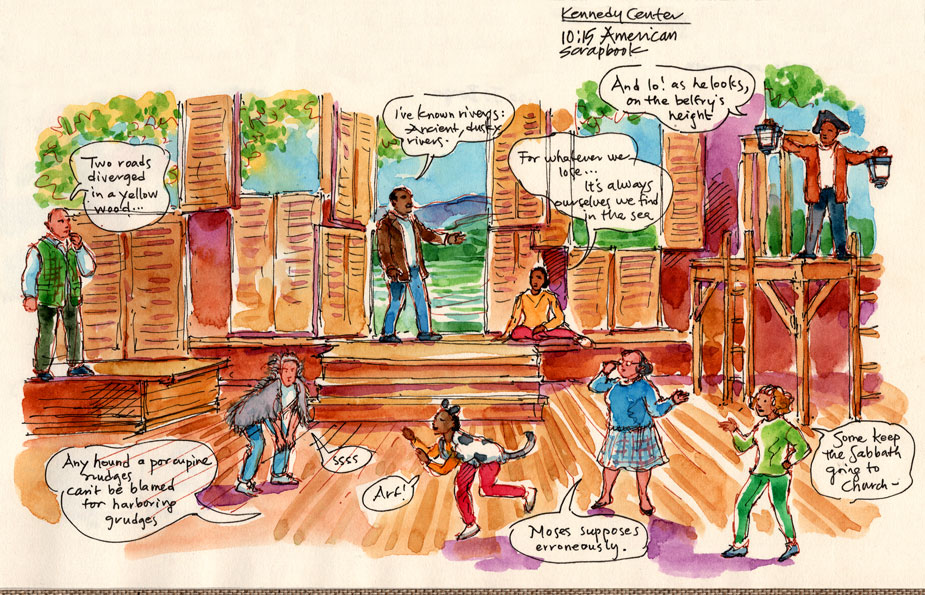
As part of a homeschoolers’ outing, my daughter and I attended American Scrapbook, A Celebration of Verse, a theatrical interpretation of some of the Kennedys’ favorite poetry. The family had a lovely tradition which (WARNING) will assuredly make you long to go back and raise your semi-literate, poetry-impaired children all over again: for the parents’ birthdays, the children Caroline and John Jr. each chose poems and then created drawings to accompany them, which were then pasted into a scrapbook.
This scrapbook collection inspired the play, which was essentially a seamlessly interwoven, thematically arranged series of “recitations”—although I hesitate to use that dry schoolhouse term, because the interpretations were so engaging and heartfelt. (I tried to sketch, but it was pretty dark and the actors were awfully “active,” thus the rough, scribbled result.)
The set was simple, modest, effective: tall wooden shutters that opened and closed in a variety of configurations to reveal changing images that supported, rather than distracted from, the spoken word.
Lively, imaginative, yet true to the spirit of the poems, the program transfixed the audience of elementary and middle-school children for an hour, which, when you’re talking about poetry, is truly a laudable achievement.
 Walter
For Valentines Day.
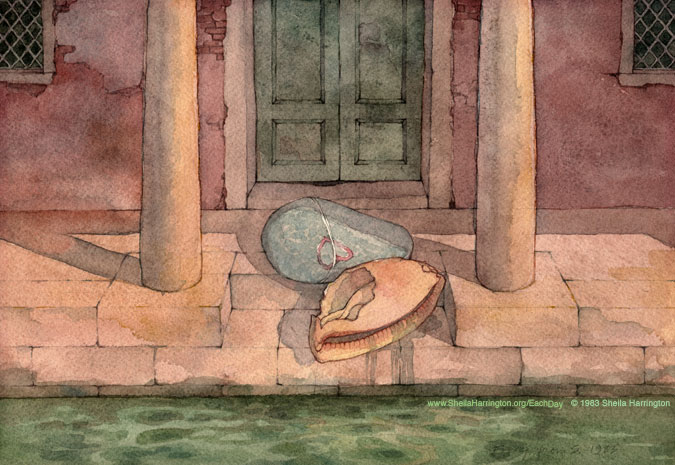
And when white moths were on the wing, And moth-like stars were flickering out, I dropped the berry in a stream And caught a little silver trout.
When I had laid it on the floor I went to blow the fire aflame, But something rustled on the floor, And some one called me by my name: It had become a glimmering girl With apple blossom in her hair Who called me by my name and ran And faded through the brightening air.
Though I am old with wandering Through hollow lands and hilly lands, I will find out where she has gone, And kiss her lips and take her hands; And walk among long dappled grass, And pluck till time and times are done The silver apples of the moon, The golden apples of the sun.
—William Butler Yeats
 Bill
Bill
This image is available as a high-resolution print on 8.5″ x 11″ archival paper.
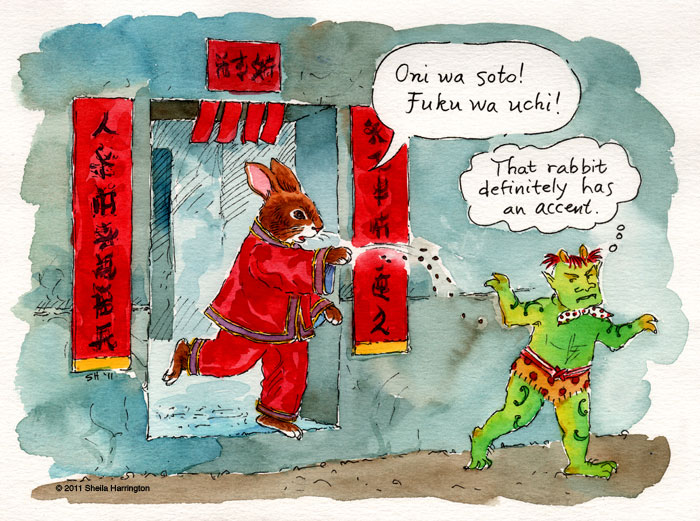 Two celebrations fall on February 3rd in 2011: Setsubun, the Japanese demon-expelling festival; and Chinese New Year, the beginning of the Chinese Year of the Rabbit. Today’s title was suggested by my brilliant husband.
The Rabbit is supposed to be the luckiest of all the signs. If you were born in the Year of the Rabbit, you are gentle, sensitive, modest, sincere, and affectionate yet shy. Rabbits enjoy being at home, surrounded by family and friends. They seek peace throughout their lives, and are sometimes seen as pushovers because they like to avoid conflict. Although the Rabbit above looks like a pretty tough character, he is, after all, defending his peaceful home from demons.
We have decided to celebrate the two events simultaneously, which will be a challenge. Setsubun involves eating as many beans as you are years old for luck, and hanging garlic or a fish head on your door and throwing beans while chanting the verse above (“Demons Out! Happiness In!”)—both useful practices for repelling demons. Chinese New Year means plenty of red decorations, writing good-fortune verses, and shooting off fireworks. For both events there is special clothing (kimonos, or anything red, or a bunny hat are all acceptable in our house) and of course special foods (like friend Mary’s world-famous Bunny Cake). And, although it’s not traditional, we are including Chinese horoscopes, fortune cookies, origami bunny-folding, and an impressive gathering in the dining room of all our children’s stuffed rabbits.
BTW, for our door we are choosing garlic instead of a fish head.
For another sketch of Setsubun, please see Demons Out! Happiness In!
For another sketch of Chinese New Year, please see Tyger, Tyger, Burning Bright.
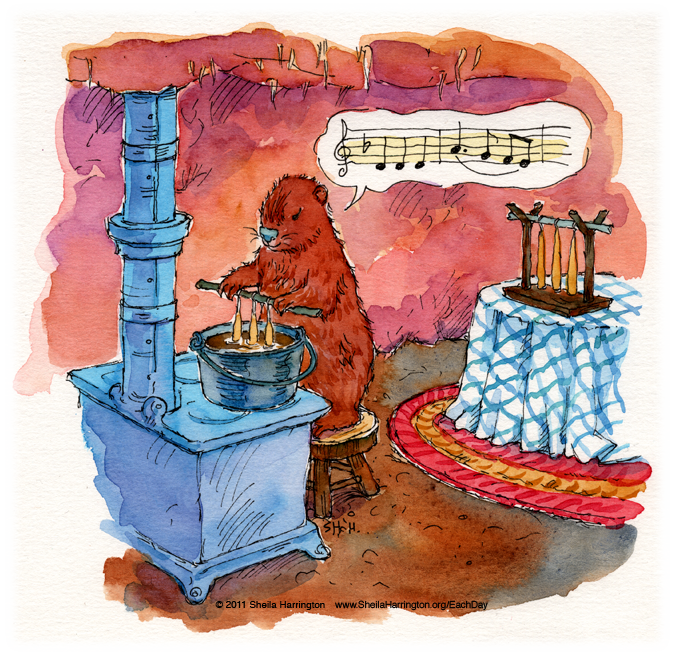
This is the day on which, according to tradition, the groundhog makes all his candles for the coming year. (When he has finished, he will stick his nose outside the burrow to check the weather.)
For another picture of the groundhog at home, please see Light Those Fires.
 Roshan (“Bright Light”)
 Marius—born today!
In honor of Carl Sandburg (1878-1967).
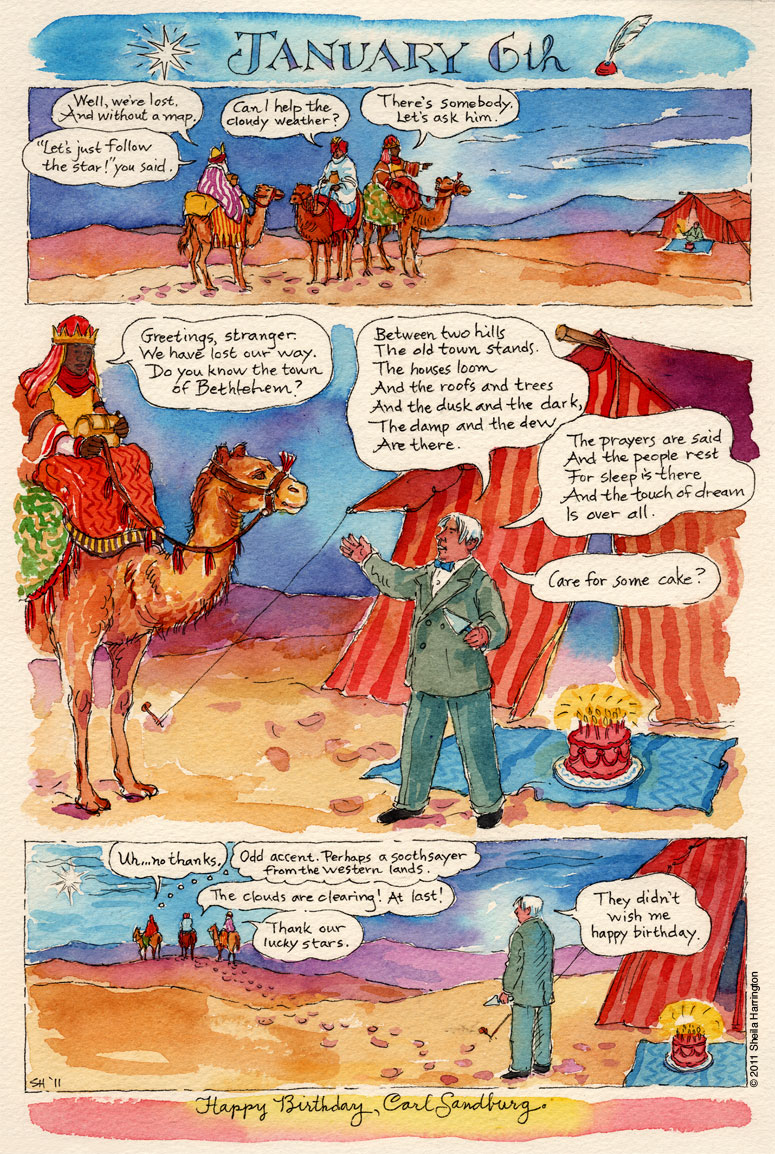
For another take on Epiphany, please see The Three Wise Women.
 Nathan
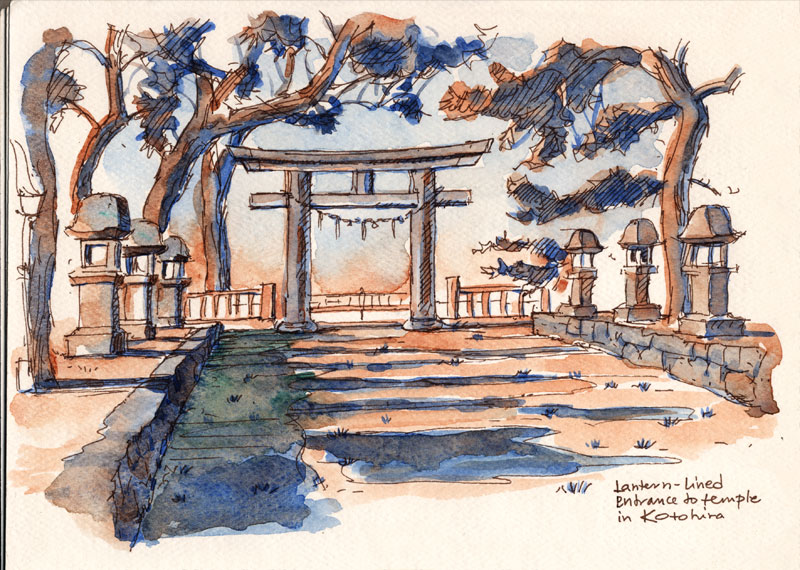
When our son was spending his first New Year’s Eve in Japan, he reported to us on the local celebrations of this most important holiday.
While we at home in the U.S. are staying up late to eat and drink, dance, and generally whoop it up with family, friends, and total strangers, in Japan the courtyards of shrines and temples are slowly filling with hundreds, even thousands, of patient, silent people waiting to make hatsumode—the first visit of the New Year.
On the stroke of midnight, all over the country, the doors open, and the temple bells begin to ring. And they ring for a total of one hundred eight times, representing the 108 sins (such as vanity, garrulity, prejudice, ingratitude, and unruliness) from which humankind must be freed before achieving nirvana. It’s part of a longer turning-of-the-year celebration during which people visit family, pay debts, eat special symbolic foods, and exchange gifts. (Although it seems that in Japan EVERY event—first trip to the dentist?—is an opportunity to exchange gifts.) What a contrast to Times Square, and beyond, where people are probably racking up those 108 sins right and left.
This is a sketch of a temple courtyard (but not on New Year’s Eve) from one of my Japan sketchbooks.
 Christopher
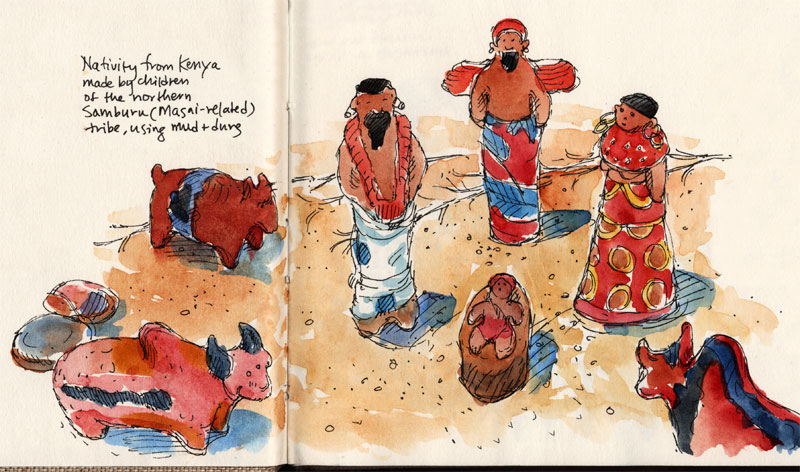
Every year Washington National Cathedral exhibits a number of examples from its large collection of Nativity scenes from around the world. The exhibition runs through January 7th, 2011.
This is one of my favorites, a scene made from mud and animal dung by children in Kenya.
 Doug
Doug
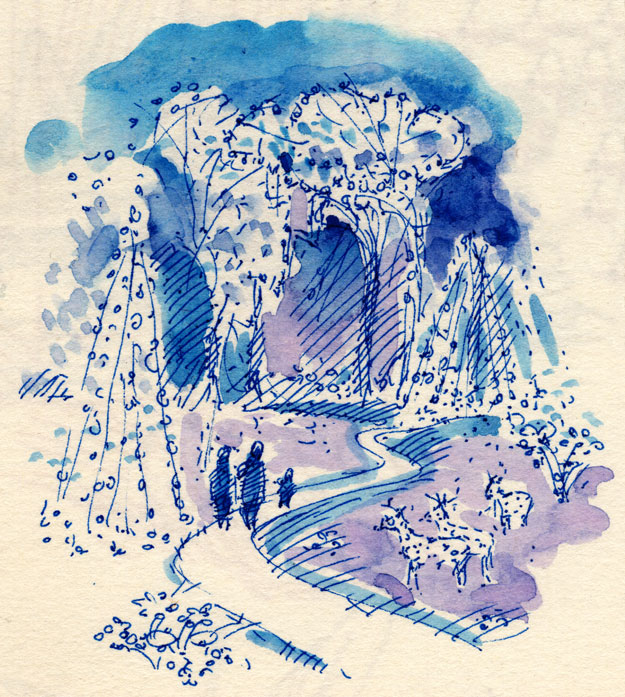
If you have never been to the Garden of Lights at Brookside Gardens in Wheaton, Maryland, I recommend it. Inside the Conservatory, different local musicians perform each evening, and you can fortify yourself with hot cocoa. Then, sufficiently warmed, you can venture out into the gardens. In summer this is a place of sunshine and glorious blooming color, but at the moment it’s a magical fairyland of lights twinkling in the darkness.
The best time to visit is when it’s bitterly cold, because it is not crowded. However, you might then be wishing for Irish coffee and hot toddies instead of cocoa.
—Howard Thurman