First Fruits

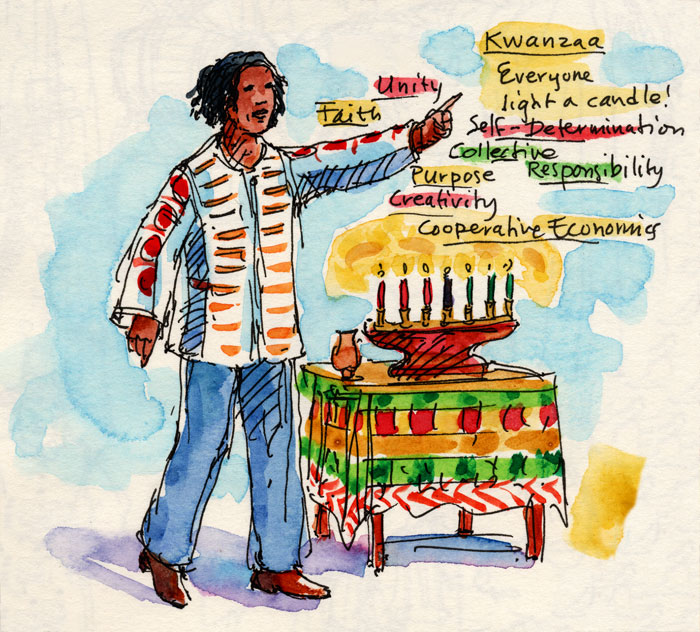
Kwanzaa

December 26th is the first of the seven days of Kwanzaa, a festival created in 1966 as a celebration of African cultural and historical heritage. Born of the Civil Rights movement, it was originally proposed as an alternative to Christmas for African-Americans who preferred not to follow the religious traditions of the culture that had uprooted and dispossessed their ancestors. However, for many families it has come to be an additional, rather than a replacement, celebration.

Kwanzaa derives from a Swahili phrase meaning “first fruits,” and its creation was inspired by African harvest festivals, but “fruits” carries a larger meaning beyond the literal, encompassing as well the blessings of family, faith, work, and cultural heritage. Each of the seven days has a special theme and is celebrated accordingly, through openly renewed commitment to significant values, storytelling, the exchange of gifts, special foods, and appreciation of traditional African art and handcrafts.

Kwanzaa has been labeled disparagingly an “invented” festival, but this criticism seems both mean-spirited and short-sighted. Every festival we celebrate was “invented” at some point as the outward manifestation of a people’s beliefs, hopes, and dreams. Somebody had to be the first to drag an evergreen branch indoors as a reminder of the the eventual return of spring and new life.

This sketch is from the Smithsonian’s wonderful Seasons of Light at Discovery Theater, which each December describes and dramatizes winter festivals of light from many cultures.

In the Stable

Creche0464

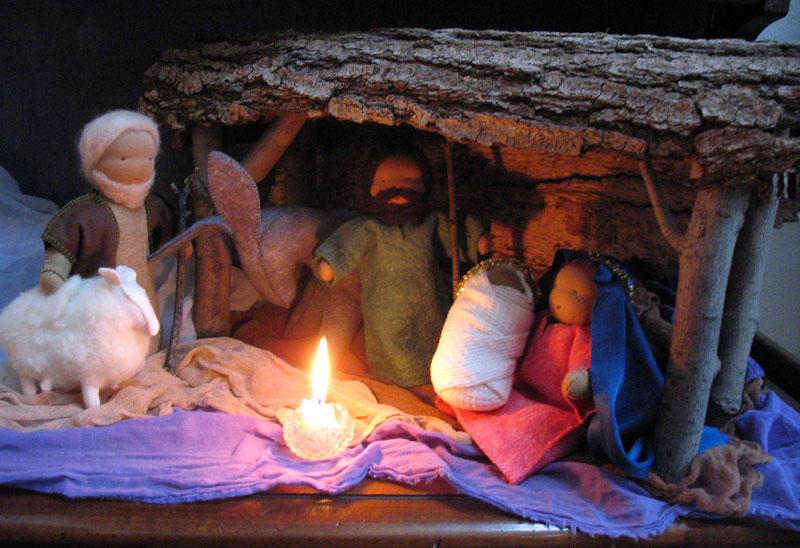
For a long time I wanted a Nativity scene, and several years ago I suddenly realized I might make one myself from stuffed wool felt. My delusional scheme was to create one figure each Advent until we would eventually have a vast elaborate setup resembling the creches of Italy and Provence and the angel tree at the Metropolitan Museum of Art. Except in wool felt.

However, once I had completed the Holy Family, a donkey, a shepherd, and a sheep, and my husband had built a stable from branches and a lovely fragment of bark (thanks, Leah!), the time available for handwork had pretty much evaporated, aside from necessities like sock-mending and the occasional Halloween costume. Perhaps one day…

I wish you all a joyful, loving, and peaceful Christmas.

CakeChrysanthAnn

CakeSprinklesStephanie

Welcome Yule!

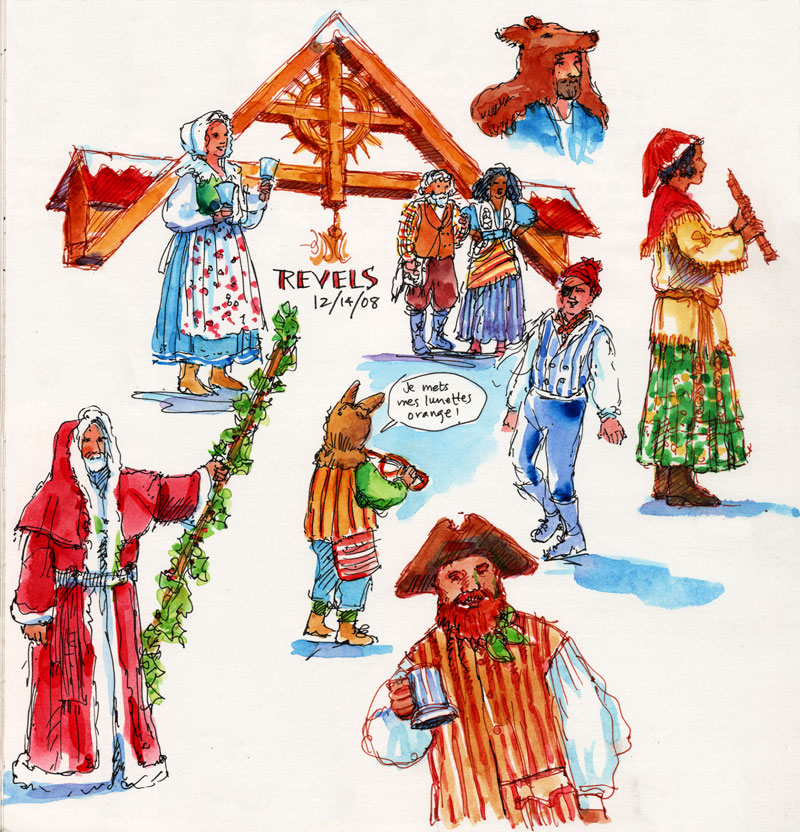
From my sketchbook, a medieval Revels.
RevelsMedieval
And so the Shortest Day came, and the year died.
And everywhere down the centuries of the snow-white world
Came people singing, dancing,
To drive the dark away.
They lighted candles in the winter trees;
They hung their homes with evergreen;
They burned beseeching fires all night long
To keep the year alive.
And when the new year’s sunshine blazed awake
They shouted, reveling.
Through all the frosty ages you can hear them
Echoing behind us—listen!
All the long echoes, sing the same delight,
This Shortest Day,
As promise wakens in the sleeping land:
They carol, feast, give thanks,
And dearly love their friends,
And hope for peace.
And now so do we, here, now,
This year, and every year.
Welcome Yule!

—Susan Cooper


Advent IV: Wrapped in sleep

Here is a verse we sometimes say during Advent before dinner, or as part of our homeschool lesson opening exercises. 

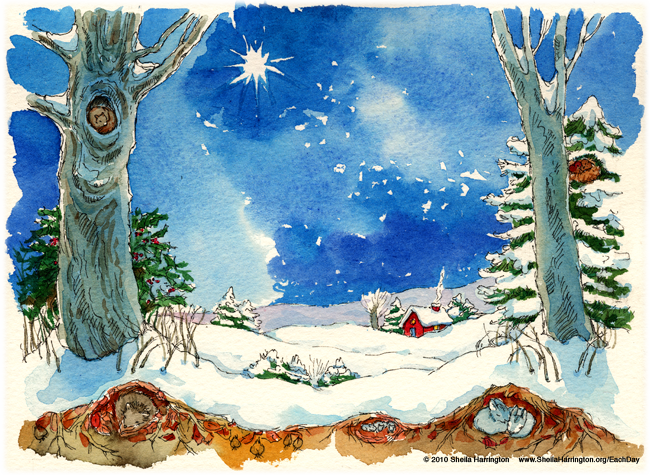
SnowyNight
Now the twilight of the year
Comes, and Christmas draweth near.
See, across the Advent sky
How the clouds move quietly.
Earth is waiting, wrapped in sleep,
Waiting in a silence deep.
Birds are hid in bush and reed
Flowers are sleeping in their seed.

Through the woodland to and fro
Silent-footed creatures go.
Hedgehog curled in prickly ball
Burrows beneath the leaves that fall.
Man and beast and bird and flower
Waiting for the midnight hour
Waiting for the infant’s birth
Down from Heaven, onto Earth.

—Ann Ellerton

This image is available as a high-resolution print on 8.5″ x 11″ archival paper.


St. Nicholas Day: Part 2

(continued from December 6th)

Santa&Moore

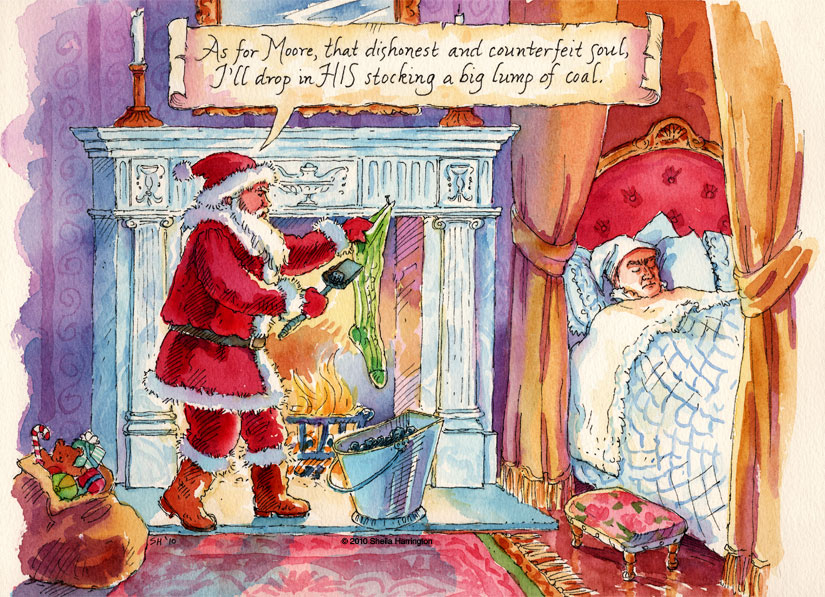
However, after Livingston’s death in 1829, Moore quietly wrote to the newspaper asking if they knew the author of the popular verse, “The Night Before Christmas.” When the editors replied that they did not, as it had been published anonymously, Moore claimed authorship, saying that he had been “too embarrassed” to claim it previously. His surprised and delighted family, and many others, came to believe him.

When Moore later included it in a book of “his” poetry (which actually included several other poems later revealed not to be Moore’s own—tsk, tsk), the astonished Livingston children protested. But would a rich and respected theologian actually LIE about his work? Not to be believed. So nobody did. Livingston’s papers, including his handwritten copy of the poem with its changes and crossed-out passages, had perished in a fire, and the children had no evidence beyond their personal knowledge. Moore later churned out several handwritten copies of his own (not exactly matching Livingston’s original, but what the heck) which eventually sold to collectors for big bucks.

End of story… until the arrival on the scene of Donald Foster, an English professor at Vassar and a well-known textual scholar, who included in his 2000 book Author Unknown a fascinating analysis of the use of language in the work of Moore and of Livingston. His conclusion, built step by step on literary evidence, is that Livingston, and not Moore, authored the poem in question.

But even we lay people, dear reader, can probably deduce this for ourselves by reading further examples of poetry.

For example, contrast with Moore’s grim and foreboding efforts the poem Livingston wrote for his own daughter’s marriage:

‘Twas summer when softly the breezes were blowing
And Hudson majestic so sweetly was flowing
The groves rang with music & accents of pleasure
And nature in rapture beat time to the measure
When Helen and Jonas so true and so loving
Along the green lawn were seen arm in arm moving
Sweet daffodils, violets and roses spontaneous
Wherever they wandered sprang up instantaneous.

And another, in a letter to his brother, praising the sewing of a cousin:

To my dear brother Beekman I sit down to write
Ten minutes past eight & a very cold night.
Not far from me sits with a baullancy cap on
Our very good couzin, Elizabeth Tappen,
A tighter young seamstress you’d ne’er wish to see
And she (blessings on her) is sewing for me.
New shirts & new cravats this morning cut out
Are tumbled in heaps and lye huddled about.
My wardrobe (a wonder) will soon be enriched
With ruffles new hemmed & wristbands new stitched.

The only real benefit from Moore’s perpetrated fraud is that Livingston’s poem has survived for generations to enjoy it. Perhaps now, thanks to Donald Foster, its true author will be recognized.

St. Nicholas Day: Part 1

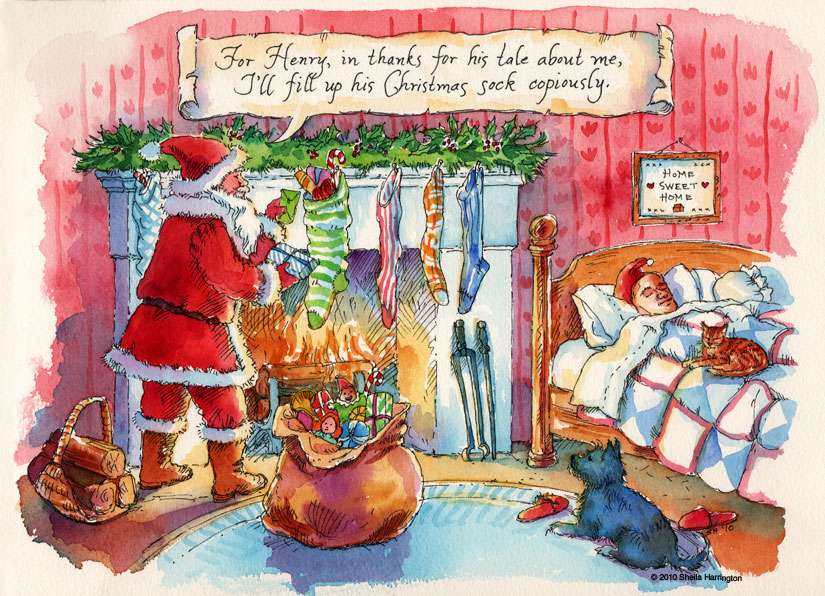
Today is the Feast of St. Nicholas. On the eve of this day, our children put out their shoes, and in the morning each finds therein a golden walnut (we have quite a collection by now) and one or two small gold-wrapped treats. In honor of this day, I post a tribute to the author of “A Visit from St. Nicholas,” Henry Livingston, Jr.

Santa&Henry

“Uh, Henry Who?” you are muttering. “I thought it was written by Clement Clarke Moore.” Well, that’s what Clement Clarke Moore would like you to think, too, unless he has repented his wicked ways in whatever hell is the repository of naughty plagiarists.

Henry Livingston (1748-1829) was born in Poughkeepsie, New York. As a young man he served briefly in the army; later he worked as a farmer and surveyor, and in his spare time wrote poetry and made sketches for the amusement of his large family (eventually nine children). His daughter Eliza wrote, “When we were children he used to entertain us on winter evenings by getting down the paint box… first he would portray something very pathetic, which would melt us to tears; the next thing would be so comic, that we would be almost wild with laughter.”

Some of his work was published anonymously in local papers and journals. One of these poems was “A Visit from St. Nicholas,” which the children recalled their father reciting to them in the early 1800s. It made its way through the family’s various households and it was submitted, as usual anonymously, and printed in the newspaper. In this pre-electronic era, writing and reading poetry were popular pastimes, and there was plenty of dreck going around. But this particular poem was well-received, and it grew in popularity. Livingston died a few years later, unacknowledged as its author, except by his family.

Enter Clement Clarke Moore (1779-1863), a prosperous Biblical scholar in New York and a relative of Livingston by marriage. Moore also dabbled in poetry in his spare time, churning out tracts and verses admonishing children and reminding them to be humble and serious. Here is an excerpt from Moore’s jolly poem “Old Santeclaus,” written from Santa’s perspective:

But where I found the children naughty,
In manners rude, in temper haughty,
Thankless to parents, liars, swearers,
Boxers, or cheats, or base tale-bearers,
I left a long, black, birchen rod,
Such as the dread command of God
Directs a Parent’s hand to use
When virtue’s path his sons refuse.

Or, how about this cheery, romantic poem Moore penned for his daughter on her wedding day:

But oh! how soon we pass this endless track,
That, like perspective art, deludes our view:
And, when we turn and on our path look back,
How short the distance! and our steps how few!

Till death do part, how gaily we repeat
When joy and health are in their prime and strength:
Life is a vista then whose borders meet;
So endless, to our fancy, seems its length.

Trust not the gilded mists and clouds that rise
Where flattering Hope and fickle Fancy reign;
But turn from these, and seek with anxious eyes
The clear bright atmosphere of Truth’s domain.

Moore’s work did not capture the heart of the public. How disappointing.

(continued on December 7th!)


Revelry

Revels08

Every year, on my to-do list for early October is: Buy Revels Tickets.

If you are not already familiar with these wonderful festivals, well, it’s about time.

The Revels was first created for the New York stage in 1957 by musician, teacher, and author John Langstaff as a celebration of traditional seasonal music, dancing, and storytelling. But it was not simply a stage performance. Langstaff realized that many of us are starved for the connection to the seasons that was part of human beings’ lives for millennia but which for the modern plugged-in citizen has largely disappeared.

Our ancestors didn’t buy tickets to watch a harvest festival, or a planting ritual, or a plea to the gods for the return of sunlight; they MADE every festival, with its traditional songs, dances, foods, and tales, all of which grew naturally out of their lives and acknowledged the continual turning of the year with its growth, loss and rebirth, sorrows and joys.

So Langstaff’s Revels straddles worlds old and new, with professionals and amateurs working together, to create events simultaneously entertaining, educational and participatory, in which audience members watch and listen, laugh (and cry), sing, dance, and sometimes join those on stage to work out a skit or song.

After his initial New York show, and a Hallmark Hall of Fame Christmas Masque (in which a young Dustin Hoffman played a dragon!), Langstaff presented a Revels in Cambridge, Massachusetts, and the concept took off. Since then numerous Revels groups have formed around the country, with permanent staff members and lots of eager volunteers, to bring these celebrations to the public, usually one in spring or summer and one near the Winter Solstice.

Langstaff’s first Revels incorporated medieval music, but over the years the repertoire has expanded to include traditional seasonal celebrations from all over the world and from many historical periods. Our family has enjoyed the Revels of India, Russia, Scandinavia, French Canada (from which these sketches), Early America, Victorian and medieval England, Renaissance Italy, and the Celtic world, each with appropriately gorgeous, colorful and meticulously researched music, folklore, customs, sets, and costumes.

This year’s DC Revels is set in Thomas Hardy’s rural England. If, in the midst of this season of darkness, you wish to find light—as well as a couple of hours’ joyful immersion in another time and place—then you are in luck. We always go as part of a great big group (then continue our own Revels afterward with dinner and music), but we didn’t buy ALL the tickets. We left some for you.

CakeChocCurls2Brian

Light the Festive Candles

For tonight, the first night of Hanukkah, a poem.
Dec1
Light the first of eight tonight—
the farthest candle to the right.
Light the first and second, too,
when tomorrow’s day is through.
Then light three, and then light four—
every dusk one candle more
Till all eight burn bright and high,
honoring a day gone by
When the Temple was restored,
rescued from the Syrian lord,
And an eight-day feast proclaimed—
The Festival of Lights—well named
To celebrate the joyous day
when we regained the right to pray
to our one God in our own way.
—Aileen Fisher