Celtic Christmas

CelticChristmas

Today is the feast day of St. Cecilia, my saint-name-day (Sheila being the Irish form of Cecilia). St. Cecilia is the patron saint of music, a fact that has always pleased me—irrationally, considering I have no musical talent beyond the ability to sing lullabies relentlessly for hours to restless children.

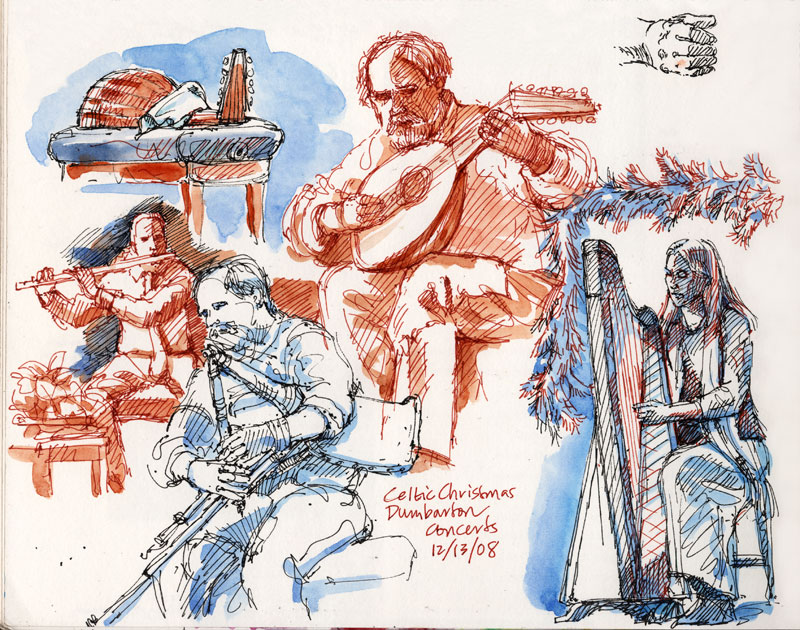
Anyway, in honor of St. Cecilia, I post this tribute to a wonderful holiday concert that my husband and I attend every year with a group of friends: Celtic Christmas, at Dumbarton Church in Washington, DC. This concert is difficult to describe. It takes place by candlelight in a beautiful old church in Georgetown, and includes traditional seasonal music, unusual obscure pieces, and original compositions, which vary from year to year. The incredibly diverse Linn Barnes plays lute, guitar, banjo, harp-guitar, and Uillean pipes. Allison Hampton plays Celtic harp as if descended from on high to share the music of the spheres. Their performances are heightened and deepened by those of amazing flutist Joseph Cunliffe and percussionist Steve Bloom.

Pieces are interspersed with Barnes’ anecdotes both serious and humorous providing historical background (here is a man serious about music). Other pieces are accompanied by Robert Aubry Davis reading evocative seasonal poetry and prose that he researches especially for the concert (here is a man serious about literature).

This annual event sweeps us into the spirit of a joyful yet poignant Christmas. We depart expecting to step out into softly falling snow, listening for sleigh bells, the call of the heavenly host, and the distant howl of a wolf.

CakeDaisiesAunt Marge

Yahrzeit2Patricia

Yahrzeit2John Fitzgerald Kennedy

Shichi-Go-San

GirlSeven

I don’t know what life in Japan is like for grown-ups, but for little children it looks pretty idyllic. Once young Japanese reach The Age of Reason, expectations for academic achievement and responsible, community-oriented behavior are quite high. But until then, Japanese (and other) children are cherished, admired, and doted-upon. Storekeepers, gas station attendants, and truck drivers keep handy stashes of sweets and tiny toys should some little one toddle by. Children are dressed in impossibly adorable clothes. Mothers are experts at the “distract and re-direct” method of discipline rather than giving the outright NO. It’s a world of bliss. When we visited our son during his stint of teaching in Japan, our daughter, then age eight, was so relentlessly and universally coddled that it’s a wonder she was willing to return home with her mean old parents.

Today is the Japanese autumn festival of Shichi-Go-San, which translates as “Seven-Five-Three.” It is a rite of passage for children. On this day (or the nearest weekend), girls age seven, boys age five, and boys and girls age three dress in traditional garb, perhaps for the first time (although this is unfortunately giving way to Western clothing) and visit Shinto shrines with their families to pray for good health and long life. Afterward the children are given “thousand-year-candy” packed in wrappers decorated with turtles and cranes, both symbols of longevity.

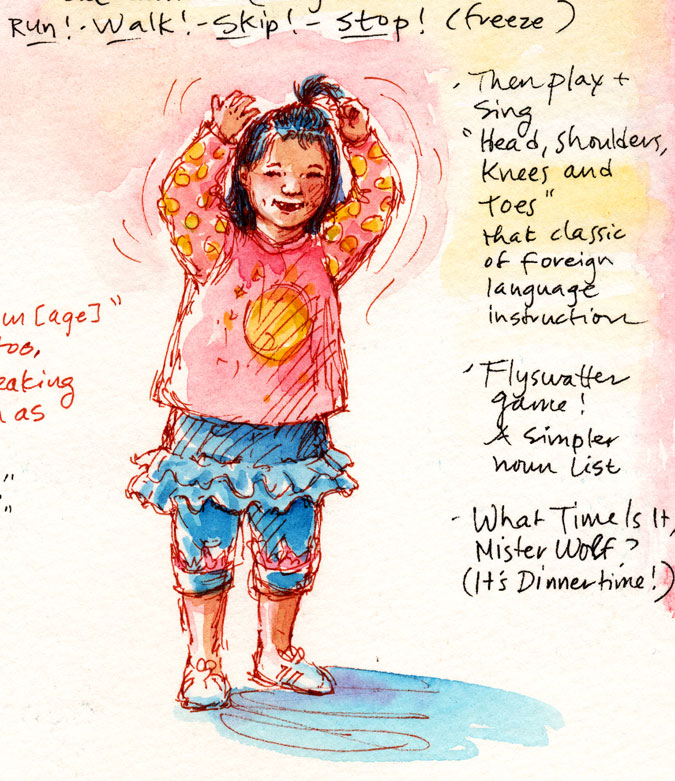
We weren’t visiting during Shichi-Go-San (although when I was seven and living in Japan I did attend the festival, appropriately attired in kimono and obi, but that’s another story). So I post this sketch of a little girl from one of my son’s classes, with the typical seven-year-old gap-tooth smile, playing one of their English-language games.


Free as a Bird

Today, after spending fifteen of the past twenty-one years under house arrest in Burma (misleadingly renamed “Republic of the Union of Myanmar” in 1989 by the psychopathic reigning military junta), the brave and resilient Aung San Suu Kyi (b. 1945) has finally been released.

Heron-Dock

Aung San Suu Kyi is the daughter of Aung San, who was considered the father of the movement for Burmese independence from Great Britain. After fighting with the British against the Japanese in WWII, Aung San and his colleagues successfully negotiated Burma’s freedom, completed a new democratic constitution, and founded a transitional government, whereupon most of them were assassinated by political rivals.

After her father’s assassination, Suu Kyi was raised by her mother, who herself became active in the new government. The fledgling democracy struggled, torn by disputes among factions, paving the way for a military coup in 1962 from which it has never recovered. Over the years the junta, though occasionally rearranging its participating hoodlums, has nevertheless successfully implemented their apparent plan to destroy all human rights and run the economy into the ground. Intermittent struggles for greater freedom and participatory democracy have been routinely crushed.

After the coup, Suu Kyi studied and worked abroad for several years, married, and had two sons, but when she returned to Burma in 1988 to care for her ailing mother, she became involved in the pro-democracy movement. That year saw mass demonstrations and the founding of a new political party, the NLD (National League for Democracy), which, unlike some self-described democratic movements, actually aspired to the establishment of genuine democracy. The junta responded to its citizens’ calls for Change by killing thousands of them. Count your blessings, USA. Many left Burma altogether (eventually including Suu Kyi’s husband and children). Suu Kyi, who helped found the NLD and became its leading candidate, was briefly put under house arrest, a punishment that would become familiar.

Having tidied up the place a bit, the military junta then called for general elections in 1990, naively believing that their fabulous management would render them universally popular. To their astonishment, the NLD won 59% of the vote, giving them 82% of the seats in Parliament and Suu Kyi the office of Prime Minister. The junta promptly declared the election results void and, despite international protests, put Suu Kyi back under house arrest, where she has mostly remained, with occasional trips to prison or the hospital or inexplicable brief periods of limited freedom to move about.

Suu Kyi has handled her confinement with incredible strength and grace, maintaining, when she can, contact with those few friends and colleagues who have been permitted to see her. Her time has been spent writing for the encouragement of her people, when she has had the materials to do so. House arrest effectively put an end to her family life, as she was informed that if she were ever to leave the country, she would not be allowed to return, obliging her to choose between a comfortable and free family life elsewhere and the continued struggle for the future of her fellow citizens. And she chose the latter. Her husband died of cancer in 1999, having been denied permission to visit his wife one last time.

Suu Kyi, an avowed Buddhist, has never advocated violence but only adherence to Burma’s democratic constitution and improvement in the lives of the Burmese people. While detained, Suu Kyi has been awarded numerous awards for her relentless yet peaceful struggle, including the 1991 Nobel Peace Prize (the prize money was used to set up a health and education trust for the Burmese people).

The government has not prevented her from writing, perhaps feeling it gives them an illusion of magnanimity. Several books have been published abroad (unavailable in Burma, obviously), one of which, Letters from Burma, written for a Japanese newspaper column, covers 52 weeks of life in Burma with subjects ranging from national festivals to sharing tea to government craziness, with delightful vivacity, humor, poignancy, and everlasting patience.

Supporters around the world rejoice at her release, but also express concern. Freedom for Suu Kyi is not really free. She is always at risk, a potential target for government operatives and their hirelings. She immediately spoke up for thousands of other Burmese political prisoners who have been similarly detained, imprisoned, or attacked, and to support an investigation into Burma’s recent rigged elections. (In Burma to support such an investigation is illegal.) Thus is the wild heron always at risk, from storms, enemies, and unexpected danger. But like the heron Suu Kyi carries on fearlessly. May she also enjoy her breath of freedom, fly strongly, and live long.

CakeAutLeavesMartha

Veterans Day/Martinmas

MartinmasVet

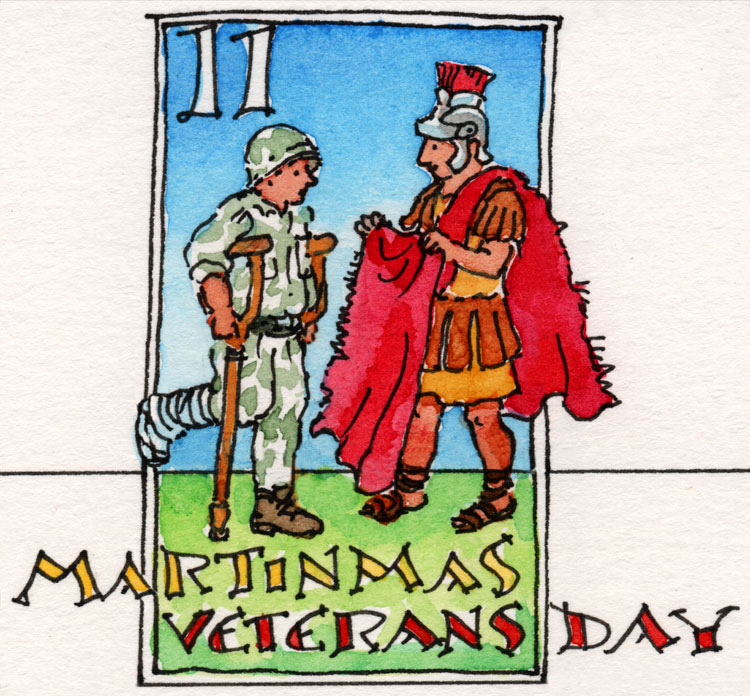
Today is Veterans’ Day, instituted first as Armistice Day after WWI, then Veterans’ Day after WWII (although my mother occasionally still called it Armistice Day) as a tribute to veterans of both world wars. It’s also the Feast of Martinmas, which is less well known in this country, although having been raised Catholic I grew up familar with the story of Saint Martin of Tours. It seems somehow fitting that Veterans Day is celebrated on the festival of a former Roman soldier.

Martin was born in the 4th century in what later became Hungary but what was then Pannonia, a province of the Roman Empire. His father, an important officer in the Roman army, naturally expected his son to follow in his footsteps (Martin had been named for Mars, the god of war, presumably to encourage that military spirit). But apparently young Martin was an easy-going, sociable fellow, more curious about strangers (and generous with handouts) than aggressive toward them, so to get him into the army his father arranged for his kidnapping and forcible enlistment by his soldiers, hoping that Martin would grow accustomed to military life through daily exposure. I bet Dad didn’t get many loving letters from the front. Today this method of recruitment is frowned upon.

However, there was Martin, a soldier at last, obliged to serve the Emperor for three years, outfitted with a Roman uniform and a sword. Even in the army, Martin was open-handed, and his military salary usually found its way into the hands of the unfortunate. His unit was sent to Gaul, as part of an ongoing attempt to civilize the native barbarians. Civilization in Gaul was eventually attained at a level far beyond their wildest dreams, but that’s another story.

One winter day, the story goes, Martin arrived at the gates of Amiens, where he encountered a poor ragged beggar shivering by the side of the road. Martin had already given away all his extra clothing, but, taking pity on the beggar, Martin unsheathed his sword and cut his warm woolen (army-issue, uh-oh) cloak in half and wrapped one half around him.

That night, Martin dreamed that Jesus appeared to him wrapped in Martin’s half-cloak saying, “Martin has covered me with this garment.” This made him determined to leave the army permanently, at the end of his term. When he attempted it, however (inconveniently during a barbarian invasion), he was accused of cowardice, in response to which he offered to advance alone against the enemy. Instead he was imprisoned. Eventually he was released at the conclusion of an armistice, and was finally able to pursue his vocation, settling in Gaul, founding an order, living very simply and developing a reputation for feeding the hungry and healing the sick.

Over the years our homeschooling group has celebrated Martinmas (sometimes in combination with Diwali, Festival of Light, which can occur at around the same time—this year it falls on the 12th) with storytelling, a night-time walk in the park carrying lanterns and singing songs about light, and afterward gathering to share dessert. Happy Martinmas! Happy Diwali! Happy Veterans Day, everyone!


Día de los Muertos

First paper cutouts, now dough…you must think I’ve forgotten how to draw.

PanDeMuertos

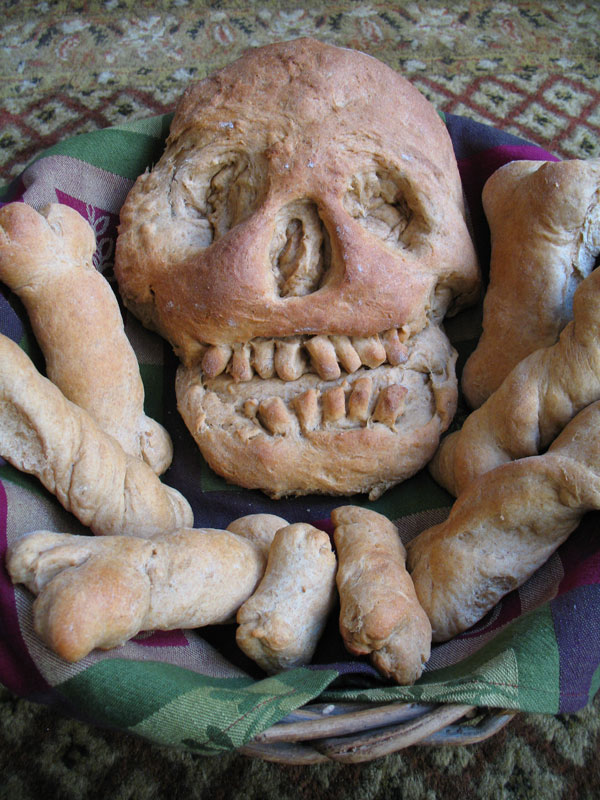
Today is All Saints Day, also known as Día de los Muertos in Latin American countries. For the last several years our homeschooling Spanish class has celebrated this day together. We set up a table and decorate it with autumn flowers and leaves, papel picado, and photographs and mementos of those who have crossed over (parents, grandparents, pets, anyone beloved). My daughter and I bake a huge anise-flavored Pan de Muerto—a skull surrounded by bones. The mother who teaches Spanish reads aloud a story about the day, written from a child’s point of view. We all sing “Hasta los Muertos Salen a Bailar” (“Even the Dead are Rising Up to Dance”) which is a really hard song to stop singing all day long once you’ve sung a few rounds. Then each family comes to the table, lights a candle, and says a few words about their loved ones, and the festival concludes with a skull-and-bones snack. Although the children devour the bread with enthusiasm, I think they actually appreciate the entire event, especially as each year brings more shared losses into our lives.

Boooo!

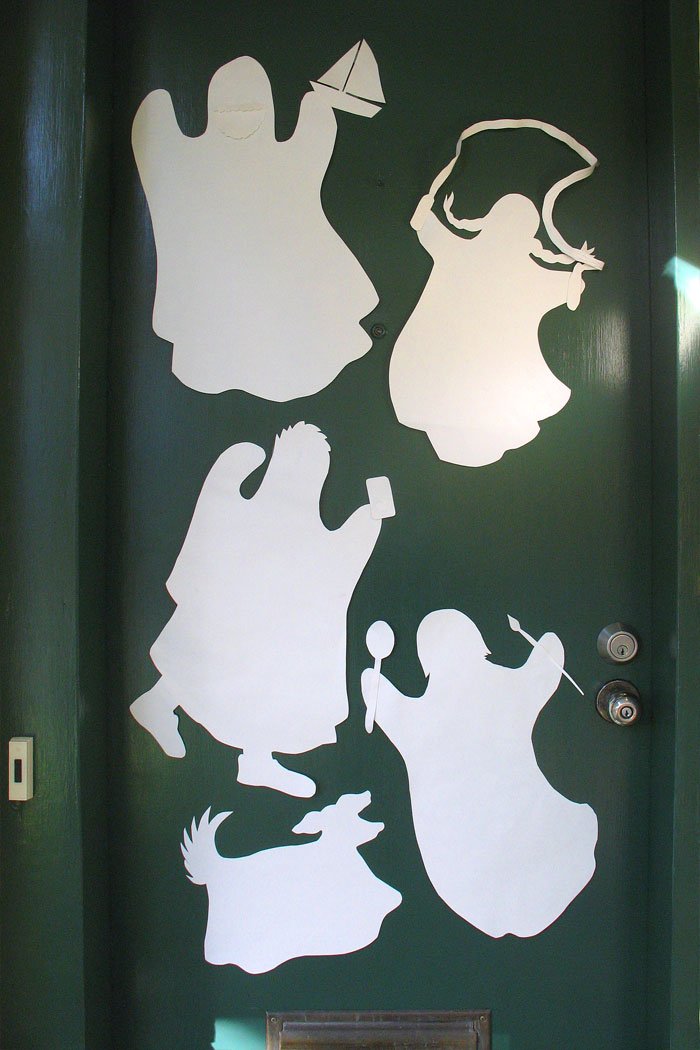
Here’s an art form I don’t use too often but which comes in handy for large-scale decorating in a hurry—big white paper cutouts. This is our frightening Halloween front door, featuring the ghost family: Dad with mini-version of boat he is building; Sis with energetic jump-rope; Bro with faithful iPhone; Mom with paintbrush and spoon; and the world’s least scary Dog, unless you fear relentless licking.

HalloweenDoor2010

United Nations Day

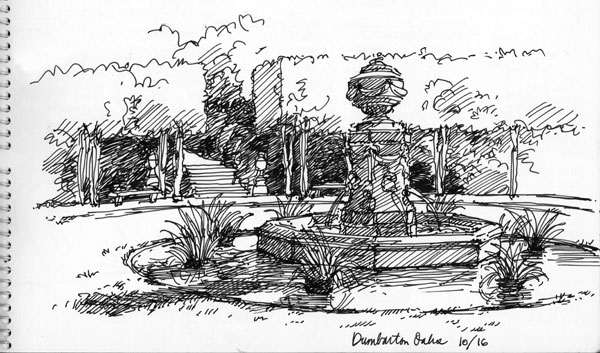
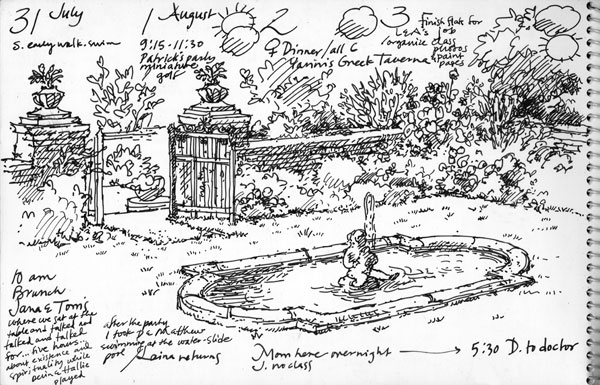
These drawings are from a couple of sketchbook-journals carried on visits to the beautiful gardens of Dumbarton Oaks in Georgetown, Washington, DC. However, I post them not for the sake of those lovely gardens themselves (to which the sketches don’t do justice) but in honor of today’s anniversary of the ratification of the charter for the brand-new United Nations. Perhaps some of you folks out there already knew that the foundation of its charter had been hammered out at Dumbarton Oaks. I only learned it recently.

DumbartonFountGrey

DumbartonPoolGrey

Dumbarton Oaks, built in 1801 as a private home, was purchased in 1920 by diplomat Robert Bliss and his wife Mildred. With Beatrix Ferrand they created the fabulous gardens and renovated the house, adding a music room for concerts and lectures, and a museum for their art collection. In 1940 they gave the property to Harvard University.

Although in 1940 the United States had not yet even officially entered the Second World War, entities private and governmental were already discussing the possible creation of a post-war international peacekeeping organization—but secretly, because of the strong isolationist, anti-League of Nations element existing in the country. Isn’t it amazing what significant matters we managed to keep secret in a pre-Internet era?

FDR first offered the optimistic term “United Nations” to refer to such an organization in a 1942 Declaration composed at the Arcadia Conference by the USA, the UK, the USSR, China, and twenty-two other countries to lay out their common goals during and after the war. Other nations signed on later. Bliss, speaking for Harvard, offered the use of Dumbarton Oaks as a possible location for future talks. This setting was deemed suitable, and the offer was accepted.

So, between August and October, 1944, representatives of the USSR, the UK, the USA, and China (although never with the USSR and China at the same table at the same time!) gathered at Dumbarton Oaks to wander the lawns, dine in the Orangery, and sit in the music room for a series of discussions. At their conclusion, the four nations had agreed upon a series of proposals which, along with provisions born of the Yalta conference, formed the basis for the new United Nations Charter, which was signed in San Francisco on October 24th, 1945.

Among the goals were these: The development of friendly international relations. The strengthening and maintenance of international peace and security. The removal of threats to peace through collective cooperation. And collective measures to solve economic and humanitarian problems.

What an impressive and inspiring global perspective, especially for a species that only a few thousand years earlier routinely regarded an unfamiliar tribe as the enemy. (This antiquated response is occasionally observed even now.) May we see these goals one day fully realized.

CakeDaisiesEugenie

Yahrzeit2Aunt Mary