Maid of Orléans

No one really knows precisely when Joan of Arc was born. But January 6, 1412 is traditionally recognized as the date, making today the 500th anniversary of her birth, the quincentennial celebration of her mysterious, heroic, and too-short life.

DomremyHouse

The outlines of the story are generally recognized: A pious girl from a rural family, in response to visions and voices she explained as those of saints and angels, approached the Dauphin, the future Charles VII, during the Hundred Years’ War, and convinced him to allow her to aid France.

Given a suit of armor and a banner with fleur-de-lis, she led newly-inspired French troops (who had formerly declined to follow the feckless and irresolute Charles into battle) to expel the English and Burgundians from her then-small country. Her successes in battle, and in eventually arranging for the coronation of the Dauphin in Reims, greatly encouraged the French, but alarmed the Burgundians and infuriated the English, who, when they finally had Joan in custody, burned her at the stake as heretic and witch and raked her ashes into the Seine to prevent the collection of relics—an indication of awareness that they had murdered an innocent. She was nineteen. Detailed records of her trial, painstakingly kept by the court, reveal to us Joan’s simplicity and humility, in contrast to the narrow-minded and vengeful scheming of her assorted judges.

These same records were made use of to acquit her posthumously later under Charles’ rule—for him it was politically expedient to have been crowned with the aid of a courageous maiden instead of a condemned witch. During the acquittal process the testimony of numerous witnesses reveals the original trial’s illegal and corrupt maneuverings.

How was an untrained teenage country girl able to lead dispirited soldiers in the wake of a string of defeats (notably Agincourt in 1415) to win a series of battles and break through enemy lines to see her king crowned? What was the nature of Joan’s voices? To this day much of her story remains unknown and a subject of speculation for historians, psychotherapists, artists, novelists, playwrights, and filmmakers. Statues of Joan are to be found all over the world, including here in Washington, DC, a gift from the Ladies of France in Exile in New York in 1922 and the only equestrian statue of a woman in the city. (There are actually only a handful of equestrian statues of women to be found anywhere, and probably more of Joan of Arc than any other.) As of 1920, Joan became—after five hundred years (the Catholic church moving with its customary excruciating slowness)—Saint Joan.

The image of Jeanne d’Arc has been co-opted, ironically, by the French extreme right, who more properly ought to take as their symbol a 15th-century right-winger: the manipulative and self-absorbed Duke of Burgundy, who turned Joan over to the English to maintain his power; the misogynist cleric Pierre Cauchon, who was fixated on Joan’s wearing of male attire; or the avaricious English themselves, whose desire for the French throne had been humiliatingly waylaid by an upstart female. The ultra-conservative Front National is no place for unconventional Joan, who defied societal expectations, suffered in battle and in prison, and died for her efforts.

The sketch is from a visit to the house in Domrémy thought to have belonged to Joan’s family.

Today is also the Feast of the Epiphany, the day on which, according to tradition, three wise men from the East carried gifts to the infant Jesus. For another take on this event, please see The Three Wise Women.

The Feast of the Epiphany is also the birthday of Carl Sandburg (1878-1967). For a comic and a poem, please see Poetic Journey of the Magi.

CakeStarsNathan

Of Two Worlds

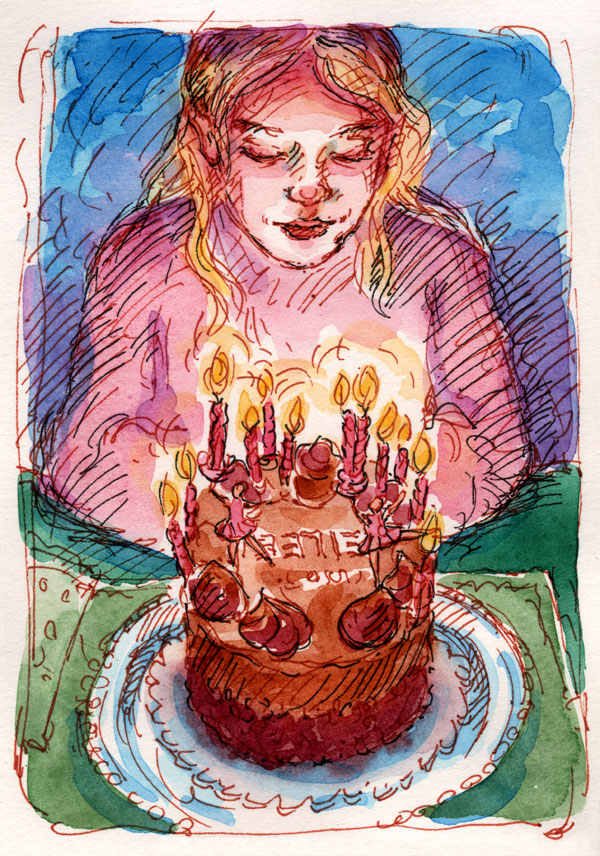
Here is my daughter blowing out her birthday candles last year. Today she enters her teen years (!), chronologically leaving childhood behind; yet in reality she is straddling two worlds. In her are blended right now the growing thoughtful awareness and surprising wry humor of a young woman, and the openheartedness and generous, candid spontaneity of a child. It’s a sometimes-challenging but always-engaging time. In honor of her day, I post this poem by Sharon Olds, as it describes a malady my daughter shares. Happy, happy birthday, dear one.

ECS12Candles

Diagnosis
By the time I was six months old, she knew something
was wrong with me. I got looks on my face
she had not seen on any child
in the family, or the extended family,
or the neighborhood. My mother took me in
to the pediatrician with the kind hands,
a doctor with a name like a suit size for a wheel:
Hub Long. My mom did not tell him
what she thought in truth, that I was Possessed.
It was just these strange looks on my face—
he held me, and conversed with me,
chatting as one does with a baby, and my mother
said, She’s doing it now! Look!
She’s doing it now! and the doctor said,
What your daughter has
is called a sense
of humor. Ohhh, she said, and took me
back to the house where that sense would be tested
and found to be incurable.

— Sharon Olds

CakeSnowmanEileen


Prince and the Pauper

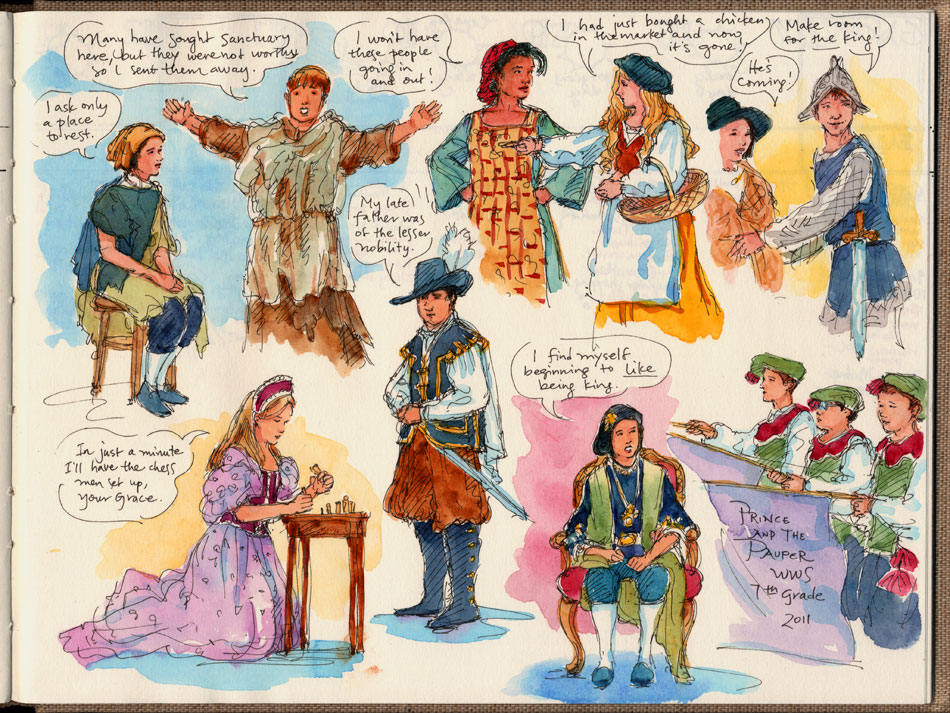
I sat in one day on a rehearsal of my daughter’s class play and surreptitiously made some sketches. Having seen a number of middle school plays over the years in which the objective seems to be to finish and get off stage as fast as possible, I was struck by the students’ expressiveness, pacing, and evident understanding of their roles.

Prince&Pauper

A Stately Pleasure Dome

If the word “Xanadu” happens to come up at our dinner table (and doesn’t it come up from time to time at yours?) we can count on our son’s launching into Coleridge’s “Kubla Khan,” which he memorized at some point due to sheer fascination with the language.

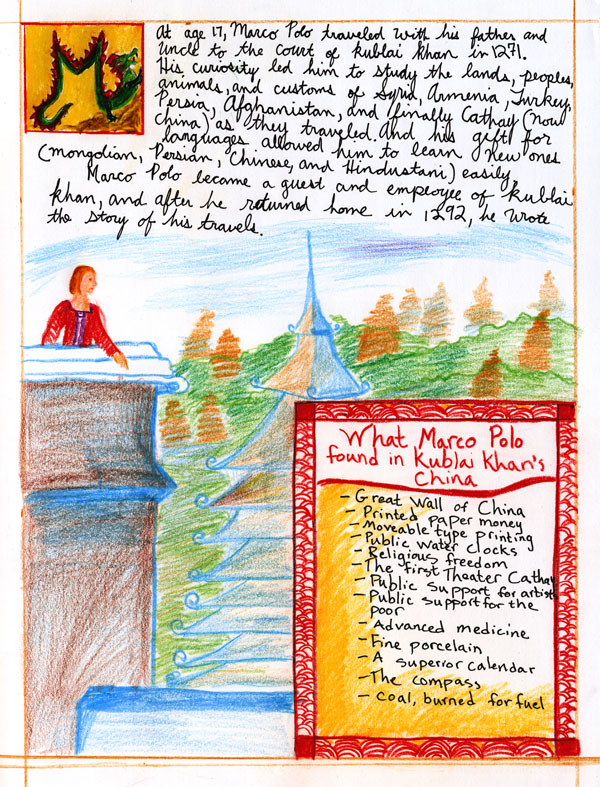
Today is the birthday of Samuel Taylor Coleridge (1772-1834), and in his honor I post the opening lines of that poem. Along with it I post my daughter’s drawing, from our homeschooling Middle Ages block, of the rooftops of Xanadu, the summer residence of Kublai Khan (grandson of Genghis Khan), who ruled China during the years of Marco Polo’s visit and subsequent years of service to the Khan.

MarcoPolo

Cambalu, the winter capital, grew quite hot in summer, so Kublai had a northern marshy river valley drained and transformed into a vast park of gardens, teahouses, terraces, and winding waterways for pleasure boats and wild birds. (Here is Marco surveying the scene from a rooftop.) At its center was the palace of polished bamboo painted with vermilion and gold and elaborate murals.

Xanadu was destroyed in the 14th century, but Marco Polo’s descriptions were familiar and inspirational to later writers, one of whose works (Samuel Purchas’ 1613 Purchas His Pilgrimage) Coleridge had been reading one summer day in 1797 before falling into a deep, some say drug-induced, sleep. While he slept, Coleridge “dreamed” the poem as a series of vivid and haunting images and phrases, which he instantly wrote down upon awakening.

In Xanadu did Kubla Khan
A stately pleasure-dome decree:
Where Alph, the sacred river, ran
Through caverns measureless to man
Down to a sunless sea.
So twice five miles of fertile ground
With walls and towers were girdled round;
And there were gardens bright with sinuous rills,
Where blossomed many an incense-bearing tree;
And here were forests ancient as the hills,
Enfolding sunny spots of greenery…

For the rest, please see Poetry Out Loud. You will want to memorize it, too.

For another Coleridge poem, and a painting, please see Thou shalt wander like a breeze.


Rainy Day Joys (Left Side)

What a pleasure to have a mostly-rainy week whose only rhythms are three daily meals and walking the dog. (And many hands make light work.) Early walks, followed by a little recorder, or sketching, or a game of cards, or curling up with a book. With a pot of split pea soup simmering on the stove.

DeepCreekWeekL

CakeSprinklesAnne

CakeChocCurls2Eli

O Roma Nobilis

According to tradition and Edward Gibbon, September 4th, 476 is the date fixed for the fall of the Western Roman Empire. (The longevous Eastern Roman Empire had mostly been ruled separately since Diocletian’s reign, 284-305, and would hang on by its fingernails until the conquest of Constantinople by the Ottoman Turks in 1453).

In reality the fall of the Empire was more of a gradual deterioration over time, like arthritis, or a growing tendency to misplace the car keys. It took hundreds of years of bad decisions, bad luck, and bad weather for the glories of Roman engineering and culture to crumble into temporary but lengthy obscurity. But September 4th was the day on which the Germanic chieftain Odovacar and his followers bashed their way into Rome and removed the lad Romulus Augustulus from his throne, sending him into early retirement. Officially, and poetically, Rome began and ended with a Romulus.

ORomaNobilis

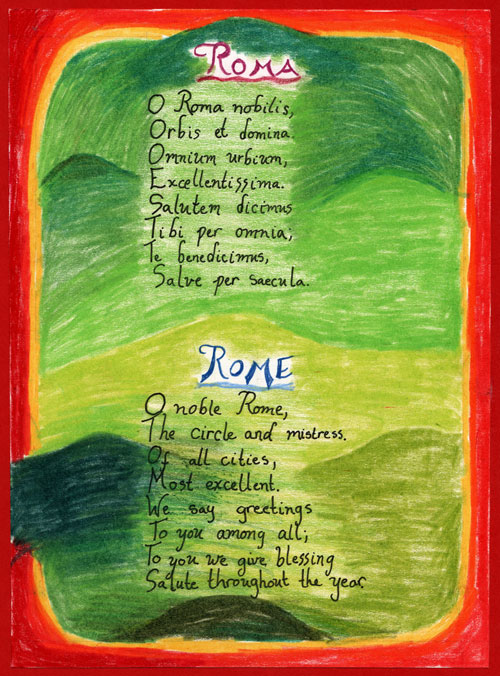
On this day of remembrance, I post a verse from my daughter’s Ancient Rome main lesson book, which we included in morning exercises while covering that block. Composed in the 9th or 10th century by an unknown author, it was supposedly sung by pilgrims trudging toward Rome. Perhaps pilgrims of the 25th century will chant a verse in the dead language of English as they make their way to New York or Washington DC.

About the Basin I Will Go

TidalBasinCherry

Despite the cold, my daughter and I bundled up and betook ourselves and the dog to the Tidal Basin just after sunrise for our annual cherry blossom breakfast. The blossoms seem unusually beautiful this year—extraordinarily cloudlike, illusory, celestial—worth every shiver. Gazing upward as we nibble our scones, it’s easy to forget the day of work and school that lies ahead of us. A serious photographer and three mallard ducks are our only companions, until the tour buses arrive.

For another cherry blossom picture, and a beautiful springtime verse from Song of Solomon, please see Cherry Blossom Breakfast.

CakeChocCurls2Saul