Now be honest. How often have you celebrated the birthday of Grover Cleveland? I thought so. Well, this is a first for me too. But it’s about time, because THIS Grover used to live in our neighborhood, as we learned during a Local History and Geography homeschooling lesson.
Cleveland (1837-1908), our 22nd AND 24th President, was born on this day in Caldwell, New Jersey, one of the nine children of a Presbyterian minister. When he was 16, his father died, and Cleveland left school to help support the family. From that point his career followed such an uneventful path that one would not imagine it arriving at the White House: assistant teacher… scribe… secretary.
Then a position as law clerk in Buffalo led to his admission to the bar without his ever actually having attended law school. Or any university. Or finishing high school. Yet he launched what turned out to be a prosperous law career. (Aren’t you just kicking yourself, you lawyers, for frittering away all that money on your education?) Well, what else was there to do after that but… run successfully for sheriff, and then Mayor? And Mayor Cleveland’s refusal to award city contracts based on political connections was remarkable and unusual enough to establish his reputation for honesty, and propelled him next into the Governor’s seat.
As the Presidential primaries loomed in 1884, the Democrats, who had not won a Presidential election since before the Civil War, eyed the blunt outspoken Cleveland as a possible challenge to the series of weak and corrupt Republican administrations with which the public was disgusted. Reformist Republican voters (“Mugwumps”) deserted their party to help put Cleveland in the White House. That’s what this country needs. More Mugwumps.
Cleveland sent shock waves through his supporters when he announced that his appointments would be based on ability rather than loyalty or party affiliation. What a concept. He also used the Presidential veto freely, especially when a bill called for profligate or potentially fraudulent spending. The most contentious issues of his Presidency were protective tariffs (he was skeptical) and the gold standard (he supported it). Ongoing disputes and enemies made over these issues led to his supposed defeat by Benjamin Harrison in the 1888 election. (Acknowledged fraud achieved Cleveland’s loss of electoral votes in key states, although he won the popular vote.) The ruinous policies of the Harrison administration, however, led to Cleveland’s re-election in 1892, leaving him to deal with the resulting crises of bank failures, economic depression and unemployment. (Hmm, where have I heard that before?)
When he entered the White House, Cleveland was a bachelor, but he had the responsibility to supervise the upbringing and education of Frances Folsom, the daughter of an old friend who had passed away and named Cleveland as executor of his estate. Cleveland must have thought she turned out pretty well because in 1885 he asked her to become the First Lady. She was 21, beautiful, and charming—he was 49—the media and the country went wild. The wedding took place in the White House with John Philip Sousa conducting the Marine Band. Frances, the youngest-ever First Lady, was extremely popular, and the activities of their growing family were followed eagerly. Baby Ruth had a candy bar named after her.
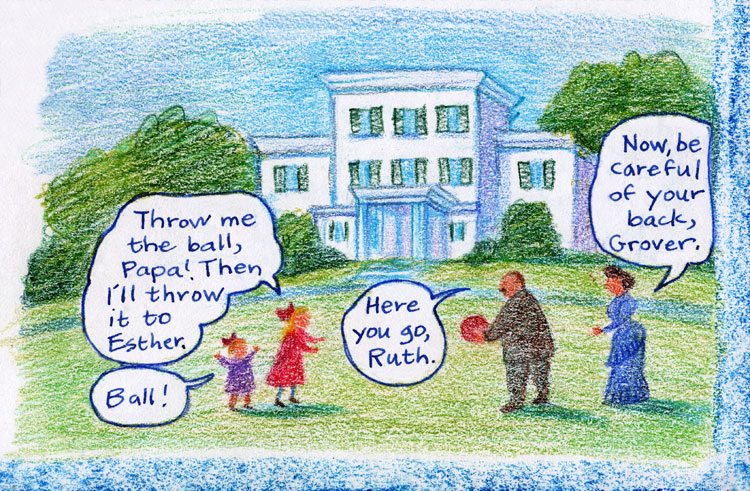
Which brings me back at last to the neighborhood. In his first term, the Clevelands modernized Oak View, a country farmhouse in northwest Washington, to use as a retreat, and Cleveland commuted downtown by buggy. Unfortunately the house has since been razed, but his presence gave the name Cleveland Park to the neighborhood. In his second term, the Clevelands, now a family, rented Woodley, the mansion built in 1801 for Philip Barton Key (Francis Scott Key’s uncle), as a summer home, where the children could enjoy peace and quiet and country air far from the bustle of the White House. This house still stands and is currently Maret School. Now, whenever I stroll by, I imagine the little Clevelands cavorting on the lawn.