Saved by the Bell

AGBellApps

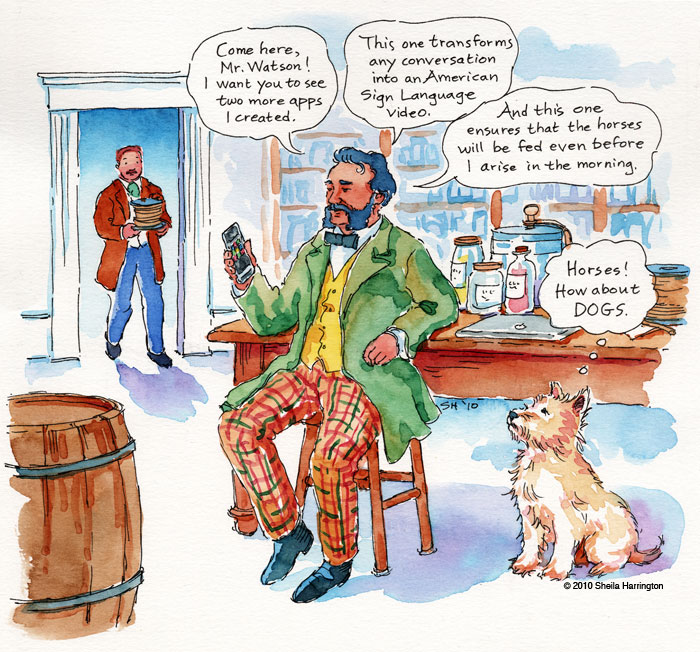
Today is the birthday of Alexander Graham Bell (1847-1922), whom many may think of as American but who was actually born in Edinburgh, Scotland (he later became an American citizen). Bell was practically destined for his future work, given his background—grandfather a speech teacher/researcher/writer, and father an elocution specialist who developed something called “Visible Speech,” a sort of alphabet of lip, throat, and tongue positions used in talking, in order to train deaf people to speak. Those were the days when use of the hands while speaking—even if you weren’t deaf—was considered unseemly in Anglo-Saxon culture. Humph.

A bright, curious, inventive boy anyway, interested in mechanics, botany, and music, he took up the family passion: the study of speech. Even his own mother’s growing deafness was an encouragement. He was homeschooled for a while, then sent for a few years of formal education, culminating in a combined learning/teaching career, but he always pursued his own experiments on the side. After Bell’s two brothers died of tuberculosis, his alarmed parents decided to take their sole remaining son, always delicate, for a cure. Where? To the Swiss Alps, you ask? No… to Canada! where they bought a farm on a river and converted a carriage house into a workshop for Alexander’s tinkering. It did the trick. Parents, take note.

Bell went on to a career of teaching deaf pupils in Boston, but carried on his experiments, and eventually succeeded in producing, with assistant Thomas Watson, a “harmonic telegraph”—the telephone; founding Bell Telephone Company; and going on to create the metal detector, the wax recording cylinder (later used in the phonograph), and the first, and very successful, hydrofoil boat.

It’s hard to imagine a world without Bell’s telephone. Perhaps it was inevitable—others were exploring along the same lines—but it doesn’t diminish the wonder of his accomplishments and of his lively inventive being.

So go call your Mom, and wish her a Happy Alexander Graham Bell’s Birthday.


Oh Canada…Oh Henry

RiverCropped

Aren’t you sometimes struck by a peculiar conjunction of events in your life? This is what’s happening here now:

1. The Olympic Games taking place in Vancouver are wrapping up. Every night we’ve had views of the fantastically beautiful British Columbia.

2. In our current homeschooling block, North American History and Geography, we now happen to be studying Canada, at this moment the Great Expulsion of 1755, when the French residents of Acadia (renamed Nova Scotia) were forcibly removed by the British.

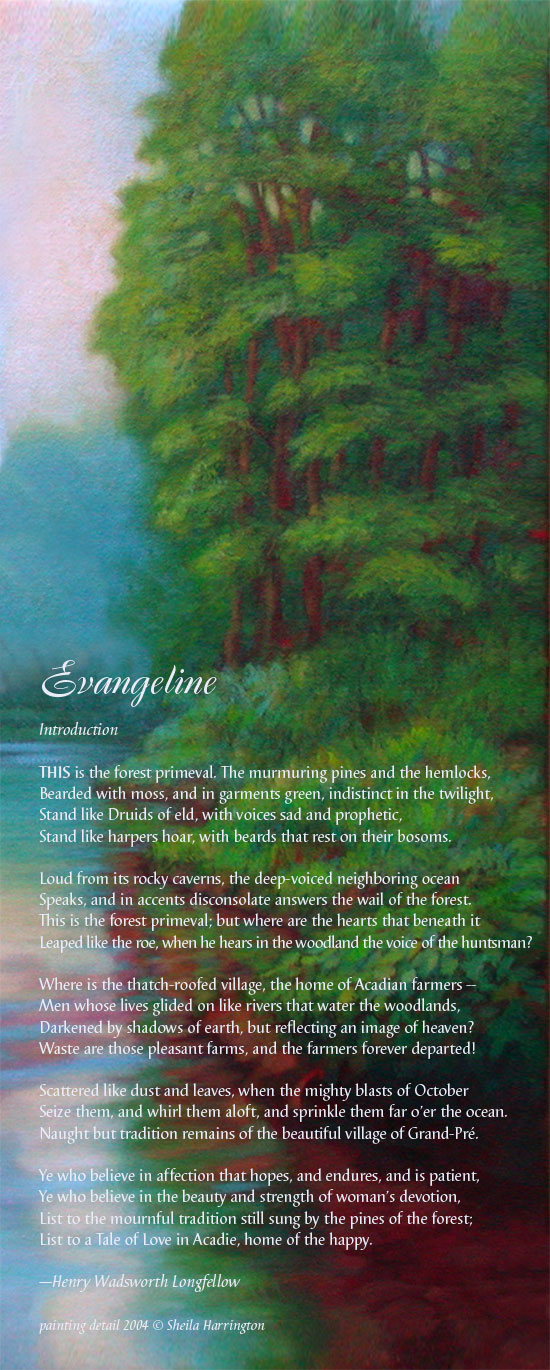
3. We are reading “Evangeline,” the poetic interpretation of that event through the story of two ill-fated lovers, by Henry Wadsworth Longfellow.

4. Today is Henry Wadsworth Longfellow’s birthday (1807-1882).

Longfellow was born actually not far from the setting of the poem, in Maine when it was still part of Massachusetts. He hoped when still in his teens that his would be a literary path, and it was—professor of languages at Bowdoin and Harvard, translator of Dante, novelist, and, in his day, probably the most popular of American poets. He was admired for his character as well as for his work. Twice widowed tragically and never recovered from his grief, he nevertheless forged on, productive, kindly, modest, and gracious in the face of later artistic criticism.

His poetry is definitely that of another era: strongly rhythmical, musical, metaphorical romantic storytelling with a capital S. You can’t listen to “Paul Revere’s Ride” or “The Song of Hiawatha” or “Evangeline” without being carried away on the current of vivid word-pictures and harmonious sound, and chanting under your breath at odd moments during the day: THIS is the FORest primEVal… It is poetry meant to be read aloud. If you haven’t ever done so, read the opening lines aloud now in your best storytelling voice, and wish Longfellow a Happy Birthday.

Literary Washington

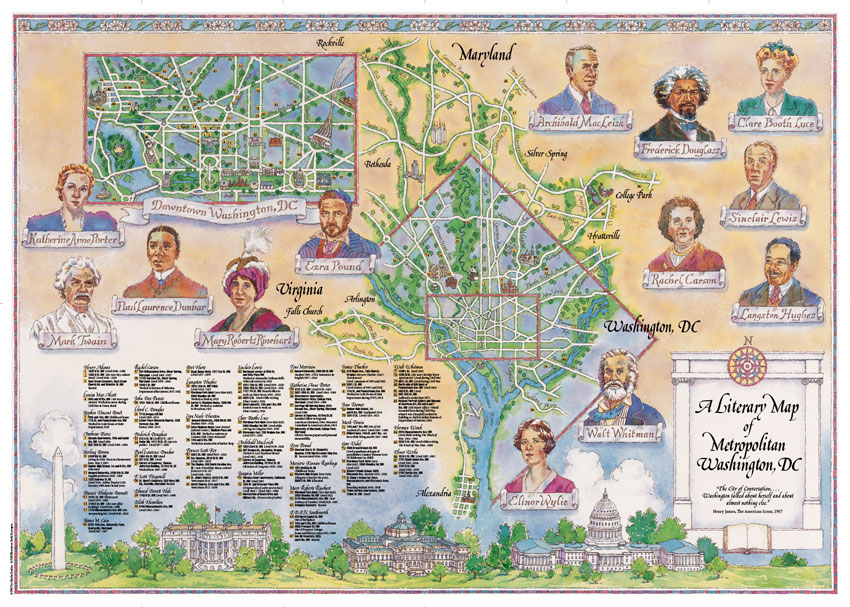
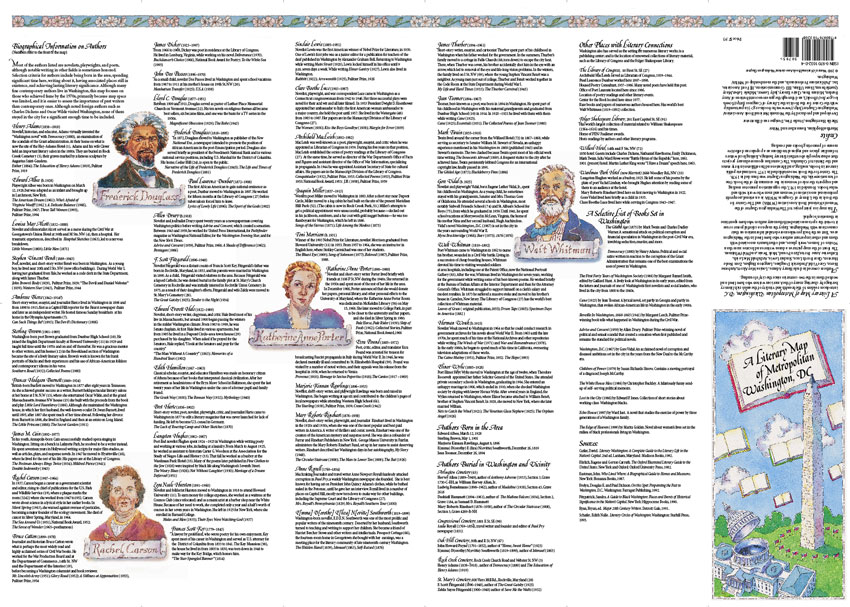
Here is the inside of the Washington DC Literary Map for which I posted the cover on 2/21. (The size in real life is 26 inches x 19 inches.)

The following is the description given on the Woman’s National Book Association website:

“The literary map identifies and celebrates locations in Washington and surrounding areas that are associated with 44 authors who have lived or worked here, including Rachel Carson, Frederick Douglass, Langston Hughes, Sinclair Lewis, Clare Booth Luce, Mark Twain, and Walt Whitman. The map also contains biographical information about the authors, a list of authors born or buried in the Washington area, other places with literary connections, and a selective list of books set in Washington.”

I was surprised myself to see how many writers have Washington, DC connections.

WashDCLitMapWeb

WashDCLitMapBack

George Washington’s City

GeorgeWashingtonCity

Today is the birthday of George Washington (1732-1799). Washington was a man of many gifts and a genuine 18th-century celebrity: a hero of the French and Indian and Revolutionary Wars, intelligent, courageous, honorable, hard-working, serious, strong and muscular, modest yet dignified, an enthusiastic dancer, a fine dresser, and, according to a friend, “the best horseman of his age.” He was also unusually tall, which always seems to impress one’s fellow citizens mightily even if one is a prize dunce. The fact that he was pretty much universally admired made it possible for the wobbly, newly-unified country to survive its first few years. He brought people together. Without him we might not have remained the United States.

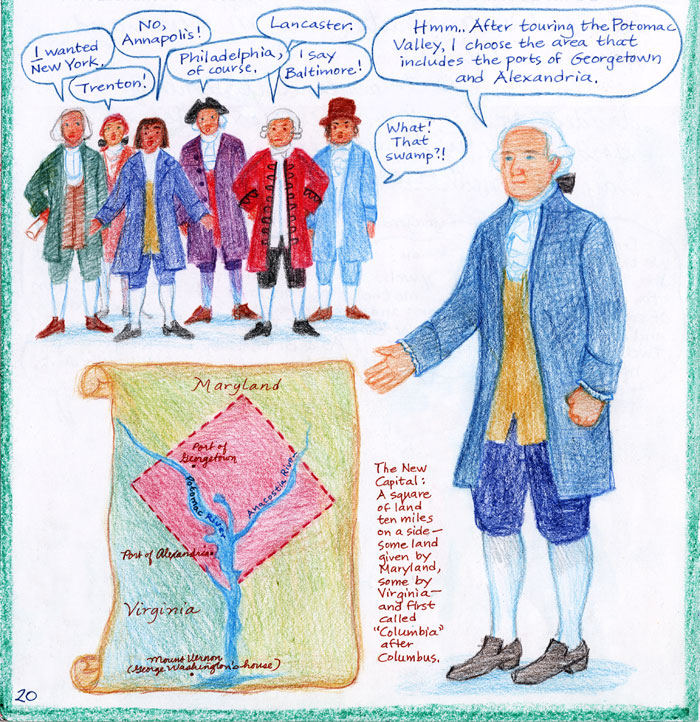
In fact Washington was, like so many of the Founding Fathers, an impressive fellow in so many ways that I cannot attempt to cover them in a single blog-post. So I offer here only one of his accomplishments, from our homeschool Local History and Geography lesson on The Founding of Washington, DC. And what a story it is, full of intrigue, scandal, and spurious investment opportunities. Plus ça change…

Once the squabbling Thirteen Colonies agreed to band together, shove the British aside, and govern themselves, they had to select a capital for the new nation. Several different cities had temporarily housed delegates and/or the Declaration of Independence itself throughout the Revolutionary years, and others put forward what they considered justifiable claims for their own beloved towns. Philadelphia was the largest city in the colonies and so would have been a natural choice if it hadn’t been a hotbed of Quakers, free blacks, abolitionists, and other Yankee troublemakers. The southern states said, If you-all choose Philadelphia, so long USA, we are out of here.

A deal was finally made to carve out a brand-new capital in more southerly location somewhere on the Potomac, and who ought to be allowed to choose the spot? None but the universally trusted and unanimously elected First President. So Washington made an exploratory journey and selected a 10-mile by 10-mile piece of land that included the little ports of Georgetown and Alexandria, situated between the Chesapeake Bay/Atlantic highway and the tempting lands to the west.

No one was really delighted with the decision except perhaps Washington himself, who worked hard both during and after his Presidency to keep interest alive and oversee the exceedingly slow construction of the new Capitol and President’s House (see the young Congress’ unwillingness to pay for anything, Each Day post 2/21). Washington, DC slowly developed from a small muddy provincial village into an interesting city that is at last worthy of its namesake. (I believe a recognizable shift took place sometime during the Kennedy administration.) Happy Birthday, dear George Washington! Our debt to you is incalculable.

Now I am going to go bake a cherry pie.

(For those interested in this subject, I recommend the excellent Washington: The Making of the American Capital, by Fergus Bordewich.)