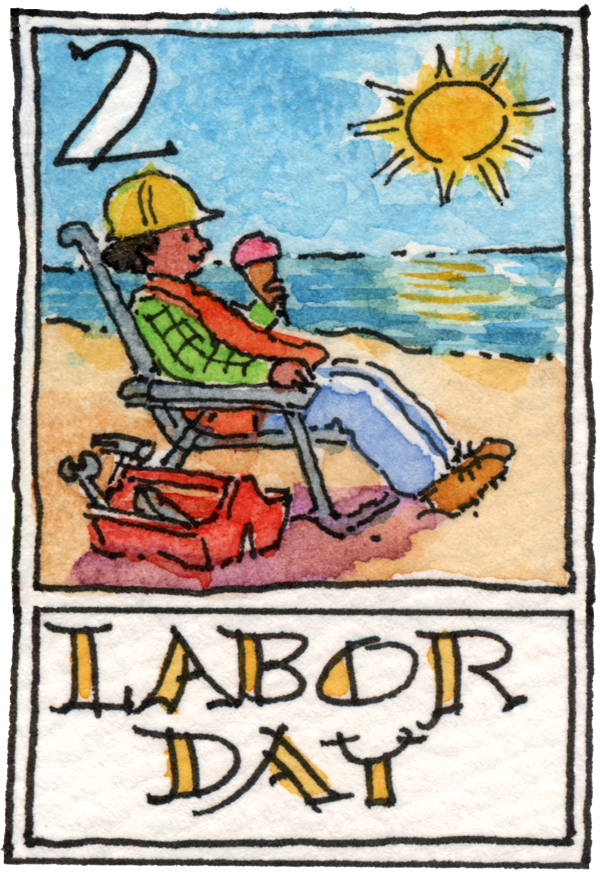
Today is the day in 1620 on which the passengers of the Mayflower came ashore at what would become Plymouth Colony, Massachusetts. I had learned in elementary school about Plymouth Rock—the boulder onto which the Puritans supposedly first stepped—and assumed it was symbolic or even mythological. But on a family trip to the area some years ago I was taken aback to find along the shore an actual Rock enshrined in a mini-temple. Thus the entry that day (featuring the Standish/Alden trio) in my sketchbook. Happy Plymouth Rock Day!
Category: Sketchbook
Bringing the Sun
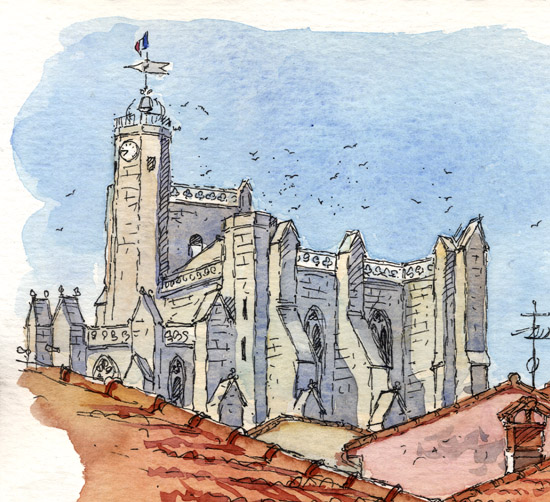
For the birthday today of Christina Rossetti (1830-1894), I post this poem, and a detail of a sketch from my France 2013 sketchbook, for those already missing the swallows and the summer sun. (For the entire sketch, please see View from the Terrace.)
Fly away, fly away over the sea,
Sun-loving swallow, for summer is done;
Come again, come again, come back to me,
Bringing the summer and bringing the sun.
—Christina Rossetti
Rise Up, O Flame
As we move into the darkest season, looking increasingly inward and reflecting on the year nearly past, and on our losses and our shortcomings, we encourage and inspire ourselves and each other with a multitude of festivals of light: Michaelmas, Dia de los Muertos, Diwali, Chanukah, Christmas. On November 11th we celebrate simultaneously Martinmas, the feast of kindly St. Martin of Tours, and Veterans Day, each with its acknowledgement of sadness, courage, and hope.
In our family, we follow a tradition begun when our children were tiny Waldorf kindergarteners, and we have a lantern walk at nightfall. Despite my [now very big] children’s inevitable complaints and eyerolling, we’ll all do the last dog-walk together, carrying our homemade paper lanterns and singing. Someday they’ll thank me…
In case you also would like to go singing through the darkness, here is one of the songs, a lovely round by Praetorius.
And It’s About Time
Happy Labor(less) Day
September, The First Day Of School
I
My child and I hold hands on the way to school,
And when I leave him at the first-grade door
He cries a little but is brave; he does
Let go. My selfish tears remind me how
I cried before that door a life ago.
I may have had a hard time letting go.
Each fall the children must endure together
What every child also endures alone:
Learning the alphabet, the integers,
Three dozen bits and pieces of a stuff
So arbitrary, so peremptory,
That worlds invisible and visible
Bow down before it, as in Joseph’s dream
The sheaves bowed down and then the stars bowed down
Before the dreaming of a little boy.
That dream got him such hatred of his brothers
As cost the greater part of life to mend,
And yet great kindness came of it in the end.
II
A school is where they grind the grain of thought,
And grind the children who must mind the thought.
It may be those two grindings are but one,
As from the alphabet come Shakespeare’s Plays,
As from the integers comes Euler’s Law,
As from the whole, inseparably, the lives,
The shrunken lives that have not been set free
By law or by poetic phantasy.
But may they be. My child has disappeared
Behind the schoolroom door. And should I live
To see his coming forth, a life away,
I know my hope, but do not know its form
Nor hope to know it. May the fathers he finds
Among his teachers have a care of him
More than his father could. How that will look
I do not know, I do not need to know.
Even our tears belong to ritual.
But may great kindness come of it in the end.
—Howard Nemerov

Citroën…Then and Now
Cows and Chocolate
Local Hero
Today, on Bastille Day, we wandered the streets of Sarlat, a Périgord village of remarkably well-preserved medieval and Renaissance architecture in the beautiful golden limestone of the region. We, and our fellow tourists, were inappropriately garbed for these picturesque balconies, flowery courtyards, and half-timbered façades. Really, only those in period costume ought to be allowed entrance.
Here I sketched the birthplace and childhood home of Étienne de la Boétie (1530-1563), philosopher, poet, government official in the reign of Charles IX, proponent of religious toleration in an era of bitter religious conflict, BFF of Montaigne, and, most famously, author of Discourse on Voluntary Servitude, in which he—centuries ahead of the French and American revolutions—questions and protests the inclination of human beings to acquiesce in their own oppression by tyrants.
Had he not succumbed to an outbreak of dysentery at the age of 32, what might he have gone on to write? His house (which, when la Boétie was born there, had just been completed five years earlier) seems an appropriate post for this national festival.
Breakfast in the Garden
We are happily settled in the Maison des Peyrat, a delightful B&B in a renovated farmhouse on a sunny green hill above Sarlat. I think our room was once a stable, but we sleep on beds, not straw. Sitting peacefully beside the salt-water swimming pool, we can watch the cows in the adjoining field, yet after breakfast it’s an easy walk downhill to the busy center of Sarlat village, crowded with vacationers in this high season.