May Revelries

RevelsAudubon

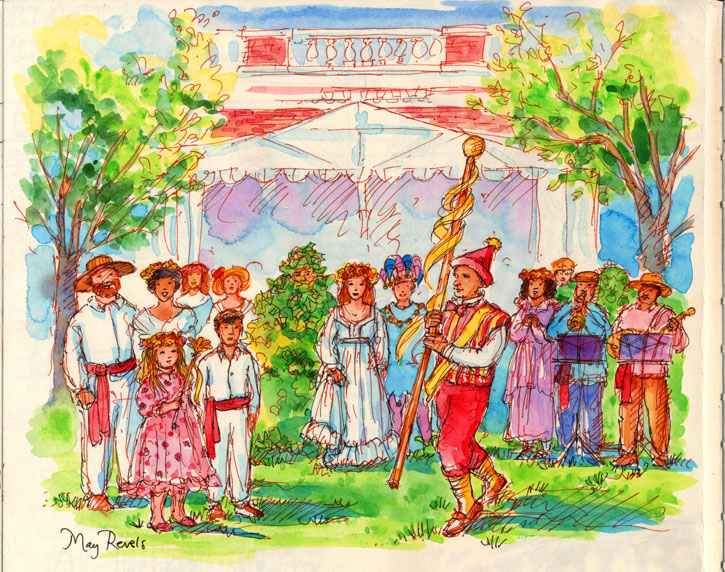
Unlike the Winter Revels, the May Revels is always held outdoors, and I recall the days when, on the first Sunday in May, Brandywine Street here in Washington DC was closed to traffic, decked with garlands of flowers, and temporarily transformed into a festive Olde Village. Nowadays the May Revels is frequently a component of Washington Cathedral’s annual Flower Mart, and, although of smaller scale, is still a lovely opportunity to watch a mummers’ play, sing, and dance around the Maypole. (And you can also visit the Flower Mart, whose featured country this year is Jamaica.)

This sketch is from a May Revels that took place at the National Audubon Society.

CakeChocCurls2Jacqui

CakeDaisiesAunt Francie

CakeBerries2Eric

Here We Come A-Piping

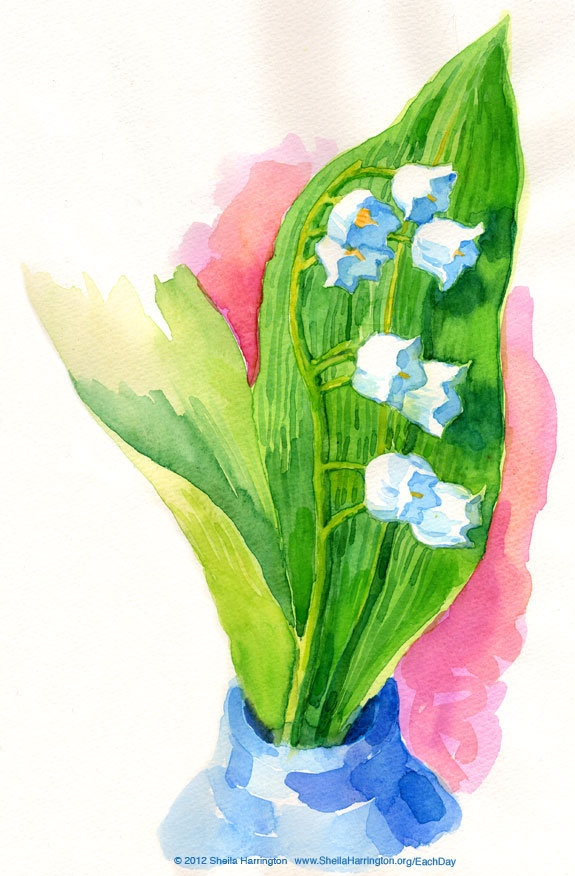
For May Day, a poem for you to chant, and a sketch of the LAST lily-of-the valley in my garden. (They popped out strangely early this year.)

In some countries, the first of May is a holiday in commemoration of the international labor movement, marked by rallies, marches, and parades in recognition of the worker, sometimes followed by picnics and dancing. This latter activity harkens back to the far more ancient festival of the first of May, which, like Groundhog Day and Dia de los Muertos, falls roughly halfway between an equinox and a solstice.

For May the first is (what else?!) a happy acknowledgement of the arrival of spring and its attendant burgeoning fertility. At last the winter is truly behind us, and the world is so fresh and green and blooming that sitting indoors at a computer seems an act of madness. Shut it down, doff the heels/necktie, deck yourself with a crown of flowers and skip about in the gentle spring sunshine, celebrating the world’s inexhaustible and optimistic fruitfulness.

LilyOfValley12


Here we come a-piping,
In Springtime and in May;
Green fruit a-ripening,
And Winter fled away.
The Queen she sits upon the strand,
Fair as lily, white as wand;
Seven billows on the sea,
Horses riding fast and free,
And bells beyond the sand.

—Traditional

CakeLilyValleyMary

CakeBerries2Josiah

Green in the City

For Earth Day, I post this sketch made while watching my daughter and a friend scrambling over the rocks in green, watery and magical Rock Creek Park, which runs through the heart of Washington DC the length of the city and beyond.

In gratitude for this resource, fellow city-dwellers, you may wish to sign up for one of the many area clean-ups through your local community association, or, alternatively, the Earth Day website, where everyone, whether urban, suburban, or rural, can discover many ways to say Thank You to Mother Earth.

For another sketch, and a history of Earth Day, please see Earth Day.

RockCreekHike

CakeDaisiesGunilla

CakeSprinklesHasse

Spring, the Sweet Spring

Whether you awakened this morning to blazing heat or a fresh fall of snow, today is officially the first day of Spring in the Northern Hemisphere. Here to celebrate the day are a cherry blossom sketch from my sketchbook and a poem by Thomas Nashe.

At this turning of the year I like to remember Louis J. Halle (1911-1988), author of the magical and engaging Spring in Washington, a journal of early-spring biking and quiet observation that opens our eyes to the timeless natural world surrounding, and oblivious to, the evanescent heap of brick and concrete within which we burrow. (I hope you can manage to think of our bureaucratic city as magical and engaging. ‘Tis a transformative season.)

For a mini-bio of Halle, please see A Capital Spring. And a merry cuckoo, jug-jug, pu-we, to-witta-woo to you!

CherryBlossomsSketch

Spring, the sweet spring, is the year’s pleasant king,
Then blooms each thing, then maids dance in a ring,
Cold doth not sting, the pretty birds do sing:
Cuckoo, jug-jug, pu-we, to-witta-woo!

The palm and may make country houses gay,
Lambs frisk and play, the shepherds pipe all day,
And we hear aye birds tune this merry lay:
Cuckoo, jug-jug, pu-we, to-witta-woo!

The fields breathe sweet, the daisies kiss our feet,
Young lovers meet, old wives a-sunning sit,
In every street these tunes our ears do greet:
Cuckoo, jug-jug, pu-we, to witta-woo!

—Thomas Nashe

Spring Is Near

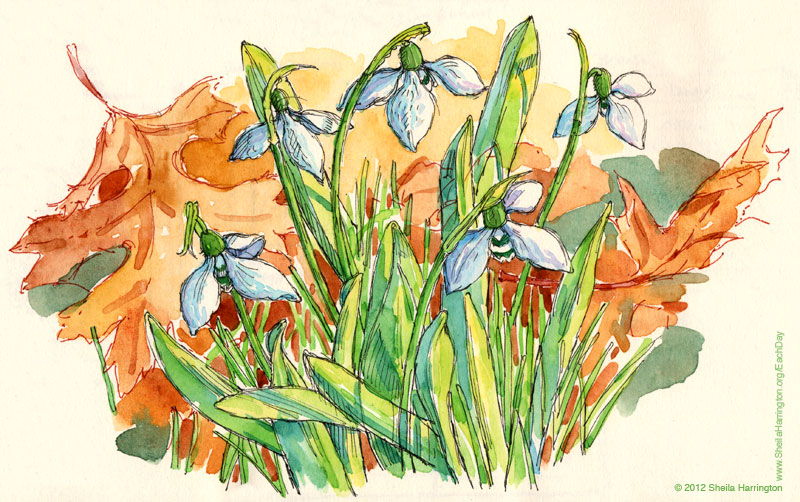
Here is a sketch from recent wanderings, and below it a verse my daughter and I learned while experiencing the properties of numbers in first grade. Its delight and usefulness lie in its three-fold-ness: three verses, in anapestic (short-short-long) monometer, about a charming three-petaled flower. During the same block I taught her to waltz, and we danced around the room chanting this poem.

For another March 1st welcome, please see In Like a Lion.

SnowdropsEmilys

Snowdrops we
Petals three
You may see.

White, green, gold
We unfold
In the cold.

Words of cheer
Speak we clear:
Spring is near.

CakeYellowRoses2Polly

It Works!

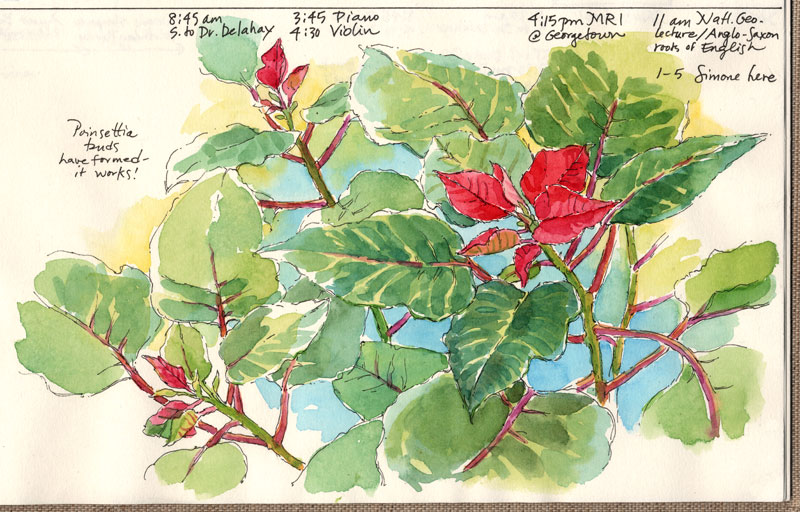
The Christmas before last, our friend Martha gave us a beautiful poinsettia plant that I repotted and set outside for the summer. It grew so large and bushy that, in November, I decided to try something I had never before attempted: getting it to bloom again.

PoinsettiaBuds

To achieve this, one must fool the innocent poinsettia into thinking it has been suddenly transported to, say, Reykjavik, by keeping it in complete darkness from 5pm to 8am for ten weeks. This would mean: 1. putting it into a dark closet, assuming there was space among the family shoes, umbrellas, and vacuum cleaner; or, 2. lugging it downstairs to the basement every night and remembering to bring it up each morning (ha!); or, 3. covering it with an opaque material.

I opted for the third option. Every night (well, that is, when I remembered), I immersed the long-suffering poinsettia in a double layer of trash bags—kind of like covering a bird cage—and removed them in the morning. I stopped before Christmas, by which time, according to the instructions, “you should see flower buds.” Hmmm. No flower buds. Oh, well, I thought, I suppose I forgot to cover it too many times, and I returned it to its sunny alcove with other wintering-over plants. What a lot of bother for nothing.

When I went to water the plants this week, lo and behold: there were BUDS, some of them beginning to open! I am thrilled, and ready to try it again next winter.

CakeRedRosesMegan

Yahrzeit3Sister Mary Daniel

Maid of Orléans

No one really knows precisely when Joan of Arc was born. But January 6, 1412 is traditionally recognized as the date, making today the 500th anniversary of her birth, the quincentennial celebration of her mysterious, heroic, and too-short life.
DomremyHouse

The outlines of the story are generally recognized: A pious girl from a rural family, in response to visions and voices she explained as those of saints and angels, approached the Dauphin, the future Charles VII, during the Hundred Years’ War, and convinced him to allow her to aid France.

Given a suit of armor and a banner with fleur-de-lis, she led newly-inspired French troops (who had formerly declined to follow the feckless and irresolute Charles into battle) to expel the English and Burgundians from her then-small country. Her successes in battle, and in eventually arranging for the coronation of the Dauphin in Reims, greatly encouraged the French, but alarmed the Burgundians and infuriated the English, who, when they finally had Joan in custody, burned her at the stake as heretic and witch and raked her ashes into the Seine to prevent the collection of relics—an indication of awareness that they had murdered an innocent. She was nineteen. Detailed records of her trial, painstakingly kept by the court, reveal to us Joan’s simplicity and humility, in contrast to the narrow-minded and vengeful scheming of her assorted judges.

These same records were made use of to acquit her posthumously later under Charles’ rule—for him it was politically expedient to have been crowned with the aid of a courageous maiden instead of a condemned witch. During the acquittal process the testimony of numerous witnesses reveals the original trial’s illegal and corrupt maneuverings.

How was an untrained teenage country girl able to lead dispirited soldiers in the wake of a string of defeats (notably Agincourt in 1415) to win a series of battles and break through enemy lines to see her king crowned? What was the nature of Joan’s voices? To this day much of her story remains unknown and a subject of speculation for historians, psychotherapists, artists, novelists, playwrights, and filmmakers. Statues of Joan are to be found all over the world, including here in Washington, DC, a gift from the Ladies of France in Exile in New York in 1922 and the only equestrian statue of a woman in the city. (There are actually only a handful of equestrian statues of women to be found anywhere, and probably more of Joan of Arc than any other.) As of 1920, Joan became—after five hundred years (the Catholic church moving with its customary excruciating slowness)—Saint Joan.

The image of Jeanne d’Arc has been co-opted, ironically, by the French extreme right, who more properly ought to take as their symbol a 15th-century right-winger: the manipulative and self-absorbed Duke of Burgundy, who turned Joan over to the English to maintain his power; the misogynist cleric Pierre Cauchon, who was fixated on Joan’s wearing of male attire; or the avaricious English themselves, whose desire for the French throne had been humiliatingly waylaid by an upstart female. The ultra-conservative Front National is no place for unconventional Joan, who defied societal expectations, suffered in battle and in prison, and died for her efforts.

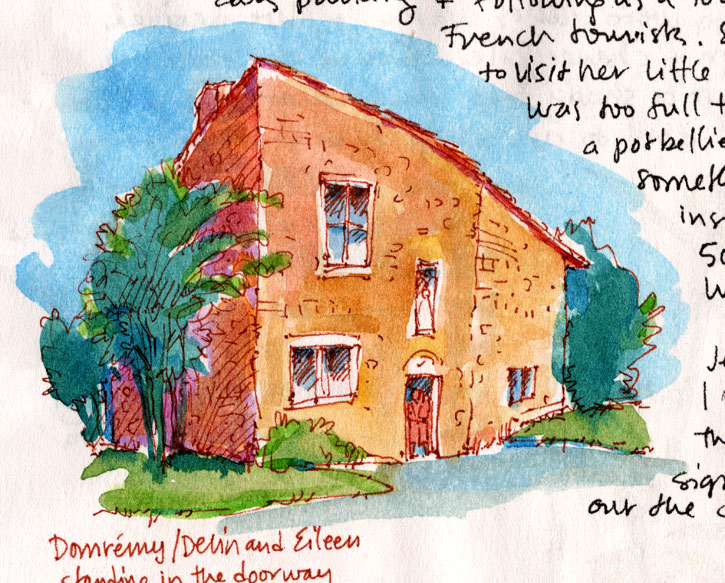
The sketch is from a visit to the house in Domrémy thought to have belonged to Joan’s family.

Today is also the Feast of the Epiphany, the day on which, according to tradition, three wise men from the East carried gifts to the infant Jesus. For another take on this event, please see The Three Wise Women.

The Feast of the Epiphany is also the birthday of Carl Sandburg (1878-1967). For a comic and a poem, please see Poetic Journey of the Magi.

CakeStarsNathan

Of Two Worlds

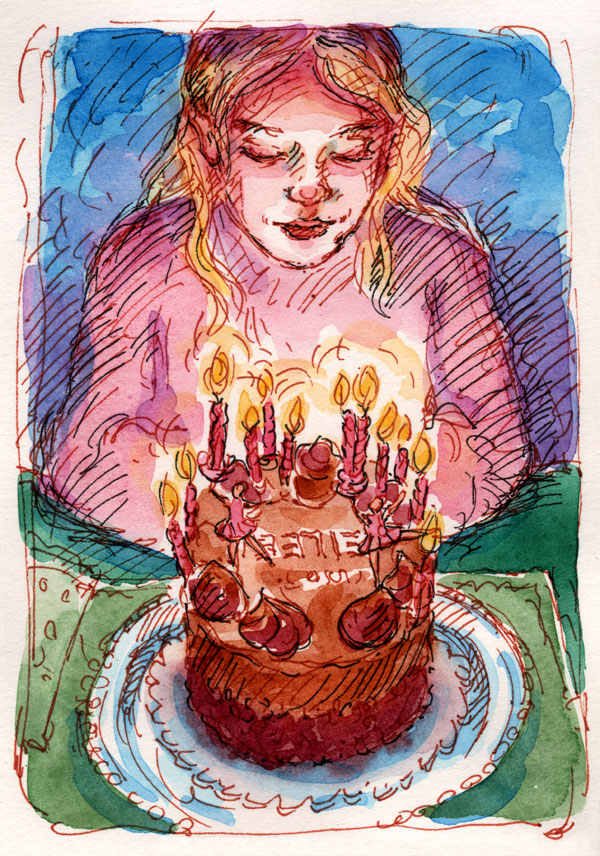
Here is my daughter blowing out her birthday candles last year. Today she enters her teen years (!), chronologically leaving childhood behind; yet in reality she is straddling two worlds. In her are blended right now the growing thoughtful awareness and surprising wry humor of a young woman, and the openheartedness and generous, candid spontaneity of a child. It’s a sometimes-challenging but always-engaging time. In honor of her day, I post this poem by Sharon Olds, as it describes a malady my daughter shares. Happy, happy birthday, dear one.

ECS12Candles

Diagnosis
By the time I was six months old, she knew something
was wrong with me. I got looks on my face
she had not seen on any child
in the family, or the extended family,
or the neighborhood. My mother took me in
to the pediatrician with the kind hands,
a doctor with a name like a suit size for a wheel:
Hub Long. My mom did not tell him
what she thought in truth, that I was Possessed.
It was just these strange looks on my face—
he held me, and conversed with me,
chatting as one does with a baby, and my mother
said, She’s doing it now! Look!
She’s doing it now! and the doctor said,
What your daughter has
is called a sense
of humor. Ohhh, she said, and took me
back to the house where that sense would be tested
and found to be incurable.

— Sharon Olds

CakeSnowmanEileen