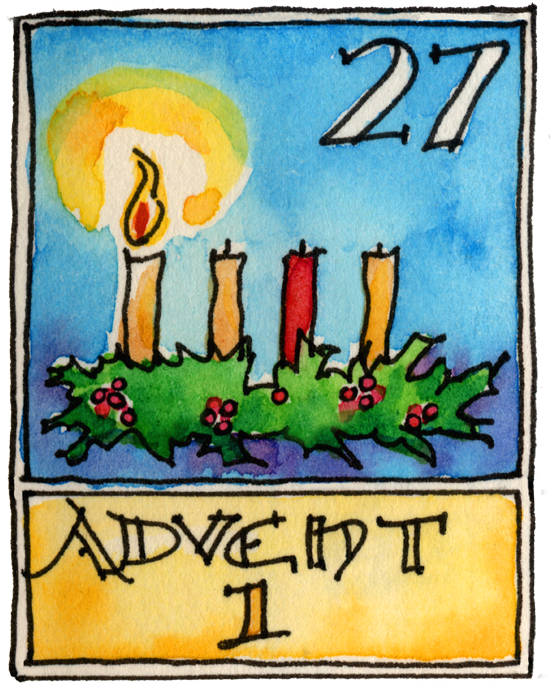
The first candle.
 Julia
 Bridget
The first candle.
Julia
Bridget
At all the major festivals and turning points of the year, it’s a natural impulse to find commonalities within the celebration with the larger human community, past and present, and gain a sense of connection.
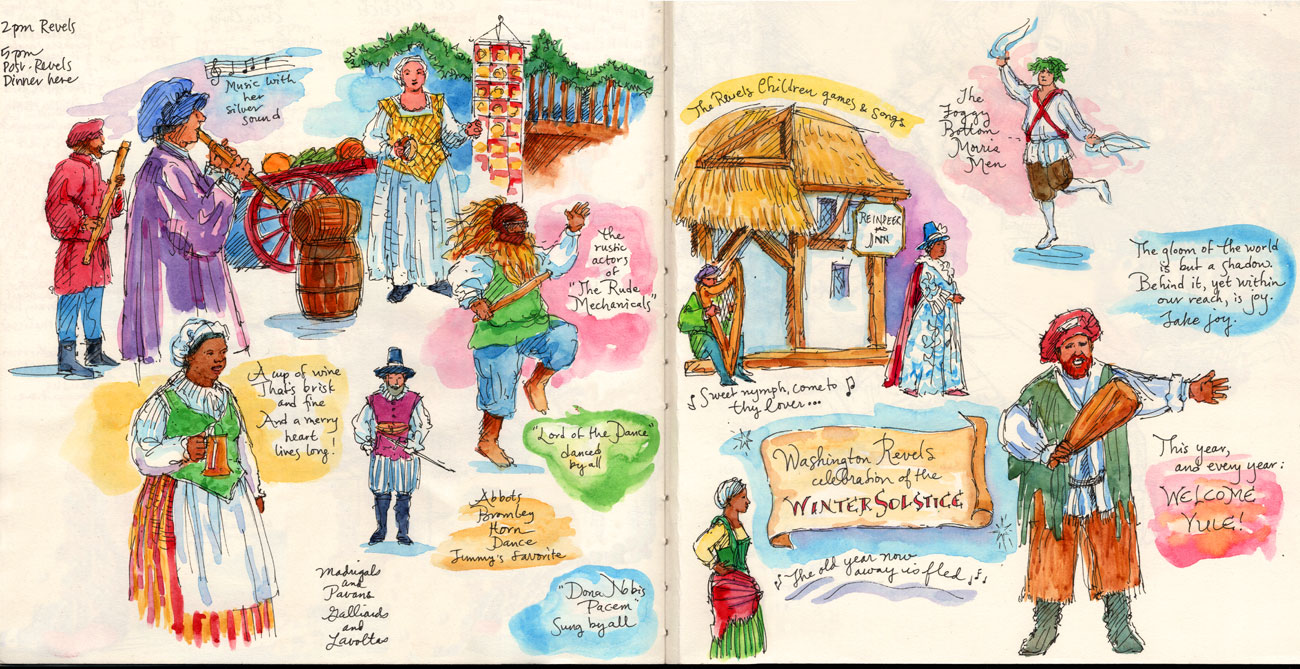
In this winter season, one especially delightful and moving experience of shared celebration is found in the music, dance, and storytelling of the Washington Revels, which each year changes its theme (always carefully researched and skillfully interpreted) but whose underlying message acknowledges and salutes the struggle to find beauty, joy, humor, peace, and love amid the darkness, uncertainty, and losses of our life journeys.
This year’s theme is Andalusian Treasures, and I quote:
Our 29th annual celebration of the winter solstice harkens back over 1,000 years to the confluence of Moorish, Sephardic and Iberian cultures in medieval Andalusia. Led by the antics of two fools, and joined by guest musicians, Trio Sefardi and Layali El Andalus (“Andalusian Nights” in Arabic), we celebrate the legacy of the extraordinary flowering of arts and culture that began there and extended to much of the world for centuries thereafter. Presenting the three cultures together on stage, we honor the symbol that Andalusia has become (however imperfect the reality) of the ideal of greater tolerance and acceptance among different cultures and religions.
Shows run December 3-4 & 9-11, matinees and evenings, at GW Lisner Auditorium in Washington, DC, and there are still tickets available through the Revels website. Believe me, once you have sung and danced for the solstice with a thousand gladsome companions, you will want to make it a family tradition.
The sketches above are from a 2007 Renaissance Revels. For more Revels sketches, and a mini-history, please see Revelry.
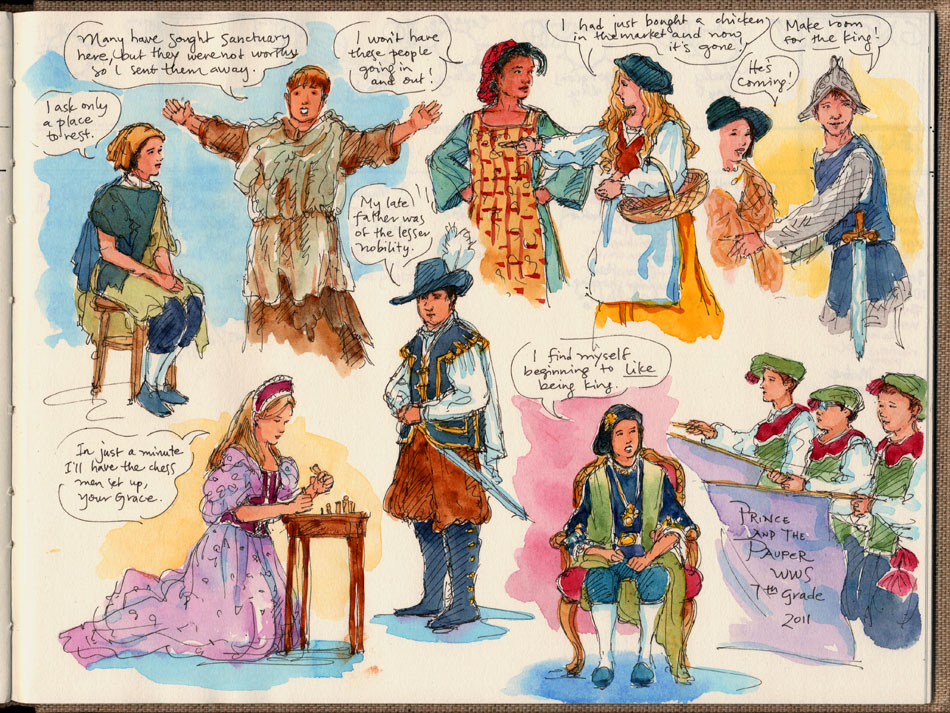
I sat in one day on a rehearsal of my daughter’s class play and surreptitiously made some sketches. Having seen a number of middle school plays over the years in which the objective seems to be to finish and get off stage as fast as possible, I was struck by the students’ expressiveness, pacing, and evident understanding of their roles.
On Saturday, November 19th, the Washington Waldorf School in Bethesda, Maryland will hold what is probably the most unusual holiday bazaar in the Washington area, reflective as it is of the artistry of Waldorf education.
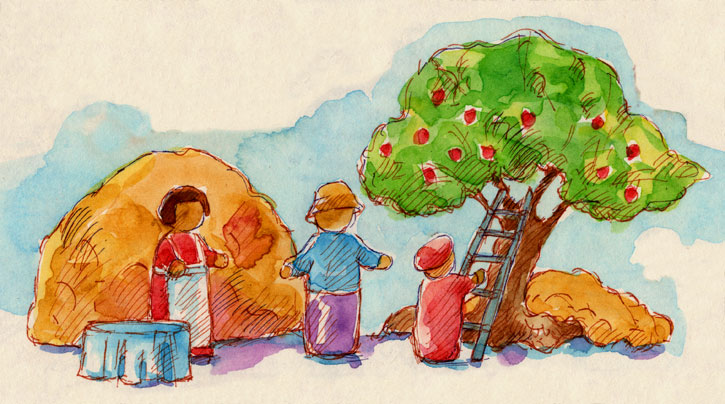
Adults with an eye to gift-giving appreciate the wide range of beautiful handcrafts, from pottery to woven scarves to toys to jewelry.
Younger children enjoy the storytelling and puppet shows, candle-decorating, visiting the Magical Maze of evergreens and twinkling lights, making an excursion to the Children’s Shop for their own secret purchases, and taking a peek into the pockets of the wandering Pocket Wizard or Pocket Lady. Older children like making wooden toolboxes, or copper lanterns, or ornamenting themselves with a henna-tattoo.
All will happily sink into a seat at the Bazaar Bistro for a truly delicious homemade lunch, a special dessert, or a cappuccino, where they can listen throughout the day to live musical offerings.
Admission is free, but, although it runs from 10 to 3, arrive promptly, because handmade goods and puppet show tickets sell out EARLY.
—Faiz Ahmed Faiz, translated by Naomi Lazard
 Filomena
Last night at about 9pm my son and I went outside with a pair of ordinary bird-watching binoculars and trained them on a bright starry object we’d been noticing in the western sky during the last dog walks of the evening. And this is what we saw (as best I can recall):

According to the NASA website (whose picture is much better than mine), this is no star, but our giant neighbor Jupiter, with four of its 62 moons: Io, Europa, Ganymede, and Callisto, called the Galilean moons, after Galileo Galilei, who first spotted them in 1610.
Jupiter appears especially bright to us right now because it is both in opposition (directly opposite the sun from Earth, peaking on Oct. 29th Universal Time) and closer to Earth than it will be again until 2022. I don’t know about you, but I find it wondrous that without the aid of observatory or telescope we can see these heavenly bodies from our city street corner. In fact, if Jupiter weren’t itself so bright, we could probably see the Galilean moons without binoculars.
Their appearance left us starry-eyed, and dwarfed the importance of political squabbling, and getting that last load of laundry done, and pretty much anything else.
Where can you go in DC this month to see a cranky wildly bewigged miser erroneously thought to be a corpse, feisty amorous twenty-somethings cavorting in 17th-century costume, a fantastically attired and exceedingly speedy cross-dressing gentleman, and an adorable live piglet, involved in a ridiculous yet intricate story spoken entirely in clever and hilarious verse (well, except by the piglet) in which all will be satisfyingly resolved by the end?
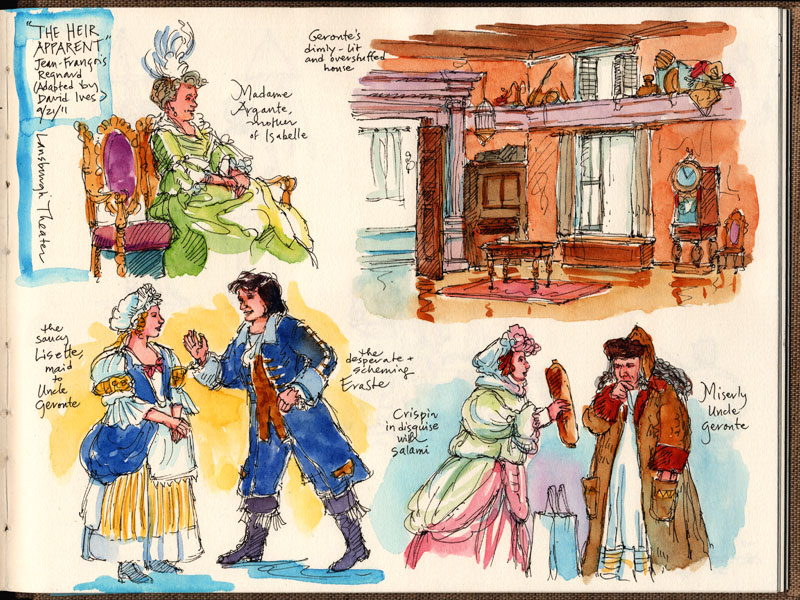
As far as I know, only at the Lansburgh Theater, in the current production of The Heir Apparent, written by Jean-François Regnard in French but brilliantly adapted into English (with sneaky modern references) by David Ives. If you would like to spend an entire evening laughing, run run run to get a ticket.
(No photography is allowed, but they don’t say a thing about sketching. Which is a bit tricky in the dark.)
Today is also the anniversary of the emancipation of poet and colonial slave Phillis Wheatley (circa 1753-1784). For a painting, poem, and mini-bio, please see An Hymn to Phillis.
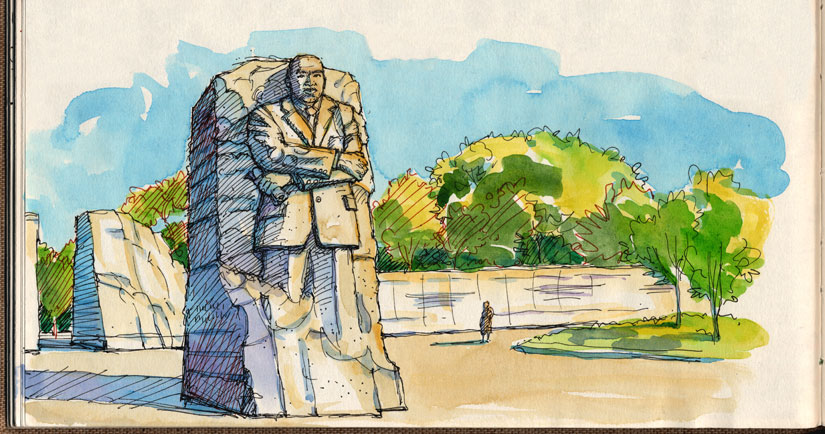
Today is the official opening of the new Martin Luther King, Jr. Memorial (postponed from its earlier date due to Hurricane Irene). However, my son and I got up very early one weekday morning a couple of weeks ago and biked down through Rock Creek Park to see it sans crowds, and, indeed, our only companions were uniformed park service staff.
I realize that this monument has been somewhat controversial, what with complaints about the determinedly literal concept and the outsourcing to China and the misleading engraved quotation. But as I walked along reading King’s words and beheld his sunlit figure gazing intently across the Tidal Basin—and pondered the changes of the last fifty years, for much of which this man, so far ahead of his time, was responsible—I could only be moved. I look forward to returning in all seasons of the year.
Today is also the birthday of Supreme Court Justice William O. Douglas (1898-1980), whom we can thank for the preservation and restoration of the Chesapeake and Ohio Canal as a park, with hiking trails and bike paths, thus averting its transformation into a highway. This is where you go in Washington, DC if you want to see hometown bald eagles, or the first bluebells. For sketches and a mini-bio, please see Justice of the Peace.
 Aunt Bett
I post this travel sketch of a London street in honor of the birthday and birthplace of William Penn (1644-1718), who actually seems to have truly been the laudable character recorded in our childhood history books.
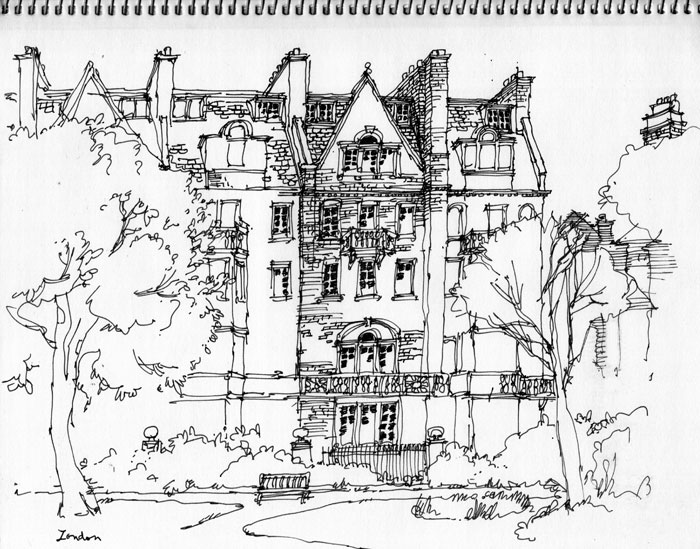
Son of a prosperous knighted admiral and his wife, herself the daughter of a rich Dutch merchant, Penn could have chosen to follow in the footsteps of others of his class, enjoying a life of comfortable privilege on property confiscated by Cromwell from political opponents and dispossessed Irish peasantry. He received the usual rigorous grammar school education accorded boys in his position, studying reading and writing, religion, mathematics, Latin, and Greek from 6am to 6pm, walking the two miles each way between home and the schoolhouse. Be sure to repeat this part to your children when they object to their many burdens.
One Sunday morning, William’s father invited Thomas Loe, a traveling preacher, to lead a service in the family castle. It was an invitation the Admiral had cause to regret, because Mr. Loe, a follower of George Fox, spoke so eloquently of Quakerism that he left a permanent impression upon young William.
At sixteen William went off to Oxford, encountering for the first time extravagantly dressed fellow students who, instead of studying, spent their time, and their parents’ money, playing cards, drinking, and one can only imagine what else. William, however, was drawn to a small handful of progressive, troublesome students who met to discuss surreptitiously such inflammatory subjects as freedom of worship, and who also dared to miss several chapel services. For which they were expelled. Whereas presumably the party-down crowd remained at Oxford as long as they faithfully paid their gambling debts.
Angry and disappointed, Willam’s father gave him a good beating and sent him off on the Grand Tour of Europe to knock some sense into him, an unusual approach to teenage misbehavior not in current use. Perhaps a taste of Parisian society, thought the Admiral, would show William the folly of his queer religious ideas! On the Continent, William acquired fluency in French and a much better wardrobe, but he soon tired of court life and resumed his studies among a group of French Huguenots who (for the moment, anyway) enjoyed an inspiring period of religious freedom.
Back home, although initially cutting an impressive new figure in society, William soon dashed his father’s hopes once again by attending Quaker meetings, sympathizing with the plight of thousands of Quakers imprisoned for their refusal to follow the Church of England, writing to the government in their defense, and eventually serving time in prison himself. On top of this he began to court a Quaker lass. His father was in despair. Beatings, lengthy trips to France, even threats of disinheritance had no effect. What could be done with such recalcitrant offspring?
To Be Continued
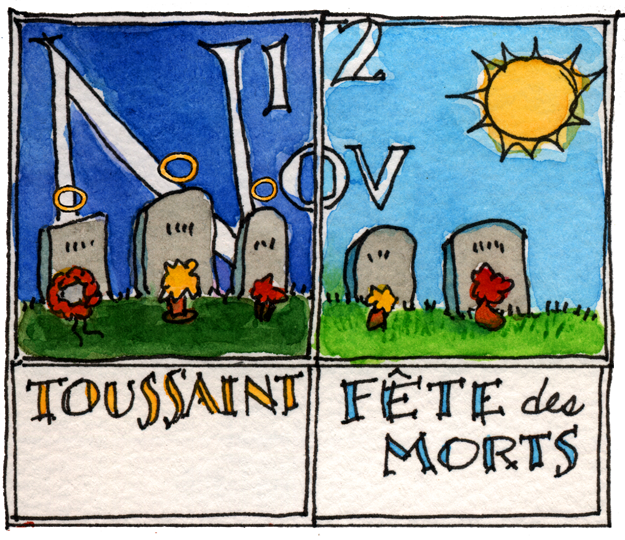
Today is also the birthday of Edward Estlin Cummings (1894-1962), known as e e cummings. For a painting and a poem, please see this is the garden.
October gave a party;
The leaves by hundreds came—
The Chestnuts, Oaks, and Maples,
And leaves of every name.
The Sunshine spread a carpet,
And everything was grand,
Miss Weather led the dancing,
Professor Wind the band.
—George Cooper
 Amelia