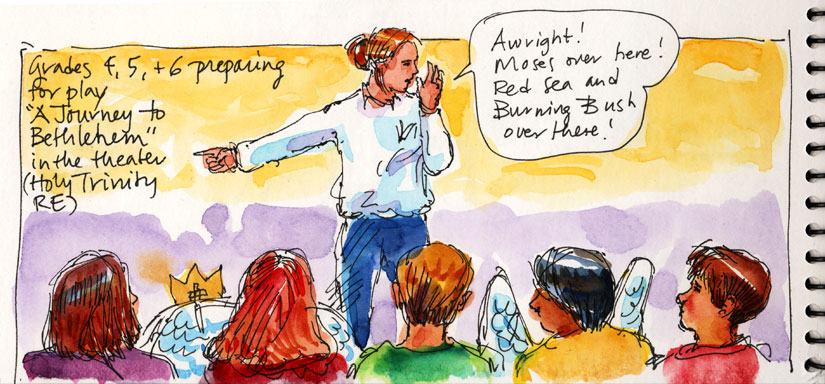
Each year during Advent, some of our church’s Sunday school classes present skits based on stories from the Old and New Testaments. By chance I happened to be present at one of the dress rehearsals.
 Gideon
 David
Each year during Advent, some of our church’s Sunday school classes present skits based on stories from the Old and New Testaments. By chance I happened to be present at one of the dress rehearsals.
Gideon
David
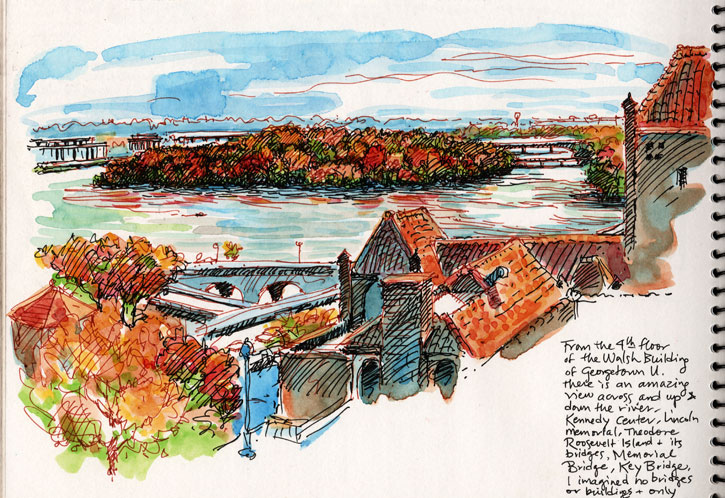
Today is the birthday of Rainer Maria Rilke (1875-1926), and so I post his poem for late autumn, along with a sketch made from the window of the Georgetown University building where my daughter has her weekly Sunday school class, and where therefore I am fortunate enough to spend a quiet hour thinking, organizing, and gazing upon this view. The setting inevitably drives my thoughts back in time—to Captain John Smith sailing up toward Great Falls… to the Native American village that preceded Georgetown… to the geological forces that carved out this valley… I am SUPPOSED to be planning my week, which seems laughable in context.
The leaves are falling, falling as if from far up,
as if orchards were dying high in space.
Each leaf falls as if it were motioning “no.”
And tonight the heavy earth is falling
away from all other stars in the loneliness.
We’re all falling. This hand here is falling.
And look at the other one. It’s in them all.
And yet there is Someone, whose hands
infinitely calm, holding up all this falling.
—Rainer Maria Rilke
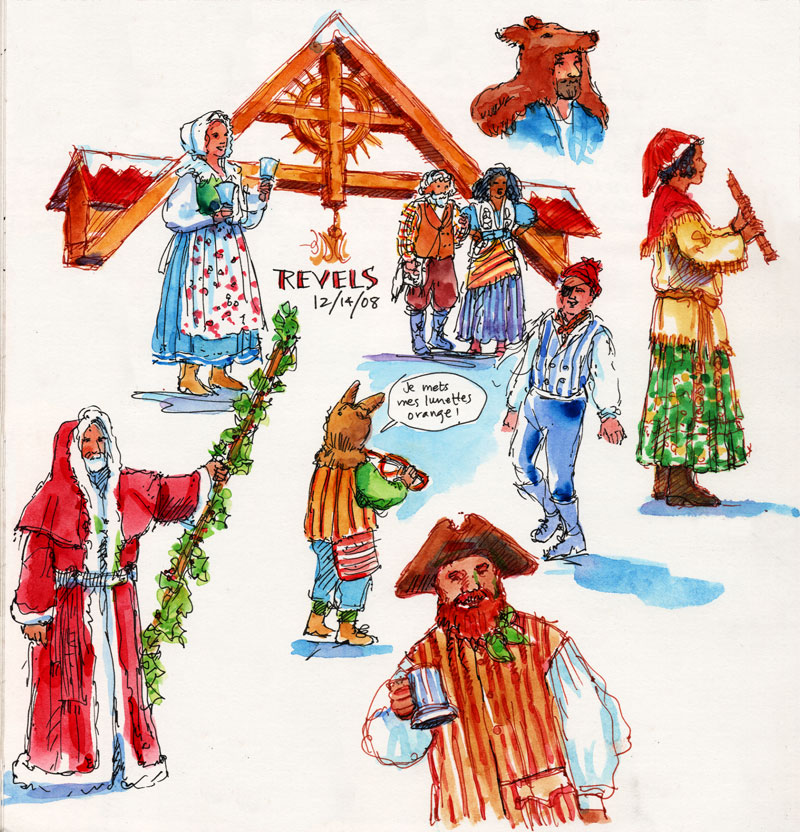
Every year, on my to-do list for early October is: Buy Revels Tickets.
If you are not already familiar with these wonderful festivals, well, it’s about time.
The Revels was first created for the New York stage in 1957 by musician, teacher, and author John Langstaff as a celebration of traditional seasonal music, dancing, and storytelling. But it was not simply a stage performance. Langstaff realized that many of us are starved for the connection to the seasons that was part of human beings’ lives for millennia but which for the modern plugged-in citizen has largely disappeared.
Our ancestors didn’t buy tickets to watch a harvest festival, or a planting ritual, or a plea to the gods for the return of sunlight; they MADE every festival, with its traditional songs, dances, foods, and tales, all of which grew naturally out of their lives and acknowledged the continual turning of the year with its growth, loss and rebirth, sorrows and joys.
So Langstaff’s Revels straddles worlds old and new, with professionals and amateurs working together, to create events simultaneously entertaining, educational and participatory, in which audience members watch and listen, laugh (and cry), sing, dance, and sometimes join those on stage to work out a skit or song.
After his initial New York show, and a Hallmark Hall of Fame Christmas Masque (in which a young Dustin Hoffman played a dragon!), Langstaff presented a Revels in Cambridge, Massachusetts, and the concept took off. Since then numerous Revels groups have formed around the country, with permanent staff members and lots of eager volunteers, to bring these celebrations to the public, usually one in spring or summer and one near the Winter Solstice.
Langstaff’s first Revels incorporated medieval music, but over the years the repertoire has expanded to include traditional seasonal celebrations from all over the world and from many historical periods. Our family has enjoyed the Revels of India, Russia, Scandinavia, French Canada (from which these sketches), Early America, Victorian and medieval England, Renaissance Italy, and the Celtic world, each with appropriately gorgeous, colorful and meticulously researched music, folklore, customs, sets, and costumes.
This year’s DC Revels is set in Thomas Hardy’s rural England. If, in the midst of this season of darkness, you wish to find light—as well as a couple of hours’ joyful immersion in another time and place—then you are in luck. We always go as part of a great big group (then continue our own Revels afterward with dinner and music), but we didn’t buy ALL the tickets. We left some for you.
 Brian

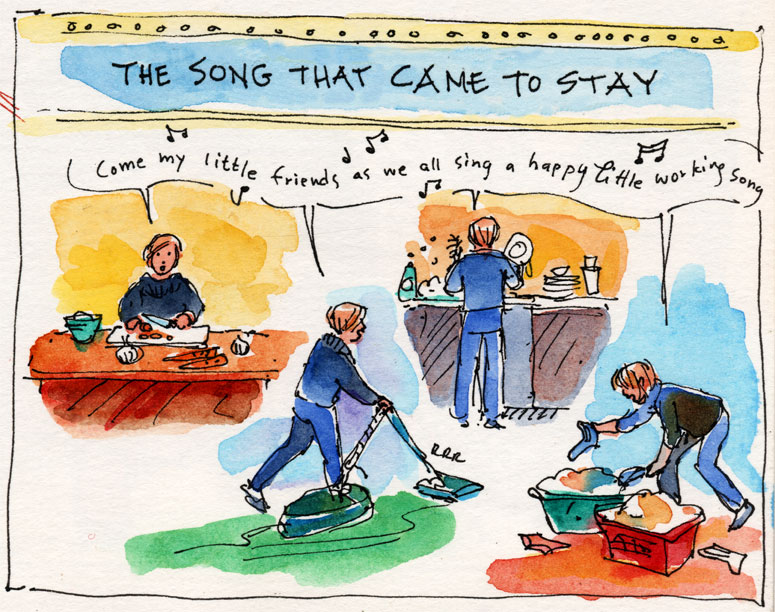
Sometimes we put this piece of music on the CD player to jump-start our Saturday chores. Really, it ought to come with a warning label. I’m still singing it hours later when I’m walking the dog, or trying to write a letter.
 Julia
 Bridget
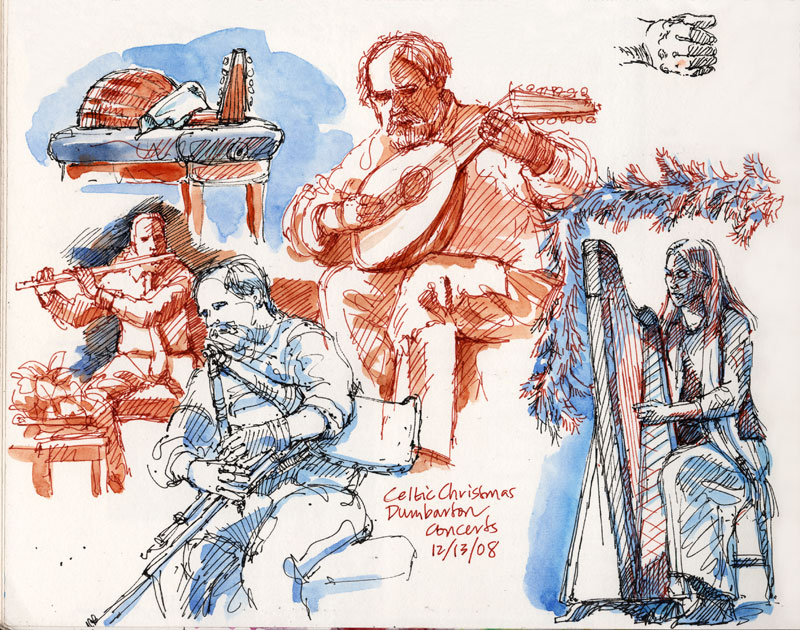
Today is the feast day of St. Cecilia, my saint-name-day (Sheila being the Irish form of Cecilia). St. Cecilia is the patron saint of music, a fact that has always pleased me—irrationally, considering I have no musical talent beyond the ability to sing lullabies relentlessly for hours to restless children.
Anyway, in honor of St. Cecilia, I post this tribute to a wonderful holiday concert that my husband and I attend every year with a group of friends: Celtic Christmas, at Dumbarton Church in Washington, DC. This concert is difficult to describe. It takes place by candlelight in a beautiful old church in Georgetown, and includes traditional seasonal music, unusual obscure pieces, and original compositions, which vary from year to year. The incredibly diverse Linn Barnes plays lute, guitar, banjo, harp-guitar, and Uillean pipes. Allison Hampton plays Celtic harp as if descended from on high to share the music of the spheres. Their performances are heightened and deepened by those of amazing flutist Joseph Cunliffe and percussionist Steve Bloom.
Pieces are interspersed with Barnes’ anecdotes both serious and humorous providing historical background (here is a man serious about music). Other pieces are accompanied by Robert Aubry Davis reading evocative seasonal poetry and prose that he researches especially for the concert (here is a man serious about literature).
This annual event sweeps us into the spirit of a joyful yet poignant Christmas. We depart expecting to step out into softly falling snow, listening for sleigh bells, the call of the heavenly host, and the distant howl of a wolf.
 Aunt Marge
 Patricia
John Fitzgerald Kennedy
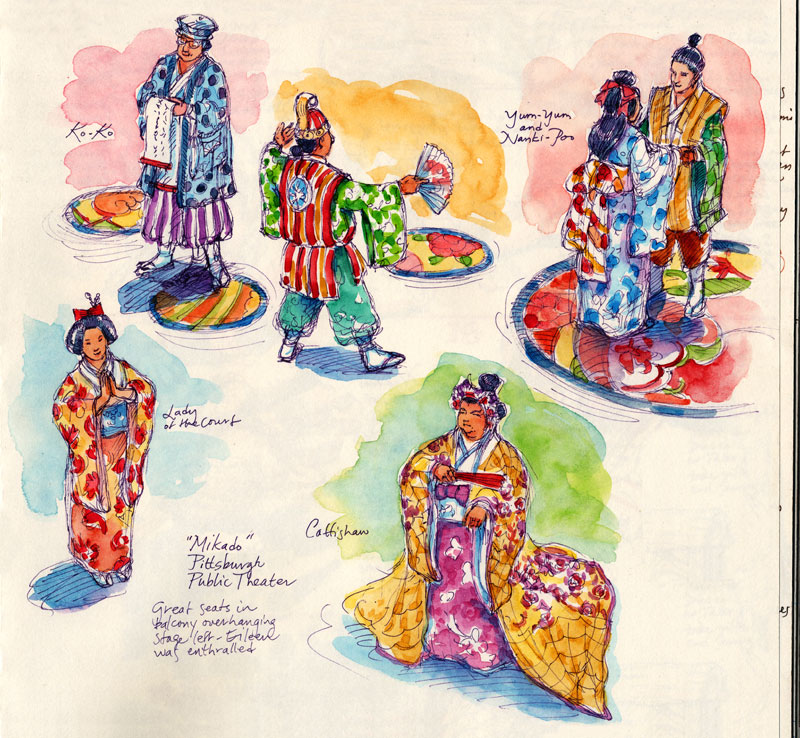
Today is the birthday of humorous librettist, dramatist, and director W.S. (William Schwenck) Gilbert (1836-1911), a man who knew how to make a line scan perfectly. It makes singing his verses so very satisfying.
In his honor, I post these sketches from a fabulous performance of The Mikado, probably Gilbert and Sullivan’s best-known and most often performed comic opera. This one took place at the Pittsburgh Public Theater a few seasons back.
The “Japanese” names, like the nonsensical G&S plots and their occasionally offensive point of view, must be taken, like most forms of entertainment, in historical context—this one, that of a supremely confident 19th-century colonial power. It’s still fun.
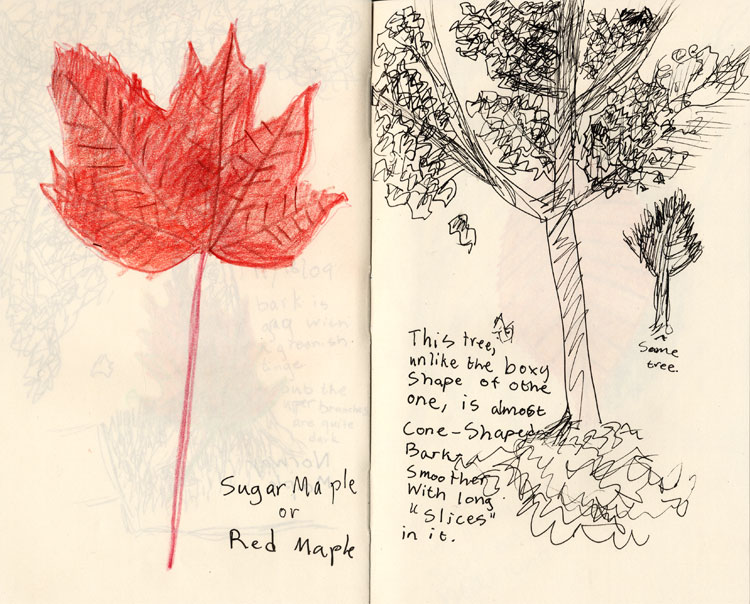
Another neighborhood tree sketch, this one by my daughter. If this IS a sugar maple, does that mean we could be tapping trees right here in Woodley Park, DC?