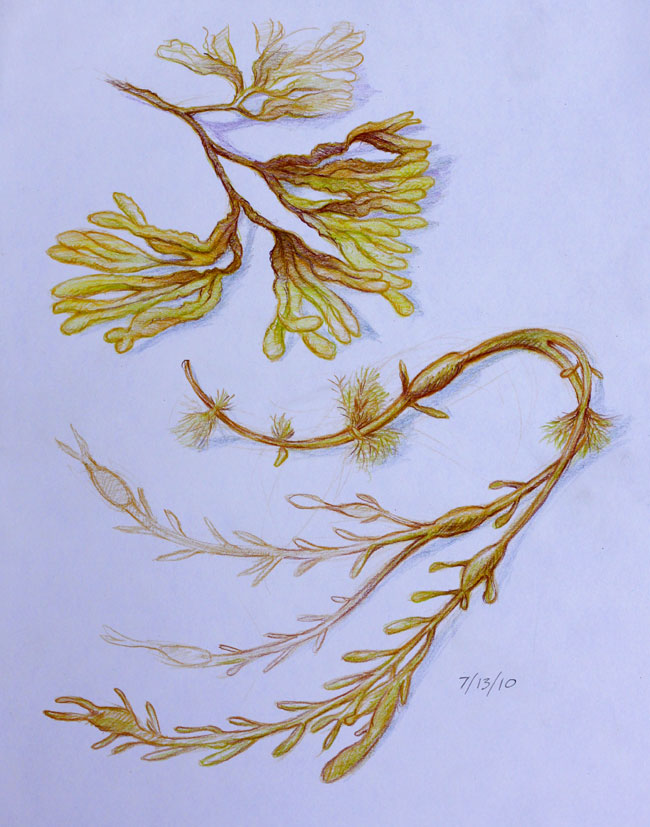
Our botany drawing for today: two kinds of seaweed we found on the beach. Both have little puffy air-filled floats.
(I wonder if we, wrapped in enough strands of this seaweed, could float ourselves?)
Our botany drawing for today: two kinds of seaweed we found on the beach. Both have little puffy air-filled floats.
(I wonder if we, wrapped in enough strands of this seaweed, could float ourselves?)
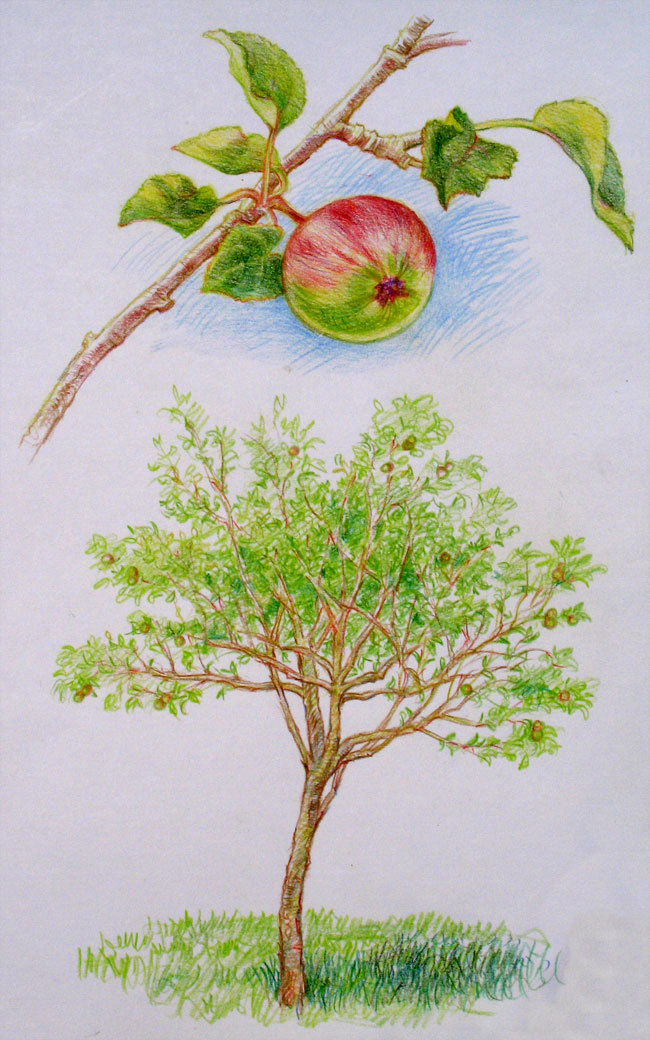
For Botany today we wander the apple orchard, examining the branches with their swelling fruit; then we sit beneath one of the trees and draw. Flies buzz overhead, birds sing in the woods nearby, and the dog stretches out on the grass for a rest. That’s what I call Natural Science.
The russet, crab and cottage red burn to the sun’s hot brass, then drop like sweat from every branch and bubble in the grass.
They lie as wanton as they fall, and where they fall and break, the stallion clamps his crunching jaws, the starling stabs his beak.
In each plump gourd the cidery bite of boys’ teeth tears the skin; the waltzing wasp consumes his share, the bent worm enters in.
I, with as easy hunger, take entire my season’s dole; welcome the ripe, the sweet, the sour, the hollow and the whole.
—Laurie Lee
 Grandma Clarke
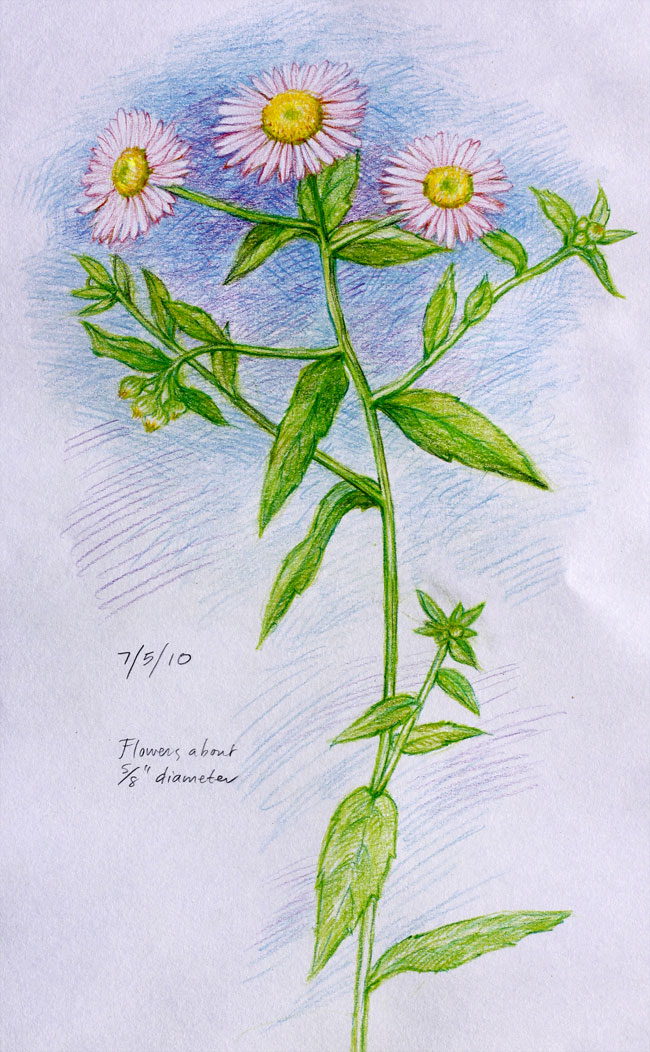
July is the season of botanical abundance, in the garden, in the fields, and along the roadside. My daughter chose these wildflowers for our botany drawing today.
 Kathy
Kathy
 Colen
Colen
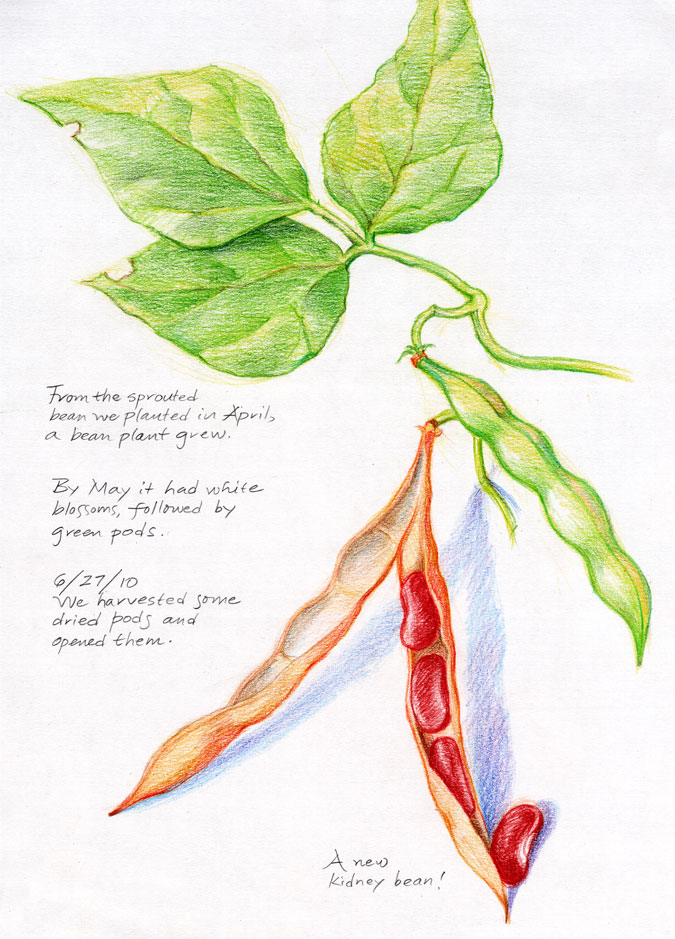
If you have been following this blog for a while, you may recall that in April my daughter and I took a kidney bean from a big jar of kidney beans in our kitchen and set it in moist cotton, whereupon it sprouted, after which we planted it in the garden. Lo and behold, it grew into a bean plant, blossomed, and brought forth brand-new kidney beans. I realize that this is not a discovery original to us, but somehow it was just as thrilling as if it were.
 Colby
Colby
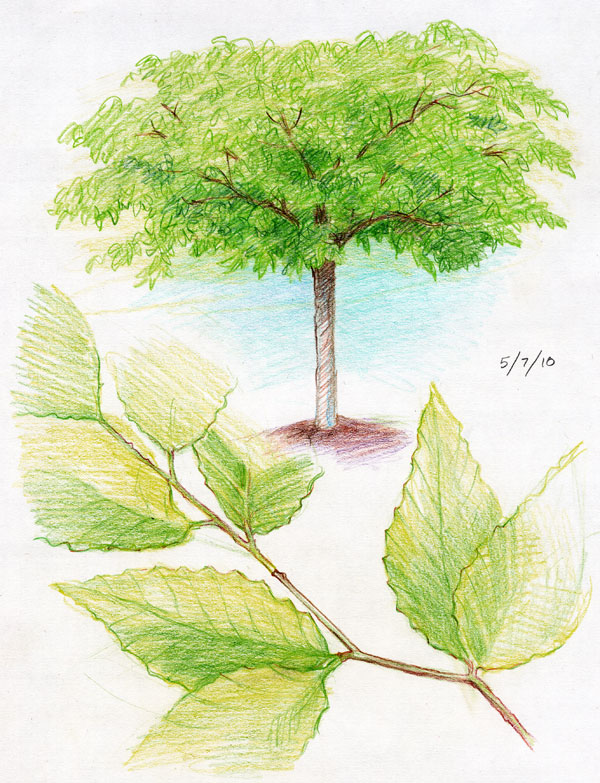
One of the projects of our homeschooling Botany block, which we began just before the spring equinox (and which looks like it will continue for a year, if we want to get a rounded view of plant life) has been a Tree Study. My daughter chose a tree in its winter state, down the street on the grounds of the hotel, and we sketched its bare branches and made crayon bark rubbings. Spring arrived; we sketched other, now-budding, even flowering and leafing trees; did other bark rubbings. Our Chosen Tree remained mystifyingly and unashamedly bare in a forest of showy blossoms and new green leaves. Good grief! Was it even ALIVE? Yet the reddish branch tips were springy, not dry.
One day the tips seemed a bit longer. The next day more so. Still no green, but increasingly long. Finally each tip gently opened to reveal a glimpse of…GREEN! Then, long clusters of large, fresh leaves unrolled themselves day by day, impossibly, from the formerly slender twiggy tips. In a few days the tree bore a bright and bushy yellow-green crown wider than it was high, well worth the wait. We sketched it in its new glory. Some of you must be familiar with this type of tree, but I only recognize a handful of varieties. Our neighbor Jason, seeing the sketch, revealed its identity: it is a hornbeam.
This is a drawing of Trifolium repens (Three leaves, creeping), otherwise known as white clover, from our Botany block. My daughter has been growing her very own patch of it in the garden, and it’s doing a lot better than the arugula.
I post this drawing because Trifolium repens was personally given its name by none other than…the Prince of Binomial Nomenclature.

Wouldn’t Prince of Binomial Nomenclature be an awesome title for a work of sophisticated tween fantasy literature? An unknown yet gifted Swedish youth—the future Prince—ventures forth into the wilderness, despite the objections of his parents, to make discoveries that change thenceforth the way we look at relationships among all living things on Earth, and founds the Grand Kingdom of Binomial Nomenclature.
This is actually a TRUE story. Today is the birthday of Carl, or Carolus, Linnaeus (1707-1778), who grew up in Stenbrohult, Sweden, in a village surrounded by farmland, woods, and mountains, a made-to-order environment for a future naturalist. But his father and grandfather were both country pastors, and they expected little Carl would follow in their footsteps, so his parents hired a tutor for his pastor-preparatory education.
Carl, however, showed from an early age a distinct inclination to wander off looking at plants. Exasperated, his family sent him away at age nine to a school in town, where classes ran from 6 am to 5 pm and consisted of studying Latin, Greek, and the Bible. Astonishingly, this did nothing to increase Linnaeus’ passion for school (although the Latin came in handy later, as we shall see). Often he skipped class to explore the fields, examining flowers. The only subjects he liked were logic and physics, taught by the town doctor, who lent him books and persuaded Linnaeus’ parents to let him become a doctor instead of a clergyman—this was an age when almost all medicines were plant-based, so knowledge of them was extremely useful—and offered him anatomy and physiology studies until he was ready for University. A doctor! What a crushing disappointment! But they reluctantly agreed.
Linnaeus enrolled first at Lund University, where his father had studied. No one there taught his real interest, botany, but he was befriended by a professor with botany books in his personal library, from which Linnaeus taught himself. When Linnaeus transferred to the University at Uppsala for its botanical gardens, his parents withdrew their financial support. You’re on your own, you little botanist.
So poor that he suffered from malnutrition and patched his shoes with paper, Linnaeus would have withdrawn from school if not for a fortunate meeting with a theology professor who was so taken with Linnaeus’ botanical knowledge that he offered him room and board and found him tutoring work. Grateful, Linnaeus thanked him with the gift of a paper he had written on pollination. Not your typical present (“Happy birthday! I wrote you a paper on pollination!”), but I guess he knew his recipient.
Why pollination? Well, Linnaeus was troubled by the popular methods of plant classification and had begun to ponder a new system. Classification of organisms was hardly a new concept, dating back at least to Aristotle, but naturalists differed on how it ought to be done, and several different systems existed. Was it to be by form? By function? By environment? (One system grouped beavers with fish, because both live in water. For a while the Catholic church permitted beaver to be eaten on fast days. That must have made the Jesuits’ work easier in North America.) What about the problem of naming? The same plant or animal was given a multitude of names in different countries. And what about the absolute flood of new, unfamiliar flora and fauna arriving from expeditions to the Americas? It was overwhelming.
Linnaeus’ paper explained a theory he had developed about the roles of stamens and pistils in plants. The professor, impressed, had it read at the Swedish Royal Academy of Science, and, although Linnaeus was still a student, he was offered a position as a botanical lecturer. His talks drew hundreds of listeners, many times the usual number. This was partly due to the controversial nature of the subject of plant reproduction (a new, hot topic) and partly due to Linnaeus’ unusually poetic and anthropomorphic descriptions of his plant subjects’ structure and habits. “The actual petals of the flower contribute nothing to generation, serving only as bridal beds,” he said. And, “It is time for the bridegroom to embrace his beloved bride and surrender his gifts to her.” That’s my kind of botany class! No wonder he brought in the crowds. Nowadays we can usually mention stamens in public without causing a shiver of excitement. (Correct me if I am wrong here.)
Please see Prince of Binomial Nomenclature: Part 2
This is a page of the Improper Fractions lesson from our homeschooling Fractions block. I hope to get the entire book up on the Homeschooling page eventually. For now it serves as an introduction for what I am about to tell you.
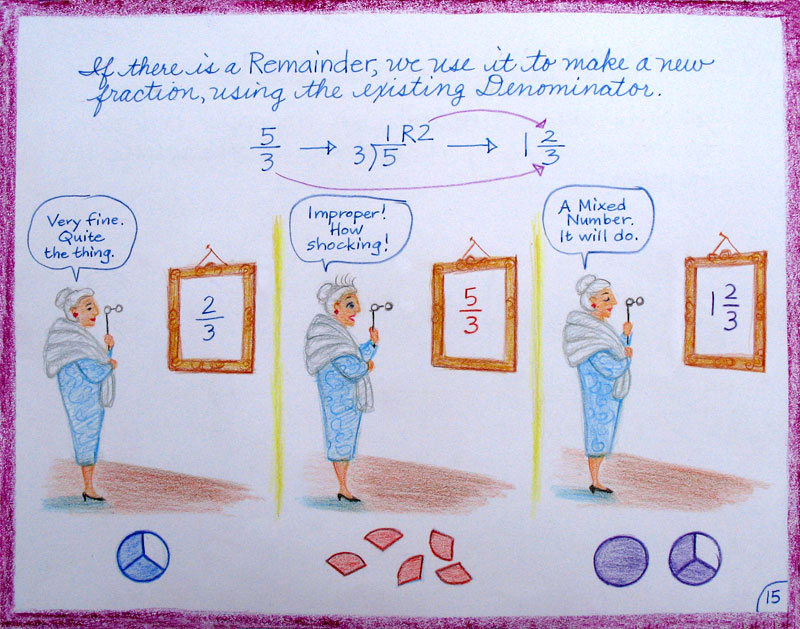
Recently a big group of us had dinner at the home of our friends Lynn and Giovanni. The meal ended with everyone playing with math puzzles and games around the dining room table. Lynn, a Math Whiz, owns hundreds of them. For years she was a math instructor and tutor. Then in 1999 she developed a summer Math Camp called “MathTree.” It’s not only for kids struggling with math, but also for kids who can’t get enough and want it included in their summers. (I understand that there actually ARE such children, although none has shown up in my family.)
MathTree has taken off—that first summer there were two locations, and now there are 26 of them (!!!), for kids ages five to teens, all over the Washington metropolitan area. Lynn has developed a hands-on approach using objects, games, puzzles, and real-life experiences. (I was reading the fliers for the camp choices and thinking I might like to sign up myself! except they don’t have my age group.) If you are looking for an unusual kids’ math camp, MathTree might be just the ticket. So I’m putting a link to the website and brochure here. As my husband and I frequently remind each other, Someday Our Children Will Thank Us.
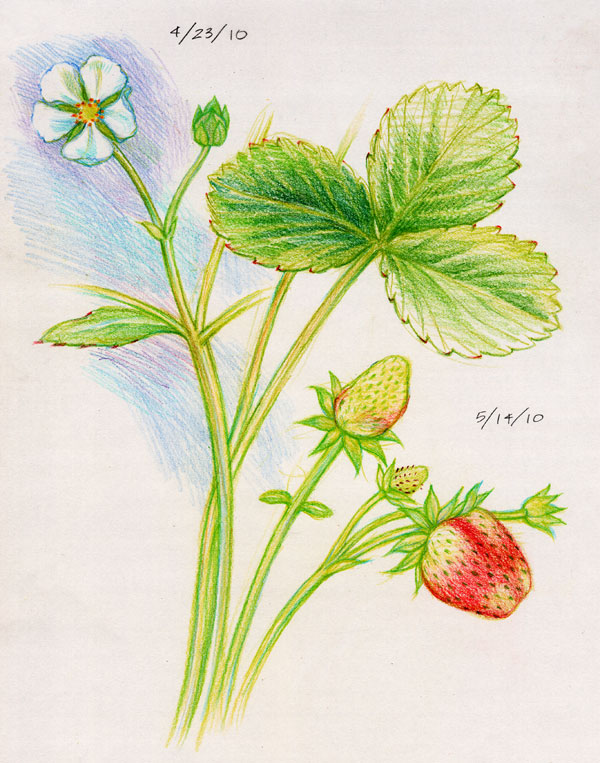
Three years ago my daughter and I bought three little strawberry plants at a school fair. Each year they have multiplied, and now we have about fifteen pots full of plants on our tiny rooftop deck. This spring we are drawing them at their different stages of development for our Botany block, and the process, from bud to fruit, is pretty fascinating. The strawberries are terrific. Unfortunately this year a squirrel has discovered them and visits often. What’s so annoying is that he (she?) doesn’t simply eat an entire strawberry, but takes large bites out of several and then wanders off. One day I caught him trying to BURY one as if it were a nut.
We’ve been watching the garden, waiting for these to open, so we could draw them for our homeschooling Botany block. And here they are, a faithful little marker of the season: lily-of-the-valley, the traditional flower of the first day of May.

 Mary
Mary
Continued from April 28th, Part I.
Pictures are from our homeschooling block, Local History and Geography.
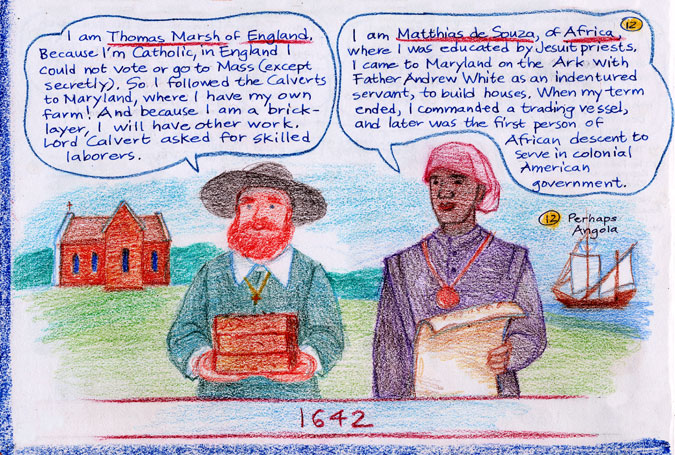
Despite Maryland’s absence of gold, colonists benefited from another resource: tobacco, which grew well and had a ready market in England. It quickly became Maryland’s principal cash crop. (In rural areas tobacco was used to pay bills even into the 20th century.) Some planters made large fortunes and imported their style of living from England, spending their time at hunting meets, dances, card parties, horse races, and similarly useful pursuits.
Tobacco rapidly depleted the soil, however, requiring continual acquisition of acreage and labor, both hired and slave, and pushing Native Americans further from their homelands. In the first half of the 18th century, England helpfully sent 10,000 convicts, mainly petty thieves and other troublesome folk, to Maryland as indentured servants. But while they worked off their indentures and freed themselves, the slave population, permanently trapped, increased. (And that’s another story.)

Maryland’s coastlines were settled first, so when German and Scotch-Irish immigrants began to arrive in the 1740s, they moved into western Maryland, creating small farms like those in Europe and New England, raising animals, growing grains (rather than tobacco) on manured fields, rotating their crops, and feeling exasperated that large wasteful eastern plantation-holders had more say in land and trade policy than they did themselves. Iron was discovered in western Maryland, and its mining and forging, mostly by slaves, accelerated rapidly. The port of Baltimore grew as grain and iron passed through for the French and Indian Wars, warfare being ever a boon to industry. Annapolis very slowly became a center of society, acquiring the attendant accoutrements of high culture: a theater, newspaper, bookshop, and jail.
By the 1770s, the now-numerous settlers (Maryland’s population was about 150,000, which included tens of thousands of African slaves and a few hundred remaining Native Americans) were inevitably, due to time, distance, and differences, less connected to Great Britain. In 1713 the currently reigning Calvert had converted to Protestantism. But Marylanders didn’t want ANY Proprietor, of any religion whatsoever. Parliament’s taxes and trading practices favoring Great Britain infuriated them, as it did colonists elsewhere. Although some were at first unsure about complete independence, Maryland sent delegates to the First Continental Congress in 1774. Four signers of the Declaration of Independence were from Maryland, including the only Catholic. Maryland militiamen fought with George Washington in the Revolutionary War (the state’s sole Tory regiment was chased across the border and later departed for Canada).
After the war finally ended in 1783—people forget how LONG it dragged on—and after the delegates to the Constitutional Convention spent the summer of 1787 heatedly wrangling over the creation of the Constitution (which story reads like a thriller in itself), Maryland ratified it the following spring, becoming the seventh of the new United States. Not only that, but Maryland provided two of the nation’s seven temporary capitals (Baltimore and Annapolis) throughout its formative years, and finally the permanent one in 1790: Washington, District of Columbia, carved from a 10-mile square on the Potomac. (Virginia took back its section in 1846.)
So, party down, Marylanders! and celebrate your stateliness by singing the Official State Song (to the tune of “O Tannenbaum”). Here are the first two verses. Just in case you don’t already know them by heart.
The despot’s heel is on thy shore,
Maryland!*
His torch is at thy temple door,
Maryland!
Avenge the patriotic gore
That flecked the streets of Baltimore,
And be the battle queen of yore,
Maryland! My Maryland!
Hark to an exiled son’s appeal,
Maryland!
My mother State! to thee I kneel,
Maryland!
For life and death, for woe and weal,
Thy peerless chivalry reveal,
And gird thy beauteous limbs with steel,
Maryland! My Maryland!
* Although the words as written, and as adopted by statute, contain only one instance of “Maryland” in the second and fourth line of each stanza, common practice is to sing “Maryland, my Maryland” each time to keep with the meter of the tune.
 Michaela
 John
John