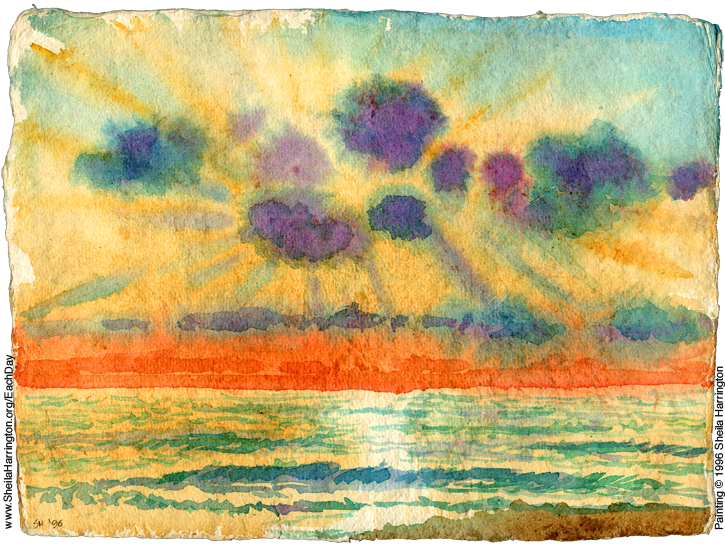
Why I Wake Early

A last look at the sunny beach before summer’s end, and a poem by Mary Oliver (b. 1935), whose birthday it is today. (This is not an upload glitch—the Indian Village watercolor paper actually is irregularly shaped.)

Beach&Houses

Hello, sun in my face.
Hello, you who made the morning
and spread it over the fields
and into the faces of the tulips
and the nodding morning glories,
and into the windows of, even, the
miserable and the crotchety—
best preacher that ever was,
dear star, that just happens
to be where you are in the universe
to keep us from ever-darkness,
to ease us with warm touching,
to hold us in the great hands of light—
good morning, good morning, good morning.
Watch, now, how I start the day
in happiness, in kindness.

—Mary Oliver

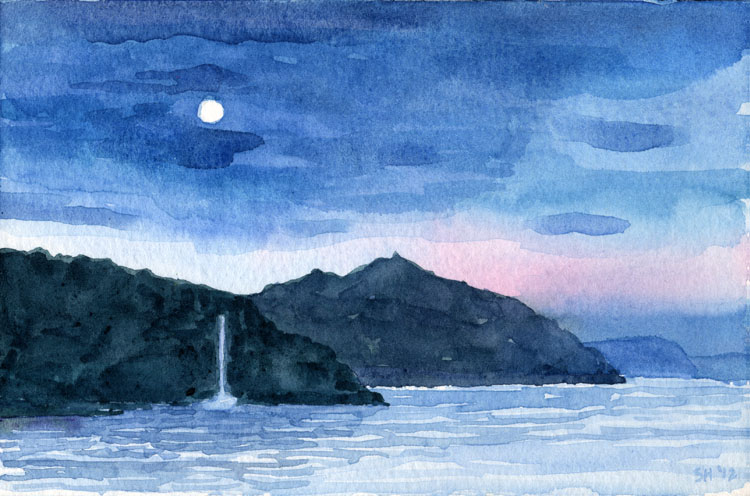
Moon Over Orcas Island

MoonOverOrcas

Keep your fingers crossed for clear skies tonight so you can see the Blue Moon: that is, the second full moon in a single month, which will not happen again until 2015. I post a watercolor of this month’s first full moon (which my daughter and I admired from Orcas Island), on August 2nd, in its honor.

It is a celestial event that seems especially significant in light of the passing on August 25th of Earth’s moonwalker Neil Armstrong—the first human being who could gaze up at the full moon and say, “I was there.”

CakeChocCurls2Katie

CakeBalloons2Rick

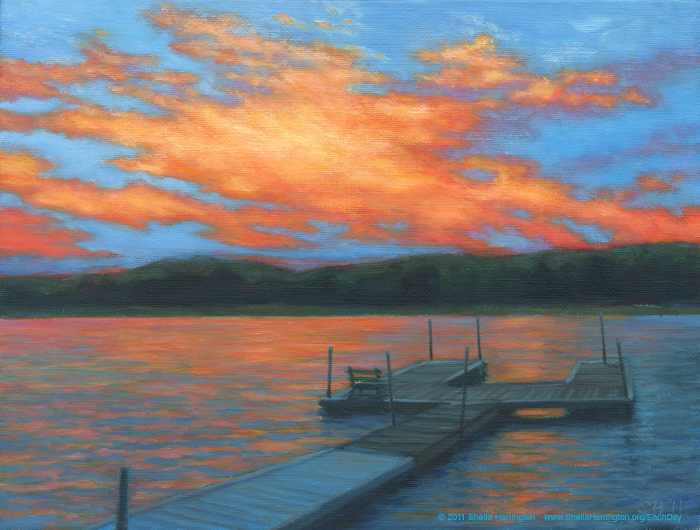
Sunrise, Deep Creek Lake

Today is the birthday of Pablo Neruda (1904-1973) and so I post this poem and its English translation, along with a painting created for our friend Martha, who introduced us to what is probably our family’s most beloved vacation destination. Thank you, Martha.

Oda a la luz encantada

La luz bajo los árboles,
la luz del alto cielo.
La luz
verde
enramada
que fulgura
en la hoja
y cae como fresca
arena blanca.

Una cigarra eleva
su son de aserradero
sobre la transparencia.

Es una copa llena
de agua
el mundo.
—Pablo Neruda

DeepCreekLakeDock

Ode To Enchanted Light

Under the trees light
has dropped from the top of the sky,
light
like a green
latticework of branches,
shining
on every leaf,
drifting down like clean
white sand.

A cicada sends
its sawing song
high into the empty air.

The world is
a glass overflowing
with water.
—Pablo Neruda

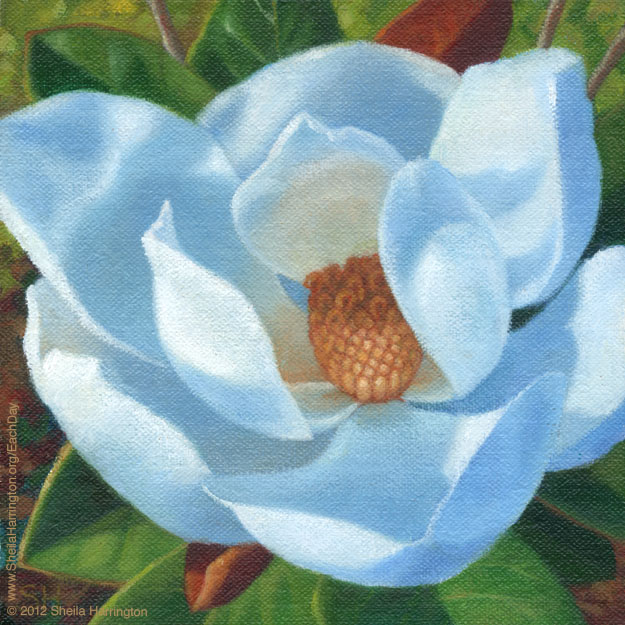
Summer in the South

Magnolia2

Today is the birthday of writer Paul Laurence Dunbar (1872–1906), a once-upon-a-time resident of Washington, DC, and the child of former slaves. His father had escaped through the Underground Railroad and fled to Canada, returning to fight in a Massachusetts regiment upon the outbreak of the Civil War; his mother, freed by emancipation and on the verge of emigrating to Liberia, instead decided to remain in the U.S. when the war ended. They met and married post-war in Dayton, Ohio, where Paul was born.

Dayton was a 19th century rural-to-urban destination for southern African-Americans, who quickly established churches, schools, newspapers, and small businesses. Paul’s mother, sure that he showed promise, enrolled herself in night classes (during the day she worked as a cook and laundress) in order to be able to teach her son to read. She encouraged his early interest in writing, and he produced his first poems at age six and began reciting them publicly at nine. In 1887, Ohio abolished racial segregation in the school system (although extracurricular activities like plays and dances remained segregated), and Paul attended local schools as the only African-American student, serving as high school class president and writer and editor for the school paper.

Despite his excellent school record and his having had several pieces of work published in local newspapers, Dunbar found it impossible as an African-American to find either employment in journalism or funds for college. Instead he began working as an elevator operator in the Callahan Building, a seven-story “skyscraper” in downtown Dayton, writing in his spare time. A former teacher’s recommendation acquired him a place reciting his poetry at a convention in Dayton of the Western Association of Writers, and his writing and beautiful voice so impressed the listeners that a nationally distributed write-up of the event brought Dunbar broader attention.

His old school friend Orville Wright, who had dropped out of high school to start a small printing company—having built a press with his brother Wilbur (this in their pre-flight days)—helped Dunbar to self-publish a collection of his poems. Dunbar sold these to his elevator passengers for a dollar apiece, probably hoping that as many as possible would ride all the way to the seventh floor (“While you’re riding with me today, might I interest you in some poetry?”) and eventually recouped his investment. Lucky the buyer with the presence of mind to hang onto that first edition.

Travel and exposure brought Dunbar contacts and supporters, some of them fellow writers. On a visit to Chicago to write about the 1892 Columbian Exhibition, Dunbar met and was befriended by Frederick Douglass. With the patronage of a superintendent of the Toledo State Hospital, Dunbar went on to publish further collections of his work, which were also well-received. Dunbar wrote his poetry both in standard English and in southern dialect, which he had learned through stories from his mother’s Kentucky childhood; the use of dialect in his work has suggested comparisons with Mark Twain.

His growing reputation led to a series of recitals around the U.S. and eventually a six-month recital tour in England, where he also collaborated on theatrical and choral pieces and an operetta. When he returned, it was to Washington, DC and a position at the Library of Congress, meanwhile writing in his free time a collection of short stories and his first novel. The work at the Library was less rewarding than he had hoped, and a whole lot dustier, exacerbating his developing tuberculosis, and with his wife’s encouragement he returned to writing and reciting full-time.

The subject matter for Dunbar’s fiction was drawn from life in black America, and, despite its somber themes, tended to optimistic conclusions. Later criticized for somewhat stereotypical characterizations and a tendency to sentimentality, his writing was unusual in its exploration of the difficulties of African-Americans, both pre- and post-Civil War. In this respect, and particularly in his work in dialect, he influenced later writers of the Harlem Renaissance.

Sadly, Dunbar succumbed to tuberculosis in 1906. During his short life he produced nearly two dozen books: collections of poetry and short stories, novels, and other works. Nevertheless, one can’t help wondering what direction his writing would have taken had he been able to live beyond the age of thirty-three.

Here is one of his poems, “Summer in the South,” and a recently-completed painting to accompany it.

To see where Paul Laurence Dunbar lived and worked in the nation’s capital, you can consult the illustrated Literary Map of Washington, DC.

The oriole sings in the greening grove
As if he were half-way waiting,
The rosebuds peep from their hoods of green,
Timid and hesitating.
The rain comes down in a torrent sweep
And the nights smell warm and piney,
The garden thrives, but the tender shoots
Are yellow-green and tiny.
Then a flash of sun on a waiting hill,
Streams laugh that erst were quiet,
The sky smiles down with a dazzling blue
And the woods run mad with riot.

—Paul Laurence Dunbar

CakePink2Agnès

Happy Summer!

SunRays3

The summer solstice arrives early in the Northern Hemisphere this year—at least according to the calendar—not because the earth has picked up speed in its travels around the sun, but because of the addition of February 29th to 2012, a Leap Year.

So, you may not be standing at Stonehenge, a Mayan ruin, or the Great Pyramid at Giza, but if you live above the equator you can still drink fermented honey, leap the bonfire, and stay up late on this longest day of the year, dancing with the fairies. Although it’s been so hot the last few days that we here might settle for the fermented honey. With plenty of ice.

In honor of this day, here is a poem by Flawn Williams, a clever take on Susan Cooper’s The Shortest Day, familiar to Winter Revelers near and far.

And so the Shortest Night came
and the power died
And everywhere down the hallways of the condos

Came people moaning, griping, seeking
To drive the heat away.
They lighted rooms with their iPhones’ flashlight apps;
They hung their walls with USB powered fans;
They imbibed obscure ales from their dark silent fridges
To keep themselves alleviated.

And when the next day’s sunshine blazed awake
They staggered, sweltering.
Through all the long hot hallways you can hear them
Echoing behind us—listen!
All the long echoes, sing the same delirium,
This Longest Day,
Till once more power returns to the sleeping land:
They shower, recharge, give thanks,
And dearly love their fridge,
And hope for no more blackouts.
And now so do we, here, now,
This year and every year.

Well, cool, y’all!

WELL, COOL, Y’ALL!

—Flawn Williams

CakeBerries2Romy

YCandleDon

Let Me Enjoy

Today is the birthday of the sensitive and melancholy Thomas Hardy (1840-1928), who in 1897 departed England for Switzerland in order to “escape the racket of the Diamond Jubilee” (Queen Victoria’s, on that occasion). He would be obliged to go much further than Switzerland this time around, what with continuous satellite coverage of Elizabeth II’s festivities.

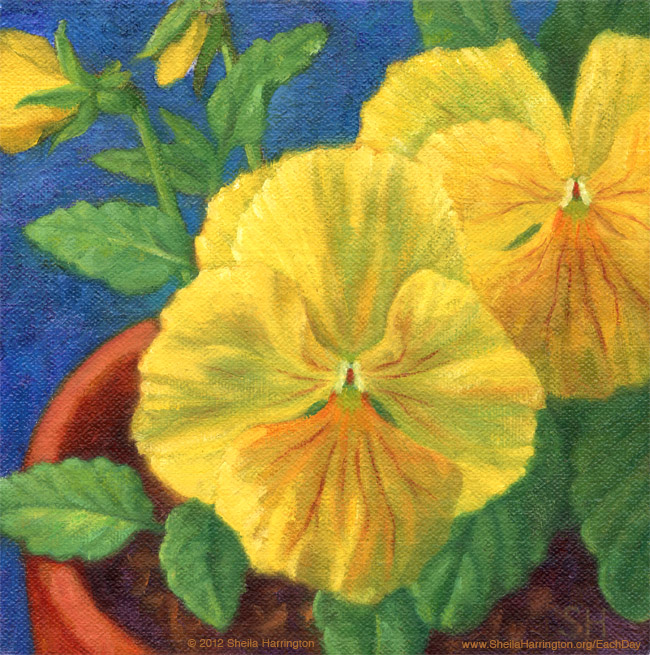
For his birthday I post this poem, and, despite the final verse’s mournful assumption about Hardy’s fate, I post also a painting of some cheerful yellow pansies. Since we know not the aims of the loveliness of pansies.

YellowPansies

Let me enjoy the earth no less
Because the all-enacting Might
That fashioned forth its loveliness
Had other aims than my delight.

About my path there flits a Fair,
Who throws me not a word or sign;
I’ll charm me with her ignoring air,
And laud the lips not meant for mine.

From manuscripts of moving song
Inspired by scenes and dreams unknown
I’ll pour out raptures that belong
To others, as they were my own.

And some day hence, towards Paradise
And all its blest—if such should be—
I will lift glad, afar-off eyes
Though it contain no place for me.

—Thomas Hardy

Artists of Woodley Park

The Stanford in Washington Art Gallery has just opened Artists of Woodley Park, and what a pleasure it is to see so many people, working in such a variety of media, in our small neighborhood. The exhibit runs until July 15th and includes painting, sculpture, prints, photography, ceramics, glasswork, woodwork, jewelry and film. Please check the website for gallery location and hours.

Below is one of a series of four of my still-life paintings in the exhibit.

GrapefruitGrnPlateBIG

CakeSprinklesCeleste

CakeGreenUncle Mike

Yahrzeit3Maurice Sendak

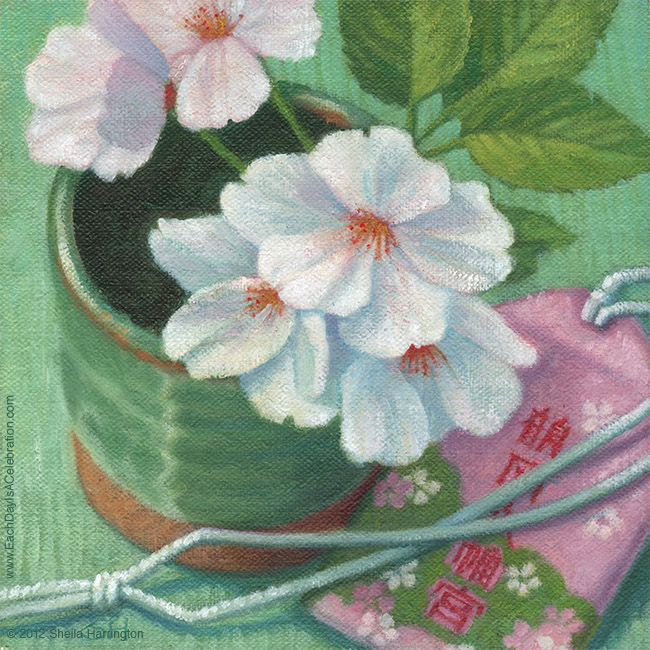
One Hundred Years of Cherry Blossoms

CherryBlossoms

This year, 2012, marks the 100-year anniversary of the gift of cherry trees from Tokyo, Japan to the city of Washington, DC, and so the annual flowering and pilgrimage to the Tidal Basin has been accompanied this season not only by the usual parade and street festivals, but also by a vast range of concerts, lectures, films, theatrical performances, cruises, workshops, and a dizzying selection of art, craft, textile, photography, and history exhibits. If you haven’t been checking them out, it’s not too late; some continue well beyond cherry blossom season.

Throughout changing administrations, evolving political systems, and wars, including one in which the United States and Japan bombed and killed each other’s citizens, the cherry trees have stood silently along the water’s edge, reliably budding and blooming each spring, and sprinkling with poignant pink-and-white petals their millions of admiring visitors. Now grown (we hope) to a more mature phase in our relationship, we two peoples take up our passports and visit one another amicably, sometimes transplanting ourselves and intermarrying.

Distantly related to rough-housing among children encountering one another in a sandbox, warfare has, throughout human history, served as a bizarre prelude to mutual recognition, acceptance, and eventual intimacy. At the height of WWII, there probably weren’t many people who, seeing their society’s young men dying horribly, envisioned enemy citizens as potential in-laws or their towns as future tourist destinations. But, given the pattern, perhaps we Americans can optimistically anticipate our grandchildren doing their study abroad, and perhaps finding their spouses, in Afghanistan and Iraq.

And, hoping you haven’t had enough cherry blossoms already, I post this completed painting, of which I showed the early stage in March. (Undoubtedly some will prefer that earlier stage!) Happy Sakura Season, everyone.

Trailing Clouds of Glory

Yesterday was the birthday of William Wordsworth (1770-1850); thus I post an excerpt from his beautiful Ode on Intimations of Immortality, so appropriate to this season and this day. Happy Passover, Happy Easter, everyone.

BeachMorning

Our birth is but a sleep and a forgetting;
The Soul that rises with us, our life’s Star,
Hath had elsewhere its setting
And cometh from afar;
Not in entire forgetfulness,
And not in utter nakedness,
But trailing clouds of glory do we come
From God, who is our home:
Heaven lies about us in our infancy
!

—William Wordsworth, from Intimations of Immortality

You can read the poem in entirety here.

For a mini-bio of Wordsworth, please see My Heart Leaps Up. For another painting and favorite poem, please see Dancing with the Daffodils.