Heavenly Strings

KarenBriggs

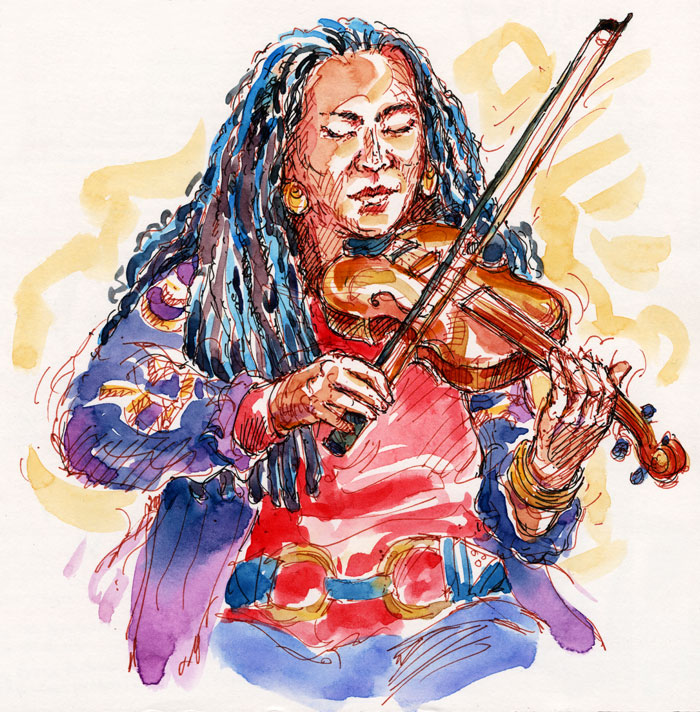
One of the numerous advantages of homeschooling is accompanying one’s children on field trips. Recently we attended a performance by amazing violinist Karen Briggs and her back-up combo. The concert, one of a series organized for school groups, was held in the Kennedy Center’s Jazz Club, which is set up with cafe tables and chairs rather than rows of seats, and intimate enough that Briggs could chat with us informally between pieces (and that I could see her well enough to sketch). She played for us a range of pieces, and her fiery interpretations and improvisations, drawing on classical, jazz, gospel, African, and Middle Eastern traditions, mesmerized and dazzled the audience, many of whom, it turned out, were young violinists. Briggs has played in concert halls all over the world and is probably best known for her work with keyboard artist Yanni. We all departed with stars in our eyes.

Yahrzeit3Erna

Yahrzeit3Joe


Boooo!

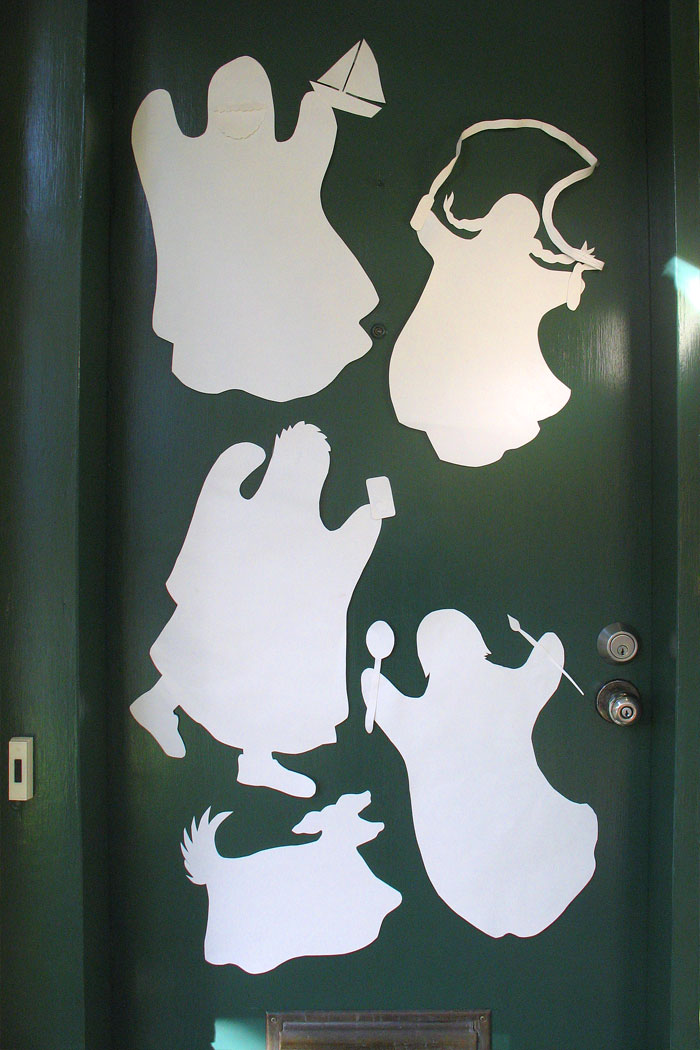
Here’s an art form I don’t use too often but which comes in handy for large-scale decorating in a hurry—big white paper cutouts. This is our frightening Halloween front door, featuring the ghost family: Dad with mini-version of boat he is building; Sis with energetic jump-rope; Bro with faithful iPhone; Mom with paintbrush and spoon; and the world’s least scary Dog, unless you fear relentless licking.

HalloweenDoor2010

United Nations Day

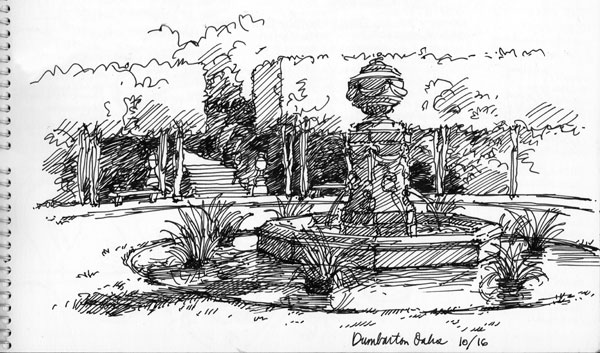
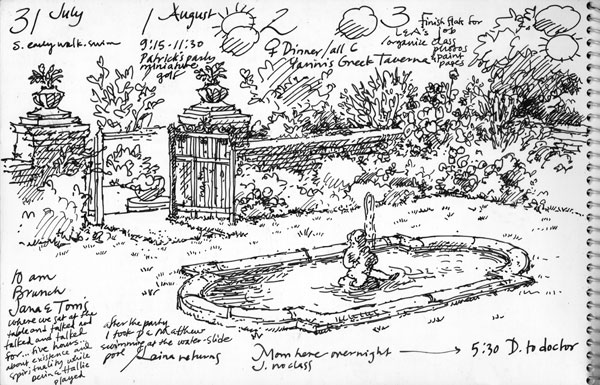
These drawings are from a couple of sketchbook-journals carried on visits to the beautiful gardens of Dumbarton Oaks in Georgetown, Washington, DC. However, I post them not for the sake of those lovely gardens themselves (to which the sketches don’t do justice) but in honor of today’s anniversary of the ratification of the charter for the brand-new United Nations. Perhaps some of you folks out there already knew that the foundation of its charter had been hammered out at Dumbarton Oaks. I only learned it recently.

DumbartonFountGrey

DumbartonPoolGrey

Dumbarton Oaks, built in 1801 as a private home, was purchased in 1920 by diplomat Robert Bliss and his wife Mildred. With Beatrix Ferrand they created the fabulous gardens and renovated the house, adding a music room for concerts and lectures, and a museum for their art collection. In 1940 they gave the property to Harvard University.

Although in 1940 the United States had not yet even officially entered the Second World War, entities private and governmental were already discussing the possible creation of a post-war international peacekeeping organization—but secretly, because of the strong isolationist, anti-League of Nations element existing in the country. Isn’t it amazing what significant matters we managed to keep secret in a pre-Internet era?

FDR first offered the optimistic term “United Nations” to refer to such an organization in a 1942 Declaration composed at the Arcadia Conference by the USA, the UK, the USSR, China, and twenty-two other countries to lay out their common goals during and after the war. Other nations signed on later. Bliss, speaking for Harvard, offered the use of Dumbarton Oaks as a possible location for future talks. This setting was deemed suitable, and the offer was accepted.

So, between August and October, 1944, representatives of the USSR, the UK, the USA, and China (although never with the USSR and China at the same table at the same time!) gathered at Dumbarton Oaks to wander the lawns, dine in the Orangery, and sit in the music room for a series of discussions. At their conclusion, the four nations had agreed upon a series of proposals which, along with provisions born of the Yalta conference, formed the basis for the new United Nations Charter, which was signed in San Francisco on October 24th, 1945.

Among the goals were these: The development of friendly international relations. The strengthening and maintenance of international peace and security. The removal of threats to peace through collective cooperation. And collective measures to solve economic and humanitarian problems.

What an impressive and inspiring global perspective, especially for a species that only a few thousand years earlier routinely regarded an unfamiliar tribe as the enemy. (This antiquated response is occasionally observed even now.) May we see these goals one day fully realized.

CakeDaisiesEugenie

Yahrzeit2Aunt Mary

Justice of the Peace

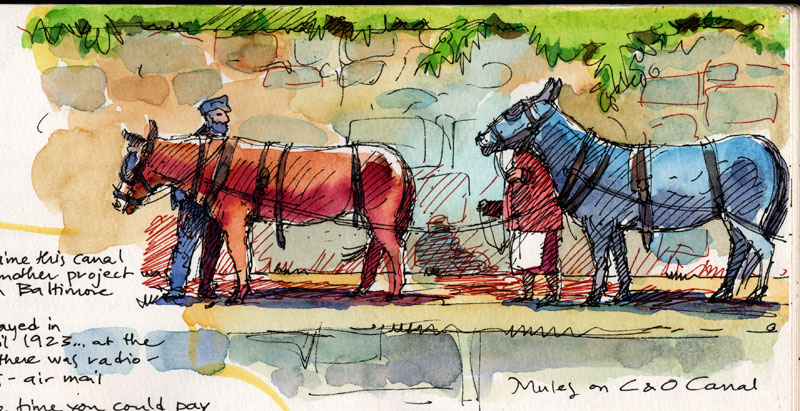
Mules

This sketch is from a canal barge tour we took on the C&O Canal as part of our homeschooling Local History & Geography block. It was mid-week, and my daughter and I were the only non-senior citizens on the trip, so she was definitely the focus of kindly attention (being small and cute with long blond braids), which was fine with her. The restored barge was beautiful, the costumed guide was excellent, the mules were friendly, and it was a lovely day.

ANYWAY, I post the sketch in honor of Supreme Court Justice William O. Douglas (1898-1980), whose birthday it is today. What, you may ask, is the connection?

Well, some of you may know that Douglas, in addition to serving for 36 years on the Supreme Court, was an avid outdoorsman and supported various environmental causes, even serving briefly on the board of the Sierra Club.

In the 1950s, an era newly keen on the divine glory of automobiles and expanses of concrete pavement, there was a movement in Congress, supported by The Washington Post, to replace the canal with a highway. Douglas, familiar with the canal’s scenery and wildlife, thought this an idiotic and short-sighted idea and challenged the Post’s editorial staff to accompany him on a hike of the canal’s entire length.

Douglas expected that perhaps a handful of folks might accompany him; however, news of the challenge spread, and by the departure date there were 58 in the group, including conservationists, historians, geologists, ornithologists, and zoologists. Each night when they crashed, the group had a free, informative lecture, offered by one of their traveling companions, on some aspect of the canal.

Word got around, and thousands of newspapers carried updates on the hikers. Organizations along the way hosted them and prepared meals. Children and townspeople watched for them and shouted their support. Some joined in for parts of the route.

Even given the ongoing attention, it was a tough hike. The C&O Canal is 185 miles long, and Douglas, age 55, maintained an average pace of 23 miles a day. This was a man who had, after all, hiked the 2,000-mile Appalachian Trail. Only eight of his companions made it to the end. By then, public support to save the canal was enormous. Douglas organized and worked with a committee to plan its restoration and preservation, and The Chesapeake and Ohio Canal National Historical Park Act finally passed in 1971.

Canal-lovers, imagine this place as a highway! Today it’s one of the most popular national parks in the U.S., enjoyed by millions of hikers, boaters, bicyclists, and birdwatchers. Not to mention the birds themselves, as well as countless fish, frogs, beaver, fox, and deer. Happy Birthday, Justice Douglas! We have you to thank for this gift, all year round.
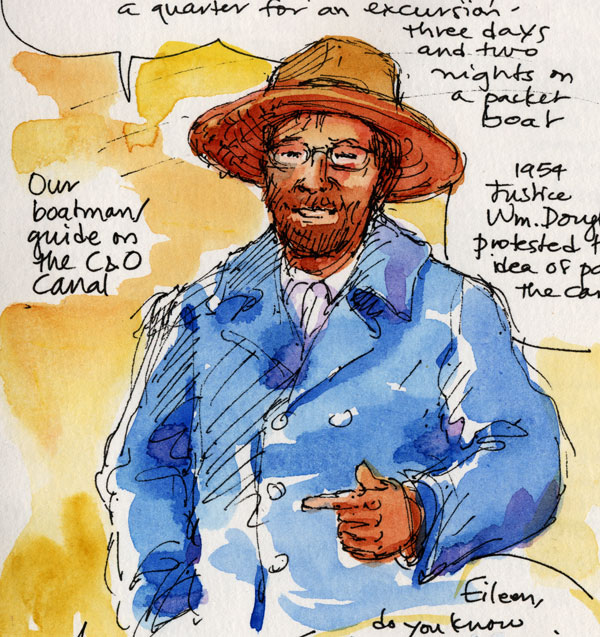

C&OCanalGuide

CakeYellowRosesAunt Bett

Opera Look-In

OperaLookIn

Each year the Washington Opera presents “Opera Look-In,” at the Kennedy Center Opera House to educate children about opera. The program presents opera in a highly accessible manner, combining storytelling, brief scenes in costume, and selected arias (accompanied by the full Opera House Orchestra!) with behind-the-scenes explanations of the use of lighting, music, costumes, and props. School groups attend from all over the Washington, DC area, including homeschool groups—lucky us.

Last year the program revolved around the opera Carmen, and included an exhibition of costumes created by fashion design students at Duke Ellington School for the Arts. This year’s program featured Ellington School students supposedly lost in an opera house, encountering as if by accident scenes from The Barber of Seville, Madame Butterfly, Lucia di Lammermoor, The Magic Flute, and (big crowd-pleaser) Cosi Fan Tutte. It’s not easy to sketch in the dark, and by the end I gave up and settled back to enjoy the humorous last quintet.

To engage an auditorium packed with elementary school students is no easy task, and the kids were riveted. I wonder how many go home and ask their parents to rent Cosi Fan Tutte so they can see the rest of the story.

Let Those People Go

Perhaps you did not hear, one grim day this past summer, about the abrupt dismissal of Hillary Fennell, our library’s much-loved children’s librarian for over 30 years, as part of the sudden and arbitrary termination of all DC Public Library part-time staff throughout the city. So long, folks, there’s the door! Hope you didn’t leave your lunch bag back at your desk, because you won’t see that again! I tried to imagine what logical thought process culminated in this bizarre event.

Dodos

St. Francis of Assisi

St.Francis

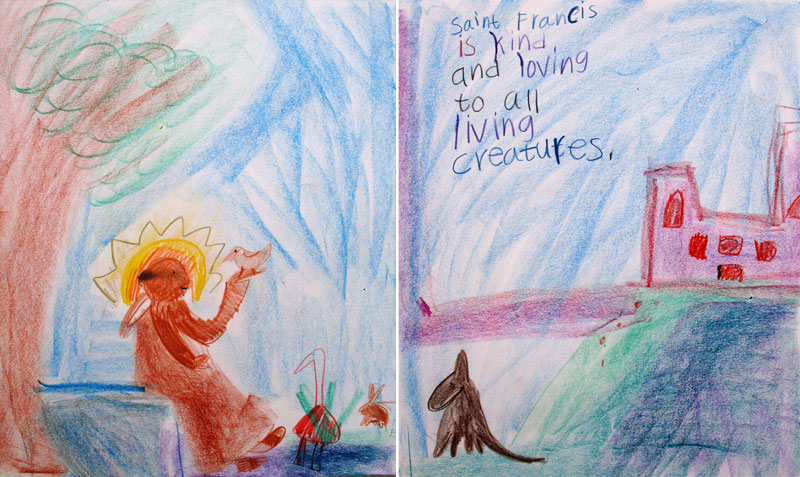
Tomorrow, October 4th, is actually the Feast Day of St. Francis, not today, but I am celebrating him a day in advance because today is the Blessing of the Animals in his honor at Washington National Cathedral. (And many other churches have similar events.) Come at 2:30 to the west steps of the Cathedral for a brief service followed by individual blessings for your dog, cat, rabbit, goldfish, or any other pet not actually life-threatening to the clergy in attendance. There will also be representatives from the Humane Society and the Animal Rescue League to accept donations of pet food and toys and to share information about adopting homeless animals.

These drawings are from my daughter’s second grade Saints, Heroes, and Heroines main lesson book.