Night of the Shooting Stars

ShootingStars

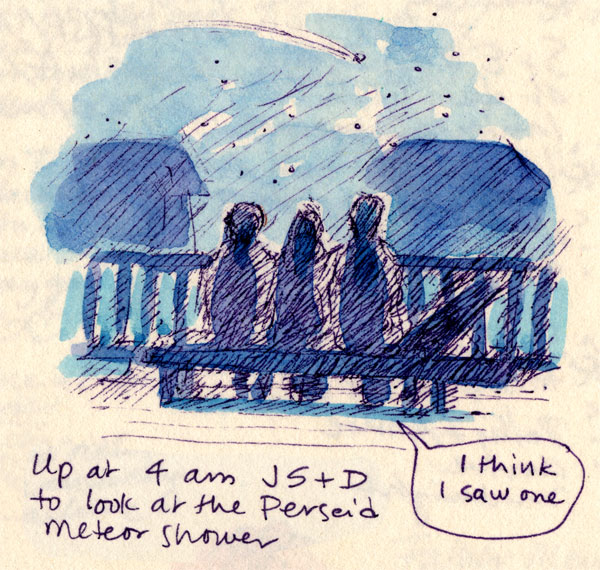
I am sad to tell you that tonight is the night of the Perseid meteor shower. Sad because here we have pouring rain and crashing thunder; not the best conditions for viewing.

A meteor shower is the debris shed by a comet as it orbits the sun, and we on Earth pass through several showers of comet-debris during the course of each year. When one of the meteors happens to enter our atmosphere, it is traveling at such a tremendous rate (thousands of miles an hour) that it’s ignited by friction—giving the impression of a falling star—and generally burns up before it hits the ground. (Sometimes a meteor makes it all the way to Earth without being consumed, in which case it is termed a meteorite. A few very large meteorites have made impressive dents in our planet.)

The Perseids are the meteors of the comet Swift-Tuttle, through whose rubble we pass in August. They are named for the constellation Perseus, because from Earth’s perspective they seem to be coming from that direction. In mid-August in this hemisphere Perseus rises in the northeast at around 11 pm or so. This year, August 12th, starting at around midnight, is supposed to be the best time for viewing the Perseids. Ha! Well, probably some of you live where it is not raining.

To view a meteor shower, it’s best to get out of the city or densely populated suburb—in other words, head for an area without lots of artificial light. In past years we have set the alarm clock (sometimes the best time is 3 or 4 am) and then gone out to sit on a deck, or lie on a rooftop, or stretch out in a big treeless field on a blanket (or, if in Vermont, shivering under the blanket) and then waited, gazing at the night sky.

Some years we’ve seen many, many. Other years (as above) we’re not so lucky. But go do it anyway. How often do we even take time to look at the Milky Way? That in itself is a rare and wonderful experience for the frazzled urban person. The additional sight of sparkling shooting stars sailing across the night sky is seriously magical.

CakePink2Douglas


Mountain Woman Part 2

Continued from Mountain Woman Part 1, August 5

Believing that women ought to share the responsibilities as well as the rights of men, Julia requested to take her turn at the night watch, but was refused. She wrote of the guard master, “He believes that woman is an angel without any sense, needing the legislation of her brothers to keep her in her place, that, restraint removed, would immediately usurp his position and no longer be an angel but unwomanly.”

MountainView

After a journey of about a month, the wagon train reached the foot of the mountains near present-day Colorado Springs and set up camp. Above them loomed Pikes Peak, which had been named for U.S. Army officer Zebulon Pike, who had come upon it in 1806, tried to climb it, and failed. (“No human being could have ascended to its pinacle [sic],” he wrote.) Despite his failure, the mountain was named for him, giving him an A for effort. In 1820 a group of government explorers finally made it to the top.

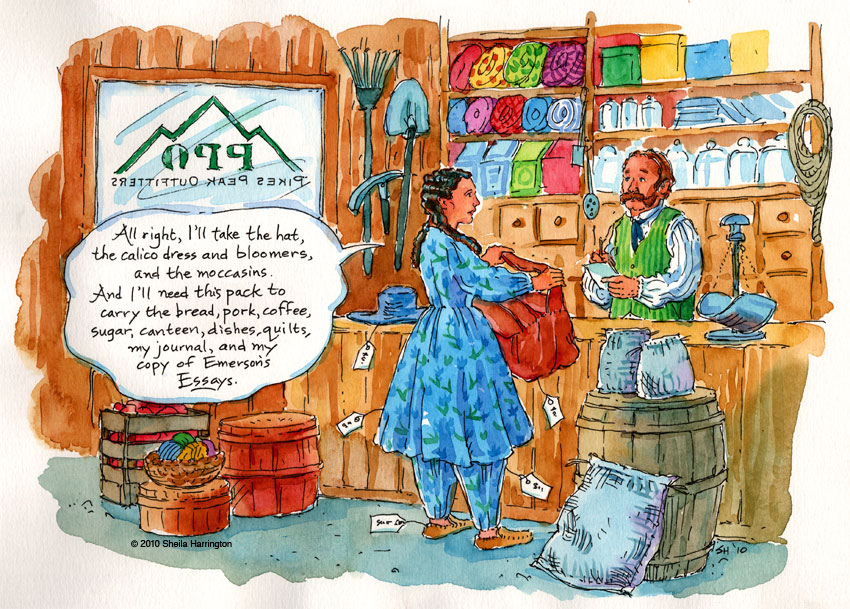
On August 1st, 1858, Julia Holmes, her husband, and two other men set out to climb Pikes Peak. The four of them carried heavy packs with food and bedding, as well as writing materials and a volume of Emerson, whom Julia admired. They had a difficult time of it, misjudging the route (no trails! no friendly National Park Service blazes!) and once running out of water. But each night, as they camped among snow-covered rocks or beside waterfalls or in a nest of spruce branches, Julia described her impressions in her journal.

When they finally reached the 14,110-foot peak on August 5th, they wrote their names on a boulder (tsk, tsk). Then Julia read aloud to the group a poem by Emerson, and stretched out upon a broad flat rock to write letters to her friends. (“Hi! You’ll never guess where I am!”) Her Pikes Peak climb gave her the nickname “Bloomer Girl.”

After that the party separated for various destinations. When Lincoln was elected President, Julia’s husband was appointed Secretary of the Territory of New Mexico, where Julia became a correspondent for The New York Tribune. She had four children, only two surviving to adulthood. Afterward they moved back East and eventually to Washington DC, where they divorced (mysteriously, and unusual for the time), and she—now a bilingual Spanish speaker—worked as chief of the Division of Spanish Correspondence for the Bureau of Education.

Like her mother, she was active in the women’s suffrage movement. After women in Wyoming and Utah Territories gained the right to vote in 1869 and 1870, women suffragists elsewhere showed up at their polls to vote, in a combination of optimism and protest; Julia Archibald Holmes is on record as one of 73 women who in 1871 made the attempt (unsuccessfully) to register to vote in Washington, DC.

As far as we know, she never climbed another geographical mountain, but she certainly scaled several metaphorical ones.

CakeWeddingTrish & Jason

CakeShellsEarl

Mountain Woman Part 1

JuliaHolmes

Imagine that you are a little girl born in a village in North America in the early 19th century. You, like the other village girls and their mothers, help maintain a family farm: growing vegetables, cooking, scrubbing, making clothes. You might see your destiny as a farmer’s wife, raising children to follow in your footsteps.

But perhaps your mother is also an advocate for women’s suffrage, and your father is a fierce abolitionist, which might give you a somewhat different perspective on your life. This was the parentage of Julia Archibald (1838-1887), later Julia Archibald Holmes, born in the village of Noël, Nova Scotia, in 1838. And today, August 5th, is the anniversary of the day she became the first woman to reach the top of Pikes Peak, Colorado, when she was twenty years old.

When Julia was about ten, the family moved to Worcester, Massachusetts (where her mother became friends with Susan B. Anthony). But they didn’t stay there long. Slavery had been abolished in Canada in 1834, but there was a growing anti-slavery movement in the United States, and Kansas was the place in which the Archibalds decided to support it. They had a mission.

A series of treaties had declared Kansas to be Indian Territory, and a number of Native American tribes had been removed from their eastern lands and resettled there. Nevertheless, increasing numbers of westward-bound pioneers followed trails that passed through the territory, and by 1850 settlers were squatting along the trails and elsewhere in Kansas. Pressure from these land-hungry folks led eventually to (familiar story) the creation of new treaties, the removal of tribes to areas yet further west, and the passage of the Kansas-Nebraska Act in 1854, opening the area officially to settlement.

It was not only Native American tribes who were unhappy about this. Slave-state Southerners were displeased that the decision about the existence of slavery in the new territory was to be left to its residents. So, as you might guess, both advocates and opponents of slavery rushed into Kansas, each staking out territory and hastily setting up local provisional governments and institutions that were attacked by both sides, setting off several years of violence that foreshadowed the Civil War.

The Archibalds settled in Lawrence, Kansas, a center of controversy, and their house became a way station on the Underground Railroad. In Lawrence Julia met James Holmes, a veteran of John Brown’s campaigns. Apparently he was fiery and dedicated; she was handsome and spirited; there were certainly similarities of background. They were married in 1857.

But they didn’t stick around in Kansas for the resolution of the national conflict. The following year they joined a wagon train headed for Colorado, where gold had been discovered. And a lot of other excited Kansans were doing the same thing. Not many gold-seekers actually found what they sought, but their immigration resulted in the founding in Colorado of towns, businesses, churches, and probably plenty of saloons, as well as a rapid dramatic increase in its population.

According to Julia’s journal, their own party was driven more by “a desire to cross the plains and behold the great mountain chain of Noth America” than to search for gold. She acquired what she deemed a sensible traveling outfit: hat, moccasins, short calico dress, and bloomers. Bloomers had been recently introduced to the public by women’s suffragists as more sensible than skirts.

Her choice of clothing gave Julia the freedom to walk beside the covered wagons instead of riding. She improved her stamina by deliberately increasing her daily distance, and she recorded her observations of wildflowers, landscape, and skies in her journal. The only other woman on the trip disapproved of Julia’s unconventional garb and stayed in her wagon, thus missing most of the scenery. (Like my children, with noses in their books when we travel. “Look! Look out the window!”)

To Be Continued—Please see August 6/Mountain Woman Part 2

Rain or Shine?

SwithinFlip2

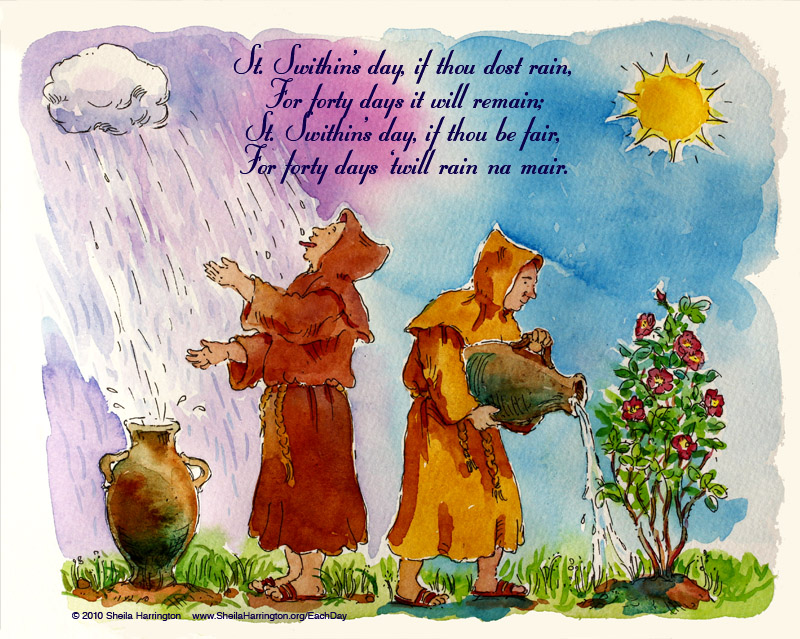
Look out the window. Doth it rain today, or doth it shine? Prepare yourself. Today is the feast day of St. Swithin, and for the next forty days you can plan your activities and wardrobe according to the old verse.

Swithin was born in the 9th century—the precise year is unknown—in Winchester, England, during the reign of King Egbert of Wessex, who ruled from 802 to 839. There are but a few reliable facts of his life, drawn from church records. Nevertheless, there must have been something about the fellow, for, both during his life and afterward, he inspired numerous stories and customs that have endured for the last twelve centuries.

Swithin was ordained as a monk and gained such a favorable reputation that he was selected as a tutor to Egbert’s son Aethelwulf. When Aethelwulf himself became king, he appointed his former tutor as bishop of Winchester, where for the next ten years Swithin built numerous churches as well as the town’s first stone bridge. Nevertheless he apparently remained a modest, unassuming fellow, charitable and sensible, preferring to go about on foot, avoiding ostentation. He also managed to convince Aethelwulf to donate a tenth of his own lands to pay for some of the church-building. Swithin’s dying request was to be buried not indoors within an elaborate shrine, as was customary with prominent folk, but outside in a simple churchyard grave, where “the rain may fall upon me, and the footsteps of passers-by.” When he died in 862, his request was granted…for a while.

But a hundred years later, when the bishops of Canterbury and Winchester were renovating the church and undertaking reforms, they cast about for relics of a saintly candidate to inspire their parishioners. Swithin had the fortune, or misfortune, to be associated with numerous miracles both before and after his death, among them the healing of ailments of the eyes and the spine, and the kindly repair of an elderly woman’s broken eggs so that they were good as new, a miracle that would certainly come in handy in any household. What luck to find a local guy that no one had yet claimed! The two bishops decided to elevate unpresumptuous St. Swithin to more prominent status. What better way than to remove his body from its humble grassy setting and place it in a more visible shrine within the newly renovated church?

Well, as the story goes, when they set about digging up Swithin, the sky clouded over, and a heavy rain began that continued for the aforementioned forty days. This would certainly indicate heavenly displeasure, if one were inclined to interpret such signs. But it did not deter the church authorities, who persisted in their plan and not only dug up St. Swithin’s body but sent his head to Canterbury Cathedral and his arm to Peterborough Abbey, rather than selfishly keep the entire saint in Winchester. They also rededicated the church (formerly dedicated to St. Peter and St. Paul). At some point along the way Swithin acquired the title of “Saint,” although he was never formally canonized by the church. He is what is known as a “home-made saint,” and churches all over the British Isles are named after him.

However, despite—or perhaps because of—all this unsolicited attention, St. Swithin still has his say every July 15th, determining the weather for the following month or so. According to a study conducted in Great Britain in the last decades of the 20th century, around mid-July the weather tends to settle into a pattern that lasts until late August, and this is true for about seven out of ten years. It either has something to do with the jet stream, or with Swithin’s periodic annoyance at being kept indoors. When it rains in August, the saying goes, “St. Swithin is christening the apples.”

Independence Day

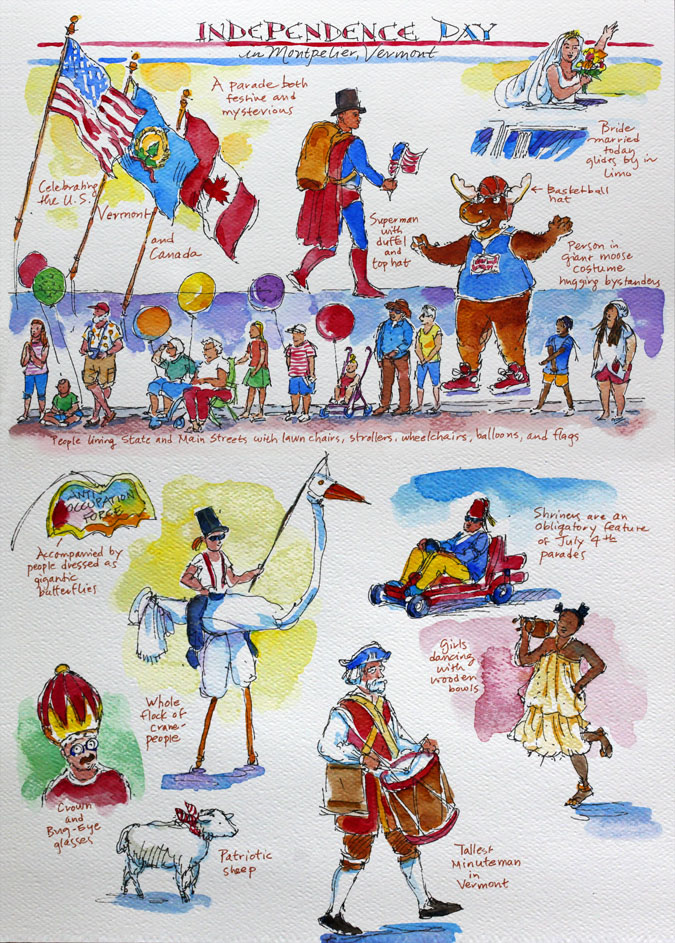
My favorite parades are not those of the professional gigantic floats and inflatable cartoon characters, but the small-town variety featuring decorated bicycles and the local fire truck. Especially if there are participants expressing themes so personal and local that they are perfectly incomprehensible to an out-of-towner.

ParadeVT10Alt


CakeStarsMelinda

CakeSprinklesCarrie

Stonehenge

Stonehenge

I hate to tell you how old this drawing is—it dates from my freewheeling pre-parenthood days. But I selected my sketch of the ancient stone calendar in honor of the summer solstice, the longest day of the year, a day on which you have the greatest amount of daylight to deck yourelf and your doorway with flowers, bathe in the local river, build and leap across a bonfire, and any other of various joyful means to celebrate light, fertility and the perpetuation of life. Happy Summer!


Flag Day

PeruvianDance

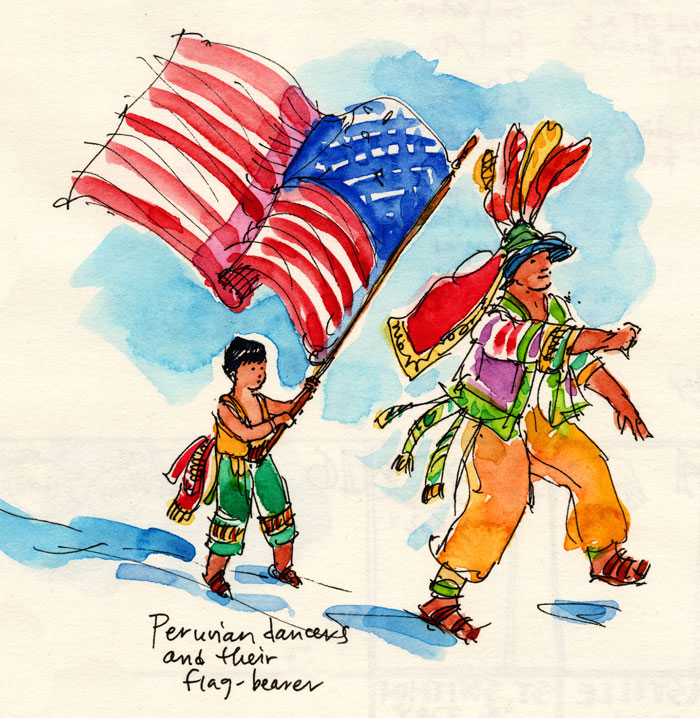
The story of the Stars and Stripes, as passed down through the family of upholsterer Betsy Ross, is that George Washington visited her and asked if she could create a flag from a sketch he presented. Upholsterers commonly took up other work to keep bread on the table (for a while Betsy Ross also made musket balls for the army). The finished product was adopted by the Continental Congress on this day in 1777 as the official flag of the new United States. I post here a sketch, from the Palisades neighborhood Fourth of July parade, of the Peruvian dance troupe’s young standard-bearer. The scene struck me as so, well, American.

Something’s Lost That Can’t Be Found

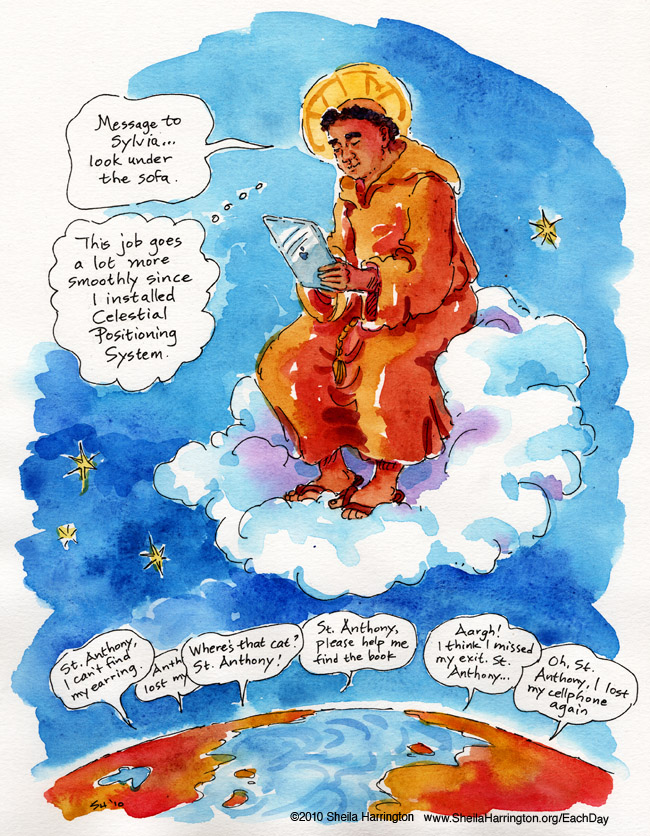
If you grew up Catholic, and you couldn’t find your homework or your lunchbox or your gym shorts, then you knew what to do. You went straight to St. Anthony, the Patron Saint of Lost Things, whose feast day it is today.

StAnthony2

St. Anthony of Padua (1195-1231) was born in Lisbon, Portugal, into a prosperous noble family. Although his parents arranged for his education at the cathedral school in Lisbon, at fifteen he left the school, against his family’s wishes, to join the followers of St. Augustine outside the city. His friends from Lisbon kept dropping in to visit him, so eventually he transferred to an even more remote priory in order to devote himself to study and prayer without distractions. Not exactly a party guy.

A visit from a group of Franciscans on their way to Morocco who were subsequently martyred there inspired him to join the Franciscan order and head straight for Morocco. (Frankly, such an episode would not motivate my career choice, but that is one reason I am not a saint.) But his Africa-bound vessel went off course and landed instead in Italy. There he was appointed to a remote hermitage.

However, sometime later, on the occasion of an ordination, when told to come forward and speak extemporaneously, he was so eloquent that he was reassigned as a traveling preacher. Much of his time was spent in Padua, so he has come to be associated with that city. As for his position as patron saint of lost things—and also of travelers and watermen—well, perhaps that derives from his having been lost at sea, yet having nevertheless reached his destination, both physically and spiritually, in the end.

So, the next time you misplace those car keys, try this:

Something’s lost that can’t be found
Please, St. Anthony, look around.

Maybe it will be useful this summer if you’re traveling without GPS.

Hope for America

I’ll bet you thought I was about to announce an alternative to fossil fuels, or at least an exciting new political candidate.

HopeForAmericaBrochCover1

No, tonight is the opening reception for a new exhibition in the Bob Hope Gallery at the Library of Congress on which my husband has been working for the past several months. It’s one of many history exhibitions he’s created for the LOC over the years. Hope for America: Performers, Politics & Pop Culture explores the involvement of entertainers in politics throughout the 20th century, often through satirical commentary, sometimes through direct participation. There is also a moving segment on Hope’s work for the USO entertaining troops all over the world, which he did for SEVENTY YEARS. The exhibition features film and television clips and radio broadcasts as well as photos, letters, sheet music, and other artifacts to tell the story.

If you are in the DC area, come visit! I’ll bet you could use a few belly laughs. (This is the cover of the brochure I designed for the exhibit.)

CakePink2Agnès