A Capital Spring

RockCreekELog

Today winter officially packed its bags and departed, and spring took the throne. It ought to come as no surprise, because we have seen it coming for weeks in the swelling tips of branches, the green points pushing up through the earth, the increase in morning birdsong that disregards Daylight Savings Time. Nevertheless every year it astonishes.

Much poetry and prose has been written in praise of spring, but if you have not yet stumbled across Louis J. Halle’s Spring in Washington, let this be the year. Beginning in the mid-1940s, Halle (1911-1988) worked in Washington, DC for about ten years at the U.S. State Department. Although Halle was a citydweller with a theoretically brief commute and could have dozed until practically the last minute, instead he had the habit of rising before dawn, hopping on his bicycle, and heading out for a ten or twelve mile exploration of DC’s wild green pockets and fringes before heading to the office.

No doctor ever prescribed a view of the open world for me, though it was the tonic I needed, rather than something to take in a glass before meals.

In 1947 he published Spring in Washington, an account of his wanderings. With wisdom, humor, an artist’s eye and a poet’s quill (well, in his case, a typewriter) he shared his observations and discoveries throughout the approach, unfolding, and departure of one expanded spring: January to June, 1947.

To snatch the passing moment and examine it for signs of eternity is the noblest of occupations. It is Olympian. Therefore I undertook to be monitor of the Washington seasons, when the government was not looking. Though it was only for my own good, that is how the poorest of us may benefit the world. A more ambitious man might seek to improve the President of the United States.

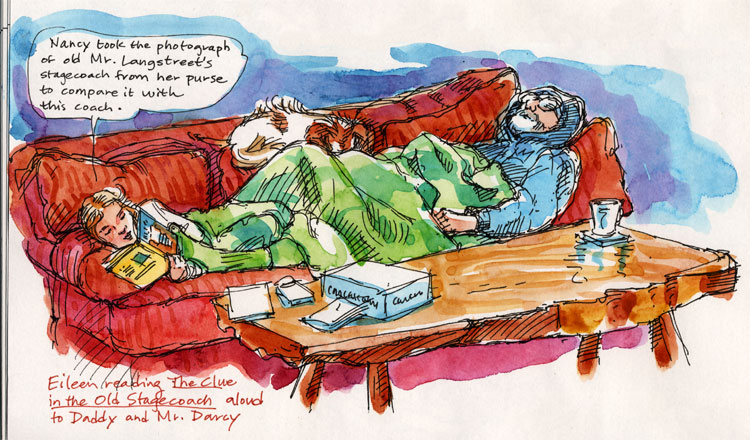
Each year I drag this book out and read aloud passages to my family. As I leaf through it now, searching for representative quotes, it’s difficult not to reproduce the book in entirety.

The muskrat swims and raises its young in the woodland stream beneath Connecticut Avenue, never knowing of the crowded buses and taxis that swarm overhead… Roaches Run is a marshy lagoon trapped between the National Airport, on one side, and the railway tracks on the other. Ducks and gulls and herons have remained faithful to it, despite low-roaring airplanes and smoke-breathing locomotives. They are accustomed to these dragons and these pterodactyls, regarding them not.

Halle moved on (his field was actually foreign policy), along the way publishing 22 books, eventually retiring to Switzerland. Plenty of hiking opportunites THERE. He made a visit to DC in 1988, to help launch a new edition of this book, the rights to which he had long ago turned over to the Audubon Naturalist Society (where his book can be obtained). While here he went birding and biking in some of the same old wild green places, which, remarkably (thanks in part to folks like himself), still survive for a venturesome bureaucrat’s early morning ramble.

In early March I look at the apparently lifeless skeletons of the elm trees on the Ellipse and say to myself that in two weeks they will be flowering, as the trees have flowered here for a hundred thousand years. In the middle of April I say that in another ten days the city will be full of singing wood thrushes, though there is none here yet. I know all this will be, but it seems to me so miraculous that I cannot take it for granted.

A few months later he made his own final migration to the great Beyond. Even if he had done nothing else on earth, this jewel of a book that resurfaces each spring, endlessly amusing, sensitive, and wise—an everlasting source of inspiration—would suffice. Happy Spring, Louis Halle.

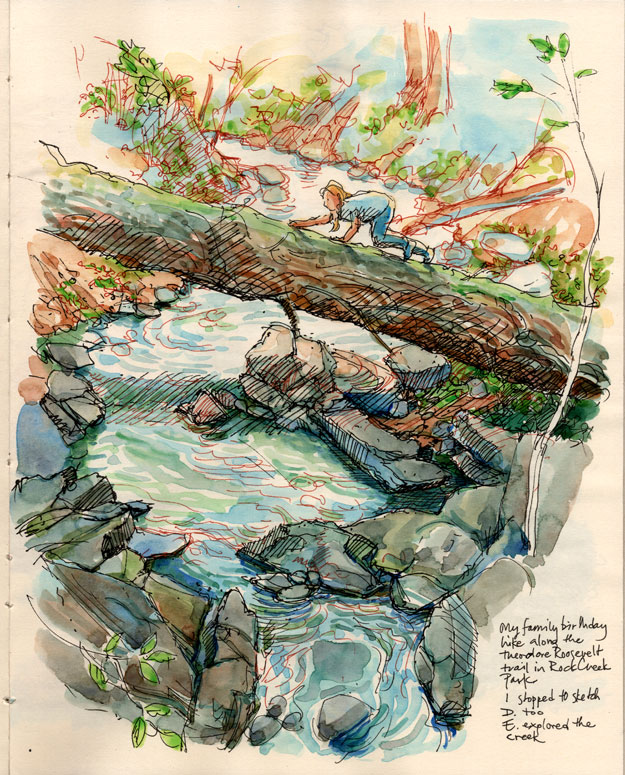
(This sketch is from a family ramble through Rock Creek Park, mere minutes from our utterly urban home.)

Many happy cookies, and the flowers on a queen

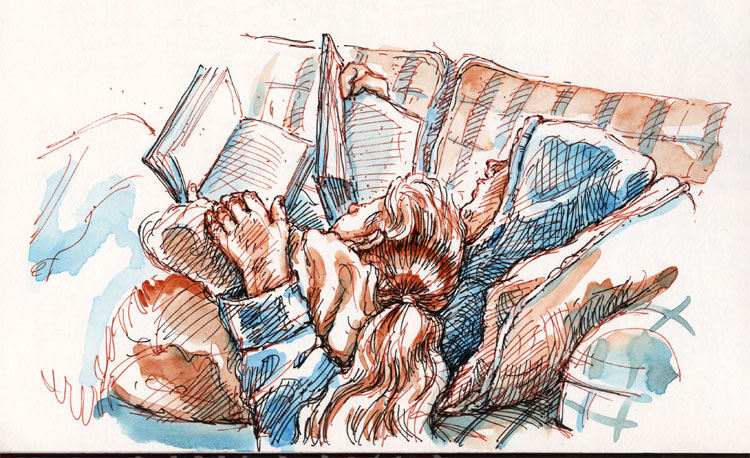
D&E-Reading

Today is the birthday of writer Shirley Jackson (1916-1965), born in San Francisco, California, but transplanted to the East Coast where she attended university and eventually settled with her husband in Vermont, raising a large family but all the while continuing, somehow, between PTA meetings and making hamburger casseroles, to write.

Many readers have probably been introduced to Jackson through her short story, “The Lottery,” once a classic of the high school English syllabus, which when it was published in the New Yorker in 1948 evoked overwhelming response exceeding that of any previously published New Yorker story.

Jackson came to my attention, however, through the books my parents owned: her collections of dark, evocative, seemingly plotless short stories that are typical to this day of New Yorker fiction (probably a contemporary literary parallel of Abstract Expressionism that nevertheless persists into the 21st century); and her similarly eerie, compelling novels. As a child, I was fascinated yet rather baffled by Jackson’s fiction.

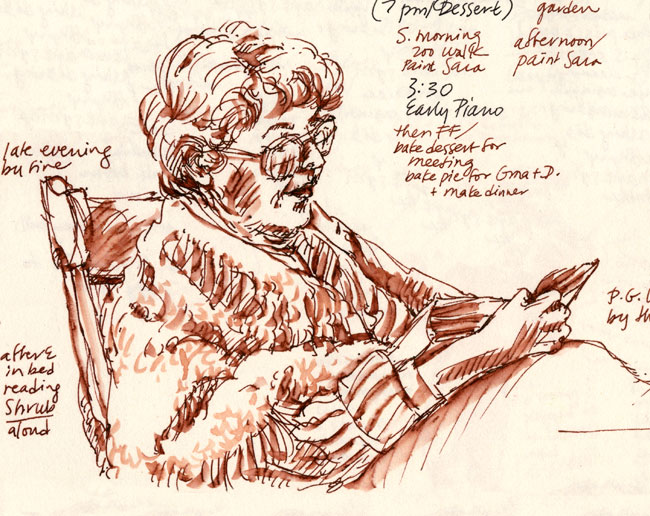
What I really liked, however, were her memoirs of her children, Life Among the Savages and Raising Demons, which I read and re-read, the pages yellowing and held together with Scotch tape. Her unsentimental, low-key, definitely politically incorrect descriptions of ordinary daily life with her four bright, imaginative children, her hovering-on-the-fringes professor husband, and their cats and dogs, in their book-stuffed rural Vermont farmhouse, made me laugh again and again. When I grew up I read the books to my husband and offspring, and now they read them to one another. Into our common family vocabulary have effortlessly crept quotes from the various children (see title above).

This winter, when you and your family are all abed with the flu, read aloud the chapter, “The Night We All Had Grippe.” Laughter is healing. Happy birthday, Shirley Jackson, many happy cookies, and thank you ever so for the years of healing episodes.

Mother of Pippi

There are some people who give joy not only during their time on this earth but who continue to spread it after they have moved on. One of them is Astrid Lindgren (1907-2002), whose birthday is today, and whose fruitful 94 years brought forth so many literary offspring. Her best-known heroine, Pippi Longstocking, was an icon of my childhood, and then of my children’s, and she will undoubtedly bring smiles to the faces of my grandchildren, if I am someday fortunate enough to have them. But we also love Lindgren’s other books, including stories of the rambunctious Emil and Lotta, and Ronia the Robber’s Daughter, and especially the lively, funny and cozy Children of Noisy Village, which lets us pretend for a while that we are living in small-town Sweden.

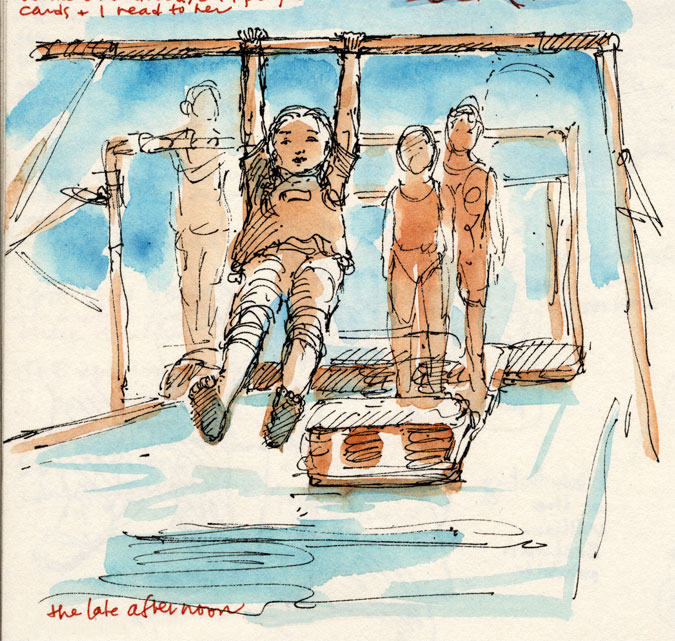
I post this sketch of my own active little “Pippi” in honor of the day. Happy, happy birthday, and many thanks, Astrid Lindgren. I hope the afterlife resembles Noisy Village.

EGymnastics

CakeChrysanthLydia

CakeChocCurls2Patrick

Young at Art

StoriesInArtNGA

The National Gallery of Art sponsors a host of programs for school groups, families, and young children, hoping to inform and inspire the next generation of art-lovers, and we have availed ourselves of a number of them. From my sketchbook I post a visit made some years ago with my daughter for a program in the “Stories in Art” series, during which an NGA docent reads aloud a story, tours the museum discussing with the children paintings relevant to the book, and then leads them in a hands-on art project, which might be drawing, painting, sculpture, printmaking, collage. On this occasion, the children listened to the delightful story The Cow Who Fell in the Canal (Phyllis Krasilovsky/Peter Spier), toured the collection of 17th-century Dutch and Italian paintings of waterways, and then painted their own landscapes.


Language Lover

RoyBlountSphinx

Here’s the answer to a question that has probably been puzzling you for some time. What do the Sphinx and the sphincter have in common? Well, they share a root in the Greek verb sphingein, to squeeze. The Sphinx, if you recall, punished those unable to solve its riddles by strangling—squeezing the air out of them. And if you’ve ever been eight months pregnant, desperately searching for the nearest ladies’ restroom, you’ve done a little squeezing yourself.

This post is in honor of Roy Blount, Jr., whose birthday it is today, and thanks to whom I discovered this etymological nugget. I first became acquainted with Roy Blount, Jr. through listening to NPR’s “Wait Wait, Don’t Tell Me,” a humorous and intelligent Saturday morning current-events quiz show to which I am sufficiently addicted to plan my weekend cooking blitz for its time slot. Blount is one of the participants, and I said to myself, “Who is this smart, funny man with the sexy, crumbly, Southern-accented voice?” and I immediately added him to the list of Guys I Admire, which includes my husband and son (at the top, naturally), Gregor Mendel, and Hektor, hero of Troy, among others.

Blount was actually born in Indiana, so he must have picked up his Southern accent in high school in Georgia. Besides the vast amount of work he does for radio and numerous periodicals, he’s written plays, screenplays, and song lyrics, and is the author of many works of fiction and non-fiction about (to name a few subjects) sports, politics, gender relations, domestic animals, poetry, and hair. The first book of his I opened was Alphabet Juice, a book hard to describe but a must-have for the bookshelf of any language-lover. Therein Blount explores from A to Zyzzyva (a class of weevils) words that intrigue, excite, or annoy him, contemplating in the process multiple dictionaries, Indo-European roots, and popular culture. Happy Birthday, Roy! How’s this for a birthday present: a “roy blount” as a meme for “curious word or phrase worthy of investigation.”

Answer: A cow.

Cleveland Park Day

If you wander today along Connecticut Avenue between Macomb and Porter Streets between 1 and 5 pm, you will encounter neighbors, local merchants, and folks from the elementary school, library, fire department, and other neighborhood organizations celebrating what’s interesting and fun about Cleveland Park. Attractions include music, food, clowns, a moon bounce, McGruff the Crime Dog, and President and Mrs. Grover Cleveland, long-ago residents presumably returning to check out old stomping grounds and new restaurants.

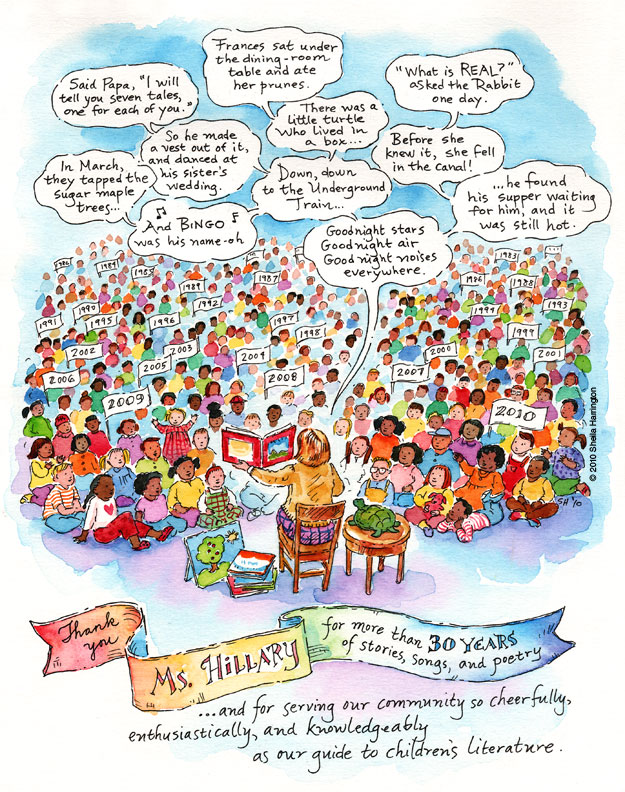
Among the events will be a tribute to Cleveland Park Library staff whose positions were suddenly and gracelessly slashed over the summer, especially beloved children’s librarian Hillary Fennell, a living encyclopedia of children’s literature and a lovely lady besides, who had served the library and its community for over thirty years. What is story hour without Ms. Hillary? (More on this in the October 5th post.)

MsHillary

CakeBerriesChristiane


Thistle, late summer

Does anyone out there know the work of Indiana writer and farm wife Rachel Peden? I came across her by accident, and some of her books, out of print for a while, have recently been re-issued in paperback. I’ll bet our library used to carry her work before they started tossing out everything published before the 21st century.

Thistle

Purple ironweed is diminishing in the pastures; thistles are down to their last silken tassels; goldenrod pours its heap of raw gold into the general fund.

—Rachel Peden

Live and Learn

Despite my misgivings, my daughter packed sixteen (16!) chapter books for this vacation. I regretted toting any extra unecessary weight in our poor Prius, already stressed with four people and a dog and ten days of their presumably vital supplies. I pictured lugging the books home again mostly unread.

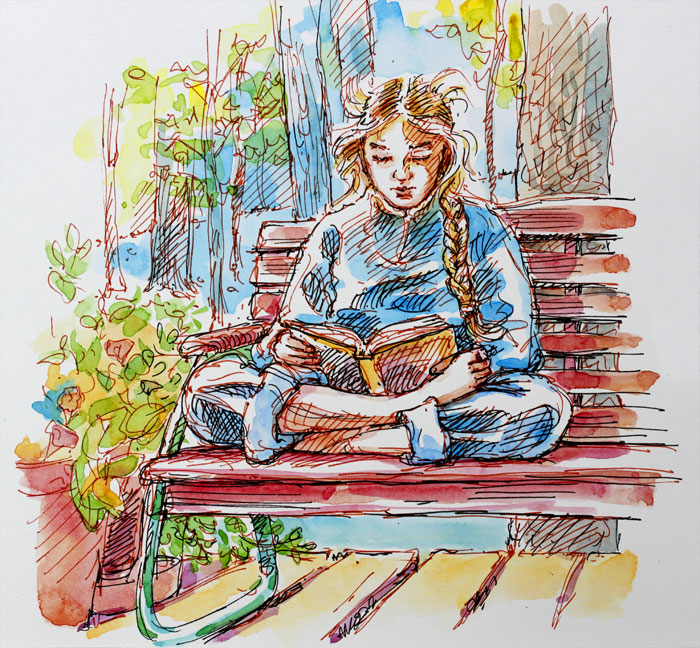
However, in addition to swimming, tubing, badminton and boules, a little Botany sketching, numerous board games, stargazing with her brother’s Star Walk app, and capably starting up and driving an 18-foot power boat (courtesy of the neighbors), here she is finishing book number 16. Now she’ll have to begin on her brother’s stack.

E&16Books

CakeWeddingMary & Brian

The Secret of the New Jersey Town

NancyDrew

This spring we visited Maplewood, New Jersey, where my husband grew up. In exploring his old haunts, like the town library, we discovered that Maplewood, New Jersey is the Home of Nancy Drew! (The library carries the entire collection.) Not to mention the Bobbsey Twins, and the Hardy Boys, and Tom Swift! I don’t see how my husband could have lived there all those years without realizing he was sharing his home town with so many celebrities. (Actually, with the publisher of their series.) I think he was busy reading the Horatio Hornblower stories.

Well, with a daughter making her way through the Nancy Drew books, he now has total Nancy Drew Awareness. Here they are having some father-daughter-dog time. I’m fairly sure he’s awake. My husband, not the dog.

CakeRedRosesCarol


Library of Congress-Part 3

(If this picture is baffling, please see the news story on the Texas school board’s decision to eliminate Thomas Jefferson from its textbooks.)

TexasTourGroup

Continued from Library of Congress–Part 2, May 7th

Spofford proposed a separate building for a library that would equal (or surpass! he suggested temptingly to Congress) the great libraries of Europe. It took about 15 years to hold a design competition and authorize funds, but at last, between 1886 and 1897, an astonishing team of architects, engineers, artists, and craftspeople created the Thomas Jefferson Building, probably the most magnificent structure in Washington, DC, and certainly the most labor-intensive per square inch.

The award-winning design was a building in the style of the Italian Renaissance, “efficient, beautiful, and safe,” and its thoughtful embellishment and finishing—despite a hovering Congress with its eye on the budget—is a suitable tribute to that period of cultural flowering. Stroll through and marvel at the multi-layered ornamentation, in paint, marble, and mosaic, depicting images and figures historical and mythological honoring the higher achievements of humanity: philosophy, natural science, music, art, theology, astronomy, law.

And these many wonders house a collection even more wondrous. Who could have foreseen, on that day in 1800 when John Adams signed the appropriations bill, what would develop from an initial purchase of 740 books and three maps? This is from the Library’s own website:

The Library of Congress is the largest library in the world, with nearly 145 million items on approximately 745 miles of bookshelves. The collections include more than 33 million books and other print materials, 3 million recordings, 12.5 million photographs, 5.3 million maps, 6 million pieces of sheet music and 63 million manuscripts… The Library receives some 22,000 items each working day and adds approximately 10,000 items to the collections daily… In 1992 it acquired its 100 millionth item.

Not only that, but at the Library you will find:

Works in 470 languages. Four Hundred and Seventy.

Newspapers in many of those languages, from all over the world.

Over 5,000 books printed BEFORE 1500, including a Gutenberg Bible.

Library Service for the Blind and Physically Handicapped, with Talking Books and other resources available free of charge.

The Center for the Book, created to promote literacy and reading, with affiliates in all 50 states.

The American Folklife Center, with 4,000 collections of stories, music, and oral history.

An ongoing program of lectures, symposia, exhibitions, concerts, book-signings, films, and tours both general and specific.

The Library of Congress also sponsors the popular annual National Book Festival on the Mall, bringing authors and readers together for readings and discussion.

Whew! And that’s not even all….for the rest of it you must go to the website to discover. Or to the Library itself.

The Library of Congress remains a work in progress, an almost unimaginable organizational, classification, conservation and retrieval challenge. Its evolution from modest beginnings is astounding. It has survived fires, civil and world wars, recessions and depressions, and an international information explosion.

And you, dear Reader, should you manage to make it to Washington, DC, and if you are at least 16 years of age (high school students must show that they have first exhausted their other sources for research) and have a valid identification card, such as a driver’s license: YOU are eligible for a Library of Congress Reader Identification card, and you may pursue your studies, with access to hundreds of years of accumulated knowledge and beauty, in the splendid Reading Room of this marvelous, this amazing, this thank-your-lucky-stars national treasure.

CakeBerries2Connie