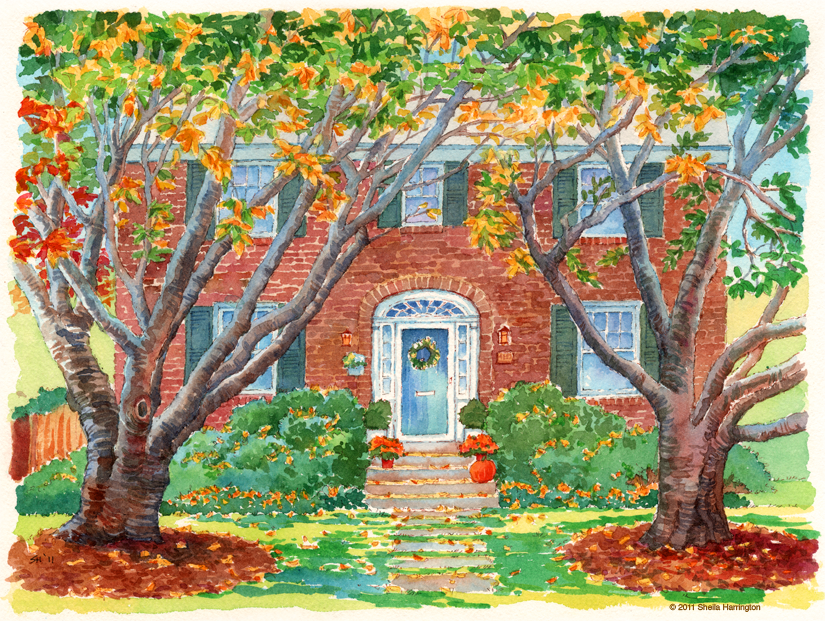
As the single-blossom cherry trees shed their pink snow, the double-cherry trees come into bloom. Here is the companion piece I created for a commission of a two-season house portrait. For the autumn portrait, please see Double-Cherry Trees, November.
Tag: Architecture
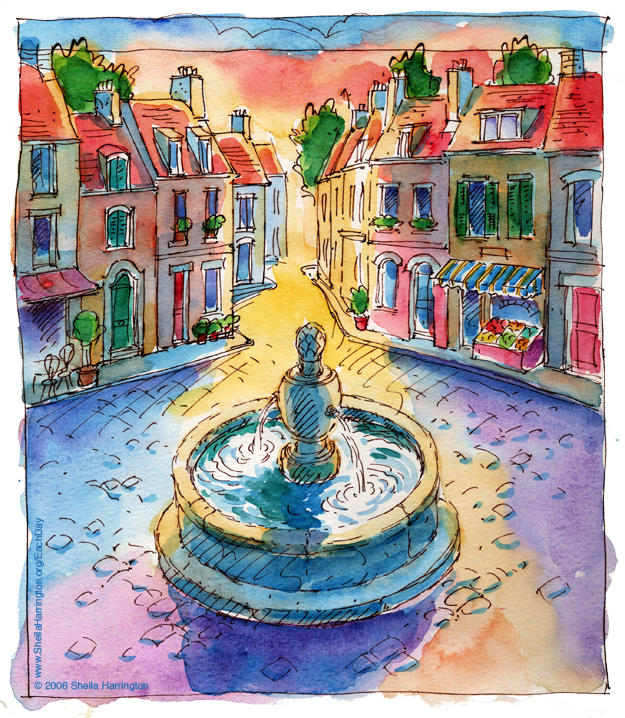
In Fountain Court
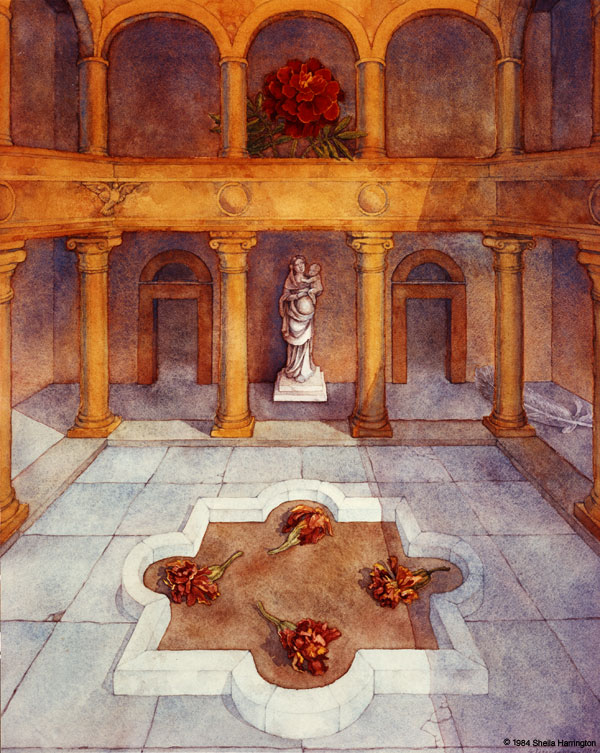
Today is the birthday of poet Arthur Symons (1865-1945), and I post in his honor this watercolor and poem, although it seems more suitable for a romantic Midsummer Eve than the end of February.
He shares his birthday with Henry Wadsworth Longfellow (1807-1882), and for a mini-bio, a painting, and the unforgettable opening lines of “Evangeline,” please see Oh Canada…Oh Henry.

The fountain murmuring of sleep,
A drowsy tune;
The flickering green of leaves that keep
The light of June;
Peace, through a slumbering afternoon,
The peace of June.
A waiting ghost, in the blue sky,
The white curved moon;
June, hushed and breathless, waits, and I
Wait too, with June;
Come, through the lingering afternoon,
Soon, love, come soon.
—Arthur Symons
Winter Solstice
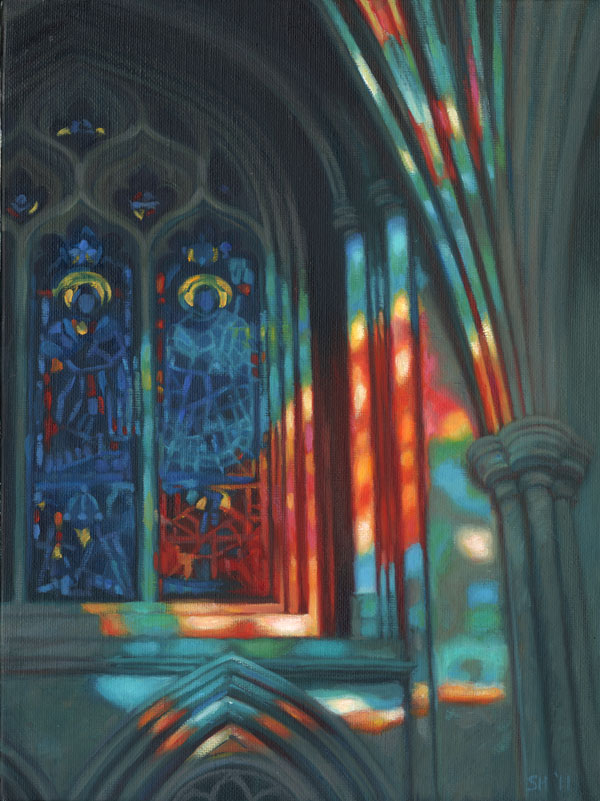
On this shortest day and longest night of the year in the Northern Hemisphere, I post a light-in-darkness painting (one of a series currently in progress based on Washington National Cathedral) and a poem by Patrick Kavanaugh. In celebration of the solstice, look for shooting stars tonight and tomorrow in the constellation Ursa Minor.
Last year, the solstice fell, for the first time since 1638, on the day of a lunar eclipse. For a sketch in honor of this event, please see Winter Solstice/Lunar Eclipse.
A Star
Beauty was that
Far vanished flame,
Call it a star
Wanting better name.
And gaze and gaze
Vaguely until
Nothing is left
Save a grey ghost-hill.
Here wait I
On the world’s rim
Stretching out hands
To Seraphim.
—Patrick Kavanaugh
Advent 2: Day in Autumn
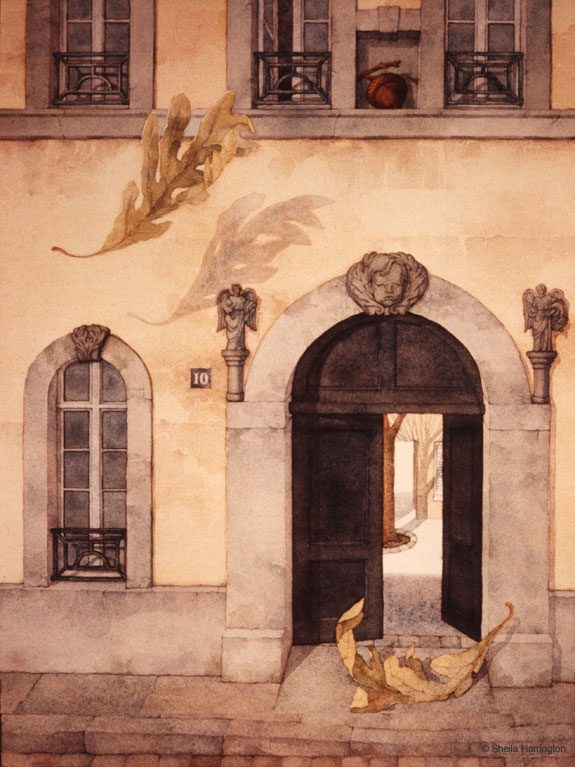
The second Sunday of Advent falls on the birthday of Rainer Maria Rilke (1875-1926), and in celebration I post this seasonal poem in the original German, along with one of its numerous translations, and a painting. If you have a translation you prefer then please tell me about it.
For another Rilke poem, and a sketch, please see Holding up all this falling.
Herr: es ist Zeit. Der Sommer war sehr groß. Leg deinen Schatten auf die Sonnenuhren, und auf den Fluren laß die Winde los. Befiel den letzten Früchten voll zu sein; gib ihnen noch zwei südlichere Tage, dränge sie zur Vollendung hin und jage die letzte Süße in den schweren Wein. Wer jetzt kein Haus hat, baut sich keines mehr. Wer jetzt allein ist, wird Es lange bleiben, wird wachen, lesen, lange Briefe schreiben und wird in den Alleen hin und her unruhig wandern, wenn die Blätter treiben.—Rainer Maria Rilke (1902)
Day in Autumn
Lord: it is time. Great was the Summer’s feast. Now lay upon the sun-dials your shadow And on the meadows have the wind released. Command the last of fruits to round their shapes; Grant two more days of south for vines to carry, To their perfection thrust them on, and harry The final sweetness into the heavy grapes. Who has not built his house will not start now Who now is by himself will long be so, Be wakeful, read, write lengthy letters, go In vague disquiet pacing up and down Denuded lanes, with leaves adrift below.—Trans. Walter Arndt (1989)
Double Cherry Trees, November
—Emily Dickinson
I received a commission to paint the dramatic double-cherry trees in front of this house at two different seasons of the year (and also create two sets of seasonal cards with the results). Here they are in their golden gowns of autumn. Watch for them in spring.
And today is the birthday of amateur scientist and astronomer Benjamin Banneker (1731-1806), grandson of a slave, who surveyed the new city of Washington, DC, created a 1792 almanac that went through several editions, and corresponded with Thomas Jefferson. For a picture and a mini-bio, please see Skywatcher.
Cats
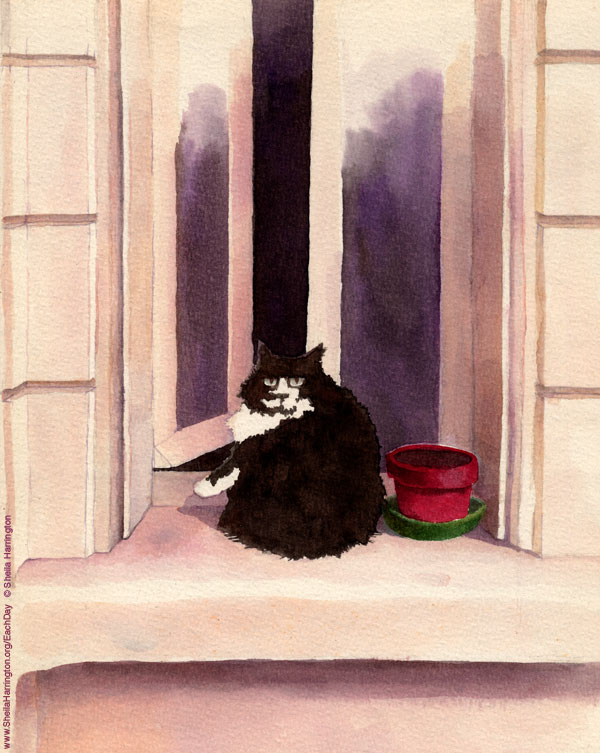
This rather fierce-looking cat is Minou, the spoiled darling of the concierge, painted in our long-ago Paris days. Minou is undoubtedly long gone, but she pretty much ruled the roost while she was around. I post her portrait here, along with this poem, in honor of Eleanor Farjeon (1881-1965), whose birthday it is today. For a brief bio of the delightful Farjeon, another of her poems, and a painting, please see Morning Has Broken.
Cats sleep Anywhere, Any table, Any chair, Top of piano, Window-ledge, In the middle, On the edge, Open drawer, Empty shoe, Anybody’s Lap will do, Fitted in a Cardboard box, In the cupboard With your frocks – Anywhere! They don’t care! Cats sleep Anywhere.—Eleanor Farjeon
The work of Christmas begins
—Howard Thurman
Man of Steel (and Iron)
Ah, Paris… The history! the art! the cafés! the romance of an evening stroll beside the Seine with the lights of the Tour Eiffel twinkling downstream! Unless, of course, you are among the artists, poets, and other French citizens of 1887 who were horrified to contemplete the erection of what one writer called “an odious column of bolted metal” that “even commercial America would not want on its soil,” and who together signed a paper protesting its construction.
Alexandre Gustave Eiffel (1832-1923) was born in Dijon, France, and after obtaining his baccalaureate came to Paris for further education. After the disappointment of rejection by the Polytechnique (take heart, aspiring applicants), he obtained a diploma in chemistry from the École Centrale de Paris and launched a career in metallurgy, a fortuitous choice at this exciting phase of the Industrial Revolution.
Eiffel was hired first to manage, then also to design, the construction of bridges. Within ten years he became an independent consultant and started his own company for the creation and construction of new large-scale iron and steel engineering projects. Because he was gifted as an engineer and construction manager, and the economy was booming, Eiffel was soon successful, rich, and in demand. He designed not only bridges but train stations, churches, lighthouses, palaces, and the armature for Bartholdi’s new Statue of Liberty. When a competition was held to design an iron tower for the Exposition Universelle de 1889, the 100th anniversary of the French Revolution, Eiffel’s design was chosen from the 107 entries. Despite the aforementioned protests, Modernists and Republicans (as opposed to Monarchists) viewed the project with enthusiasm.
Construction began in January 1887, and the increasing fascination of the steadily growing tower foreshadowed its future popularity. It was completed in twenty-six months without a single fatality, and as the newly tallest structure in the world immediately drew crowds of visitors. (Amazingly, the weight of the tower per square inch is no greater than that of a man sitting in a chair.)
Eiffel went on to design other projects, including an ill-fated Panama Canal venture in 1887 that, through no fault of his, collapsed due to financial mismanagement. Discouraged, he turned from construction to experimental research (another of his passions). Eiffel had planned in advance multiple functions for the new tower, and he began a series of aerodynamic, meteorological and radiotelegraphic experiments to be undertaken from its height. In 1898 an antenna was mounted for radio transmission.
Originally planned for removal after twenty years, by 1907 the tower had become far too useful and admired. A new generation of artists now celebrated the Eiffel Tower in paint and literature. Who can envision Paris without it? Of all Eiffel’s work, this tower that bears his name is probably the most beloved. Happy Birthday, Gustave Eiffel! What a gift you have given to painters, photographers, filmmakers and lovers.
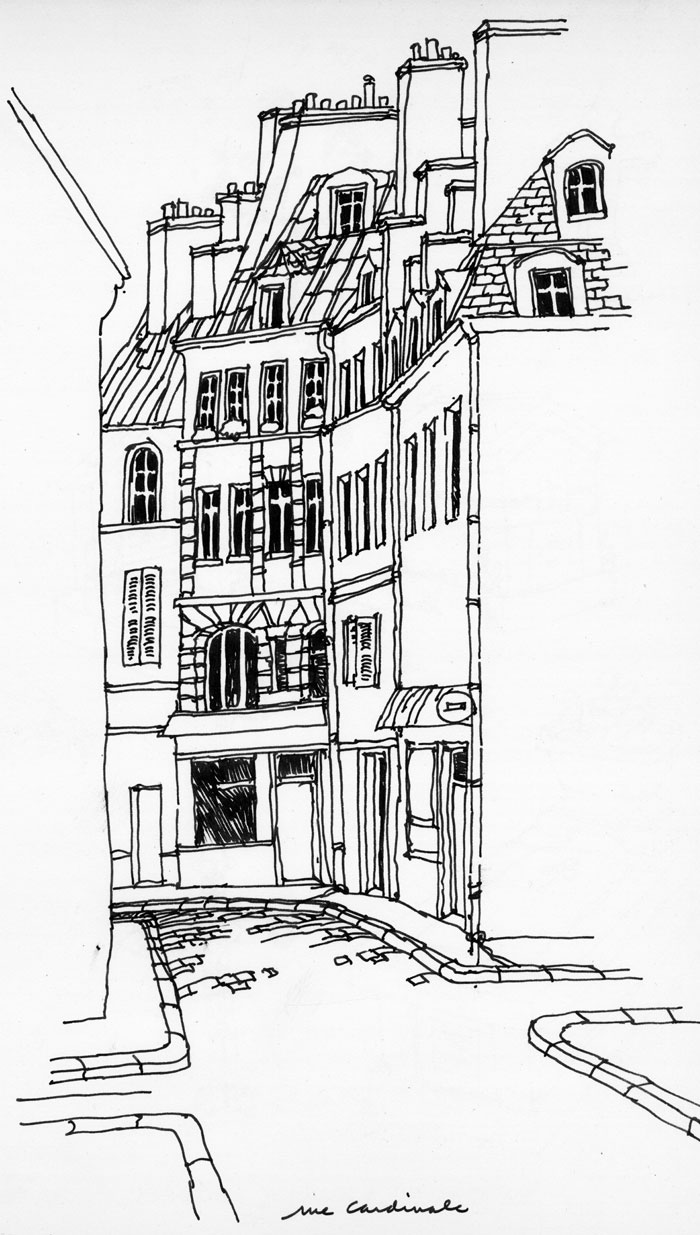
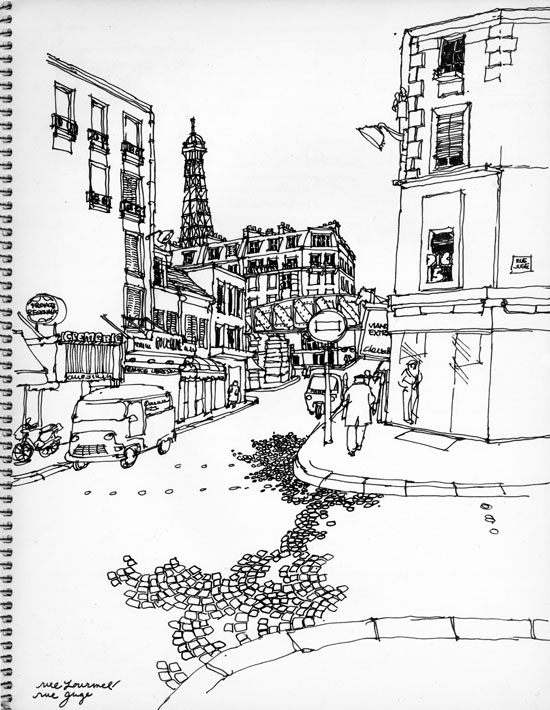
This sketch is from our old neighborhood in Paris.

Dans la rue
Today is the birthday of Andre Malraux (1901-1976), writer, art historian, explorer of Indochina, anti-Franco fighter in the Spanish Civil War, member of the French Resistance, and France’s first Minister of Cultural Affairs, and it is in his honor that I post this sketch from his home town.
Youth is a religion from which one always ends up being converted.—Andre Malraux
this is the garden
In honor of Edward Estlin Cummings (1894-1962), whose birthday it is today, a painting and a poem.
this is the garden: colours come and go, frail azures fluttering from night’s outer wing strong silent greens serenely lingering, absolute lights like baths of golden snow. This is the garden: pursed lips do blow upon cool flutes within wide glooms, and sing (of harps celestial to the quivering string) invisible faces hauntingly and slow. This is the garden. Time shall surely reap and on Death’s blade lie many a flower curled, in other lands where other songs be sung; yet stand They here enraptured, as among the slow deep trees perpetual of sleep some silver-fingered fountain steals the world.—ee cummings![]()