Sugarloaf Mountain hike

E&SCarderock

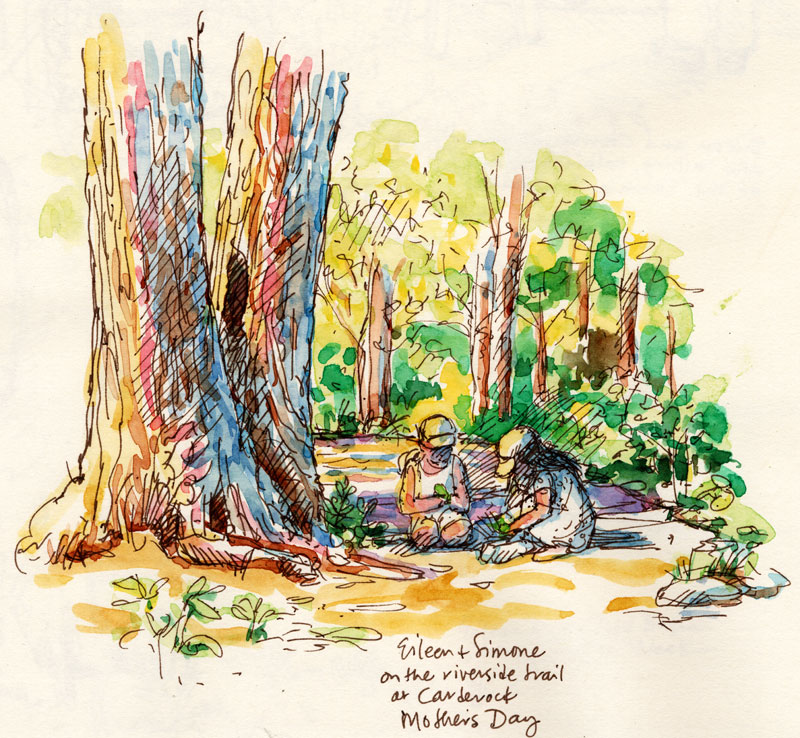
This sketch is from a Mothers Day hike at Carderock a couple of years ago, and I’m posting it as an excuse to tell you Washingtonians about another hike entirely, on Saturday, May 22nd, sponsored by the Audubon Naturalist Society. Melanie Choukas-Bradley and Tina Brown (respectively, author and illustrator of Sugarloaf: The Mountain’s History, Geology and Natural Lore) will lead a hike at Sugarloaf Mountain while simultaneously discussing the botany, wildlife, geology, and history of the area. (They must have better lungs than I do!) At the lunch break, Tina Brown will give a nature-sketching demonstration, so carry your sketchbooks.

Some of you may have attended Melanie Choukas-Bradley’s wonderful Earth Day talk about the botanical highlights of the Washington area, which was entertainingly intertwined with local history and biography. If you didn’t make it to the talk, you can look for her book, City of Trees. (It’s not often I can find three of my favorite subjects in ONE book.)

You can find more details about the hike at the Audubon website.


Library of Congress-Part 2

Continued from Library of Congress–Part 1, on April 24th

SpoffordArk

In its two-plus centuries, the Library of Congress has had a mere thirteen Librarians. They often serve a very long time, a sort of Library Supreme Court Justice. One of them was Archibald MacLeish (1892-1982), whose birthday it is today.

Born in Illinois, educated at Yale with a major in English, and at Harvard Law School, MacLeish might have had a straightforward uneventful law career, with writing and teaching as secondary pursuits, but for having served in the Army in World War I. Perhaps it was this wartime-planted seed that was sprouting when he left his law firm after three years and moved to Paris with his wife. There he spent five years writing poetry and drama and hanging out with the Hemingway-Fitzgerald-Pound crowd.

Well, how do you keep ’em down on the firm, after they’ve seen Paree. Instead of resuming his law practice after returning stateside, MacLeish continued to write, and to work for Fortune magazine. He had been, after all, an English major, and some of them do find employment—look at Garrison Keillor.

The anti-fascist viewpoint expressed in MacLeish’s writing drew the attention of President Roosevelt, who decided to appoint MacLeish as the next Librarian of Congress, over Republican Congressional opposition (“Expatriate!” “Communist!” “Poet!”). Professional librarians weren’t too happy about it either, since MacLeish was a Library World illegal immigrant. Once installed, however, he proved his skills and dedication, beginning with a major administrative reorganization of the rather uneven and semi-catalogued Library, clarifying its collection goals (Where are the holes to be filled?) and acquisitions policies (How can we fill them?), and requesting (and receiving!) a major expansion of Library budget and staff.

MacLeish also brought writers onto Library staff, launched poetry readings, wrote speeches for FDR, and much more which you can read about in detail on the Library’s website. Pretty amazing that he could accomplish all this in his 1939 to 1944 term, move on to serve as Assistant Secretary of State, then follow up with a writing/teaching career, winning Pulitzer Prizes for his drama and poetry, for which he is probably better-known.

The current Librarian, Dr. James Billington, has been a serious advocate of the National Digital Library Program, an ongoing project to digitize resources within the Library of Congress, making them accessible to that part of the world’s population (i.e., nearly everyone) which cannot make a personal visit to the physical Library in Washington, DC. In conjunction with this he proposed the creation of a multilingual World Digital Library, which was launched, with UNESCO, in 2009. Billington is a writer and a Russian scholar with a list of talents, awards, and accomplishments inside and outside the Library that is far too long to include here, but you can peruse his bio on the Library’s website, and then ponder sorrowfully how you yourself have frittered away your allotted time on this earth. Each Librarian brings his (so far it’s only been His) distinctive interests and talents to the post, thus enriching the Library.

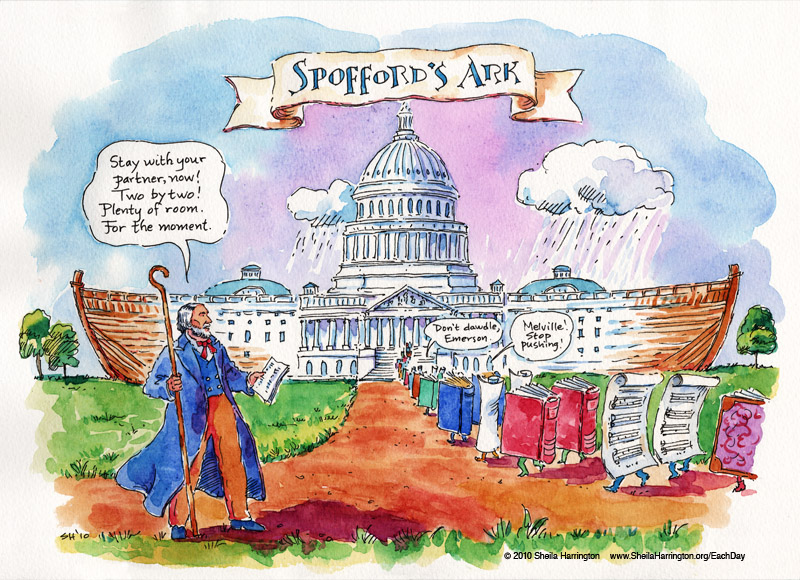
Possibly the best known Librarian of Congress—the “Father” of its modern incarnation—is Ainsworth Rand Spofford (served 1865-1897), who increased the Library’s collection dramatically AND acquired for it a new home.

Spofford, born in New Hampshire and homeschooled (homeschoolers take note), was clearly headed for a life among books—avid reader, bookstore clerk, a founder of the Literary Club of Cincinnati, newspaper reporter and editor, and finally Assistant Librarian, then Librarian, of Congress. He managed to get the Smithsonian’s vast library transferred to the Library of Congress, and he persuaded Congress to pass a copyright law of 1870 that centralized all U.S. copyright registration at the Library—huge in itself!—and also required authors to deposit in the Library two copies of every book, map, print, and piece of music registered in the United States. (The copyright protection law extends even to works of foreign origin, with reciprocal protection. But there is apparently nothing the Library of Congress, or anyone else, can do about peculiar Chinese versions of Harry Potter that incorporate Chinese wizards, hobbits, and a belly dancer.) As you might guess, even if you have not a mathematical mind, such a law rapidly increased the Library’s collections.

A terrible fire on Christmas Eve, 1851, apparently due to a spark from an unattended fireplace, had, sadly, destroyed about two-thirds of the Library’s contents, including much of Jefferson’s original library. But the collection had been replenished in the 1850s, and by now the Library was stuffed to the gills. Over its history it had been moved around the Capitol, in and out of various spaces, to accommodate its growth. But the moment had come—the moment that we ourselves experience when we say, “I cannot put one more dishtowel into this kitchen drawer! We need to move!” And Spofford recognized that moment.

Library of Congress–Part 3

CakeStarsKarla

Library of Congress-Part 1

JeffersonBooks

On this day in 1800, President John Adams approved legislation appropriating $5,000 to fund a hitherto nonexistent Congressional library.

Now, when the United States was young and the ink was still drying on the [mostly] ratified Constitution, its first Congress met for a short while (1790 to 1800) in Philadelphia. This contender for the role of Nation’s Capital was merely a disappointed temporary location, resigned to the government’s eventual transfer south. In the meantime, however, Philadelphia was, thanks largely to William Penn and Benjamin Franklin, a highly livable city—the most populated in the country (Washington, DC wasn’t even in the Top Twenty), with paved and lighted streets lined with sidewalks, fine masonry buildings, a university, a hospital, a fire department, gardens and parks, theaters and shops and philosophical societies and libraries—much like today, but without WiFi. The Library Company of Philadelphia offered the use of its fine collection to members of Congress free of charge, at a time when library use was by paid subscription.

When the government packed up and trudged southward to the Potomac in 1800, they said to one another in despair, “Where in this muddy village of farms, taverns, and unfinished government buildings will we do the research and study necessary for Congressional legislation and malediction?”

Fortunately, the previous Congress had been planning ahead, and in 1801, a collection of 740 books and three maps, purchased with the appropriated funds, arrived from London. They were stored, along with the papers Congress had brought from Philadelphia, in a room of the partially-built Capitol Building. It was primarily a collection of legal, economic, and historical works. The next President, Thomas Jefferson (He Who Must Not Be Named in Texas), a voracious scholar himself—if there was any subject that never interested him it is apparently unrecorded—signed a law creating the post of Librarian of Congress.

Fire is a perpetual threat to the flammable cities of civilization, and disaster can result merely from an unsnuffed candle. The Library has suffered from several, mostly minor, fires. But in August 1814, during the War of 1812, the British set about destroying Washington’s public buildings, to avenge the Americans’ destruction of the public buildings of Toronto. Although parts of the Capitol held up remarkably well, its interior, filled with wooden furniture, paintings, and irreplaceable documents and books, was highly flammable. That was the end of the library.

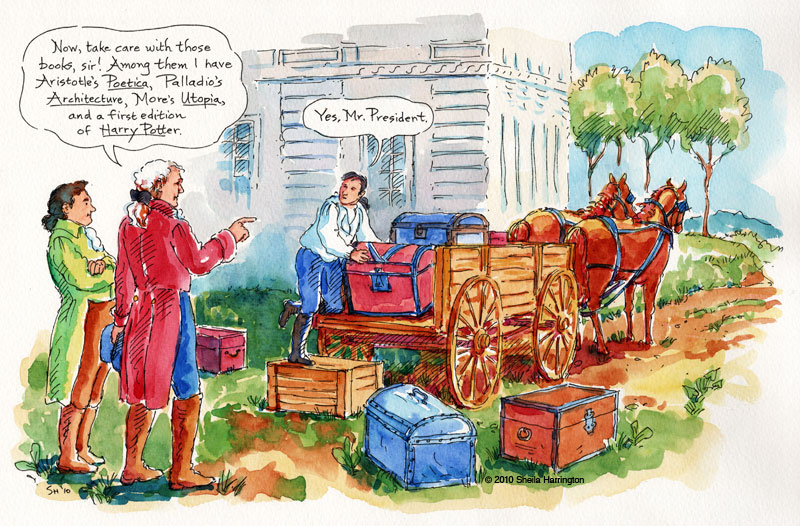
But only temporarily. Because Jefferson, now in retirement and short of cash, offered to sell his personal library to the U.S. government as the foundation of a new collection. So in 1815 he was paid $23,900 for his 6,487 books, which arrived by horse and wagon from Monticello.

What a collection it was. Not only works of law, economics, and history, to replace the lost books. But also: Biography. Geography. Chemistry. Botany. Medicine. Anatomy. Architecture. Philosophy. Painting and sculpture. Theater. Music. Literature. Essays. Mythology. Religion (including a copy of the Koran). And not only in English, but also works in French, Spanish, German, Latin, Greek, and Russian, several of which languages Jefferson spoke or read.

Some members of Congress objected to the collection’s breadth, explaining rather myopically, “the library was too large for the wants of Congress,” but Jefferson famously responded, “There is…no subject to which a member of Congress may not have occasion to refer,” and that statement has guided the Library in its acquisitions over the years.

For Library of Congress-Part 2: Please see May 7th

My Heart Leaps Up

My heart leaps up when I behold
A rainbow in the sky.
So was it when my life began;
So is it now I am a man;
So be it when I grow old,
Or let me die!
The Child is father of the Man;
And I could wish my days to be
Bound each to each by natural piety.
—William Wordsworth

Rainbow

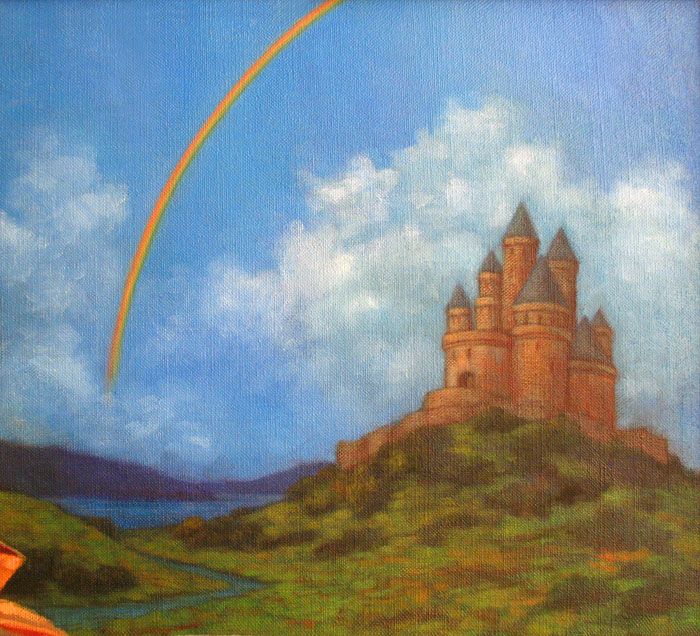
(painting is a detail from a larger work, The Age of Reason)

Whenever someone in the family mentions a rainbow, my husband launches into this poem. (It’s now inevitably become a sort of family tradition—wait for it….) And today we celebrate the fortuitous birthday of its author, William Wordsworth (1770-1850), born in Cumberland, England.

Is it obligatory for English poets to have had unhappy childhoods? Wordsworth’s was no exception—his father, mysteriously, lived apart from the family, and when the children’s mother died, instead of taking them in, he parcelled them out between boarding schools and a series of unpleasant misery-inducing relatives. Wordsworth wasn’t reunited with his beloved favorite sister Dorothy for years. The highlight of his dismal schooling (besides introducing him to his future wife) was the holidays, which he consistently spent going long walks in nature and writing poetry.

At twenty Wordsworth set off on a walking tour of Italy, Switzerland, and post-Revolutionary France, where he became a passionate advocate of the republican cause. In France he formed a liaison with a local girl, but the relationship was discouraged by her parents (despite his having fathered a daughter whom he visited and supported rather erratically over the years). He returned home alone, disillusioned by the increasing violence of the revolution and England’s violent response to it, aimless, without profession, depressed.

This dark period was finally relieved by a legacy from Raisley Calvert, a sculptor and loyal former classmate, that allowed Wordsworth to support himself while writing poetry. May we all be so fortunate in our old school friends! With a steady income, he was able to form a household with Dorothy and their mutual friend Samuel Coleridge that Dorothy termed “three persons with one soul.”

It was a creative partnership that marked the birth of English Romanticism. Inspired by one another, Wordsworth and Coleridge produced innovative, experimental, controversial poetry, and Dorothy’s letters (luckily for literary historians) documented the process. Wordsworth defined poetry as “the spontaneous overflow of powerful feelings” but his rapture was borne within measured frameworks, among them the sonnet form, which Wordsworth reawakened after its long disuse. In 1798 they published Lyrical Ballads (“Tintern Abbey,” “The Idiot Boy,” “Rime of the Ancient Mariner”) and Romanticism was up and running.

The Romantic movement emphasized the value of individual experience, the contributions of ethnic traditions and folklore, the primal power of wild landscape and the wonders of nature, a consciousness of the infinite, and the use of imagination and the senses as a path to spiritual truth. It was a break from the formal elegance, polish, dignity and conservative restraint that characterized the formerly hot movement, Neoclassicism. Instead of, say, a series of elevated dramatic couplets on the epic semi-divine hero of ancient tragedy, we have a lyrical meditation on the soul-response to a sea of daffodils, or to the loss of a much-loved child. A personal perspective on life, the natural world, and mortality.

Yes…quite a break! taken up by Blake, Scott, and Göethe, followed by a whole string of younger Romantic poets and writers (Byron, Shelley, Keats, Hugo, Dumas, Pushkin) and the Transcendentalists (Emerson, Thoreau) and later the Victorians (Browning, Tennyson). Where would it end?? Culture as well as politics seems to be an ongoing struggle between the poles of head and heart, with adherents of each movement certain of having achieved a universally valid means of expression. But that is a subject for another post.

The partnership foundered on a falling-out with Coleridge, a pretty gloomy fellow, as one would expect of someone who writes a lengthy baffling poem about a curse-bearing dead albatross. Wordsworth and Dorothy moved on, settling eventually in the beautiful Lake District, that region abundant in literary inspiration and indomitable tourists. Joined by Robert Southey, the two became known as the “Lake Poets,” and Wordsworth married and proceeded to have five children. A sizable household. But a household that, as any other, had its share of suffering, with the drowning of William and Dorothy’s brother, and the deaths of three of the children. Wordsworth’s poetry grew more sober, restrained, and elegiac. In fact in his later years, while serving as England’s poet laureate, he was criticized by younger writers for his increasing conservatism. Suffering and loss does shade and temper youthful abandon.

Even if you can’t recite a Romantic poem in entirety, you know that your head is filled with lovely memorable fragments (“Dear God! the very houses seem asleep; And all that mighty heart is lying still…” “I wandered lonely as a cloud That floats on high o’er vales and hills…” “The Soul that rises with us, our life’s Star, Hath had elsewhere its setting, And cometh from afar…”) that are part of our literary legacy and that emerge in moments of wonder and joy. For the fragments, for the poetry, for the consciousness that shaped them, and for my husband’s regular recital of the rainbow poem, thank you, William Wordsworth, and Happy Birthday.


Let My People Go

Passover begins at sunset today. In celebration I post here a page of my daughter’s Main Lesson book from our Stories of the Hebrew People block.

And after the sun goes down, in Jewish households all over the world a child will ask the first of the Four Questions: Why is this night different from all other nights?

TenPlagues

Loveliest of Trees

Every year about now I start muttering this poem to myself. And I ponder how suitable it was that its author, Alfred Edward Housman (1859-1936), was born on this day, in the season of the lovely, evanescent, and melancholy cherry blossom.

Housman was one of seven children of a rather depressed solicitor in Fockburg, England who had a tendency to invest heavily in failed inventions. No wonder he was depressed. Housman’s health was frail, and in school he was subject to bullying. As many were, in pretty much any fine olde boys’ public school. His beloved mother’s death when he was twelve was a severe blow. However, as a student he showed great promise, and he won a scholarship to Oxford, where he took up classics.

Although he was brilliant, Housman was unwilling to expend much energy on what didn’t interest him, and he much preferred his studies of the Latin poets to philosophy and ancient history. He failed to pass his final exams, and there is speculation that the cause was not only neglect of his studies but also the disappointing (and lifelong) attachment he had developed to his school roommate, Moses Jackson, which never went beyond friendship (Jackson being heterosexual).

Housman’s failure to pass his studies made it impossible to enter a position in academia, but Jackson, who couldn’t give him True Love, obtained for Housman through his connections the next best thing—a Steady Government Job. (And that sounds really attractive in the current economy.) So for the next ten years Housman was a London Patent Office Clerk by day and classical scholar by night, studying Greek and Roman classics independently and writing articles for learned journals, gradually gaining an impressive reputation that led to a professorship in Latin, first at University College, London, and then Cambridge University, where he eventually published several volumes of his meticulous textual analysis and translation.

But do we remember Housman for his brilliant Latin scholarship? No, we do not. Unless we are brilliant Latin scholars ourselves. No, this clerk by day and scholar by night was somehow finding the time to write evocative lyrical poetry. In 1896 he assembled a collection of 63 of his poems and went looking for a publisher. After being rejected by several, he decided to publish the collection, titled A Shropshire Lad, at his own expense, surprising his colleagues, who evidently had had no idea of Housman’s other interest. The book sold slowly at first, but as musicians set some of his ballad-like poems to music, its reputation grew, and with the advent of the First World War, his themes of death and loss struck a chord in the public. It became one of the most popular volumes of serious poetry ever published.

Apparently an aloof, intimidating professor with a sarcastic wit, Housman was not an easy companion, and when Jackson married, he did not even send Housman word. Housman gradually became increasingly reclusive. But when Jackson was gravely ill in Canada, Housman decided to assemble his unpublished poems so that his old friend could read them before he died. These were published as Last Poems in 1922, 36 years after A Shropshire Lad. One more collection was published posthumously.

And that’s it. What Housman created as a sideline (“I am not a poet by trade; I am a professor of Latin”) has become an inextricable and unforgettable component of the body of English poetry. Housman said once, “The emotional part of my life was over when I was thirty-five years old.” Yet his poetry, at once spare and vivid, is imbued with feeling, without being sentimental. What he did not permit himself in life he has given us on the page.

So go for a walk under the pink and drifting petals, and wish Alfred Housman a Happy Birthday.

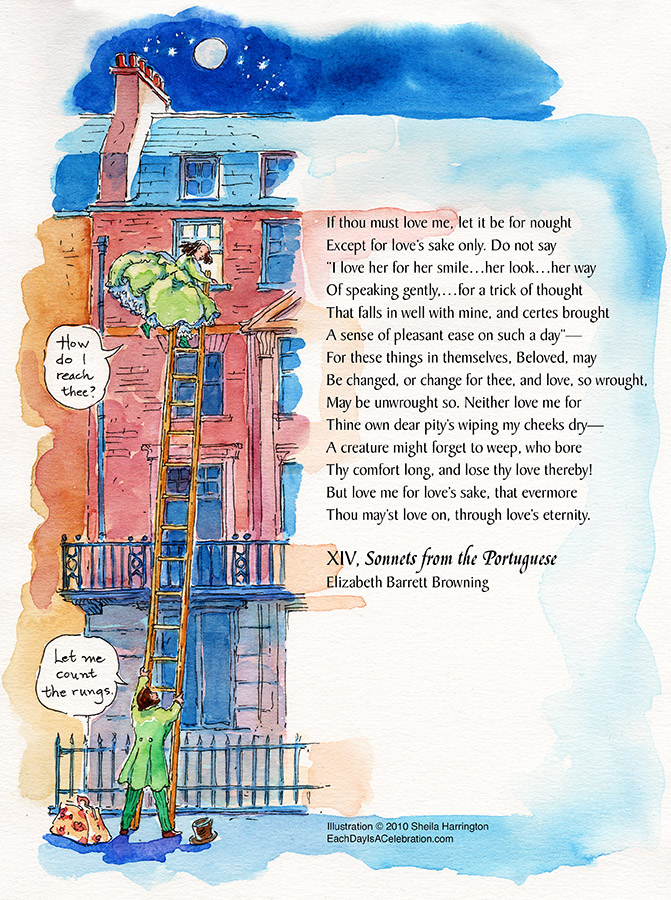
A Love Story


How is this for a romantic tale: Intellectual semi-invalid is still living at home in seclusion in her mid-thirties, quietly writing poetry and essays. Her published, widely read poems catch the attention of a handsome fellow-poet, six years her junior, who writes her a lengthy letter that says, among other things:

I love your verses with all my heart, Miss Barrett… so into me it has gone, and part of me it has become… and I love you too.

Thus began a correspondence—reluctant on her side, urgent on his, between Elizabeth Barrett (1806-1861), whose birthday it is today, and Robert Browning—that culminated in their growing mutual attachment and eventual secret elopement. Like many (all?) romantic tales, it had its dark underside, this one of slavery, paternal tyranny, multiple sad deaths, and mysterious illness.

Barrett was the first-born in a large prosperous family in Coxhoe, England, whose income derived partly from slave-worked plantations in Jamaica (perhaps this was related to Barrett’s later abolitionist stance). She was educated at home and demonstrated in childhood a gift for language: writing poetry, reading Milton, Shakespeare, and Dante, and learning Greek, Latin, and Hebrew (incorporated later into her poetry) sufficiently well to take up translation and analysis. To these she later added Italian, German, and Spanish.

But by age twenty she was already declining physically from some unknown, untreatable cause. The deaths of her mother and grandmother took their toll on her, and the accidental drowning of a favorite brother made her a recluse in her misery. In the meantime the abolition of slavery in England brought an end to the Jamaica income and obliged the family to live simply. Throughout all this she continued to write and publish essays and poetry, passionate, deeply felt, finely crafted, expressive of political and social as well as personal themes. And despite her seclusion, she corresponded widely with other writers and scholars.

Thus Browning was smitten. When he finally whisked Barrett off secretly to tie the knot and honeymoon in Italy, her father disinherited her—as he did each of his children who chose to marry. Some family therapy would not have been amiss here.

After their marriage Barrett showed Browning the sonnets she had been writing, the most famous of which (not the one above, but number XLIII) has been widely reproduced (and parodied). The couple stayed in Italy and, despite their late start, Barrett/Browning gave birth to a little Robert when she was 43. So their tale concludes probably as happily as any—with the two of them madly in love, raising their babe, writing poetry together, respected, reasonably comfortable, and in ITALY besides. Happy Birthday (and apologies), Elizabeth Barrett Browning, with gratitude not only for the poetry but for the love story.


Literary Washington

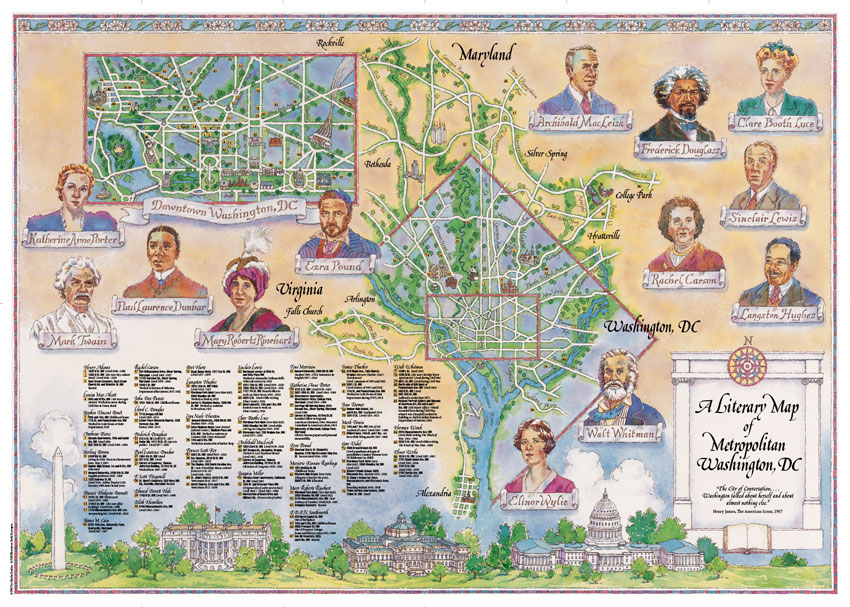
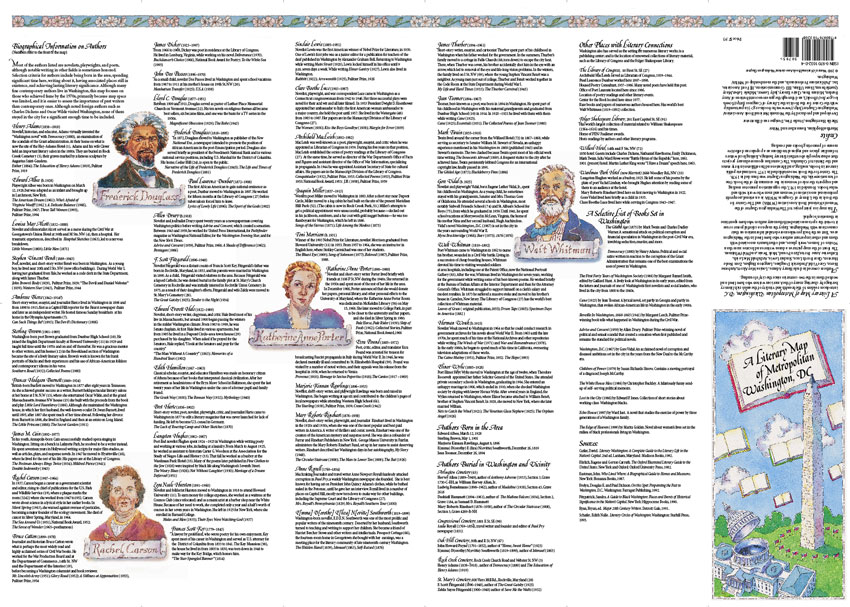
Here is the inside of the Washington DC Literary Map for which I posted the cover on 2/21. (The size in real life is 26 inches x 19 inches.)

The following is the description given on the Woman’s National Book Association website:

“The literary map identifies and celebrates locations in Washington and surrounding areas that are associated with 44 authors who have lived or worked here, including Rachel Carson, Frederick Douglass, Langston Hughes, Sinclair Lewis, Clare Booth Luce, Mark Twain, and Walt Whitman. The map also contains biographical information about the authors, a list of authors born or buried in the Washington area, other places with literary connections, and a selective list of books set in Washington.”

I was surprised myself to see how many writers have Washington, DC connections.

WashDCLitMapWeb

WashDCLitMapBack

Washington’s Monument

LitMapCover

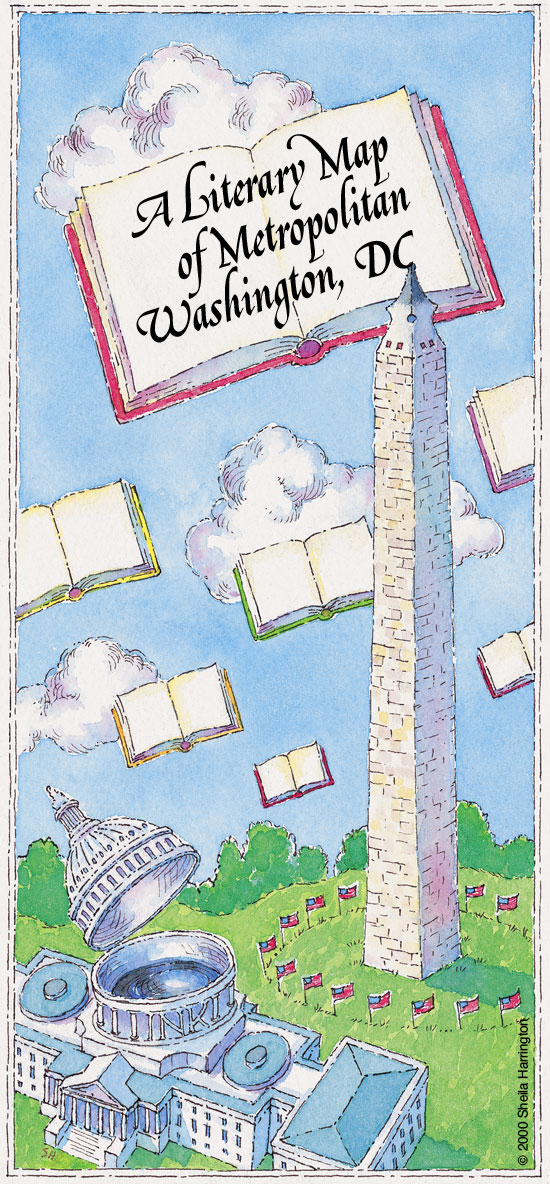
Today is the 125th anniversary of the dedication (in 1885) of the Washington Monument. It was certainly a long time a-building, considering Pierre Charles L’Enfant had included a location for a monument to George Washington in his 1791 drawings for the new capital city. What L’Enfant had in mind, though, was an equestrian statue.

After Washington died in 1799, Congress thought a tomb might be a better plan—hey, how about right inside the Capitol? But his wife Martha wasn’t too happy with that idea. Progress stalled until the 1830s, when a group of impatient citizens raised funds themselves and held a competition for a monument design. The other entries were far more complicated: designs for monuments rich in Gothic windows, enlivened by multicolored stonework, festooned with all manner of carving and statuary. It makes me wonder how much the final choice was driven by budget. Even the award-winning design by Robert Mills originally had a colonnade at the base.

Construction began at last in 1848 and continued in fits and starts, slowed by the Civil War, lack of money, and anti-Catholic fervor (don’t ask). Congress occasionally offered funds. Reading American history I am struck by how reluctant the U.S. government used to be to spend money on much of anything, no matter the generally acknowledged need or value. When Congress finally decided to fund the rest, the monument went up quickly and immediately began to draw crowds. According to the National Park Service, it has over 800,000 visitors a year and is still the TALLEST STONE STRUCTURE in the WORLD. How about that.

You may be asking, “What the heck does this have to do with a picture of a Monument-Pen?” Well, uh… this image is the cover of a Literary Map of Washington DC commissioned by the Women’s National Book Association and featuring writers who have lived and worked here. For February 21st, I searched my work for a Monument image. And thereby hangs the tale. (Later this month I will post the illustrated map inside, so you can see what it looks like. It’s available at DC bookshops or through the WNBA.)

There is a celebration of the anniversary at 1pm today at the foot of the Monument.

The Tomes They Are A-Changin’

Stepford

This may be a little cryptic. It’s my response to a recent meeting held at the much-loved local library, in which unwelcome developments present and future were laid out before us. Despite its being held during a snowstorm, the meeting was well-attended by many unhappy patrons.