Sometimes when we have breakfast outside, a mockingbird lands on the Japanese maple in front of the house, then hops down to the porch flower box and eyes our plates. After an offering of scone or toast, he/she flies off with it, then returns for more. I wonder if there are little ones in a nearby nest? One morning I had my sketchbook with me.
Author: Sheila
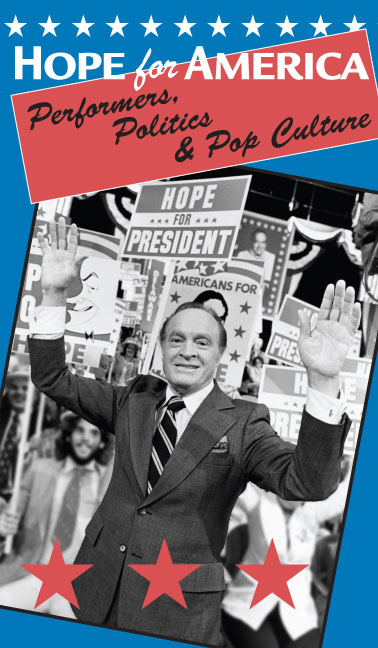
Hope for America
I’ll bet you thought I was about to announce an alternative to fossil fuels, or at least an exciting new political candidate.
No, tonight is the opening reception for a new exhibition in the Bob Hope Gallery at the Library of Congress on which my husband has been working for the past several months. It’s one of many history exhibitions he’s created for the LOC over the years. Hope for America: Performers, Politics & Pop Culture explores the involvement of entertainers in politics throughout the 20th century, often through satirical commentary, sometimes through direct participation. There is also a moving segment on Hope’s work for the USO entertaining troops all over the world, which he did for SEVENTY YEARS. The exhibition features film and television clips and radio broadcasts as well as photos, letters, sheet music, and other artifacts to tell the story.
If you are in the DC area, come visit! I’ll bet you could use a few belly laughs. (This is the cover of the brochure I designed for the exhibit.)
It’s a jungle out there
Birthday Guy
Here is Al, sketched “without my permission!” as he put it, after a dinner party. Today is his birthday, and he has a life of unusually useful work to celebrate: years as a Civil Rights Movement lawyer in the South (the stories he can tell!), and many more years leading the ACLU’s National Prison Project. He’s usually on the road somewhere, fighting for prisoners’ rights, the abolishing of torture, and the improvement of dreadful prison conditions in the U.S. and all over the world. (He believes prisoners are human beings, which is not a universally shared opinion.)
Although Al may look like (and can be when necessary) Mr. Tough Guy, which has certainly come in handy in his work, under that rough-hewn exterior beats the heart of a cupcake. Maybe that’s a clue to his choice of profession. Also he’s an awesome chef. Happy Birthday, Al! I know you won’t have to bake your own cake.
On Deadline
Déjeuner sur l’herbe
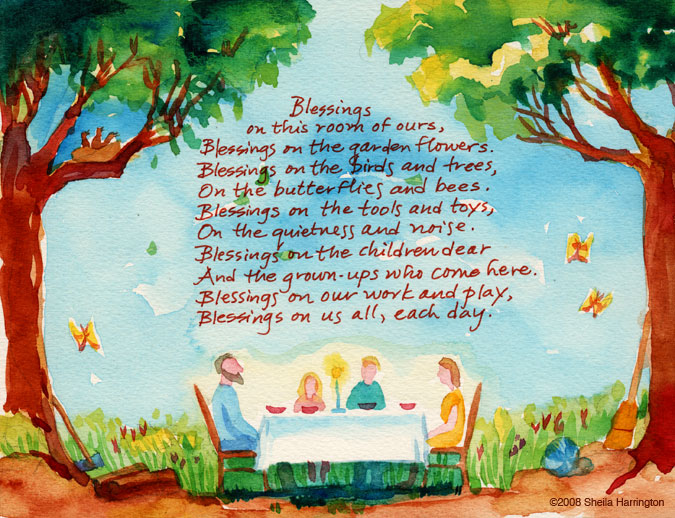
From our family verse book. One of my favorite things about mild weather is dining outside. We do it whenever we can, even if it just means downing a bowl of cereal on the front porch while waving to the neighbors heading off on their morning missions. Although I do love a tablecloth, and candles. And I haven’t yet found the right wine for oat flakes.
Rites of Passage
From my sketchbook. It’s the season of graduations, and weddings, and the perpetual hankie in the hand and lump in the throat.
In her room at the prow of the house Where light breaks, and the windows are tossed with linden, My daughter is writing a story.I pause in the stairwell, hearing From her shut door a commotion of typewriter-keys Like a chain hauled over a gunwale.
Young as she is, the stuff Of her life is a great cargo, and some of it heavy: I wish her a lucky passage.
But now it is she who pauses, As if to reject my thought and its easy figure. A stillness greatens, in which
The whole house seems to be thinking, And then she is at it again with a bunched clamor Of strokes, and again is silent.
I remember the dazed starling Which was trapped in that very room, two years ago; How we stole in, lifted a sash
And retreated, not to affright it; And how for a helpless hour, through the crack of the door, We watched the sleek, wild, dark
And iridescent creature Batter against the brilliance, drop like a glove To the hard floor, or the desk-top,
And wait then, humped and bloody, For the wits to try it again; and how our spirits Rose when, suddenly sure,
It lifted off from a chair-back, Beating a smooth course for the right window And clearing the sill of the world.
It is always a matter, my darling, Of life or death, as I had forgotten. I wish What I wished you before, but harder.
—Richard Wilbur
Prince of Binomial Nomenclature: Part 2
Continued from Prince of Binomial Nomenclature: Part 1, May 23rd
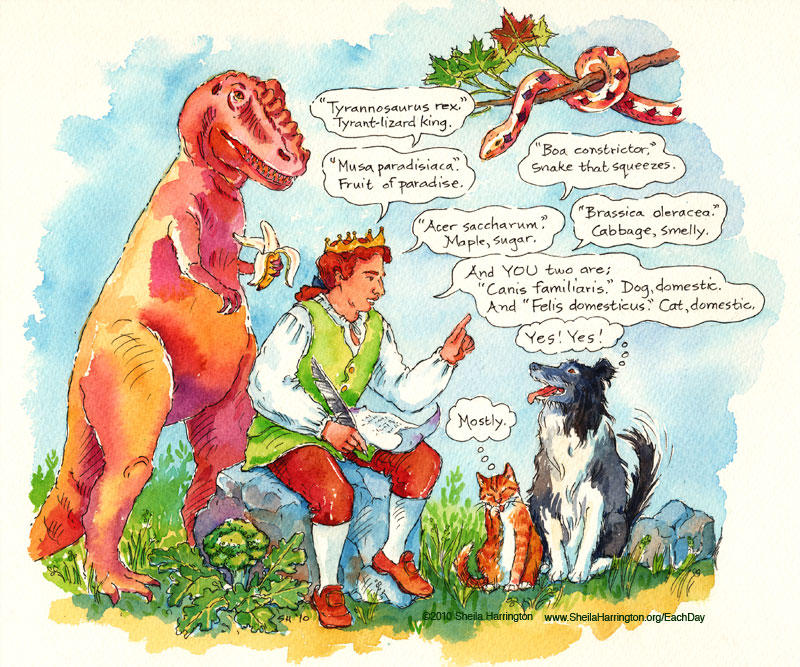
Longing to expand his perspective, Linnaeus applied for and received a grant for a field expedition to Lapland, a rugged region above the Arctic Circle, where he expected to find many unrecorded species. Linnaeus spent five months exploring and studying rocks, plants, insects, animals, and people, and returned with thousands of specimens (no people though), filled with excitement. He returned to lecturing, and planned a series of books cataloguing species according to his new system.
Linnaeus DID actually long for a reproductive life of his own. He paid court to a young lady whose father, not taking a wandering botanist very seriously, insisted that Linnaeus wait three years and meanwhile establish some means of supporting a family. So Linnaeus went off to Holland, whose universities were better equipped than those of Sweden, to complete his medical degree. He also found work there managing and classifying the contents of Dutch zoological and botanical gardens.
THEN, in 1735, while still in Holland, he published his book Systema Naturae, which explained his concept of classification. Linnaeus grouped plants and animals into genera—groups whose members have something in common, usually structural or related to reproduction. (Linnaeus was the first to classify whales as mammals.) Then he subdivided each group into species. (His complete heirarchy, as you may recall from high school, is Kingdom, Class, Order, Genus, and Species.) And then he gave each member a two-part name based on these divisions, replacing all previously-used cumbersome lengthy descriptions. These two-part names were in Latin, which was, and still is, the universal language of science. I told you those Latin classes would come in handy.
Systema Naturae hit the botanical world like a bolt of lightning. The notion that PLANTS (seemingly so innocent!) had a Sexual Life, by which Linnaeus partly categorized them, was outrageous and horrifying to some naturalists, and Linnaeus was criticized for “nomenclatural wantonness.” But, despite objections on both theological and moral grounds, Linnaeus’ achievement launched him from obscurity to fame. A binomial concept had been proposed by Swiss botanist Gaspard Bauhin in 1623 but was never widely used. When Linnaeus combined it with his new categorization methods, the idea spread rapidly. Here was a practical tool: reasonable, memorable, universally applicable. Not only could scientists from different countries know they were communicating about the same species; it was even easy for amateurs to use, and it sparked a more widespread interest in natural history. Such is the effect of nomenclatural wantonness.
Now back in Sweden as an established botany professor, Linnaeus was able to marry his fiancée, although he spent so much time away on expeditions that she might have been happier with one of her other suitors. He lectured, wrote many works on botany, corresponded with other naturalists, revised and expanded Systema Naturae many times throughout his life (it eventually reached 2,300 pages), led collecting expeditions, and inspired his students to travel throughout the world as botanical and zoological explorers. One circumnavigated the world with Captain Cook. Others went to North America, Japan, China, and Southeast Asia, returning with specimens (or occasionally dying in a distant land; collecting could be dangerous work). Eventually he was knighted for his contributions to science and became Carl von Linné. So there, Mom and Dad.
Linnaeus himself gave scientific names to 4,200 animals and 7,700 plants, generally choosing names to reflect physical qualities, but occasionally to honor a friend or colleague, or, with a particularly ugly or toxic specimen, to insult someone who had annoyed him. Be wary of affronting a botanist. They are still lurking out there today…naming species.
With some modifications due to our modern understanding of evolution, Linnaeus’ system is still in use today, and pretty much taken for granted. But whenever you say Homo sapiens, or Boa constrictor, perhaps now you will think of Carolus Linnaeus, who made it possible, and you will celebrate his birthday every May 23rd. If you weren’t doing so already.
Throughout his life Linnaeus was a deeply religious fellow. He saw his work as clarifying for the world the underlying connections among living things and confirming the intelligence of a great Creator. Ironically, however, because his work made possible far greater understanding and communication among naturalists everywhere, it led to observations of surprising patterns and eventually to the shocking speculation by Charles Darwin and Alfred Russell Wallace that species, instead of having been from their Day of Creation exactly as we know them now, had perhaps changed over time. Over a long, long time. We do not know the ultimate consequences of our life’s work.
Neverland
From my sketchbook. Scenes from the Washington Waldorf School end-of-year senior class production of Peter Pan two years ago. It was terrific—both exciting and hilarious. Captain Hook was played by a tiny fierce blonde. I am a fan of school plays, even those not featuring my own children. But this was an especially significant production, because the class had lost a beloved member in an auto accident, a lovely girl many of us had known since kindergarten and infancy, and the play was dedicated to her memory.
St. Ronan
There are probably a dozen St. Ronans, some Irish, some Scottish, all with different feast days. And the one I’m choosing actually had his feast day YESTERDAY, June 1, but that day was taken by John Masefield. So I’m noodging Ronan onto June 2nd. Being saintly, he surely won’t mind.
This St. Ronan was an Irish missionary who had left Ireland and lived in a forest overlooking the Bay of Douarnenez in Brittany, a location I would select myself if I were an Irish missionary. The story goes that his wife disliked his proselytizing among their Breton neighbors, so she accused him of being a werewolf. When you want to reform your husband, drastic action is required. But when Ronan was brought before the authorities, the nearby hunting dogs failed to attack him, thus proving his innocence. He went on to become a wandering healer of the sick and was buried in what is now Locronan.
What, you may ask, does this have to do with the picture above? Well…it’s a stretch, but the CD Lord Ronan’s Return (for which I painted this cover) was named for another wandering Ronan. And you can learn more about that one, as well as how to obtain this CD of lovely music by by Linn Barnes and Allison Hampton, by going to their website. Happy St. Ronan’s Day! (yesterday)