Maryland, My Maryland

Pictures by my daughter from the Local History and Geography homeschooling block.

On this day in 1788, Maryland became the 7th state to ratify the Constitution. Perhaps you live in Maryland and never knew how this came about. Or perhaps Maryland is terra incognita because you live far away, in Nepal, or Virginia. In any case, I am going to tell you.
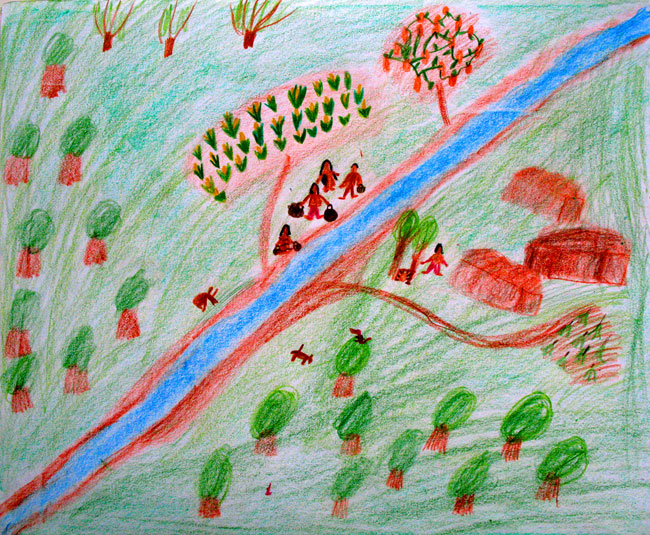
Campsite

For thousands of years human beings on the shores of the Chesapeake Bay fished, farmed, and fought one another without foreign interference. However, the seagoing vessels across the Atlantic Ocean grew ever-larger, and when Italian Giovanni Caboto, in the pay of Henry VII of England, wandered into codfish-rich Newfoundland/Maine waters in 1497, that was enough for England to claim the promising land. (They also insisted on referring to Caboto as “John Cabot” to help make their case.)

One hundred and ten years later Captain John Smith, although mainly concerned with the floundering colony in Virginia, ventured up the Chesapeake Bay, pronounced it goodly and pleasant, and produced a map that received much attention. So when George Calvert, the first Lord Baltimore, tired of the anti-Catholic feeling in Protestant England (Catholics were considered untrustworthy and could not hold office, vote, or worship openly), he asked his friend King Charles I to give him a piece of this New World land.

Calvert had tried Newfoundland first, but his settlers died of harsh weather and disease. His request was granted, but the Virginians were unhappy about the potential nearness of Papists. Well, suggested Charles, how about just a northern sliver of Virginia, about 10,000 square miles around the Chesapeake Bay—nobody there except non-Christian native dwellers! Calvert accepted this parcel, to tax and govern as he saw fit, in exchange for two Indian arrowheads a year, an enviably low rent.

Shortly afterward George Calvert died, so his younger son Leonard set sail in the Ark and the Dove and a party that included settlers and adventurers, several gentlemen, a handful of women, a number of indentured servants, and three priests. The group was a mixture of Catholics and Protestants, as it was Calvert’s intention to set up a religious-tolerant community. When they arrived at the mouth of the Potomac in March 1634, they were kindly greeted by the surprised yet helpful Yaocomico inhabitants, who, tiring of attacks by their Susquehannah neighbors, were fortuitously planning a move west. They granted the newcomers their land, along with houses, fields, and useful botanical, zoological, and culinary tips. The settlers renamed the territory Terra Maria, in honor of Queen Henrietta Maria (daughter of King Henri IV of France). Terra Maria: Mary-Land.
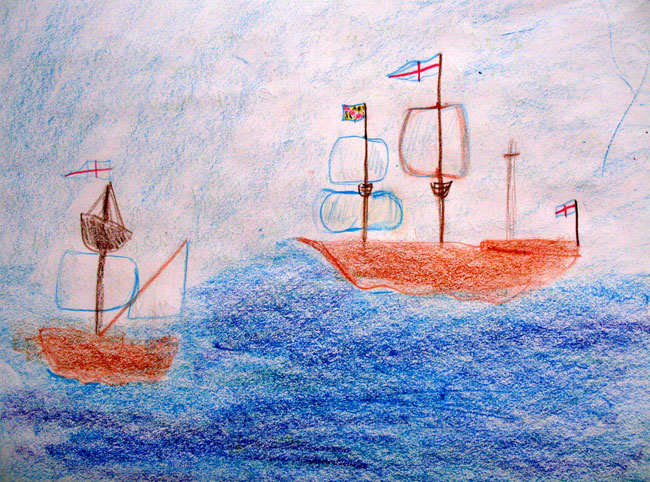
Ark&Dove

The Maryland settlers were better prepared than their hapless predecessors in Jamestown, those aristocratic younger sons who arrived in their best clothes ready to pick up the gold and jewels lying scattered on the shores of America. No, these folks brought tools and seeds and useful skills like carpentry, and had been recruited by Calvert on condition of willingness to work hard. The village, now called Saint Mary’s City, Maryland’s capital, was quickly fortified and the surrounding lands divided and allotted according to size of the household living on it: for heads of household, wives, and indentured servants, 100 acres each; for children 50 acres each. You can imagine that this arrangement encouraged emigration of large groups. “And here is my cousin Robert… and his son John…and their three manservants…” Voilá—450 more acres!

Although the Calverts were Proprietors—they actually “owned” Maryland and could govern it as they saw fit—the settlers announced that they intended to make their own laws. Calvert objected, and an uneasy compromise was worked out, but this insistence on self-rule was, as we know, a harbinger of things to come. Calvert did convince them to pass his Act of Toleration in 1649, which guaranteed religious freedom to Christians, although the arrangement was: if you deny the divinity of Jesus Christ you will be executed. Such means of ensuring uniform worship have not entirely fallen out of favor in 2010. The Act lasted until the Puritans chopped off Charles I’s head for tyrannical cluelessness (no longer a capital offense in Great Britain). In 1692 England and its colonies were declared officially Protestant. The new leaders burned down the Catholic churches in Maryland and moved its capital to Puritan-founded Providence—renamed Annapolis for Protestant Queen Anne.

To be continued April 29th: Part II.

CakeBerries2Edith


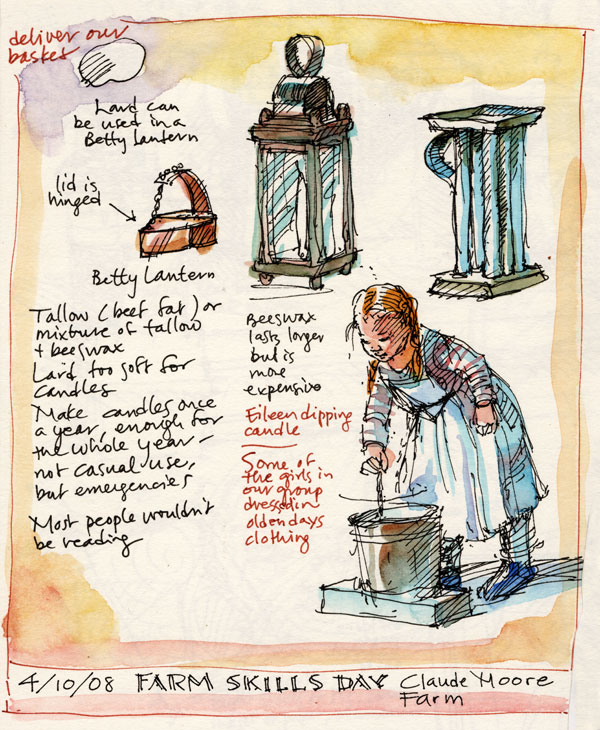
Farm Skills Day

Three times a year Claude Moore Colonial Farm (a small corner of McLean, Virginia that is frozen permanently in the year 1771) holds a Farm Skills Day to teach 21st century children about what life was like for colonial Virginia families way back when. The content varies somewhat with the season. This was an April visit, and the children carded wool and dipped candles.

FarmSkillsDay

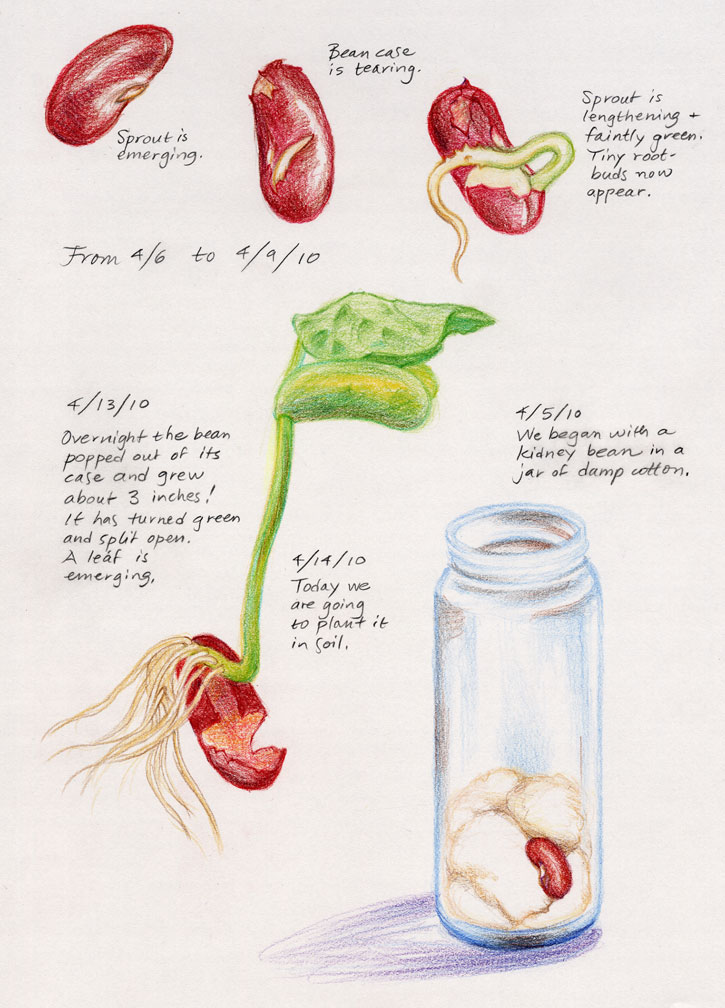
Bean Sprout

It’s lovely to go outside each morning in this season and see what new surprise (dogwood? dandelion?) awaits us. But if you have never put a bean into a jar of damp cotton balls and watched to see what happens over the next few days, I recommend it as an annual springtime activity. To watch the magical unfolding in your own kitchen does renew respect for what’s happening in the larger world. This is a sketch from our homeschooling Botany block.

KidneyBean

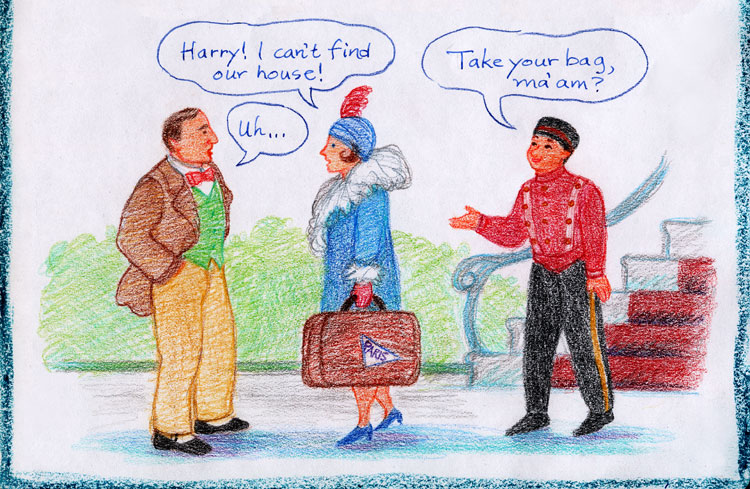
Wild About Harry

This picture is from our Local History and Geography lesson block.

Wardman

If you lived in Washington, DC in 1938, ONE out of every TEN of your neighbors was living in a house or apartment built by Harry Wardman (1872-1938), whose birthday it is today. Not bad for a guy born in Bradford, England who came to the United States at age 17 and started out as a department store floorwalker in New York. He moved on to a store in Philadelphia, then to Washington, DC in 1893, where he found carpentry work and learned to build staircases.

Wardman wasn’t satisfied with staircases, however. Washington suffered from housing shortages both after the Civil War and after World War I, and Wardman was poised and eager to fill the need. He moved on from staircases to building entire houses, and then larger structures: buying land, building on it and selling, then buying new land for another project. He built apartment buildings, office buildings, hotels, clubs, and whole neighborhoods of row houses renowned for the quality of their construction and materials.

Wardman built many of Washington’s grandest apartment buildings, the Hay-Adams Hotel, and the British Embassy, but his best-known project is probably the Wardman Park Hotel in Woodley Park. Wardman and his wife already had an impressive mansion in the neighborhood, at the intersection of the newly-extended Connecticut Avenue and Woodley Road. An iron bridge had only just been built in 1891 allowing easier travel across the ravine of Rock Creek Valley, and Wardman decided that Woodley Park would be a fine location for a hotel.

So in 1916, while his wife was overseeing their daughter’s schooling in Paris, Wardman ordered a crew to empty their house of its furnishings, and then he had the place torn down, to be replaced by the Wardman Park Hotel (now the Marriott Wardman Park). People called it “Wardman’s Folly.” Why, you ask? Supposedly because no one in his right mind would ever want to stay in a hotel soooo far away from downtown. But I’m trying to imagine returning from a trip to Paris and discovering that my husband has knocked down our house and replaced it with a hotel. “Folly” is certainly one word that would come to mind. Many other words, too, probably.

Wardman made a fortune. By 1929 he had amassed $30 million (which I understand was a lot of money in those days). Most of it was lost in the stock market crash, but he retained enough to continue some of his building projects and was on his way to a second fortune when he died, having spent years putting roofs of one sort or another over the heads of Washingtonians. Our family lives today in a Wardman neighborhood (our house turns 100 years old this year), and I definitely plan to put some candles in the dessert tonight and sing Happy Birthday to Harry.

CakeBalloons2Greg

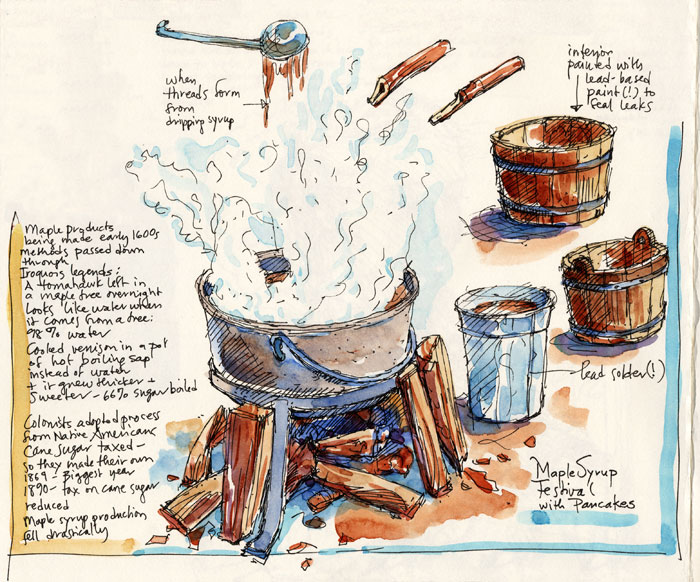
Sugaring off

MapleSyrup

Spring is a time for field trips—outdoors, if possible. This is from my sketchbook, when, as part of a homeschooling Farming block one year, we visited Cunningham Falls in the Catoctin Mountains for their annual maple syrup festival. We were able to see the entire process from tree-tapping to boiling down sap to sampling the final product at a pancake breakfast. Wonderful park guides provided explanations of each step and answered our many questions. The syrup was a whole lot better than their Lake Wobegon pancakes, though. They definitely need a new recipe.


Cherry Blossom Breakfast

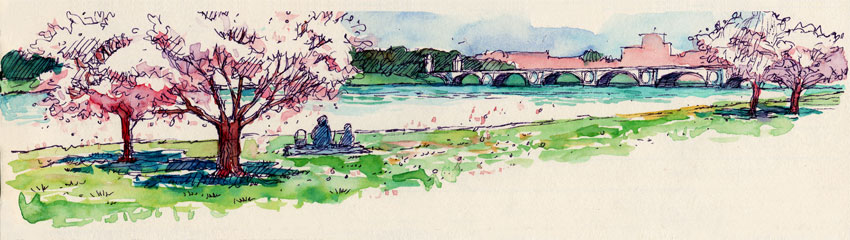
This morning we officially began our homeschooling Botany block, with springtime poetry, an early morning picnic and stroll under the cherry blossoms, and a long conversation about the astonishing, exuberant and generous world of plants, which brings forth hourly surprises in this season. (Was it only last month that a mountain of snow still blocked the alley exit?)

CherryBlossomPicnic

Lo, the winter is past, the rain is over and gone;
the flowers appear on the earth;
the time of the singing of birds is come,
and the voice of the turtle is heard in our land.

The fig tree putteth forth her green figs,
and the vines with the tender grape give a good smell.

Arise, my love, my fair one, and come away.

—Song of Solomon 2:11-13

CakeBerries2Louise


Down on the Farm

Farmhouse

Each spring at this time, the children of our homeschooling coop spend a week on a working farm. They feed the animals, gather eggs, milk cows, spread manure, plant seeds, work on meal preparation and cleanup, and generally help out with whatever needs to be done. This year they also participated in gathering and boiling sap for maple syrup, which they then ate with their pancakes the next morning. When we parents go to fetch them at the end of the week, they are muddy, tired, and already looking forward to returning next year. We always hope the children will come home begging for a few more chores to be added to their lists. Maybe if we kept a cow…


Season of Life 1

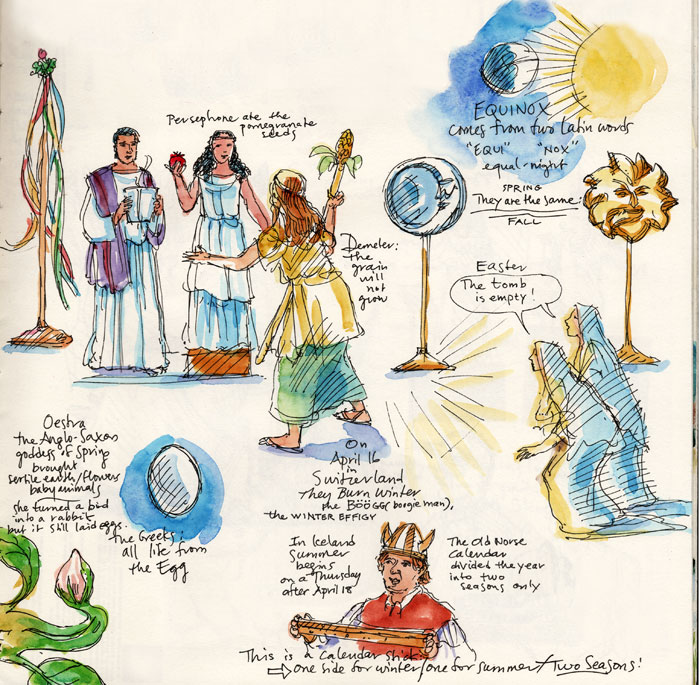
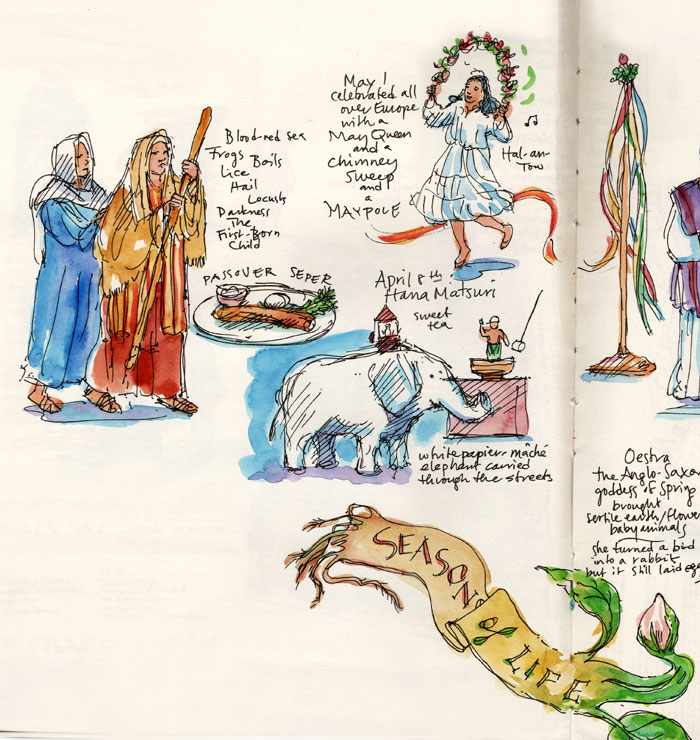
Each year Discovery Theater at the Smithsonian offers a performance in celebration of spring festivals in various cultures. My daughter and I attended as part of a homeschoolers’ outing, and I took along my sketchbook. The homages to the season were skillfully woven together with music, dancing, brief dramatic episodes, and rapid costume and prop changes by the very small yet impressive multi-talented cast. It was lively and engaging, but really tough to sketch and make notes! More like a series of scrawls. Since these fill a spread of my sketchbook, it’s too big for one post, so just the left side today: Passover, the Maypole, and Hana Matsuri.

SeasonOfLifeL

C&O Canal

CanalVisit

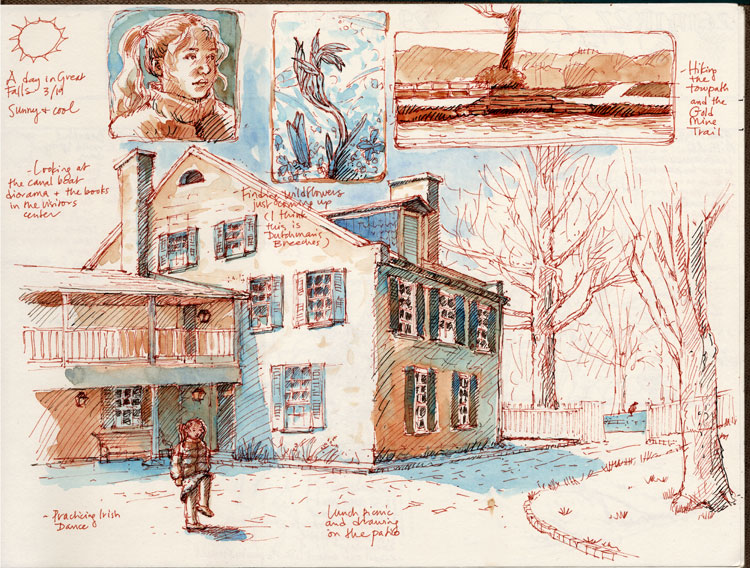
From my sketchbook, in the spring a couple of years ago. We took a break from lessons in the middle of the week to walk along the C&O Canal, look at emerging wildflowers, visit the small history exhibit in the Great Falls Tavern Visitors Center, and have a picnic lunch in its garden. One of the many advantages of homeschooling.