Peas of Mind Part II

(Continued from Peas of Mind Part I, July 20)
Peas

Speculation on this subject probably dates from prehistory, when nomadic peoples discovered that fallen seed produced new grain, and that it was handier to domesticate sheep than to chase after them in the wild. Selective breeding of plants and animals is thousands of years old.

But how did it all work? Why did sheep vary in color, size, and wool quality? For that matter, why did sheep give birth to lambs instead of, say, lentils? Was it all an unchanging predetermined system, set in motion by a Creator? Was variation due to inner mechanisms, or to external factors, like environmental requirements, or supernatural forces? Did new species generate spontaneously, from water, mud, cheese, and old rags? Was there an underlying material explanation for the workings of the Great Chain of Being?

Every people has had its explanation for the workings of existence. From mythology to religion to philosophy, theories abound. And as the world has shrunk and human consciousness evolves, explanations are increasingly shared, expanded, and abandoned.

By the 17th and 18th centuries, the Western world was seized with a new fever of questioning in all areas of natural science. By the 19th, scientists working independently in diverse fields were moving inexorably from childlike faith in mythology and magic toward a secular, observation-based, material Explanation For Everything. It was the early adolescence of Western thought: Ha! You don’t know everything, God, so I’m going to search for the truth myself! And maybe I’ll find out you’re not even there! Questioners sought to discover universal underlying principles of existence, revealing that they retained a desire for Oneness through science that would replace loss of faith. But that’s another post…

So back to Mendel and his peas. (I realize this is my SECOND post about a monk this month! but that is pure coincidence.)

Pea plants are self-pollinating, but Mendel controlled pollination by removing stamens from selected plants and pollinating specific generations by hand, controlling for one characteristic at a time and keeping detailed mathematical records of the results. His experiments revealed consistently that, although the offspring of a first generation of peas always resembled the parents, the offspring of two crossed generations resembled only ONE parent—and, most surprising, that among the offspring of the hybrids, three out of four peas displayed one parental trait and the fourth pea displayed the other.

Other scientists had previously studied cross-pollination, but without coming to final conclusions or developing laws of inheritance. But Mendel, after growing thirty thousand plants over eight years, deduced the existence of what he called dominant and recessive traits, controlled by elements within the egg cell and the pollen of plants (later called genes). He also concluded that each parent carries half the elements passed on to offspring, and that these individual elements remain present and distinct, controlling specific characteristics like eye and hair color. (We’re no longer talking about peas here, except for unusual, Pixar-type peas.) This was in contrast to others, including Charles Darwin, who thought that characteristics from parents blended within the offspring.

In 1865 Mendel presented his findings to the Natural Sciences Society of Brünn, and later mailed printed copies throughout the scientific community (Darwin got one), but he received little response. Some fellow scientists were confused by his mathematical approach and his talk of distinct inherited traits. And what did peas have to do with people? Mendel was disappointed, but shortly thereafter he was elected abbot of the monastery, and although he continued gardening and beekeeping, his duties left no time for further experimentation. His position, however, now made possible financial assistance for his sister’s children (and a fire house for his home village).

Upon Mendel’s death, his successor burned his papers. (Horrors! I bet there’s a secret story in that.) Fortunately, the papers Mendel had mailed abroad survived. But it wasn’t until the early 1900s that his work was rediscovered by several scientists working independently of one another in Holland, Germany, England, and the United States, taking them by surprise. His work was challenged and his theories modified, but he had grasped certain basic principles of heredity fifty years ahead of anyone else, and terminology was developed for the field of study Mendel had initiated and the mechanisms and processes he had described.

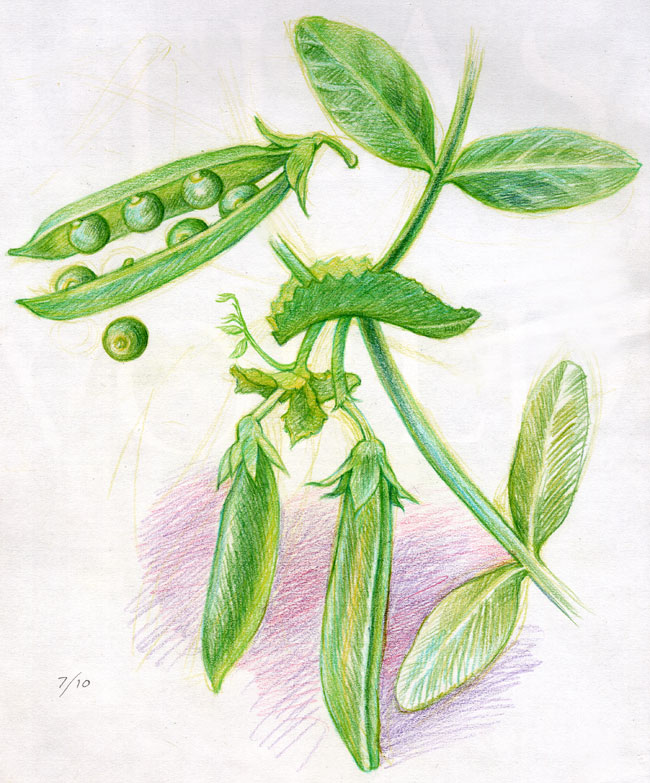
Even though middle school was a LONG time ago, I cannot see peas in a garden without thinking of dear Gregor. Sigh. Including these delicious sugar-snaps growing in our friend Susan’s Vermont garden, which my daughter and I sketched for our Botany block. We picked and ate plenty of them, too. That was for our Gastronomy block.

Peas of Mind Part I

Gregor

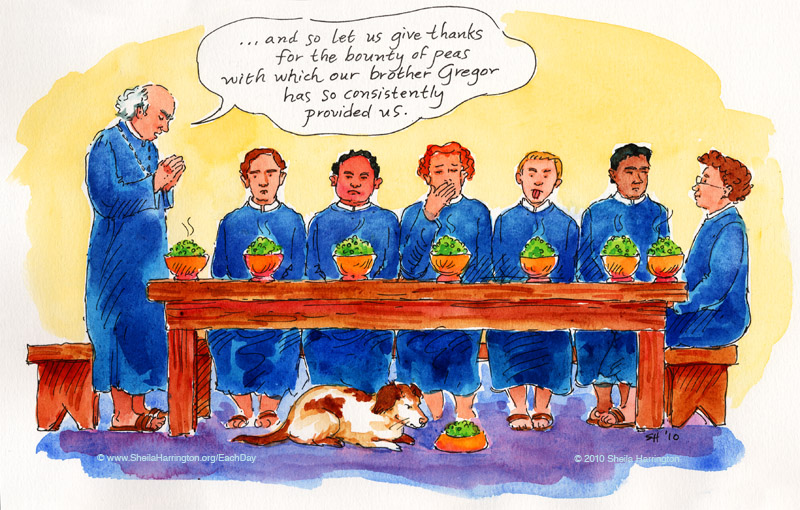
When I was in 8th grade, I had a crush on Gregor Mendel. No, he was not a Czechoslovakian exchange student. He was a 19th-century scientist whose birthday it is today. And what red-blooded schoolgirl would not fall for a man who was fascinated with plant and animal heredity and grew thousands of peas to test a hypothesis, thereby becoming the father of modern genetics? (Well, probably there are a few. But it’s a pattern: in third grade my admiring glances fell upon the boy who won all the class math competitions; and my hubby, a man of diverse talents like sculpture, electrical wiring, and the infant football-carry, is also no slouch in the brains department.)

Gregor Johann Mendel (1822-1884) was born into a farming family in the tiny village of Heinzendorf in what was then the Austrian empire and is now the Czech Republic. A bright boy, curious about the many growing things he observed in his rural world, he quickly outgrew the village grammar school. His parents, though not well-off, paid what they could for him to attend school in the next town—which was tuition plus only half his meals, so Gregor often went hungry.

Funding ended abruptly when Mendel was 16 and a back injury prevented his father from farming. Although he always helped with the farm work, Mendel, the only son, was more interested in studying plants and sheep than in raising them. So eventually the farm was sold to provide for living expenses and daughters’ dowries. Mendel took on tutoring work to continue paying for classes and books. And Mendel’s younger sister used her dowry to help her big brother finish high school. Now THAT is a loving sister.

But university education couldn’t be paid for with tutoring. One teacher suggested a solution: if Mendel didn’t mind giving up the possibility of marriage and family, he could enter an abbey. Friars followed a range of paths. They didn’t spend all their time praying and preaching—they were farmers, beekeepers, bakers, teachers, mathematicians, philosophers, scientists. For centuries this had been the road to education for many bright but poor boys (undoubtedly many of them without a genuine vocation).

So Mendel entered the Augustinian Abbey of St. Thomas in Brno, known for its intellectual pursuits and its enormous library, to continue his education. The abbot, recognizing Mendel’s gifts, sent him on to the University of Vienna to study with leading scientists (one of them Christian Doppler, of Doppler effect fame). When he returned, he taught science at the monastery-run high school, for which he apparently had a natural gift, teaching with refreshing clarity and humor. At the same time he continued his own studies in astronomy, meteorology, zoology, and botany.

Interested in the mysteries of heredity since his farming childhood, he wished to investigate its laws. He began breeding mice of different colors to study the pattern of color inheritance, but the bishop thought the study of mouse-breeding was messy and unsuitable for a monk. So Mendel switched to garden peas, which are better-smelling and less shocking in their reproductive habits (although the subject of plant reproduction had certainly shocked the colleagues of Carolus Linnaeus in the previous century).

Mendel received a garden plot in the monastery’s botanical garden and began to experiment with thirty-four varieties of peas: tall, short, yellow, green, wrinkled, smooth, white blossoms, purple blossoms, grey seed, white seed. His goal was to determine what principles governed heredity. Clearly offspring shared some traits with their parents—but which ones, and why? How were characteristics passed from one generation to the next?

TO BE CONTINUED! See July 21st.


Rain or Shine?

SwithinFlip2

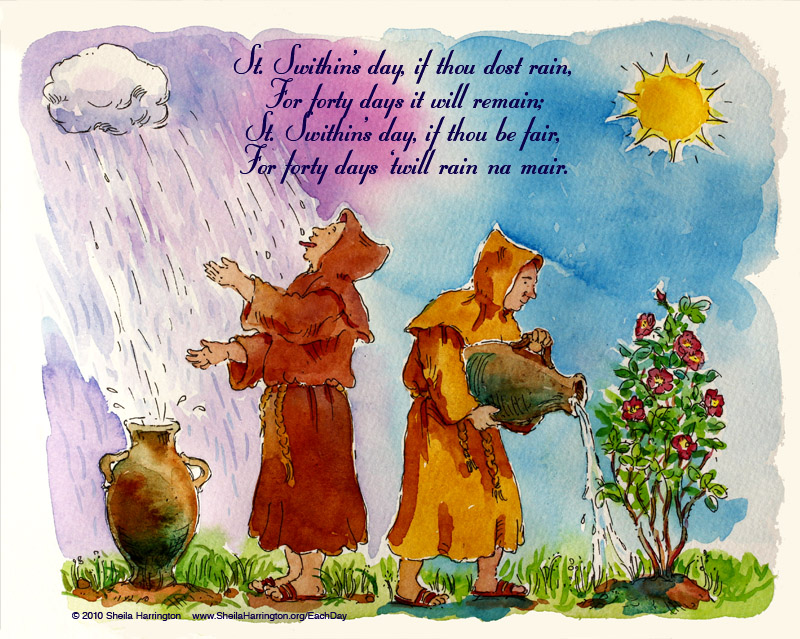
Look out the window. Doth it rain today, or doth it shine? Prepare yourself. Today is the feast day of St. Swithin, and for the next forty days you can plan your activities and wardrobe according to the old verse.

Swithin was born in the 9th century—the precise year is unknown—in Winchester, England, during the reign of King Egbert of Wessex, who ruled from 802 to 839. There are but a few reliable facts of his life, drawn from church records. Nevertheless, there must have been something about the fellow, for, both during his life and afterward, he inspired numerous stories and customs that have endured for the last twelve centuries.

Swithin was ordained as a monk and gained such a favorable reputation that he was selected as a tutor to Egbert’s son Aethelwulf. When Aethelwulf himself became king, he appointed his former tutor as bishop of Winchester, where for the next ten years Swithin built numerous churches as well as the town’s first stone bridge. Nevertheless he apparently remained a modest, unassuming fellow, charitable and sensible, preferring to go about on foot, avoiding ostentation. He also managed to convince Aethelwulf to donate a tenth of his own lands to pay for some of the church-building. Swithin’s dying request was to be buried not indoors within an elaborate shrine, as was customary with prominent folk, but outside in a simple churchyard grave, where “the rain may fall upon me, and the footsteps of passers-by.” When he died in 862, his request was granted…for a while.

But a hundred years later, when the bishops of Canterbury and Winchester were renovating the church and undertaking reforms, they cast about for relics of a saintly candidate to inspire their parishioners. Swithin had the fortune, or misfortune, to be associated with numerous miracles both before and after his death, among them the healing of ailments of the eyes and the spine, and the kindly repair of an elderly woman’s broken eggs so that they were good as new, a miracle that would certainly come in handy in any household. What luck to find a local guy that no one had yet claimed! The two bishops decided to elevate unpresumptuous St. Swithin to more prominent status. What better way than to remove his body from its humble grassy setting and place it in a more visible shrine within the newly renovated church?

Well, as the story goes, when they set about digging up Swithin, the sky clouded over, and a heavy rain began that continued for the aforementioned forty days. This would certainly indicate heavenly displeasure, if one were inclined to interpret such signs. But it did not deter the church authorities, who persisted in their plan and not only dug up St. Swithin’s body but sent his head to Canterbury Cathedral and his arm to Peterborough Abbey, rather than selfishly keep the entire saint in Winchester. They also rededicated the church (formerly dedicated to St. Peter and St. Paul). At some point along the way Swithin acquired the title of “Saint,” although he was never formally canonized by the church. He is what is known as a “home-made saint,” and churches all over the British Isles are named after him.

However, despite—or perhaps because of—all this unsolicited attention, St. Swithin still has his say every July 15th, determining the weather for the following month or so. According to a study conducted in Great Britain in the last decades of the 20th century, around mid-July the weather tends to settle into a pattern that lasts until late August, and this is true for about seven out of ten years. It either has something to do with the jet stream, or with Swithin’s periodic annoyance at being kept indoors. When it rains in August, the saying goes, “St. Swithin is christening the apples.”