
From another May, a family hike along the C&O Canal.
I realize my burnt sienna/ultramarine wash gives it an autumnal look, but it really WAS May. I’ll experiment with some other warm/cool mixes and aim for a range of muted greens.
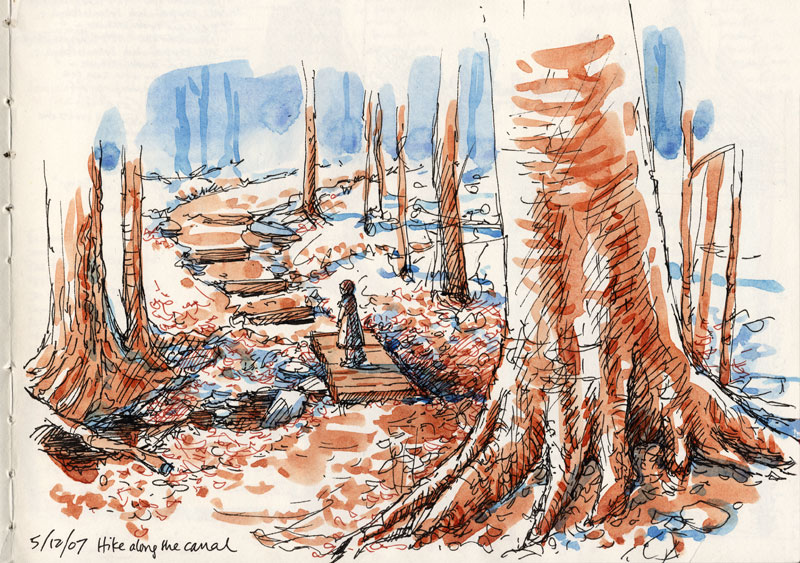
From another May, a family hike along the C&O Canal.
I realize my burnt sienna/ultramarine wash gives it an autumnal look, but it really WAS May. I’ll experiment with some other warm/cool mixes and aim for a range of muted greens.
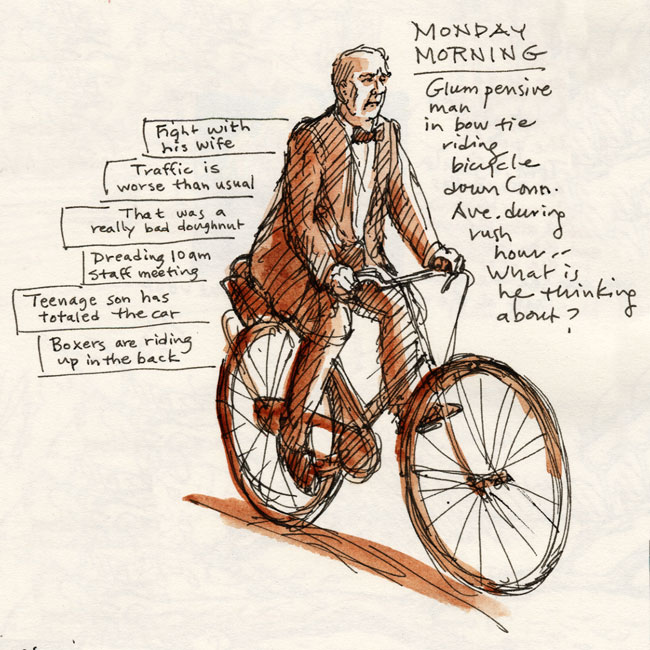
This is a work in progress, part of a series of paintings I am working on whenever I have a chance (not too often lately) based on Washington National Cathedral, a place I have loved to visit, draw, and paint since I was a teenager. I put it up today in honor of the Cathedral’s annual Flower Mart, a festival taking place even as I post. Each year a different part of the world is featured, in food, music, and dance—this year it’s the Ukraine—and there are flowers and crafts for sale, and a small, very old and beautiful carousel (the first my children ever rode). I wish I were there instead of sitting here working! Maybe this afternoon, if my fairy godmother arrives.

Continued from Library of Congress–Part 1, on April 24th
In its two-plus centuries, the Library of Congress has had a mere thirteen Librarians. They often serve a very long time, a sort of Library Supreme Court Justice. One of them was Archibald MacLeish (1892-1982), whose birthday it is today.
Born in Illinois, educated at Yale with a major in English, and at Harvard Law School, MacLeish might have had a straightforward uneventful law career, with writing and teaching as secondary pursuits, but for having served in the Army in World War I. Perhaps it was this wartime-planted seed that was sprouting when he left his law firm after three years and moved to Paris with his wife. There he spent five years writing poetry and drama and hanging out with the Hemingway-Fitzgerald-Pound crowd.
Well, how do you keep ’em down on the firm, after they’ve seen Paree. Instead of resuming his law practice after returning stateside, MacLeish continued to write, and to work for Fortune magazine. He had been, after all, an English major, and some of them do find employment—look at Garrison Keillor.
The anti-fascist viewpoint expressed in MacLeish’s writing drew the attention of President Roosevelt, who decided to appoint MacLeish as the next Librarian of Congress, over Republican Congressional opposition (“Expatriate!” “Communist!” “Poet!”). Professional librarians weren’t too happy about it either, since MacLeish was a Library World illegal immigrant. Once installed, however, he proved his skills and dedication, beginning with a major administrative reorganization of the rather uneven and semi-catalogued Library, clarifying its collection goals (Where are the holes to be filled?) and acquisitions policies (How can we fill them?), and requesting (and receiving!) a major expansion of Library budget and staff.
MacLeish also brought writers onto Library staff, launched poetry readings, wrote speeches for FDR, and much more which you can read about in detail on the Library’s website. Pretty amazing that he could accomplish all this in his 1939 to 1944 term, move on to serve as Assistant Secretary of State, then follow up with a writing/teaching career, winning Pulitzer Prizes for his drama and poetry, for which he is probably better-known.
The current Librarian, Dr. James Billington, has been a serious advocate of the National Digital Library Program, an ongoing project to digitize resources within the Library of Congress, making them accessible to that part of the world’s population (i.e., nearly everyone) which cannot make a personal visit to the physical Library in Washington, DC. In conjunction with this he proposed the creation of a multilingual World Digital Library, which was launched, with UNESCO, in 2009. Billington is a writer and a Russian scholar with a list of talents, awards, and accomplishments inside and outside the Library that is far too long to include here, but you can peruse his bio on the Library’s website, and then ponder sorrowfully how you yourself have frittered away your allotted time on this earth. Each Librarian brings his (so far it’s only been His) distinctive interests and talents to the post, thus enriching the Library.
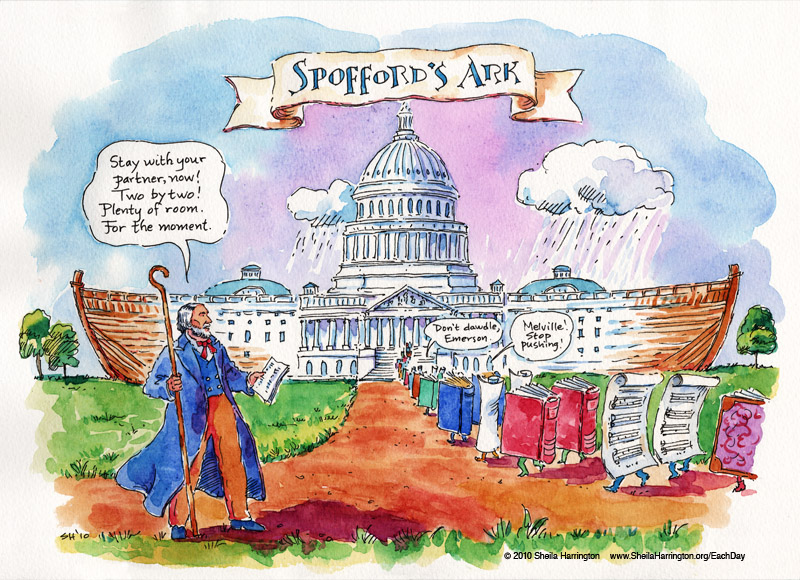
Possibly the best known Librarian of Congress—the “Father” of its modern incarnation—is Ainsworth Rand Spofford (served 1865-1897), who increased the Library’s collection dramatically AND acquired for it a new home.
Spofford, born in New Hampshire and homeschooled (homeschoolers take note), was clearly headed for a life among books—avid reader, bookstore clerk, a founder of the Literary Club of Cincinnati, newspaper reporter and editor, and finally Assistant Librarian, then Librarian, of Congress. He managed to get the Smithsonian’s vast library transferred to the Library of Congress, and he persuaded Congress to pass a copyright law of 1870 that centralized all U.S. copyright registration at the Library—huge in itself!—and also required authors to deposit in the Library two copies of every book, map, print, and piece of music registered in the United States. (The copyright protection law extends even to works of foreign origin, with reciprocal protection. But there is apparently nothing the Library of Congress, or anyone else, can do about peculiar Chinese versions of Harry Potter that incorporate Chinese wizards, hobbits, and a belly dancer.) As you might guess, even if you have not a mathematical mind, such a law rapidly increased the Library’s collections.
A terrible fire on Christmas Eve, 1851, apparently due to a spark from an unattended fireplace, had, sadly, destroyed about two-thirds of the Library’s contents, including much of Jefferson’s original library. But the collection had been replenished in the 1850s, and by now the Library was stuffed to the gills. Over its history it had been moved around the Capitol, in and out of various spaces, to accommodate its growth. But the moment had come—the moment that we ourselves experience when we say, “I cannot put one more dishtowel into this kitchen drawer! We need to move!” And Spofford recognized that moment.
 Karla
Karla
Here are the lovely grounds of the neighborhood Marriott Wardman Park hotel before they cut down most of the trees. Sigh. My daughter was skipping along, filling a basket with fallen blossoms.

Come, lovely May, with blossoms
And boughs of tender green,
And lead me over the meadows
Where cowslips first were seen.
For now I long to welcome
The radiant flowers of spring,
And through the wild woods wander,
And hear the sweet birds sing.
—Traditional
Continued from April 28th, Part I.
Pictures are from our homeschooling block, Local History and Geography.
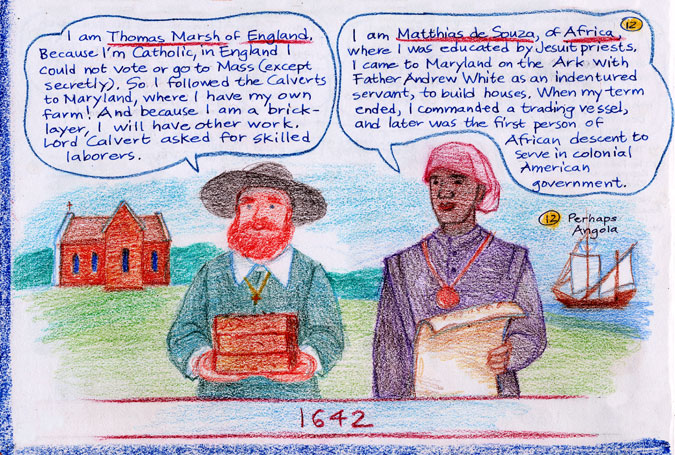
Despite Maryland’s absence of gold, colonists benefited from another resource: tobacco, which grew well and had a ready market in England. It quickly became Maryland’s principal cash crop. (In rural areas tobacco was used to pay bills even into the 20th century.) Some planters made large fortunes and imported their style of living from England, spending their time at hunting meets, dances, card parties, horse races, and similarly useful pursuits.
Tobacco rapidly depleted the soil, however, requiring continual acquisition of acreage and labor, both hired and slave, and pushing Native Americans further from their homelands. In the first half of the 18th century, England helpfully sent 10,000 convicts, mainly petty thieves and other troublesome folk, to Maryland as indentured servants. But while they worked off their indentures and freed themselves, the slave population, permanently trapped, increased. (And that’s another story.)

Maryland’s coastlines were settled first, so when German and Scotch-Irish immigrants began to arrive in the 1740s, they moved into western Maryland, creating small farms like those in Europe and New England, raising animals, growing grains (rather than tobacco) on manured fields, rotating their crops, and feeling exasperated that large wasteful eastern plantation-holders had more say in land and trade policy than they did themselves. Iron was discovered in western Maryland, and its mining and forging, mostly by slaves, accelerated rapidly. The port of Baltimore grew as grain and iron passed through for the French and Indian Wars, warfare being ever a boon to industry. Annapolis very slowly became a center of society, acquiring the attendant accoutrements of high culture: a theater, newspaper, bookshop, and jail.
By the 1770s, the now-numerous settlers (Maryland’s population was about 150,000, which included tens of thousands of African slaves and a few hundred remaining Native Americans) were inevitably, due to time, distance, and differences, less connected to Great Britain. In 1713 the currently reigning Calvert had converted to Protestantism. But Marylanders didn’t want ANY Proprietor, of any religion whatsoever. Parliament’s taxes and trading practices favoring Great Britain infuriated them, as it did colonists elsewhere. Although some were at first unsure about complete independence, Maryland sent delegates to the First Continental Congress in 1774. Four signers of the Declaration of Independence were from Maryland, including the only Catholic. Maryland militiamen fought with George Washington in the Revolutionary War (the state’s sole Tory regiment was chased across the border and later departed for Canada).
After the war finally ended in 1783—people forget how LONG it dragged on—and after the delegates to the Constitutional Convention spent the summer of 1787 heatedly wrangling over the creation of the Constitution (which story reads like a thriller in itself), Maryland ratified it the following spring, becoming the seventh of the new United States. Not only that, but Maryland provided two of the nation’s seven temporary capitals (Baltimore and Annapolis) throughout its formative years, and finally the permanent one in 1790: Washington, District of Columbia, carved from a 10-mile square on the Potomac. (Virginia took back its section in 1846.)
So, party down, Marylanders! and celebrate your stateliness by singing the Official State Song (to the tune of “O Tannenbaum”). Here are the first two verses. Just in case you don’t already know them by heart.
The despot’s heel is on thy shore,
Maryland!*
His torch is at thy temple door,
Maryland!
Avenge the patriotic gore
That flecked the streets of Baltimore,
And be the battle queen of yore,
Maryland! My Maryland!
Hark to an exiled son’s appeal,
Maryland!
My mother State! to thee I kneel,
Maryland!
For life and death, for woe and weal,
Thy peerless chivalry reveal,
And gird thy beauteous limbs with steel,
Maryland! My Maryland!
* Although the words as written, and as adopted by statute, contain only one instance of “Maryland” in the second and fourth line of each stanza, common practice is to sing “Maryland, my Maryland” each time to keep with the meter of the tune.
 Michaela
 John
John
Pictures by my daughter from the Local History and Geography homeschooling block.
On this day in 1788, Maryland became the 7th state to ratify the Constitution. Perhaps you live in Maryland and never knew how this came about. Or perhaps Maryland is terra incognita because you live far away, in Nepal, or Virginia. In any case, I am going to tell you.

For thousands of years human beings on the shores of the Chesapeake Bay fished, farmed, and fought one another without foreign interference. However, the seagoing vessels across the Atlantic Ocean grew ever-larger, and when Italian Giovanni Caboto, in the pay of Henry VII of England, wandered into codfish-rich Newfoundland/Maine waters in 1497, that was enough for England to claim the promising land. (They also insisted on referring to Caboto as “John Cabot” to help make their case.)
One hundred and ten years later Captain John Smith, although mainly concerned with the floundering colony in Virginia, ventured up the Chesapeake Bay, pronounced it goodly and pleasant, and produced a map that received much attention. So when George Calvert, the first Lord Baltimore, tired of the anti-Catholic feeling in Protestant England (Catholics were considered untrustworthy and could not hold office, vote, or worship openly), he asked his friend King Charles I to give him a piece of this New World land.
Calvert had tried Newfoundland first, but his settlers died of harsh weather and disease. His request was granted, but the Virginians were unhappy about the potential nearness of Papists. Well, suggested Charles, how about just a northern sliver of Virginia, about 10,000 square miles around the Chesapeake Bay—nobody there except non-Christian native dwellers! Calvert accepted this parcel, to tax and govern as he saw fit, in exchange for two Indian arrowheads a year, an enviably low rent.
Shortly afterward George Calvert died, so his younger son Leonard set sail in the Ark and the Dove and a party that included settlers and adventurers, several gentlemen, a handful of women, a number of indentured servants, and three priests. The group was a mixture of Catholics and Protestants, as it was Calvert’s intention to set up a religious-tolerant community. When they arrived at the mouth of the Potomac in March 1634, they were kindly greeted by the surprised yet helpful Yaocomico inhabitants, who, tiring of attacks by their Susquehannah neighbors, were fortuitously planning a move west. They granted the newcomers their land, along with houses, fields, and useful botanical, zoological, and culinary tips. The settlers renamed the territory Terra Maria, in honor of Queen Henrietta Maria (daughter of King Henri IV of France). Terra Maria: Mary-Land.
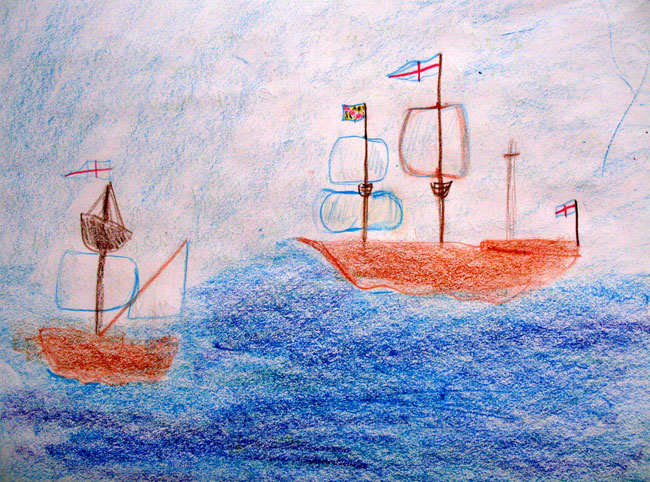
The Maryland settlers were better prepared than their hapless predecessors in Jamestown, those aristocratic younger sons who arrived in their best clothes ready to pick up the gold and jewels lying scattered on the shores of America. No, these folks brought tools and seeds and useful skills like carpentry, and had been recruited by Calvert on condition of willingness to work hard. The village, now called Saint Mary’s City, Maryland’s capital, was quickly fortified and the surrounding lands divided and allotted according to size of the household living on it: for heads of household, wives, and indentured servants, 100 acres each; for children 50 acres each. You can imagine that this arrangement encouraged emigration of large groups. “And here is my cousin Robert… and his son John…and their three manservants…” Voilá—450 more acres!
Although the Calverts were Proprietors—they actually “owned” Maryland and could govern it as they saw fit—the settlers announced that they intended to make their own laws. Calvert objected, and an uneasy compromise was worked out, but this insistence on self-rule was, as we know, a harbinger of things to come. Calvert did convince them to pass his Act of Toleration in 1649, which guaranteed religious freedom to Christians, although the arrangement was: if you deny the divinity of Jesus Christ you will be executed. Such means of ensuring uniform worship have not entirely fallen out of favor in 2010. The Act lasted until the Puritans chopped off Charles I’s head for tyrannical cluelessness (no longer a capital offense in Great Britain). In 1692 England and its colonies were declared officially Protestant. The new leaders burned down the Catholic churches in Maryland and moved its capital to Puritan-founded Providence—renamed Annapolis for Protestant Queen Anne.
To be continued April 29th: Part II.
 Edith
Edith
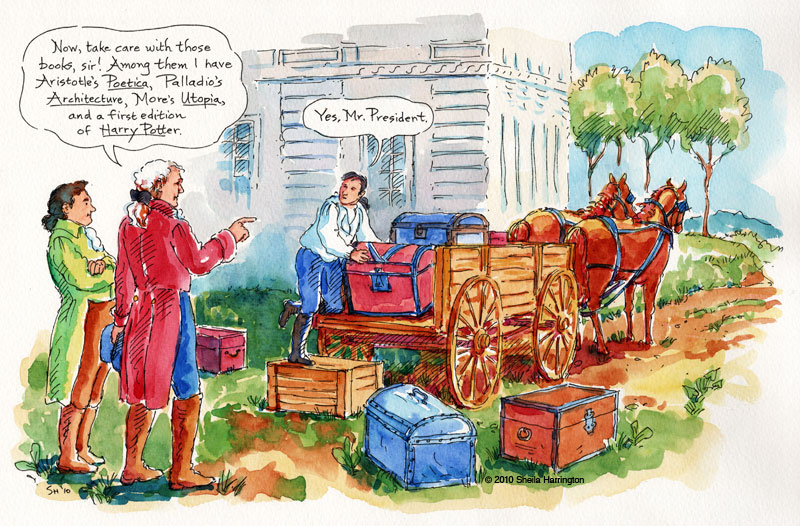
On this day in 1800, President John Adams approved legislation appropriating $5,000 to fund a hitherto nonexistent Congressional library.
Now, when the United States was young and the ink was still drying on the [mostly] ratified Constitution, its first Congress met for a short while (1790 to 1800) in Philadelphia. This contender for the role of Nation’s Capital was merely a disappointed temporary location, resigned to the government’s eventual transfer south. In the meantime, however, Philadelphia was, thanks largely to William Penn and Benjamin Franklin, a highly livable city—the most populated in the country (Washington, DC wasn’t even in the Top Twenty), with paved and lighted streets lined with sidewalks, fine masonry buildings, a university, a hospital, a fire department, gardens and parks, theaters and shops and philosophical societies and libraries—much like today, but without WiFi. The Library Company of Philadelphia offered the use of its fine collection to members of Congress free of charge, at a time when library use was by paid subscription.
When the government packed up and trudged southward to the Potomac in 1800, they said to one another in despair, “Where in this muddy village of farms, taverns, and unfinished government buildings will we do the research and study necessary for Congressional legislation and malediction?”
Fortunately, the previous Congress had been planning ahead, and in 1801, a collection of 740 books and three maps, purchased with the appropriated funds, arrived from London. They were stored, along with the papers Congress had brought from Philadelphia, in a room of the partially-built Capitol Building. It was primarily a collection of legal, economic, and historical works. The next President, Thomas Jefferson (He Who Must Not Be Named in Texas), a voracious scholar himself—if there was any subject that never interested him it is apparently unrecorded—signed a law creating the post of Librarian of Congress.
Fire is a perpetual threat to the flammable cities of civilization, and disaster can result merely from an unsnuffed candle. The Library has suffered from several, mostly minor, fires. But in August 1814, during the War of 1812, the British set about destroying Washington’s public buildings, to avenge the Americans’ destruction of the public buildings of Toronto. Although parts of the Capitol held up remarkably well, its interior, filled with wooden furniture, paintings, and irreplaceable documents and books, was highly flammable. That was the end of the library.
But only temporarily. Because Jefferson, now in retirement and short of cash, offered to sell his personal library to the U.S. government as the foundation of a new collection. So in 1815 he was paid $23,900 for his 6,487 books, which arrived by horse and wagon from Monticello.
What a collection it was. Not only works of law, economics, and history, to replace the lost books. But also: Biography. Geography. Chemistry. Botany. Medicine. Anatomy. Architecture. Philosophy. Painting and sculpture. Theater. Music. Literature. Essays. Mythology. Religion (including a copy of the Koran). And not only in English, but also works in French, Spanish, German, Latin, Greek, and Russian, several of which languages Jefferson spoke or read.
Some members of Congress objected to the collection’s breadth, explaining rather myopically, “the library was too large for the wants of Congress,” but Jefferson famously responded, “There is…no subject to which a member of Congress may not have occasion to refer,” and that statement has guided the Library in its acquisitions over the years.
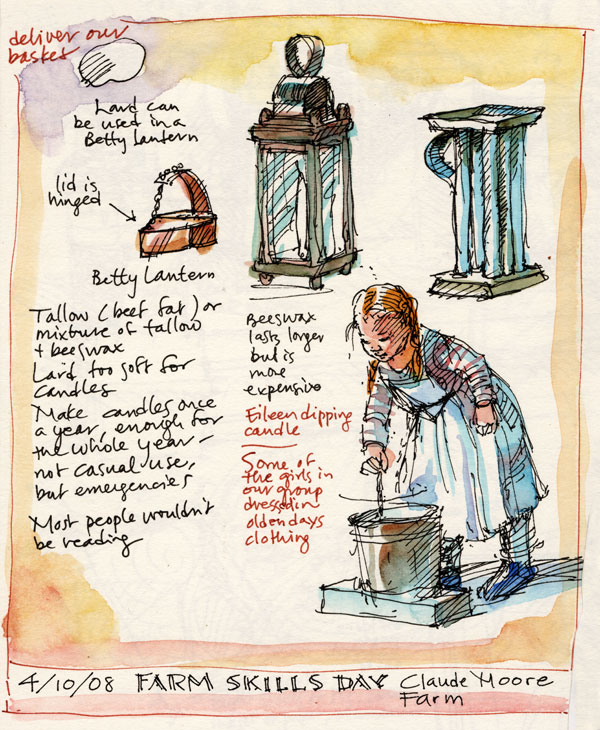
Three times a year Claude Moore Colonial Farm (a small corner of McLean, Virginia that is frozen permanently in the year 1771) holds a Farm Skills Day to teach 21st century children about what life was like for colonial Virginia families way back when. The content varies somewhat with the season. This was an April visit, and the children carded wool and dipped candles.
 Ruthie
 Chris
Chris