Double Anniversary

On this day in 1870, caricaturist Thomas Nast first used the donkey as a symbol for the Democratic party. For a Democratic donkey comic, please see March On.

And today is the actual birthday of Dr. Martin Luther King, Jr. (1929-1968), whose accomplishments and contributions we celebrate tomorrow. More on Dr. King in the Thomas Nast post, as well as tomorrow, on his national holiday.

DonkeyJourneyDetail

Maid of Orléans

No one really knows precisely when Joan of Arc was born. But January 6, 1412 is traditionally recognized as the date, making today the 500th anniversary of her birth, the quincentennial celebration of her mysterious, heroic, and too-short life.

DomremyHouse

The outlines of the story are generally recognized: A pious girl from a rural family, in response to visions and voices she explained as those of saints and angels, approached the Dauphin, the future Charles VII, during the Hundred Years’ War, and convinced him to allow her to aid France.

Given a suit of armor and a banner with fleur-de-lis, she led newly-inspired French troops (who had formerly declined to follow the feckless and irresolute Charles into battle) to expel the English and Burgundians from her then-small country. Her successes in battle, and in eventually arranging for the coronation of the Dauphin in Reims, greatly encouraged the French, but alarmed the Burgundians and infuriated the English, who, when they finally had Joan in custody, burned her at the stake as heretic and witch and raked her ashes into the Seine to prevent the collection of relics—an indication of awareness that they had murdered an innocent. She was nineteen. Detailed records of her trial, painstakingly kept by the court, reveal to us Joan’s simplicity and humility, in contrast to the narrow-minded and vengeful scheming of her assorted judges.

These same records were made use of to acquit her posthumously later under Charles’ rule—for him it was politically expedient to have been crowned with the aid of a courageous maiden instead of a condemned witch. During the acquittal process the testimony of numerous witnesses reveals the original trial’s illegal and corrupt maneuverings.

How was an untrained teenage country girl able to lead dispirited soldiers in the wake of a string of defeats (notably Agincourt in 1415) to win a series of battles and break through enemy lines to see her king crowned? What was the nature of Joan’s voices? To this day much of her story remains unknown and a subject of speculation for historians, psychotherapists, artists, novelists, playwrights, and filmmakers. Statues of Joan are to be found all over the world, including here in Washington, DC, a gift from the Ladies of France in Exile in New York in 1922 and the only equestrian statue of a woman in the city. (There are actually only a handful of equestrian statues of women to be found anywhere, and probably more of Joan of Arc than any other.) As of 1920, Joan became—after five hundred years (the Catholic church moving with its customary excruciating slowness)—Saint Joan.

The image of Jeanne d’Arc has been co-opted, ironically, by the French extreme right, who more properly ought to take as their symbol a 15th-century right-winger: the manipulative and self-absorbed Duke of Burgundy, who turned Joan over to the English to maintain his power; the misogynist cleric Pierre Cauchon, who was fixated on Joan’s wearing of male attire; or the avaricious English themselves, whose desire for the French throne had been humiliatingly waylaid by an upstart female. The ultra-conservative Front National is no place for unconventional Joan, who defied societal expectations, suffered in battle and in prison, and died for her efforts.

The sketch is from a visit to the house in Domrémy thought to have belonged to Joan’s family.

Today is also the Feast of the Epiphany, the day on which, according to tradition, three wise men from the East carried gifts to the infant Jesus. For another take on this event, please see The Three Wise Women.

The Feast of the Epiphany is also the birthday of Carl Sandburg (1878-1967). For a comic and a poem, please see Poetic Journey of the Magi.

CakeStarsNathan

The old year now away is fled

HappyNewYearLitPud

The old year now away is fled,
The new year it is entered;
Then let us all our sins downtread,
And joyfully all appear.
Let’s be merry be this holiday
And let us run with sport and play
Hang sorrow, let’s cast care away—
God send us a merry new year!
—English, 13th century

CakeBalloons2Christopher

Yahrzeit3Jacky


Of Two Worlds

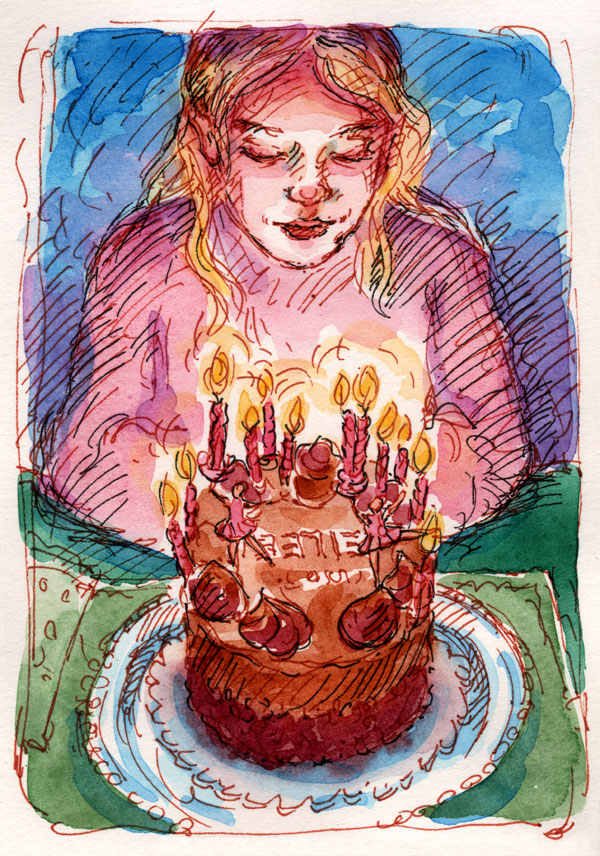
Here is my daughter blowing out her birthday candles last year. Today she enters her teen years (!), chronologically leaving childhood behind; yet in reality she is straddling two worlds. In her are blended right now the growing thoughtful awareness and surprising wry humor of a young woman, and the openheartedness and generous, candid spontaneity of a child. It’s a sometimes-challenging but always-engaging time. In honor of her day, I post this poem by Sharon Olds, as it describes a malady my daughter shares. Happy, happy birthday, dear one.

ECS12Candles

Diagnosis
By the time I was six months old, she knew something
was wrong with me. I got looks on my face
she had not seen on any child
in the family, or the extended family,
or the neighborhood. My mother took me in
to the pediatrician with the kind hands,
a doctor with a name like a suit size for a wheel:
Hub Long. My mom did not tell him
what she thought in truth, that I was Possessed.
It was just these strange looks on my face—
he held me, and conversed with me,
chatting as one does with a baby, and my mother
said, She’s doing it now! Look!
She’s doing it now! and the doctor said,
What your daughter has
is called a sense
of humor. Ohhh, she said, and took me
back to the house where that sense would be tested
and found to be incurable.

— Sharon Olds

CakeSnowmanEileen


Why I Have A Crush On You, UPS Man

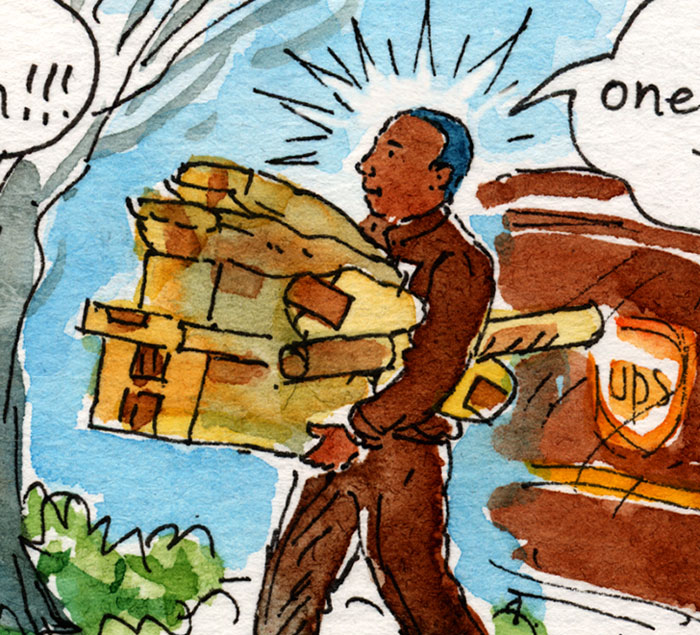
In the season of the ubiquitous brown truck, I post this love poem by Alice N. Persons.

For another [visual] take on the same subject, please see Season of Waiting.

SeasonWaitingUPS

you bring me all the things I order
are never in a bad mood
always have a jaunty wave as you drive away
look good in your brown shorts
we have an ideal uncomplicated relationship
you’re like a cute boyfriend with great legs
who always brings the perfect present
(why, it’s just what I’ve always wanted!)
and then is considerate enough to go away
oh, UPS Man, let’s hop in your clean brown truck and elope !
ditch your job, I’ll ditch mine
let’s hit the road for Brownsville
and tempt each other
with all the luscious brown foods —
roast beef, dark chocolate,
brownies, Guinness, homemade pumpernickel, molasses cookies
I’ll make you my mama’s bourbon pecan pie
we’ll give all the packages to kind looking strangers
live in a cozy wood cabin
with a brown dog or two
and a black and brown tabby
I’m serious, UPS Man. Let’s do it.
Where do I sign?

—Alice N. Persons

Advent 3: Birthday Wishes

In honor of my husband’s birthday, I post a sketch of him on holiday, painting, which is something I hope he will find more time to do as he fulfills his ongoing quest for retirement.

He shares this birthday with writer Alfred de Musset (1810-1857), and so I post a poem that speaks eloquently, and appropriately, of the overlooked and sleeping poet universally within.

JPainting

Ami, tu l’as bien dit: en nous, tant que nous sommes,
Il existe souvent une certaine fleur
Qui s’en va dans la vie et s’effeuille du coeur.
“Il existe, en un mot, chez les trois quarts des hommes,
Un poète mort jeune à qui l’homme survit.”
Tu l’as bien dit, ami, mais tu l’as trop bien dit.

Tu ne prenais pas garde, en traçant ta pensée,
Que ta plume en faisait un vers harmonieux,
Et que tu blasphémais dans la langue des dieux.
Relis-toi, je te rends à ta Muse offensée ;
Et souviens-toi qu’en nous il existe souvent
Un poète endormi toujours jeune et vivant.

Friend, you have spoken well: in us, such as we are,
There frequently exists a certain flower
That blossoms, fades and from the heart its leaves are shed.
“In three quarters of mankind, you understand,
A poet has died young yet outlived by the man.”
Well said, my friend—but a little too well said.

You didn’t pay attention, laying out your thought,
That your pen made poetry then and there, unsought.
In his own tongue you took Apollo’s name in vain.
I betray you to your injured Muse: Read again,
And remember that in all of us there often keeps
A poet young and vibrant, who is not dead, but sleeps.

—Alfred de Musset

PieForJJimmy

December

Dec1-11

First snow! The flakes,
So few, so light,
Remake the world
In solid white.

All bundled up,
We feel as if
We were fat penguins,
Warm and stiff.

The toy-packed shops
Half split their sides,
And Mother brings home
Things she hides.

Old carols peal.
The dusk is dense.
There is a mood
Of sweet suspense.

The shepherds wait,
The kings, the tree—
All wait for something
Yet to be,

Some miracle.
And then it’s here,
Wrapped up in hope—
Another year.

John Updike