A Capital Spring

RockCreekELog

Today winter officially packed its bags and departed, and spring took the throne. It ought to come as no surprise, because we have seen it coming for weeks in the swelling tips of branches, the green points pushing up through the earth, the increase in morning birdsong that disregards Daylight Savings Time. Nevertheless every year it astonishes.

Much poetry and prose has been written in praise of spring, but if you have not yet stumbled across Louis J. Halle’s Spring in Washington, let this be the year. Beginning in the mid-1940s, Halle (1911-1988) worked in Washington, DC for about ten years at the U.S. State Department. Although Halle was a citydweller with a theoretically brief commute and could have dozed until practically the last minute, instead he had the habit of rising before dawn, hopping on his bicycle, and heading out for a ten or twelve mile exploration of DC’s wild green pockets and fringes before heading to the office.

No doctor ever prescribed a view of the open world for me, though it was the tonic I needed, rather than something to take in a glass before meals.

In 1947 he published Spring in Washington, an account of his wanderings. With wisdom, humor, an artist’s eye and a poet’s quill (well, in his case, a typewriter) he shared his observations and discoveries throughout the approach, unfolding, and departure of one expanded spring: January to June, 1947.

To snatch the passing moment and examine it for signs of eternity is the noblest of occupations. It is Olympian. Therefore I undertook to be monitor of the Washington seasons, when the government was not looking. Though it was only for my own good, that is how the poorest of us may benefit the world. A more ambitious man might seek to improve the President of the United States.

Each year I drag this book out and read aloud passages to my family. As I leaf through it now, searching for representative quotes, it’s difficult not to reproduce the book in entirety.

The muskrat swims and raises its young in the woodland stream beneath Connecticut Avenue, never knowing of the crowded buses and taxis that swarm overhead… Roaches Run is a marshy lagoon trapped between the National Airport, on one side, and the railway tracks on the other. Ducks and gulls and herons have remained faithful to it, despite low-roaring airplanes and smoke-breathing locomotives. They are accustomed to these dragons and these pterodactyls, regarding them not.

Halle moved on (his field was actually foreign policy), along the way publishing 22 books, eventually retiring to Switzerland. Plenty of hiking opportunites THERE. He made a visit to DC in 1988, to help launch a new edition of this book, the rights to which he had long ago turned over to the Audubon Naturalist Society (where his book can be obtained). While here he went birding and biking in some of the same old wild green places, which, remarkably (thanks in part to folks like himself), still survive for a venturesome bureaucrat’s early morning ramble.

In early March I look at the apparently lifeless skeletons of the elm trees on the Ellipse and say to myself that in two weeks they will be flowering, as the trees have flowered here for a hundred thousand years. In the middle of April I say that in another ten days the city will be full of singing wood thrushes, though there is none here yet. I know all this will be, but it seems to me so miraculous that I cannot take it for granted.

A few months later he made his own final migration to the great Beyond. Even if he had done nothing else on earth, this jewel of a book that resurfaces each spring, endlessly amusing, sensitive, and wise—an everlasting source of inspiration—would suffice. Happy Spring, Louis Halle.

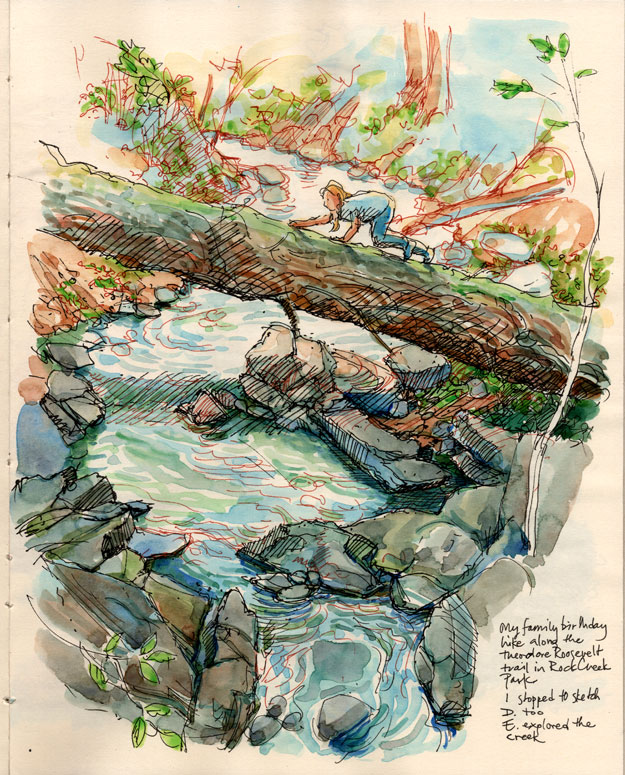
(This sketch is from a family ramble through Rock Creek Park, mere minutes from our utterly urban home.)

AMusement for All

Muses5

On this day in 1773 a committee of the Charlestown (South Carolina) Library Society established the first public museum in the United States. Except that there wasn’t yet a United States. South Carolina was still a British colony, and the Charlestown Library Society’s inspiration for its project was the British Museum, the world’s first national public museum, founded in 1753. But by the time the doors of the new museum opened to the public in 1824, South Carolina was, and has mostly remained, part of the U.S.A. To this day you can visit and admire its displays of local natural history specimens, which the [now] Charleston Museum has continued to acquire over the centuries, along with South Carolina memorabilia.

Collecting is undoubtedly a natural human impulse, ever since our hairy ancestors stored up grain for the winter. Once basic necessities were taken care of, human beings with leisure time and/or disposable income continued for millennia to assemble various collections, from seashells to sapphires, but they were primarily for private enjoyment, profit, or study. Royalty and the well-to-do collected, and even commissioned, statuary, paintings, and elaborate furnishings for their palaces. Scholars created and collected manuscripts to share with other scholars. Scientists and amateurs alike collected unusual plants, animals, fossils, and other natural specimens, increasingly so from the 18th century onward as human beings questioned assumptions about the origins of life, the earth and the universe.

But what we now call a Museum did not exist until rather recently. The word comes from the Mouseion at Alexandria, Egypt, which was not a collection of objects for perusal by curious passersby but rather a gathering place for scholars to share scientific and mathematical discoveries (option #2 above). If you were an educated Greek male living in the Mediterranean world in the 3rd century BC and possessed both scholarly interests and travel funds, off you went to Alexandria, which had by then replaced Athens as a cultural center. Euclid studied there. So did Archimedes. The Mouseion included the famous Library of Alexandria, which sought to collect works (or copies thereof) from all over the ancient world, and at its height boasted hundreds of thousands of papyrus scrolls. Eratosthenes served as one of its librarians.

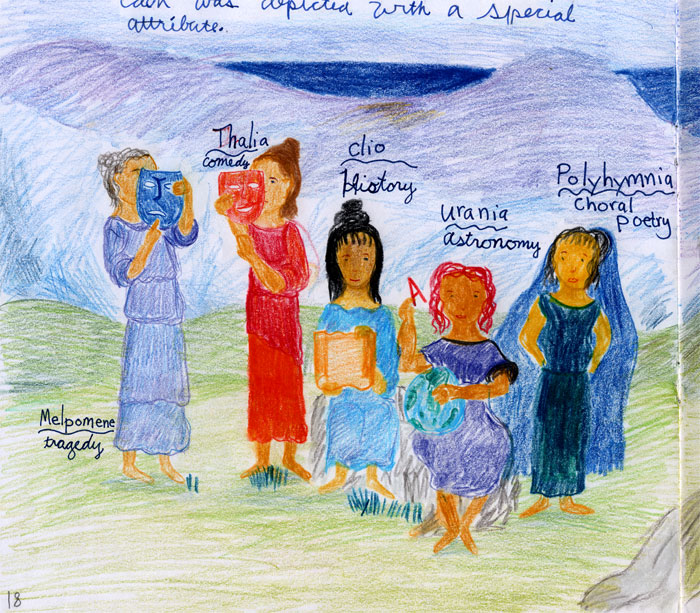
The name Mouseion indicated an institution dedicated to the Muses, who are the nine daughters of Mnemosyne, goddess of memory. Each daughter embodies a different pursuit—Lyric Poetry, Tragedy, History, etc.—and is responsible for its nurture and inspiration. These are offspring to brag about at any parent gathering. “So, what are your daughters up to these days?” “Oh, they’re the Muses of Choral Poetry… Dance… Astronomy… .” References to the Muses abound in painting and literature, from Raphael to Moreau, Homer to Shakespeare.

We honor them still when we speak of Music, or when we cross the threshold of one of the world’s thousands of Museums, which today often still serve as centers for scholarly study, but in addition are open to ordinary citizens like you and me and contain fabulous collections of every imaginable kind of art, artifact, and animal, in every possible subject—science, history, transportation, sports, toys, bananas (I kid you not)—where we can open our eyes and our minds in wonder. And even get a slice of pizza and a postcard. Thank you, oh Muses.

This is a drawing of five of them, from my daughter’s homeschooling Ancient Greece main lesson block.

Heavenly Light

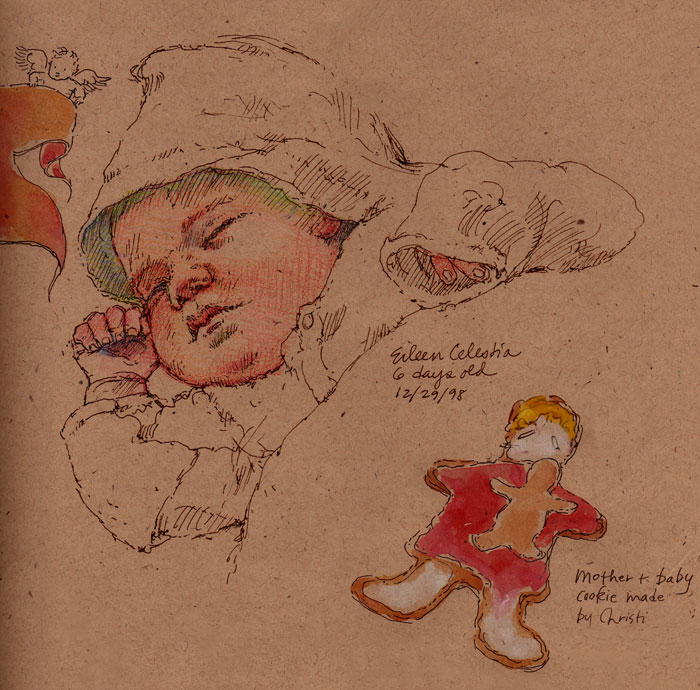
ECS-6Days

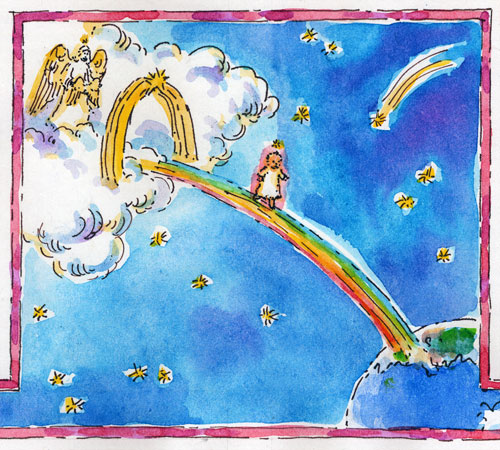
After my husband and I had completely given up hoping for another child, along came our wonderful little late-in-life surprise, making us a foursome and our solitary first-born a grateful Big Brother. Who could guess looking at this sweetly sleeping 6-day old babe that she would unfold into our exuberant, passionate, imaginative, joyful twelve-year-old who sings, leaps and dances through life, and who continues to bring wonder and surprise into every single day. Happy Birthday, dear Eileen! We are so glad you danced down the rainbow bridge to us.

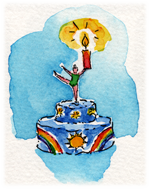
CakeDancer2Eileen


Rainbow Bridge

Twelve years ago today I was in labor. I had been in labor since dawn of the winter solstice the day before. We said: A solstice baby! Uh, no, guess not. Labor would continue for another two days… My daughter was contemplating the looooong journey ahead of her.

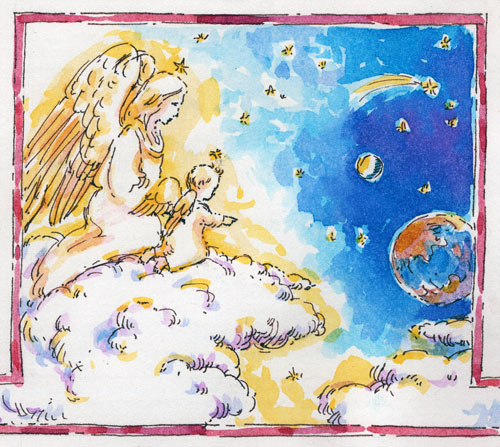
E&Angel

Then she was ready. You go girl!

ERainbowBridge

These sketches are from a baby journal I began after our daughter was born. Not the same day though.

This is a verse we say on the eve of a birthday (filling in the appropriate ages):

When I have said my evening prayer,
And clothes are folded on the chair,
And mother switches off the light,
I’ll still be [     ] years old tonight.

But from the very break of day,
Before the children rise and play,
Before the purple turns to gold,
Tomorrow I’ll be [     ] years old.

[     ] kisses when I wake,
[     ] candles on my cake.

—Anonymous

Paint-Your-Own

E&Plate

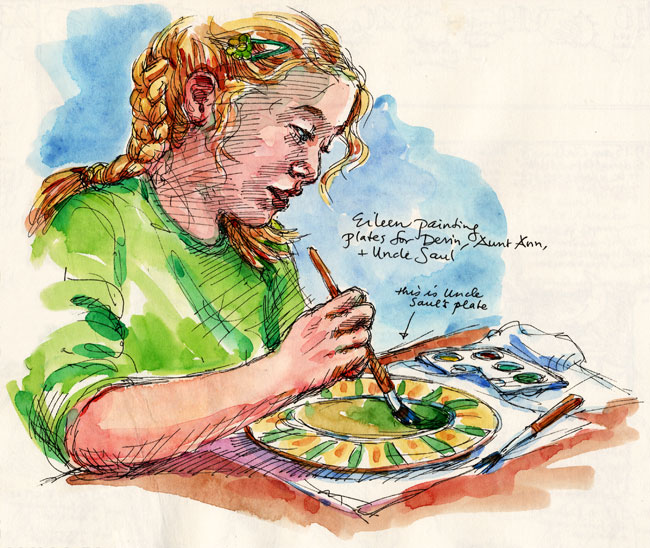
Paint-Your-Own ceramic places do a booming business during the holiday season. My son has a growing collection of dishes imaginatively painted by his sister—if he ever gets married, he and his bride won’t need to buy a single dessert plate. (I hope she will like plenty of color.)

For those without inspiration, there is a large selection of mass-produced figurines. But we always go for the plain white dishes. I’m sorry, but I pity the grandparent who finds the Little Mermaid paperweight under the tree.

This sketch is from another Christmas season, so I’m not spoiling any surprises.

Many happy cookies, and the flowers on a queen

D&E-Reading

Today is the birthday of writer Shirley Jackson (1916-1965), born in San Francisco, California, but transplanted to the East Coast where she attended university and eventually settled with her husband in Vermont, raising a large family but all the while continuing, somehow, between PTA meetings and making hamburger casseroles, to write.

Many readers have probably been introduced to Jackson through her short story, “The Lottery,” once a classic of the high school English syllabus, which when it was published in the New Yorker in 1948 evoked overwhelming response exceeding that of any previously published New Yorker story.

Jackson came to my attention, however, through the books my parents owned: her collections of dark, evocative, seemingly plotless short stories that are typical to this day of New Yorker fiction (probably a contemporary literary parallel of Abstract Expressionism that nevertheless persists into the 21st century); and her similarly eerie, compelling novels. As a child, I was fascinated yet rather baffled by Jackson’s fiction.

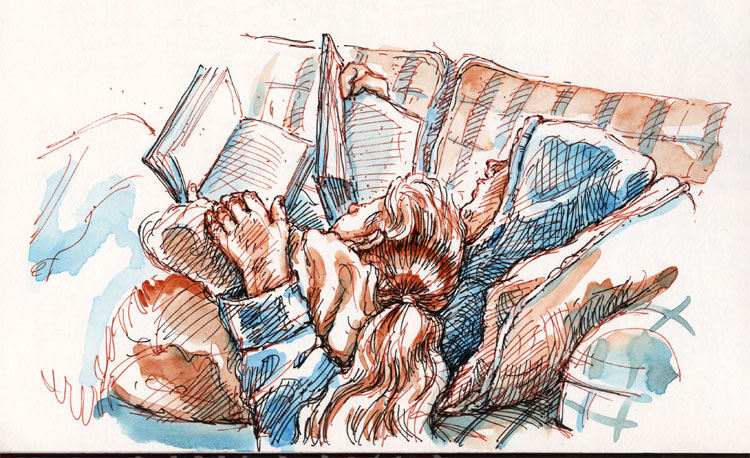
What I really liked, however, were her memoirs of her children, Life Among the Savages and Raising Demons, which I read and re-read, the pages yellowing and held together with Scotch tape. Her unsentimental, low-key, definitely politically incorrect descriptions of ordinary daily life with her four bright, imaginative children, her hovering-on-the-fringes professor husband, and their cats and dogs, in their book-stuffed rural Vermont farmhouse, made me laugh again and again. When I grew up I read the books to my husband and offspring, and now they read them to one another. Into our common family vocabulary have effortlessly crept quotes from the various children (see title above).

This winter, when you and your family are all abed with the flu, read aloud the chapter, “The Night We All Had Grippe.” Laughter is healing. Happy birthday, Shirley Jackson, many happy cookies, and thank you ever so for the years of healing episodes.

Paradise Lost

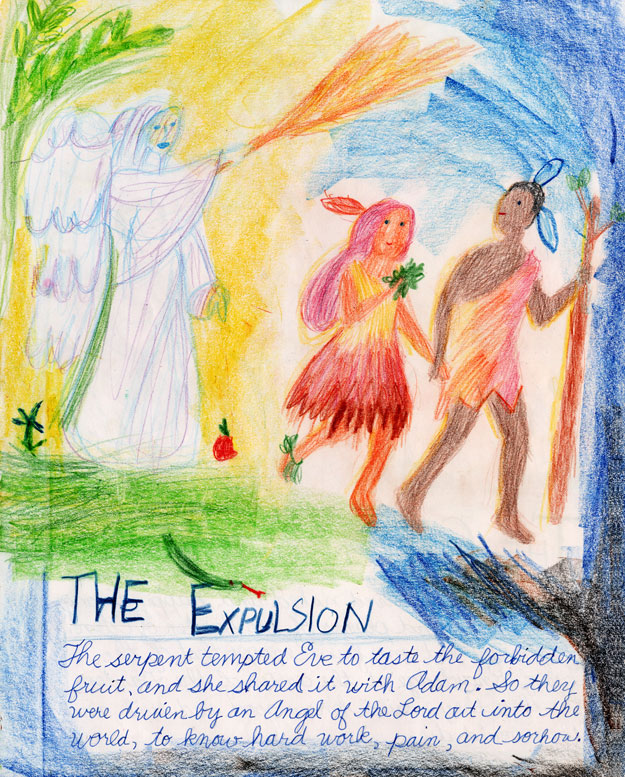
Today is the birthday of John Milton (1608-1674), and in his honor I post the closing lines of his masterpiece Paradise Lost, along with a drawing by my daughter from our homeschooling Old Testament block several years ago. It’s not exactly a match, but I couldn’t resist.

Her drawing belies the solemnity of the poem. Adam and Eve actually look rather pleased at their departure from the Garden of Eden.

ExpulsionES

In either hand the hastening angel caught
Our lingering parents, and to the eastern gate
Led them direct, and down the cliff as fast
To the subjected plain; then disappeared.
They, looking back, all the eastern side beheld
Of Paradise, so late their happy seat,
Waved over by that flaming brand; the gate
With dreadful faces thronged, and fiery arms:
Some natural tears they dropt, but wiped them soon;
The world was all before them, where to choose
Their place of rest, and Providence their guide:
They, hand in hand, with wandering steps and slow,
Through Eden took their solitary way.

—John Milton