Mother of Pippi

There are some people who give joy not only during their time on this earth but who continue to spread it after they have moved on. One of them is Astrid Lindgren (1907-2002), whose birthday is today, and whose fruitful 94 years brought forth so many literary offspring. Her best-known heroine, Pippi Longstocking, was an icon of my childhood, and then of my children’s, and she will undoubtedly bring smiles to the faces of my grandchildren, if I am someday fortunate enough to have them. But we also love Lindgren’s other books, including stories of the rambunctious Emil and Lotta, and Ronia the Robber’s Daughter, and especially the lively, funny and cozy Children of Noisy Village, which lets us pretend for a while that we are living in small-town Sweden.

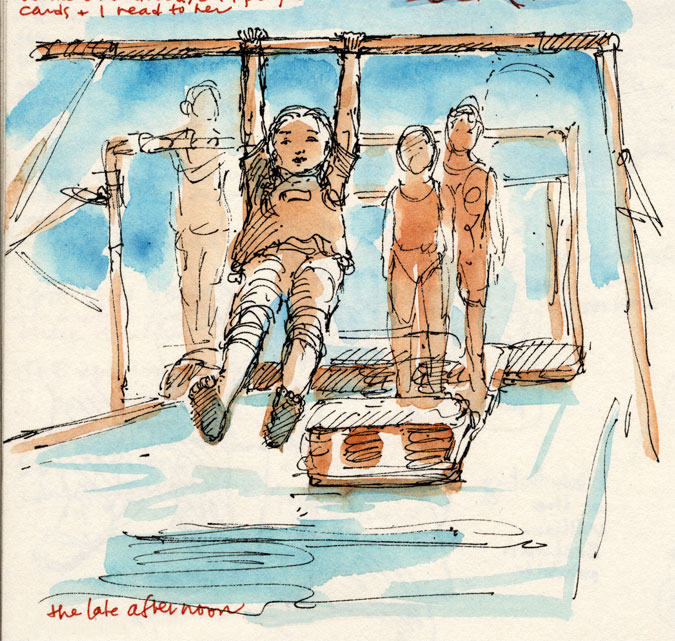
I post this sketch of my own active little “Pippi” in honor of the day. Happy, happy birthday, and many thanks, Astrid Lindgren. I hope the afterlife resembles Noisy Village.

EGymnastics

CakeChrysanthLydia

CakeChocCurls2Patrick

Skywatcher

If you lived in 17th century England and were found guilty of stealing, consequences could be severe: whipping, branding, a term in the pillory, even hanging. An alternative was transportation to the New World and seven years of indentured servitude. The colonies needed laborers.

For some people what was essentially permanent exile might have seemed worse than hanging. But it apparently worked out well for one Molly Welsh, a dairymaid who was transported and indentured to a Maryland tobacco planter in 1683 when she was found guilty of stealing, or at least knocking over, a pail of milk. It was a life-changing accident. After working a seven-year term, Molly had earned enough to buy a tobacco farm of her own, and bought a slave named Banneka (or Banneky) to help work it. Although interracial marriage was illegal at the time, love triumphed. Molly freed Banneka; the two were married and had four daughters.

One of their daughters also fell in love with a slave, so her parents bought his freedom to enable them to marry. Because like many slaves he had no surname, when they married he took their name (now Banneker) as well. And these were the parents of Benjamin Banneker (1731-1806), whose birthday it is today.
BannekerECS

Benjamin was from all accounts a very bright child. His grandmother Molly taught him to read and write, and he was eager to learn from any available source. But books were few. Around 1770, three Ellicott brothers from a large Pennsylvania Quaker family built a mill, homes, and store nearby, which eventually became the hub of a prosperous community (now Ellicott City). The Ellicotts and their offspring were mechanically inclined and enjoyed experimenting with mechanical and scientific inventions. The family befriended their knowledge-hungry neighbor Benjamin and lent him books, tools, and a telescope.

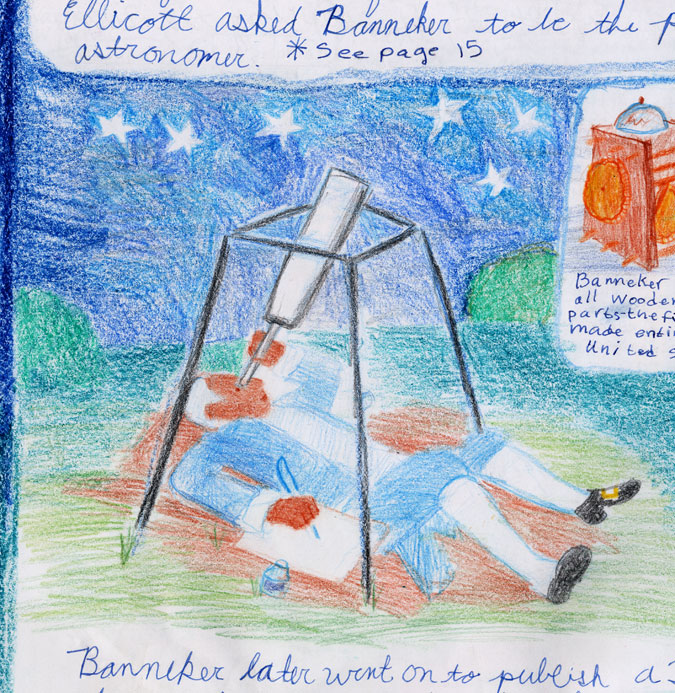
From that moment Banneker was devoted to astronomy, which he taught himself from the books and from studies of the night sky he made (in addition to carrying on the work of the family farm). He became so skilled that in 1791, when Andrew Ellicott, who had helped complete the Mason-Dixon Line survey, was hired to survey the land for the nation’s new capital city, he asked Benjamin Banneker to help him with the necessary astronomical observations. It’s pretty rough spending your nights outdoors for months stretched out on the cold ground measuring the stars when you’re 59 years old, but Banneker agreed. (This is the scene depicted above in my daughter’s Main Lesson book from our homeschooling Local History and Geography block.) So off they went to lay out the boundaries for the ten-by-ten-mile square that was to become Washington, DC. Some of the original boundary stones are still visible.

In the course of this project Banneker grew ill and was obliged to retire to the farm. But he was undeterred from his studies, and by 1792 he had created and published an almanac that included forecasts of weather, tides, eclipses and other movements of heavenly bodies—all calculated by Banneker—as well as festival days, essays and poetry (including work by Phillis Wheatley), instructions for home medical care, and Banneker’s views on free public education and religion.

The almanac was distributed in four states and went through several editions, one of which included an exchange of correspondence between Banneker and Thomas Jefferson, then serving as Secretary of State under George Washington. Banneker pointed out in his letter the irony of Jefferson’s having stated in the Declaration of Independence that “all men are created equal” while simultaneously “detaining by fraud and violence so numerous a part of my brethren, under groaning captivity and cruel oppression.” In Jefferson’s polite and complimentary response, however, he avoids addressing this conundrum in his life, as he adroitly managed to do whenever it was mentioned.

Abolitionists in the colonies and Great Britain were thrilled with the almanac as another piece of evidence for the immorality—in fact, the downright senselessness—of slavery. Happy Birthday, Benjamin Banneker. Your work is another milestone on the road to freedom.

CakeBerries2Tashina

Woman in the Air

Probably ever since we began paying attention to the birds, we human beings have longed to fly ourselves. And once the Wright Brothers proved this possible in 1903, it was not only men who were keen to give it a try.

Blanche Stuart Scott (1885-1970), born in Rochester, New York, was known as a “tomboy.” Her father let her drive the family automobile around town, and although some of the neighbors objected to a fifteen-year-old behind the wheel, there was as yet no minimum driving age.

In 1910 Scott became the first woman to drive across the country, from New York City to San Francisco, which brought her to the attention of Jerome Fanciulli, a promoter for Glenn Curtiss. Curtiss was a pioneer in the U.S. aviation industry, who designed aircraft and hired pilots to demonstrate his products. He wasn’t crazy about the idea of training a female pilot, though he agreed to accept her as a pupil—but he kept a block of wood behind her throttle pedal, so that although Scott learned to operate the plane and run it back and forth on the ground, it never took off.

Airplane-ECS

This was probably fun for a while, but one day while Scott was practicing, the block of wood mysteriously became dislodged. Oops! Wonder how THAT happened! Scott zoomed off on an unscheduled flight, alarming her instructor but landing safely, and demonstrating that a woman could actually operate a plane not only on the ground, but also in the air. Eventually she joined Curtiss’ Exhibition Team, and made her first Official Flight on October 23rd, 1910, of which today is the anniversary. (That first “accidental” flight didn’t count.)

Scott became known as “Tomboy of the Air,” flying upside-down and executing heart-stopping dives, for a heart-stopping salary, too. In 1911 she made the first woman’s long-distance flight—sixty miles—another “unplanned” event, when she decided one day just to keep flying. Scott went on to become the first female pilot to test prototypes, but after a number of male colleagues lost their lives in terrible accidents, and sensing that her spectators anticipated her own eventual crash, she retired from flying and spent several decades in broadcasting instead. Her flying days weren’t over, however—in 1948 she became the first American woman to fly in a jet, piloted by none other than Chuck Yeager.

From a travel sketchbook I post a page that seemed appropriate for today’s anniversary: airplane/daring daughter.

CakeChrysanthJan


Ten/Ten/Ten

Ten

Somewhere in the world there must be a person turning ten years old on this day, perhaps even someone actually born at 10:10 in the morning. Happy Birthday to you! It’s a special one.

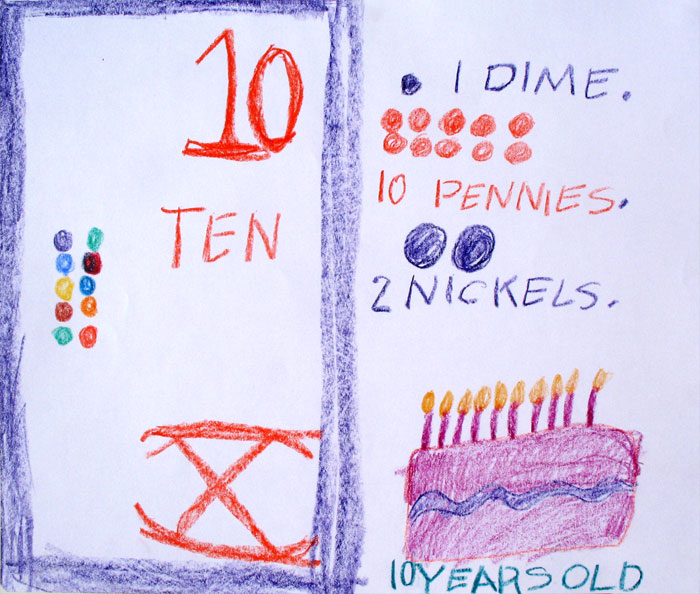
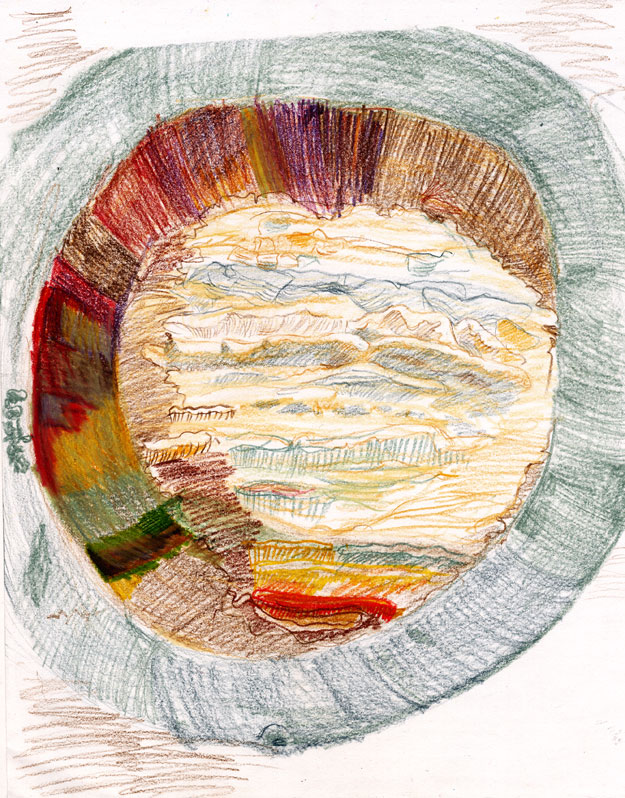
In honor of this day, here is a page from my daughter’s first grade homeschooling main lesson book, Numbers. I don’t know about you, but I am perfectly content to be living in a base-ten number world, with the ten represented by a one followed by a zero. And it was not a foregone conclusion. We could be living in a base-twenty world, like the ancient Mayan, Aztec, Celtic, and Germanic peoples (remnants of which groupings by twenty survive in some modern European counting systems). Or a base-sixty world, like the Babylonians. Or, we could be using base ten but still be lumbering along in lengthy strings of Roman numerals, with nary a zero to be seen. And the computer would never have been born.

CakeGreenPeter

St. Francis of Assisi

St.Francis

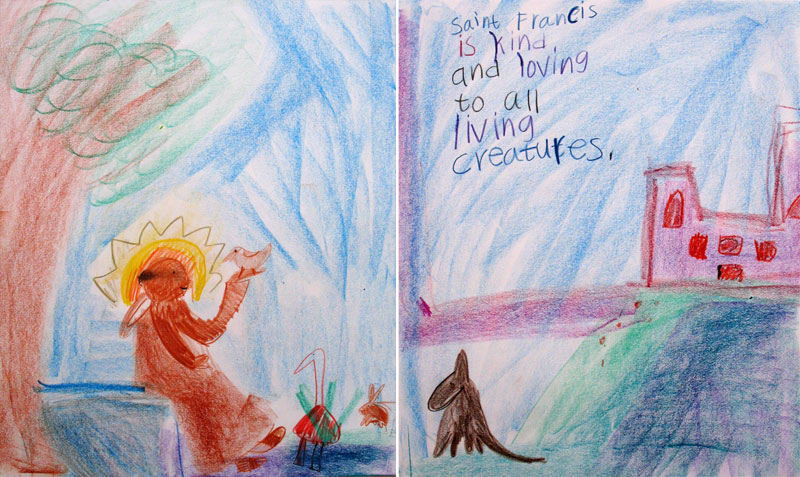
Tomorrow, October 4th, is actually the Feast Day of St. Francis, not today, but I am celebrating him a day in advance because today is the Blessing of the Animals in his honor at Washington National Cathedral. (And many other churches have similar events.) Come at 2:30 to the west steps of the Cathedral for a brief service followed by individual blessings for your dog, cat, rabbit, goldfish, or any other pet not actually life-threatening to the clergy in attendance. There will also be representatives from the Humane Society and the Animal Rescue League to accept donations of pet food and toys and to share information about adopting homeless animals.

These drawings are from my daughter’s second grade Saints, Heroes, and Heroines main lesson book.


Live and Learn

Despite my misgivings, my daughter packed sixteen (16!) chapter books for this vacation. I regretted toting any extra unecessary weight in our poor Prius, already stressed with four people and a dog and ten days of their presumably vital supplies. I pictured lugging the books home again mostly unread.

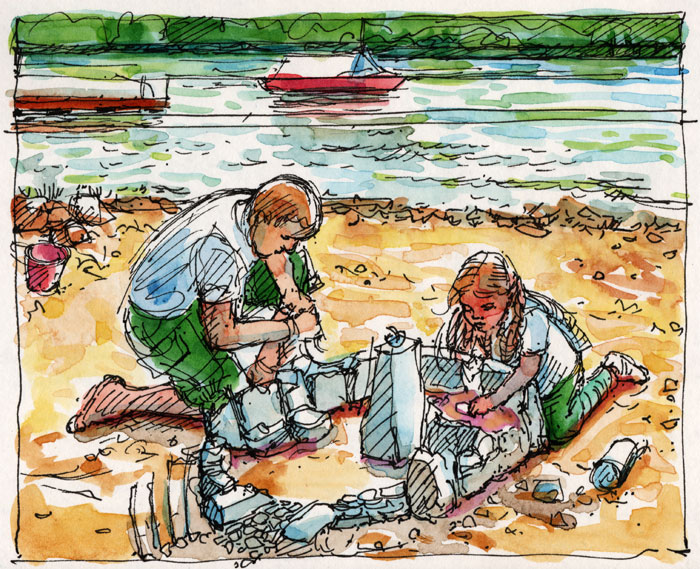
However, in addition to swimming, tubing, badminton and boules, a little Botany sketching, numerous board games, stargazing with her brother’s Star Walk app, and capably starting up and driving an 18-foot power boat (courtesy of the neighbors), here she is finishing book number 16. Now she’ll have to begin on her brother’s stack.

E&16Books

CakeWeddingMary & Brian