Library of Congress-Part 2

Continued from Library of Congress–Part 1, on April 24th
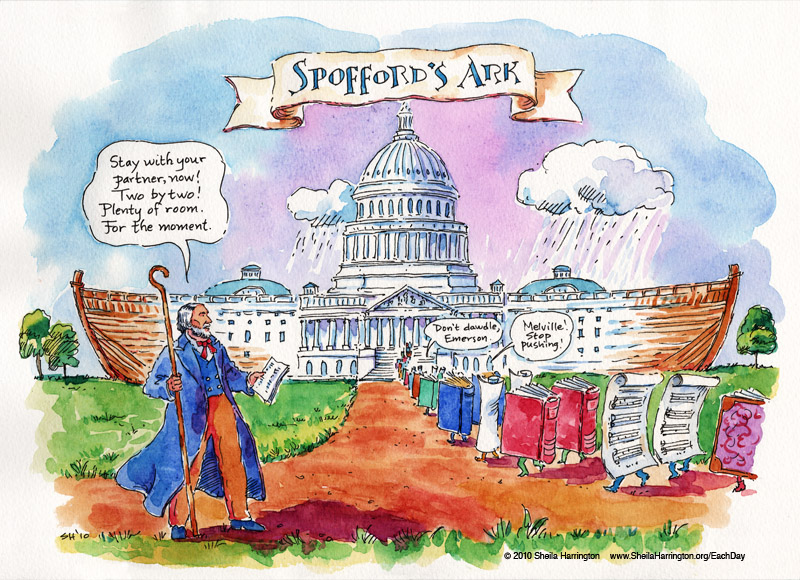
SpoffordArk

In its two-plus centuries, the Library of Congress has had a mere thirteen Librarians. They often serve a very long time, a sort of Library Supreme Court Justice. One of them was Archibald MacLeish (1892-1982), whose birthday it is today.

Born in Illinois, educated at Yale with a major in English, and at Harvard Law School, MacLeish might have had a straightforward uneventful law career, with writing and teaching as secondary pursuits, but for having served in the Army in World War I. Perhaps it was this wartime-planted seed that was sprouting when he left his law firm after three years and moved to Paris with his wife. There he spent five years writing poetry and drama and hanging out with the Hemingway-Fitzgerald-Pound crowd.

Well, how do you keep ’em down on the firm, after they’ve seen Paree. Instead of resuming his law practice after returning stateside, MacLeish continued to write, and to work for Fortune magazine. He had been, after all, an English major, and some of them do find employment—look at Garrison Keillor.

The anti-fascist viewpoint expressed in MacLeish’s writing drew the attention of President Roosevelt, who decided to appoint MacLeish as the next Librarian of Congress, over Republican Congressional opposition (“Expatriate!” “Communist!” “Poet!”). Professional librarians weren’t too happy about it either, since MacLeish was a Library World illegal immigrant. Once installed, however, he proved his skills and dedication, beginning with a major administrative reorganization of the rather uneven and semi-catalogued Library, clarifying its collection goals (Where are the holes to be filled?) and acquisitions policies (How can we fill them?), and requesting (and receiving!) a major expansion of Library budget and staff.

MacLeish also brought writers onto Library staff, launched poetry readings, wrote speeches for FDR, and much more which you can read about in detail on the Library’s website. Pretty amazing that he could accomplish all this in his 1939 to 1944 term, move on to serve as Assistant Secretary of State, then follow up with a writing/teaching career, winning Pulitzer Prizes for his drama and poetry, for which he is probably better-known.

The current Librarian, Dr. James Billington, has been a serious advocate of the National Digital Library Program, an ongoing project to digitize resources within the Library of Congress, making them accessible to that part of the world’s population (i.e., nearly everyone) which cannot make a personal visit to the physical Library in Washington, DC. In conjunction with this he proposed the creation of a multilingual World Digital Library, which was launched, with UNESCO, in 2009. Billington is a writer and a Russian scholar with a list of talents, awards, and accomplishments inside and outside the Library that is far too long to include here, but you can peruse his bio on the Library’s website, and then ponder sorrowfully how you yourself have frittered away your allotted time on this earth. Each Librarian brings his (so far it’s only been His) distinctive interests and talents to the post, thus enriching the Library.

Possibly the best known Librarian of Congress—the “Father” of its modern incarnation—is Ainsworth Rand Spofford (served 1865-1897), who increased the Library’s collection dramatically AND acquired for it a new home.

Spofford, born in New Hampshire and homeschooled (homeschoolers take note), was clearly headed for a life among books—avid reader, bookstore clerk, a founder of the Literary Club of Cincinnati, newspaper reporter and editor, and finally Assistant Librarian, then Librarian, of Congress. He managed to get the Smithsonian’s vast library transferred to the Library of Congress, and he persuaded Congress to pass a copyright law of 1870 that centralized all U.S. copyright registration at the Library—huge in itself!—and also required authors to deposit in the Library two copies of every book, map, print, and piece of music registered in the United States. (The copyright protection law extends even to works of foreign origin, with reciprocal protection. But there is apparently nothing the Library of Congress, or anyone else, can do about peculiar Chinese versions of Harry Potter that incorporate Chinese wizards, hobbits, and a belly dancer.) As you might guess, even if you have not a mathematical mind, such a law rapidly increased the Library’s collections.

A terrible fire on Christmas Eve, 1851, apparently due to a spark from an unattended fireplace, had, sadly, destroyed about two-thirds of the Library’s contents, including much of Jefferson’s original library. But the collection had been replenished in the 1850s, and by now the Library was stuffed to the gills. Over its history it had been moved around the Capitol, in and out of various spaces, to accommodate its growth. But the moment had come—the moment that we ourselves experience when we say, “I cannot put one more dishtowel into this kitchen drawer! We need to move!” And Spofford recognized that moment.

Library of Congress–Part 3

CakeStarsKarla

Maryland Part II

Continued from April 28th, Part I.

Pictures are from our homeschooling block, Local History and Geography.

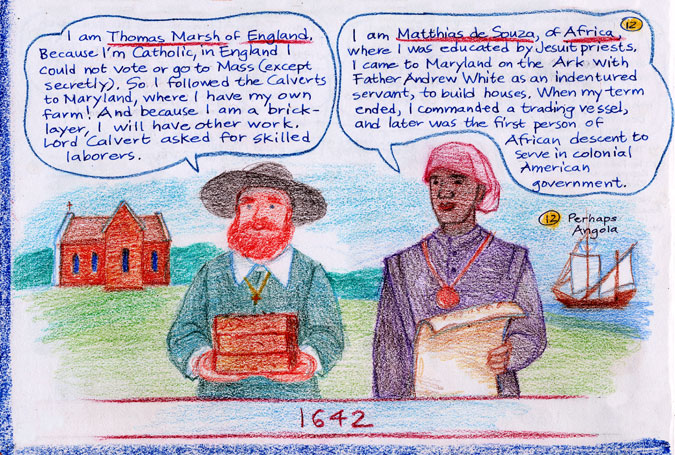
Marsh-Souza


Despite Maryland’s absence of gold, colonists benefited from another resource: tobacco, which grew well and had a ready market in England. It quickly became Maryland’s principal cash crop. (In rural areas tobacco was used to pay bills even into the 20th century.) Some planters made large fortunes and imported their style of living from England, spending their time at hunting meets, dances, card parties, horse races, and similarly useful pursuits.

Tobacco rapidly depleted the soil, however, requiring continual acquisition of acreage and labor, both hired and slave, and pushing Native Americans further from their homelands. In the first half of the 18th century, England helpfully sent 10,000 convicts, mainly petty thieves and other troublesome folk, to Maryland as indentured servants. But while they worked off their indentures and freed themselves, the slave population, permanently trapped, increased. (And that’s another story.)

Chogan-Susanna

Maryland’s coastlines were settled first, so when German and Scotch-Irish immigrants began to arrive in the 1740s, they moved into western Maryland, creating small farms like those in Europe and New England, raising animals, growing grains (rather than tobacco) on manured fields, rotating their crops, and feeling exasperated that large wasteful eastern plantation-holders had more say in land and trade policy than they did themselves. Iron was discovered in western Maryland, and its mining and forging, mostly by slaves, accelerated rapidly. The port of Baltimore grew as grain and iron passed through for the French and Indian Wars, warfare being ever a boon to industry. Annapolis very slowly became a center of society, acquiring the attendant accoutrements of high culture: a theater, newspaper, bookshop, and jail.

 In 1763-67 the final, and very peculiar, shape of Maryland was determined when astronomer Charles Mason and surveyor Jeremiah Dixon were hired to resolve an old boundary dispute between Maryland and Pennsylvania due to overlapping land grants made in the 17th century. They marked the border with 230 stones, some of which remain today, little knowing that their boundary would come to be regarded—inaccurately—as the division between slave and free territory.

By the 1770s, the now-numerous settlers (Maryland’s population was about 150,000, which included tens of thousands of African slaves and a few hundred remaining Native Americans) were inevitably, due to time, distance, and differences, less connected to Great Britain. In 1713 the currently reigning Calvert had converted to Protestantism. But Marylanders didn’t want ANY Proprietor, of any religion whatsoever. Parliament’s taxes and trading practices favoring Great Britain infuriated them, as it did colonists elsewhere. Although some were at first unsure about complete independence, Maryland sent delegates to the First Continental Congress in 1774. Four signers of the Declaration of Independence were from Maryland, including the only Catholic. Maryland militiamen fought with George Washington in the Revolutionary War (the state’s sole Tory regiment was chased across the border and later departed for Canada).

After the war finally ended in 1783—people forget how LONG it dragged on—and after the delegates to the Constitutional Convention spent the summer of 1787 heatedly wrangling over the creation of the Constitution (which story reads like a thriller in itself), Maryland ratified it the following spring, becoming the seventh of the new United States. Not only that, but Maryland provided two of the nation’s seven temporary capitals (Baltimore and Annapolis) throughout its formative years, and finally the permanent one in 1790: Washington, District of Columbia, carved from a 10-mile square on the Potomac. (Virginia took back its section in 1846.)

So, party down, Marylanders! and celebrate your stateliness by singing the Official State Song (to the tune of “O Tannenbaum”). Here are the first two verses. Just in case you don’t already know them by heart.

The despot’s heel is on thy shore,
Maryland!*
His torch is at thy temple door,
Maryland!
Avenge the patriotic gore
That flecked the streets of Baltimore,
And be the battle queen of yore,
Maryland! My Maryland!

Hark to an exiled son’s appeal,
Maryland!
My mother State! to thee I kneel,
Maryland!
For life and death, for woe and weal,
Thy peerless chivalry reveal,
And gird thy beauteous limbs with steel,
Maryland! My Maryland!

* Although the words as written, and as adopted by statute, contain only one instance of “Maryland” in the second and fourth line of each stanza, common practice is to sing “Maryland, my Maryland” each time to keep with the meter of the tune.

CakeDaisiesMichaela

CakeBalloons2John

Maryland, My Maryland

Pictures by my daughter from the Local History and Geography homeschooling block.

On this day in 1788, Maryland became the 7th state to ratify the Constitution. Perhaps you live in Maryland and never knew how this came about. Or perhaps Maryland is terra incognita because you live far away, in Nepal, or Virginia. In any case, I am going to tell you.

Campsite

For thousands of years human beings on the shores of the Chesapeake Bay fished, farmed, and fought one another without foreign interference. However, the seagoing vessels across the Atlantic Ocean grew ever-larger, and when Italian Giovanni Caboto, in the pay of Henry VII of England, wandered into codfish-rich Newfoundland/Maine waters in 1497, that was enough for England to claim the promising land. (They also insisted on referring to Caboto as “John Cabot” to help make their case.)

One hundred and ten years later Captain John Smith, although mainly concerned with the floundering colony in Virginia, ventured up the Chesapeake Bay, pronounced it goodly and pleasant, and produced a map that received much attention. So when George Calvert, the first Lord Baltimore, tired of the anti-Catholic feeling in Protestant England (Catholics were considered untrustworthy and could not hold office, vote, or worship openly), he asked his friend King Charles I to give him a piece of this New World land.

Calvert had tried Newfoundland first, but his settlers died of harsh weather and disease. His request was granted, but the Virginians were unhappy about the potential nearness of Papists. Well, suggested Charles, how about just a northern sliver of Virginia, about 10,000 square miles around the Chesapeake Bay—nobody there except non-Christian native dwellers! Calvert accepted this parcel, to tax and govern as he saw fit, in exchange for two Indian arrowheads a year, an enviably low rent.

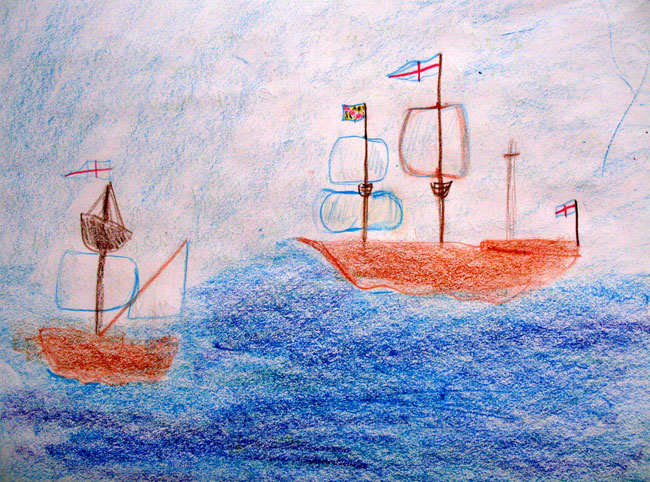
Shortly afterward George Calvert died, so his younger son Leonard set sail in the Ark and the Dove and a party that included settlers and adventurers, several gentlemen, a handful of women, a number of indentured servants, and three priests. The group was a mixture of Catholics and Protestants, as it was Calvert’s intention to set up a religious-tolerant community. When they arrived at the mouth of the Potomac in March 1634, they were kindly greeted by the surprised yet helpful Yaocomico inhabitants, who, tiring of attacks by their Susquehannah neighbors, were fortuitously planning a move west. They granted the newcomers their land, along with houses, fields, and useful botanical, zoological, and culinary tips. The settlers renamed the territory Terra Maria, in honor of Queen Henrietta Maria (daughter of King Henri IV of France). Terra Maria: Mary-Land.

Ark&Dove

The Maryland settlers were better prepared than their hapless predecessors in Jamestown, those aristocratic younger sons who arrived in their best clothes ready to pick up the gold and jewels lying scattered on the shores of America. No, these folks brought tools and seeds and useful skills like carpentry, and had been recruited by Calvert on condition of willingness to work hard. The village, now called Saint Mary’s City, Maryland’s capital, was quickly fortified and the surrounding lands divided and allotted according to size of the household living on it: for heads of household, wives, and indentured servants, 100 acres each; for children 50 acres each. You can imagine that this arrangement encouraged emigration of large groups. “And here is my cousin Robert… and his son John…and their three manservants…” Voilá—450 more acres!

Although the Calverts were Proprietors—they actually “owned” Maryland and could govern it as they saw fit—the settlers announced that they intended to make their own laws. Calvert objected, and an uneasy compromise was worked out, but this insistence on self-rule was, as we know, a harbinger of things to come. Calvert did convince them to pass his Act of Toleration in 1649, which guaranteed religious freedom to Christians, although the arrangement was: if you deny the divinity of Jesus Christ you will be executed. Such means of ensuring uniform worship have not entirely fallen out of favor in 2010. The Act lasted until the Puritans chopped off Charles I’s head for tyrannical cluelessness (no longer a capital offense in Great Britain). In 1692 England and its colonies were declared officially Protestant. The new leaders burned down the Catholic churches in Maryland and moved its capital to Puritan-founded Providence—renamed Annapolis for Protestant Queen Anne.

To be continued April 29th: Part II.

CakeBerries2Edith


Library of Congress-Part 1

JeffersonBooks

On this day in 1800, President John Adams approved legislation appropriating $5,000 to fund a hitherto nonexistent Congressional library.

Now, when the United States was young and the ink was still drying on the [mostly] ratified Constitution, its first Congress met for a short while (1790 to 1800) in Philadelphia. This contender for the role of Nation’s Capital was merely a disappointed temporary location, resigned to the government’s eventual transfer south. In the meantime, however, Philadelphia was, thanks largely to William Penn and Benjamin Franklin, a highly livable city—the most populated in the country (Washington, DC wasn’t even in the Top Twenty), with paved and lighted streets lined with sidewalks, fine masonry buildings, a university, a hospital, a fire department, gardens and parks, theaters and shops and philosophical societies and libraries—much like today, but without WiFi. The Library Company of Philadelphia offered the use of its fine collection to members of Congress free of charge, at a time when library use was by paid subscription.

When the government packed up and trudged southward to the Potomac in 1800, they said to one another in despair, “Where in this muddy village of farms, taverns, and unfinished government buildings will we do the research and study necessary for Congressional legislation and malediction?”

Fortunately, the previous Congress had been planning ahead, and in 1801, a collection of 740 books and three maps, purchased with the appropriated funds, arrived from London. They were stored, along with the papers Congress had brought from Philadelphia, in a room of the partially-built Capitol Building. It was primarily a collection of legal, economic, and historical works. The next President, Thomas Jefferson (He Who Must Not Be Named in Texas), a voracious scholar himself—if there was any subject that never interested him it is apparently unrecorded—signed a law creating the post of Librarian of Congress.

Fire is a perpetual threat to the flammable cities of civilization, and disaster can result merely from an unsnuffed candle. The Library has suffered from several, mostly minor, fires. But in August 1814, during the War of 1812, the British set about destroying Washington’s public buildings, to avenge the Americans’ destruction of the public buildings of Toronto. Although parts of the Capitol held up remarkably well, its interior, filled with wooden furniture, paintings, and irreplaceable documents and books, was highly flammable. That was the end of the library.

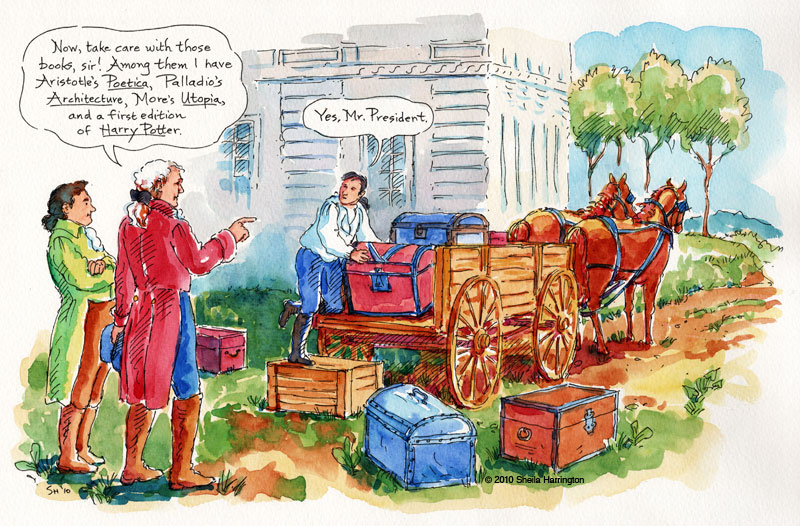
But only temporarily. Because Jefferson, now in retirement and short of cash, offered to sell his personal library to the U.S. government as the foundation of a new collection. So in 1815 he was paid $23,900 for his 6,487 books, which arrived by horse and wagon from Monticello.

What a collection it was. Not only works of law, economics, and history, to replace the lost books. But also: Biography. Geography. Chemistry. Botany. Medicine. Anatomy. Architecture. Philosophy. Painting and sculpture. Theater. Music. Literature. Essays. Mythology. Religion (including a copy of the Koran). And not only in English, but also works in French, Spanish, German, Latin, Greek, and Russian, several of which languages Jefferson spoke or read.

Some members of Congress objected to the collection’s breadth, explaining rather myopically, “the library was too large for the wants of Congress,” but Jefferson famously responded, “There is…no subject to which a member of Congress may not have occasion to refer,” and that statement has guided the Library in its acquisitions over the years.

For Library of Congress-Part 2: Please see May 7th

Earth Day

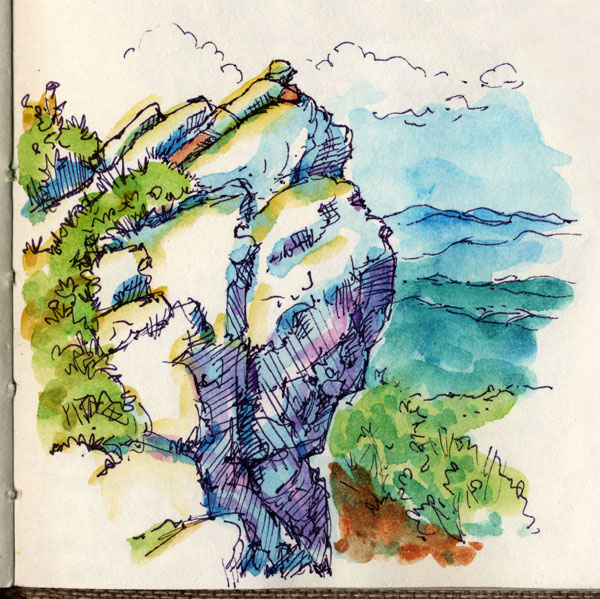
From my sketchbook. My husband regarding the earth from a Shenandoah Valley peak.

ShenandoahCliff600

Today is Earth Day, a day on which we attempt to recall that Mother Earth is the source of all life and nourishment and that we ought to stop greedily stuffing ourselves with her resources and dumping toxic waste all over her. Human beings are clearly a bunch of sloppy ungrateful thankless brats. What’s a mother to do? Lose her cool? Blow her top?

A holiday to celebrate the Earth was proposed in 1969 by peace activist John McConnell and was originally, and logically, intended to be celebrated on the Equinox, around March 22nd. In fact the first Earth Day WAS celebrated on March 22nd, 1970, in San Francisco, California.

However, U.S. Senator Gayelord Nelson of Wisconsin had, coincidentally, planned an environmental awareness day to take place that same year, on April 22nd. This event coordinated the efforts of a number of autonomous grass-roots environmental groups who had been working independently of one another on different issues for a while—air and water pollution, oil spills, pesticides, loss of green space, extinction of species, various other environmental disasters—and who recognized their common purpose. The April 22nd event received more attention and thus determined the future “official” date. It was a movement in embryo just waiting for its birthday. Millions participated in the celebration, all over the country.

Only a few years earlier Rachel Carson had been vilified for her condemnation of DDT; now the brand-new Environmental Protection Agency burst onto the scene. Then the Occupational Safety and Health Administration. Followed by a slew of environmental legislation: The Clean Air Act. The Water Pollution Control Act. The Safe Drinking Water Act. The Endangered Species Act. The Toxic Substances Control Act. Then we got fuel efficiency standards for cars. That one’s been harder for Americans to get used to, given their love of enormous cars, and their increasingly enormous rear ends. It’s amazing how quickly things moved along in the first decade (grinding to a standstill and retreating for a while in the 80s under the Reagan “You’ve Seen One Tree You’ve Seen Them All” administration).

In 1990 Earth Day was declared an annual national holiday, and it went global. Now it’s a huge international event marked by every conceivable environment-friendly related activity. “The environment” is no longer a fringe issue. We recycle, we compost, we buy organic, we conserve water, we take public transportation, we use the energy-efficient bulbs with their repellent prison-like glow. (I am told they are getting better.) Living green is not only socially acceptable; it’s a Madison Avenue device to sell more products (kind of defeats the goal of preserving the environment). The White House, the EPA, the National Park Service, Greenpeace, National Geographic, every community large and small (except perhaps the NRA), you name it, has its Earth Day events, publicized on their websites, through which citizens can do something to educate themselves and/or make a difference. I am going to tell my own neighbors about two of them right now:

April 22nd, 2010: 7:00pm at the Cleveland Park Library, Melanie Choukas-Bradley, author of City of Trees, will give a talk about the botanical history and diversity of Washington, DC. For more information, please call (202) 282-3080.

April 24th, 2010: 9 to 11am, a neighborhood ivy-pulling-and-trash-cleanup event in the park along Rock Creek Drive and Normanstone Drive. All ages. For more information, please email woodlandnormanstoneneighbors@gmail.com.

I hope you are finding a useful and jolly community event in your own neighborhood. And remember…“every day is Earth Day.”

CakeBerries2Gunilla

CakeBalloons2Hasse


Renaissance Man

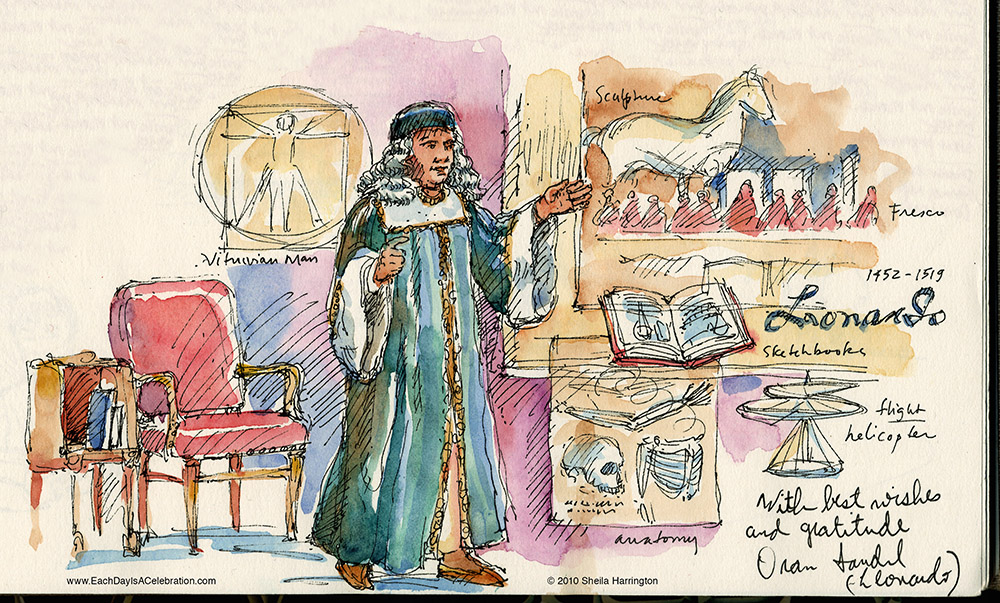
In the middle of Italy, in the middle of the 15th century, a prosperous Florentine attorney had an assignation with a peasant girl who subsequently became pregnant. Having no intention of marrying out of his class, he nevertheless adopted the child (and married someone else). But it’s doubtful either suspected that their dalliance would produce one of the most extraordinary geniuses of an extraordinary era. Or perhaps of any era. Today is the birthday of that baby, Leonardo da Vinci (1452-1519), and what can I say of this man that hasn’t already been said a thousand times, and much better too? But in respect I devote today’s post to him, along with a sketch I made at a Smithsonian Discovery Theater performance about his life (signed by the actor, Oran Sandel).

The period we call the Italian Renaissance stretched from the 14th to the 16th centuries, when the disposable wealth of a growing middle class helped to fund travel, trade, manufacture, learning and art, and the educated citizen reached back beyond a medieval sleep to rediscover the classical world and open his mind to earth and sky. Leonardo’s life-span fell at the heart of this era. He was not an isolated pheomenon; he was part of a continuum that stretched from Piero della Francesca and Donatello to Michelangelo and Raphael. And yet within this continuum he is remarkable.

Little Leonardo had no formal schooling, but apparently showed an early aptitude for mathematics, music, and drawing, and at fourteen was apprenticed to the artist Andrea del Verocchio. Now, “artist” is a label with a shifting interpretation, and in 15th-century Italy it did not mean a superstar who sat pouring out his heart and his genius before an easel or a block of marble. No, an artist was a bloke whom you hired to manage all sorts of practical and decorative tasks. Verrochio got his start as a goldsmith, and when his work sent him to Rome and he perceived the city’s appreciation of statuary, he said to himself, “Allora—I can do that!” And so he did, creating sculpture in plaster, marble, and bronze, with the occasional bell-casting to keep pasta on the table.

Leonardo was a gifted pupil who studied both artistic and technical skills, working in metal, plaster, leather, and wood as well as paint, and, the story goes, he quickly surpassed his master. At 20 he was admitted to a guild composed of artists, chemists, and physicians (perhaps this made it handy to study anatomy).

He began to receive commissions, and after a few years applied to the Duke of Milan for an appointment, writing that he could design bridges, canals, and buildings; make light and heavy weaponry; create sculpture; and paint. How’s that for a resume? He was hired, and his many tasks included not only those above but decorating palace rooms, creating pageants, and designing costumes for festivals. It seems like a waste of his talents, but one of the most striking and curious aspects of Leonardo was his apparently inexhaustible interest in everything and its effect on his limitless imagination.

The list of his interests is stunning. Of course he was interested in the human face and form in all its positions, moods, and stages of life, from the beautiful to the grotesque, from the skeleton to the fetus to the movement of blood. But he also loved animal life, and all of nature, not just its forms but its structures and functions. He was fascinated by the movement of water, by clouds, by astronomy. He explored the wonders of geometry, optics, color, light, heat, sound, magnetism, geology, fossils, the chemistry of pigments, the flight of birds. He filled thousands and thousands of journal pages with his observations and sketches. He designed (famously ahead of his time) predecessors of the armored tank, the helicopter, the hang-glider.

And, yes, he painted. Probably, although we are aware of his multi-faceted pursuits, we remember him best for his painting. The Mona Lisa. The Last Supper. The Virgin of the Rocks. He didn’t leave us many (and what he did leave is astonishing)—a mere handful of finished paintings and sculptures. Thousands of sketches. And a number of works that are unfinished, or deteriorating because of his use of experimental materials. When we gaze upon his people, living and breathing and thinking and feeling upon the canvas, we might wonder:

What was going on with this artist that he didn’t feel compelled to bring forth a few more amazing works of art?

Was he such a perfectionist that the energy for his approach was limited? (He was famous for—and exasperated his clients with—the preparation, the thought, the hundreds of studies that preceded any final work.)

Was the process more interesting to him than the product?

What’s with all the hobbies? Did he think he was going to live FOREVER, for heaven’s sake?

Near the end of his life, when he was working for the French king François I (designing canals, arranging pageants), he wrote despairingly in one of his notebooks, “I have wasted my hours.” But in another he wrote, “As a day well-spent makes it sweet to sleep, so a life well-spent makes it sweet to die.” I am hoping it is the latter thought that was with him at the end.

One Small Step for l’Homme

ParisMass

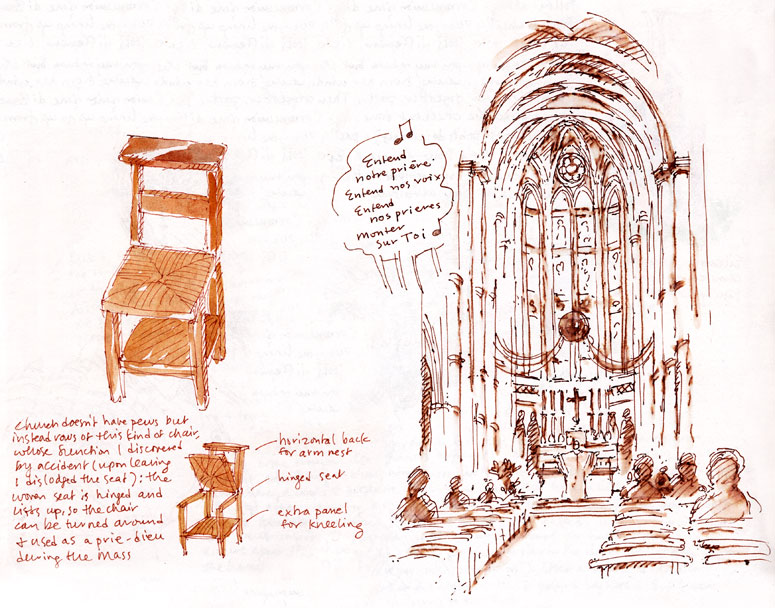
When I travel, I like to see what Mass is like in other places, especially in foreign countries, now that it’s no longer in Latin and I can listen to the local language. Even if I don’t speak the language, the structure of the service is familiar enough that I know what’s happening. I guess that’s part of the appeal of standardized religions. It’s like being a member of a club, and you get to participate as long as you follow the rules, learn the secret handshake, and wear the moose hat.

I did this sketch at a church in Epinal, France some years ago, and I post it here because it seemed suitable for today’s anniversary of the declaration of the Edict of Nantes in 1598. If this event does not leap out from the Renaissance history drawer of your brain, let me remind you.

In the 16th century, France was in the midst of its Wars of Religion. Just like many other nations whose boundaries we take for granted in our own lifetimes, “France” was an evolving entity torn by factions jostling for influence and supremacy, while ordinary peasants muddled along growing periodically-trampled cabbages as best they could. When the teachings of Martin Luther were introduced to France and were received with interest, even passion, by part of the population, it lit a fire in the hearts of others who (choose one):

a. were genuinely concerned about the immortal souls of these lost sheep.

b. feared the loss of power and riches that affiliation with the approved Catholic designation afforded them.

c. said, “Hey, here’s an opportunity to get rid of that rich relative/persistent creditor/tiresome spouse.”

d. foresaw that 36 years of people slaughtering each other and desecrating their forms of worship would be a jolly good way to spend their time.

(Answer is probably e.)

The Huguenots (French Protestants) and the French Catholics each spoke as if convinced of the one-true-faith-ness of their respective choices and sought not only to protect their own practices but to squash each others’ altogether. The neighbors were called in (Protestant England and Flanders; Catholic Spain and the Papal States) and arrived shouting, brandishing weapons, and eyeing the attractive lands near their borders. Numerous skirmishes, all-out battles, and horrible massacres alternated with periodic treaties and edicts which brought peace briefly and were then ignored.

Complicating this struggle was the irony that, not too far down the line of succession to the throne, was Henri of Navarre, a sword-wieldin’, skirt-chasin’, freedom-lovin’ mec* (worth an eventual post here) and a Huguenot himself. Catherine de Medici, mother of the young and unstable King Charles IX, was more practical than religious, and her principal aim was to keep control of France in her children’s hands. As what mother wouldn’t. She proposed a marriage between her beautiful daughter Marguerite and Henri of Navarre, and, despite disapproval from nearly everybody on both sides, the marriage took place in Paris. Followed immediately by the horrible St. Batholomew’s Day Massacre, the worst yet.

Henri was obliged to flee Paris, and when Charles IX died shortly thereafter, Henri had to fight his way back to Paris at the head of an army to be recognized as the new King Henri IV. He successfully conquered one region after another, but staunchly Catholic (or perhaps just relentlessly stubborn and contrary) Paris held out, eating rats du jour right through a siege, until Henri relented and decided to convert to Catholicism. This was not a big deal to him, as he had practiced both faiths while growing up depending on whether he was at court or at home. But it was a huge deal for the country, annoying both disappointed Protestants and skeptical Catholics.

Once he was ensconced, however, Henri showed the kingly stuff he was made of, launching a series of highly successful financial and agricultural reforms and huge public service projects. He then took the opportunity to enact what you, faithful reader (if you are still with me here), have followed this post so long to discover: THE EDICT OF NANTES, which authorized freedom of Protestant worship, the press, eligibility to public office (his brilliant finance minister was a Huguenot), and equal admission to schools, universities, and hospitals. It also authorized payment of Protestant ministers by the government. (This tolerance extended only to Protestants—forget Jews, Muslims, or atheists.) Simultaneously he allowed the previously exiled and troublesome Jesuits to return to France, taking one as his confessor. And he pardoned miscreants from both sides of the Wars of Religion. Thus Catholic and Protestant fanatics alike were infuriated.

But Henri’s intelligent policies and genial personality made him popular with ordinary folks, and France entered a new era of prosperity and relative tolerance that lasted until Louis XIV unwisely revoked the Edict of Nantes in 1685, resulting in a brain drain as thousands of Protestants took their skills and industry to friendlier locations. The 87-year period had been one step on the journey toward toleration of differences—a long and stumbling journey that, we must admit, is still in progress. Light a candle at dinner tonight in gratitude for each step.

*dude

Wild About Harry

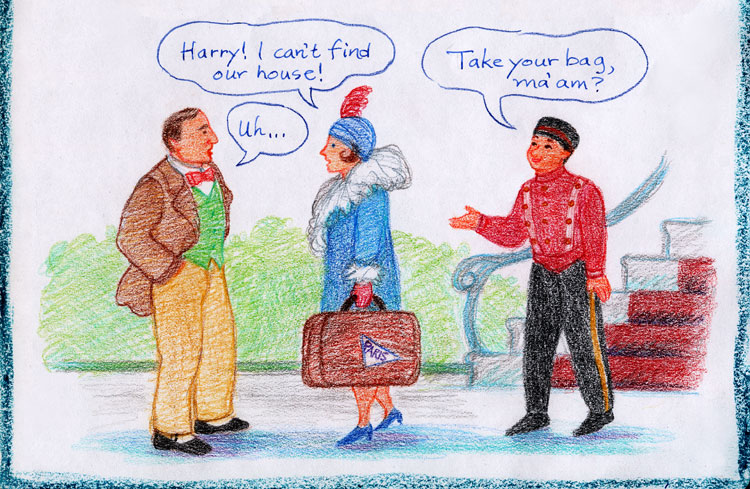
This picture is from our Local History and Geography lesson block.

Wardman

If you lived in Washington, DC in 1938, ONE out of every TEN of your neighbors was living in a house or apartment built by Harry Wardman (1872-1938), whose birthday it is today. Not bad for a guy born in Bradford, England who came to the United States at age 17 and started out as a department store floorwalker in New York. He moved on to a store in Philadelphia, then to Washington, DC in 1893, where he found carpentry work and learned to build staircases.

Wardman wasn’t satisfied with staircases, however. Washington suffered from housing shortages both after the Civil War and after World War I, and Wardman was poised and eager to fill the need. He moved on from staircases to building entire houses, and then larger structures: buying land, building on it and selling, then buying new land for another project. He built apartment buildings, office buildings, hotels, clubs, and whole neighborhoods of row houses renowned for the quality of their construction and materials.

Wardman built many of Washington’s grandest apartment buildings, the Hay-Adams Hotel, and the British Embassy, but his best-known project is probably the Wardman Park Hotel in Woodley Park. Wardman and his wife already had an impressive mansion in the neighborhood, at the intersection of the newly-extended Connecticut Avenue and Woodley Road. An iron bridge had only just been built in 1891 allowing easier travel across the ravine of Rock Creek Valley, and Wardman decided that Woodley Park would be a fine location for a hotel.

So in 1916, while his wife was overseeing their daughter’s schooling in Paris, Wardman ordered a crew to empty their house of its furnishings, and then he had the place torn down, to be replaced by the Wardman Park Hotel (now the Marriott Wardman Park). People called it “Wardman’s Folly.” Why, you ask? Supposedly because no one in his right mind would ever want to stay in a hotel soooo far away from downtown. But I’m trying to imagine returning from a trip to Paris and discovering that my husband has knocked down our house and replaced it with a hotel. “Folly” is certainly one word that would come to mind. Many other words, too, probably.

Wardman made a fortune. By 1929 he had amassed $30 million (which I understand was a lot of money in those days). Most of it was lost in the stock market crash, but he retained enough to continue some of his building projects and was on his way to a second fortune when he died, having spent years putting roofs of one sort or another over the heads of Washingtonians. Our family lives today in a Wardman neighborhood (our house turns 100 years old this year), and I definitely plan to put some candles in the dessert tonight and sing Happy Birthday to Harry.

CakeBalloons2Greg

My Heart Leaps Up

My heart leaps up when I behold
A rainbow in the sky.
So was it when my life began;
So is it now I am a man;
So be it when I grow old,
Or let me die!
The Child is father of the Man;
And I could wish my days to be
Bound each to each by natural piety.
—William Wordsworth

Rainbow

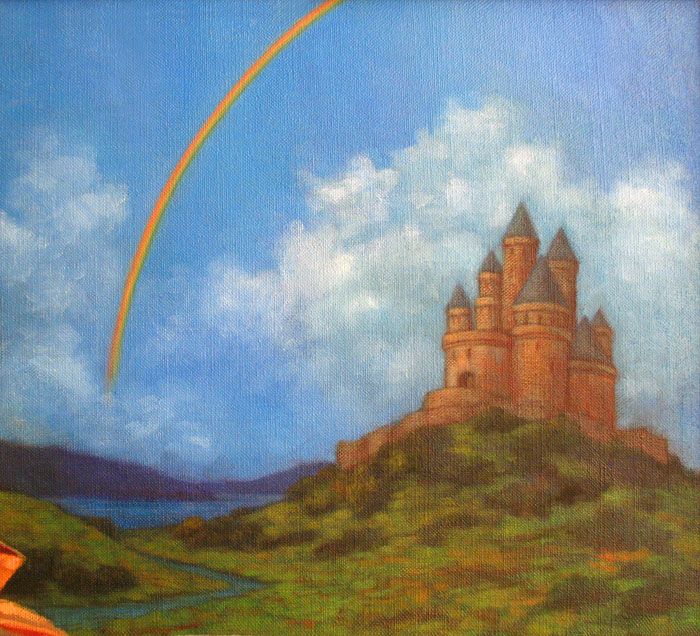
(painting is a detail from a larger work, The Age of Reason)

Whenever someone in the family mentions a rainbow, my husband launches into this poem. (It’s now inevitably become a sort of family tradition—wait for it….) And today we celebrate the fortuitous birthday of its author, William Wordsworth (1770-1850), born in Cumberland, England.

Is it obligatory for English poets to have had unhappy childhoods? Wordsworth’s was no exception—his father, mysteriously, lived apart from the family, and when the children’s mother died, instead of taking them in, he parcelled them out between boarding schools and a series of unpleasant misery-inducing relatives. Wordsworth wasn’t reunited with his beloved favorite sister Dorothy for years. The highlight of his dismal schooling (besides introducing him to his future wife) was the holidays, which he consistently spent going long walks in nature and writing poetry.

At twenty Wordsworth set off on a walking tour of Italy, Switzerland, and post-Revolutionary France, where he became a passionate advocate of the republican cause. In France he formed a liaison with a local girl, but the relationship was discouraged by her parents (despite his having fathered a daughter whom he visited and supported rather erratically over the years). He returned home alone, disillusioned by the increasing violence of the revolution and England’s violent response to it, aimless, without profession, depressed.

This dark period was finally relieved by a legacy from Raisley Calvert, a sculptor and loyal former classmate, that allowed Wordsworth to support himself while writing poetry. May we all be so fortunate in our old school friends! With a steady income, he was able to form a household with Dorothy and their mutual friend Samuel Coleridge that Dorothy termed “three persons with one soul.”

It was a creative partnership that marked the birth of English Romanticism. Inspired by one another, Wordsworth and Coleridge produced innovative, experimental, controversial poetry, and Dorothy’s letters (luckily for literary historians) documented the process. Wordsworth defined poetry as “the spontaneous overflow of powerful feelings” but his rapture was borne within measured frameworks, among them the sonnet form, which Wordsworth reawakened after its long disuse. In 1798 they published Lyrical Ballads (“Tintern Abbey,” “The Idiot Boy,” “Rime of the Ancient Mariner”) and Romanticism was up and running.

The Romantic movement emphasized the value of individual experience, the contributions of ethnic traditions and folklore, the primal power of wild landscape and the wonders of nature, a consciousness of the infinite, and the use of imagination and the senses as a path to spiritual truth. It was a break from the formal elegance, polish, dignity and conservative restraint that characterized the formerly hot movement, Neoclassicism. Instead of, say, a series of elevated dramatic couplets on the epic semi-divine hero of ancient tragedy, we have a lyrical meditation on the soul-response to a sea of daffodils, or to the loss of a much-loved child. A personal perspective on life, the natural world, and mortality.

Yes…quite a break! taken up by Blake, Scott, and Göethe, followed by a whole string of younger Romantic poets and writers (Byron, Shelley, Keats, Hugo, Dumas, Pushkin) and the Transcendentalists (Emerson, Thoreau) and later the Victorians (Browning, Tennyson). Where would it end?? Culture as well as politics seems to be an ongoing struggle between the poles of head and heart, with adherents of each movement certain of having achieved a universally valid means of expression. But that is a subject for another post.

The partnership foundered on a falling-out with Coleridge, a pretty gloomy fellow, as one would expect of someone who writes a lengthy baffling poem about a curse-bearing dead albatross. Wordsworth and Dorothy moved on, settling eventually in the beautiful Lake District, that region abundant in literary inspiration and indomitable tourists. Joined by Robert Southey, the two became known as the “Lake Poets,” and Wordsworth married and proceeded to have five children. A sizable household. But a household that, as any other, had its share of suffering, with the drowning of William and Dorothy’s brother, and the deaths of three of the children. Wordsworth’s poetry grew more sober, restrained, and elegiac. In fact in his later years, while serving as England’s poet laureate, he was criticized by younger writers for his increasing conservatism. Suffering and loss does shade and temper youthful abandon.

Even if you can’t recite a Romantic poem in entirety, you know that your head is filled with lovely memorable fragments (“Dear God! the very houses seem asleep; And all that mighty heart is lying still…” “I wandered lonely as a cloud That floats on high o’er vales and hills…” “The Soul that rises with us, our life’s Star, Hath had elsewhere its setting, And cometh from afar…”) that are part of our literary legacy and that emerge in moments of wonder and joy. For the fragments, for the poetry, for the consciousness that shaped them, and for my husband’s regular recital of the rainbow poem, thank you, William Wordsworth, and Happy Birthday.


Let My People Go

Passover begins at sunset today. In celebration I post here a page of my daughter’s Main Lesson book from our Stories of the Hebrew People block.

And after the sun goes down, in Jewish households all over the world a child will ask the first of the Four Questions: Why is this night different from all other nights?

TenPlagues